


A homemade Peking duck is a glorious, very special treat. I've done it at least ten times to get these instructions down for you. It takes commitment but after the initial prep, it's interesting how little else is involved. You can spend time to make the accoutrements for serving a Peking duck feast, such as Mandarin pancakes (bao bing, bo bing). On this page, you'll find a rough outline of this cooking project plus a detailed recipe. Additionally, there are links to detailed pages with step-by-step photos and bonus pointers for each of the three major steps: (1) blowing up the duck, (2) scalding and tanning the duck, and (3) roasting the duck.
Basic pointers
Here's a Peking duck countdown:
- Up to 2 month ahead: Make the Mandarin pancakes. Freeze for up to 2 months or refrigerate for up to 2 days . See the Mandarin Pancake Mini Class and recipe at my newsletter, Pass the Fish Sauce.
- 2 days before: Blow up the duck and give it a tan. Refrigerate to let it dry.
- Day 3 (the big Peking duck day):
- 4 hours before serving: Remove the duck from the refrigerator to take the chill off.
- 3 hours before serving: Preheat the oven, then roast the duck. Meanwhile, prep the duck sauce and accompaniments (the recipe is in the Mandarin Pancake Mini Class). Return the mandarin pancakes to room temperature.
- 1 hour before serving: After the duck is done and has cooled a bit, remove its skin, then loosely tent the skin with foil and keep warm in the oven. Take the duck apart, remove the flesh in large piece; tent loosely with foil and keep warm in the oven. Save the bones for soup broth or another project.
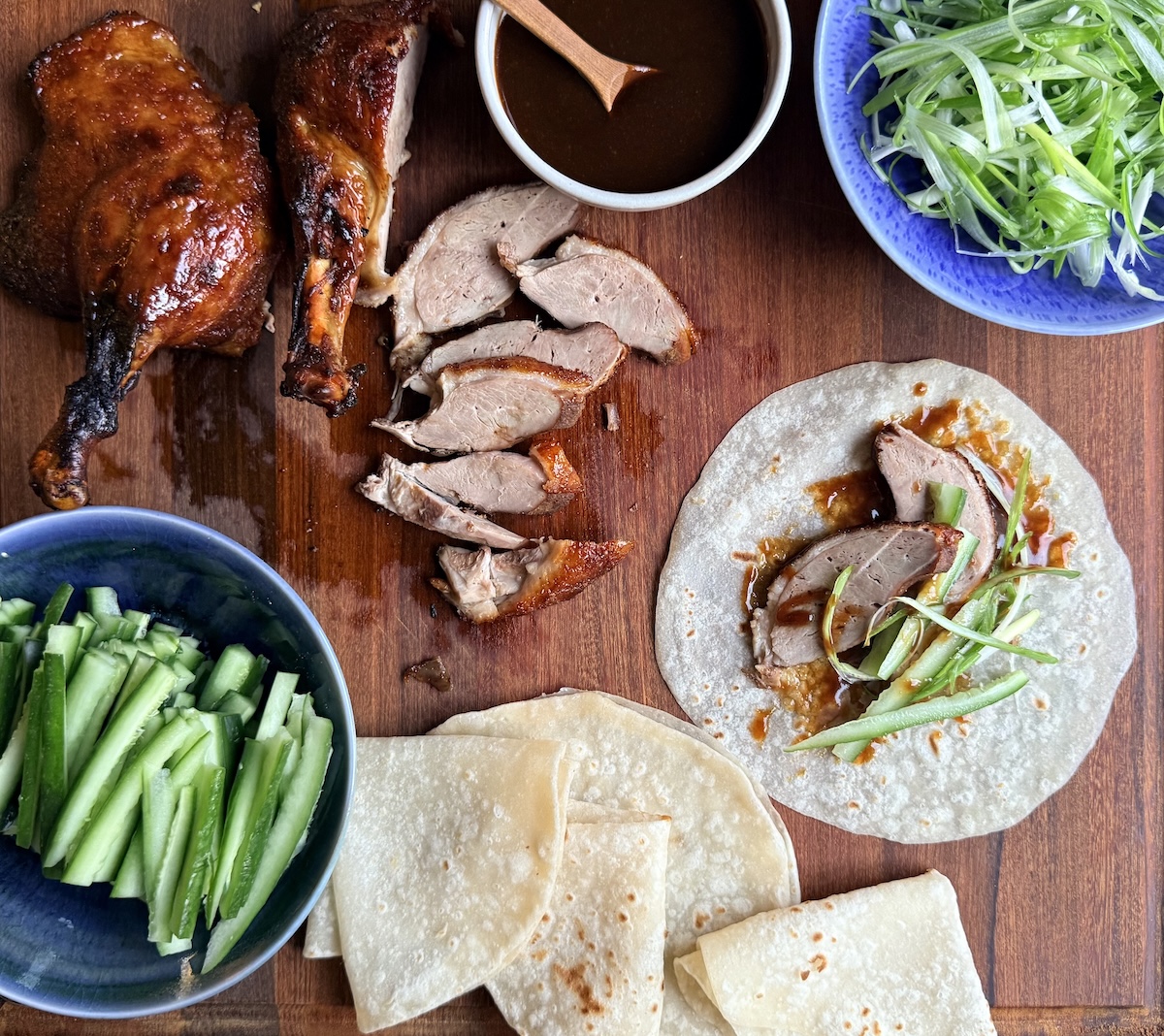
- 15 minutes before serving: Steam the pancakes, set the duck accompaniments at the table. Cut up the skin and flesh and arrange on 1 or 2 plates. Serve with the Mandarin pancakes and accompaniments.
First up, where and how to buy a duck?
I don't have a live poultry shop near me so I bought my duck at a Chinese market in San Jose, California. Such a grocery store has a high turnover of duck and they are freshly butchered with the head and feet still attached. Don't be turned off as that is how they traditionally come. Do your best to find an unblemished duck and check the packed date. Ducks by Maple Leaf and Culver are often sold at Asian markets. They are gutted and cleaned already. In 2026, at about $4.50 per pound, a 4 ¼ pound (2 kilo) duck is $18. Supermarkets and specialty grocers may carry Marys, Hudson Valley Farms, and Liberty Farms ducks for $30 to $40 each. This all may seem expensive but I assure you that homemade Peking duck will taste like a million bucks! Okay, not that much, but a lot!
Major steps to Peking duck happiness
What to expect to do for this recipe? Here's a summary of the three major steps.
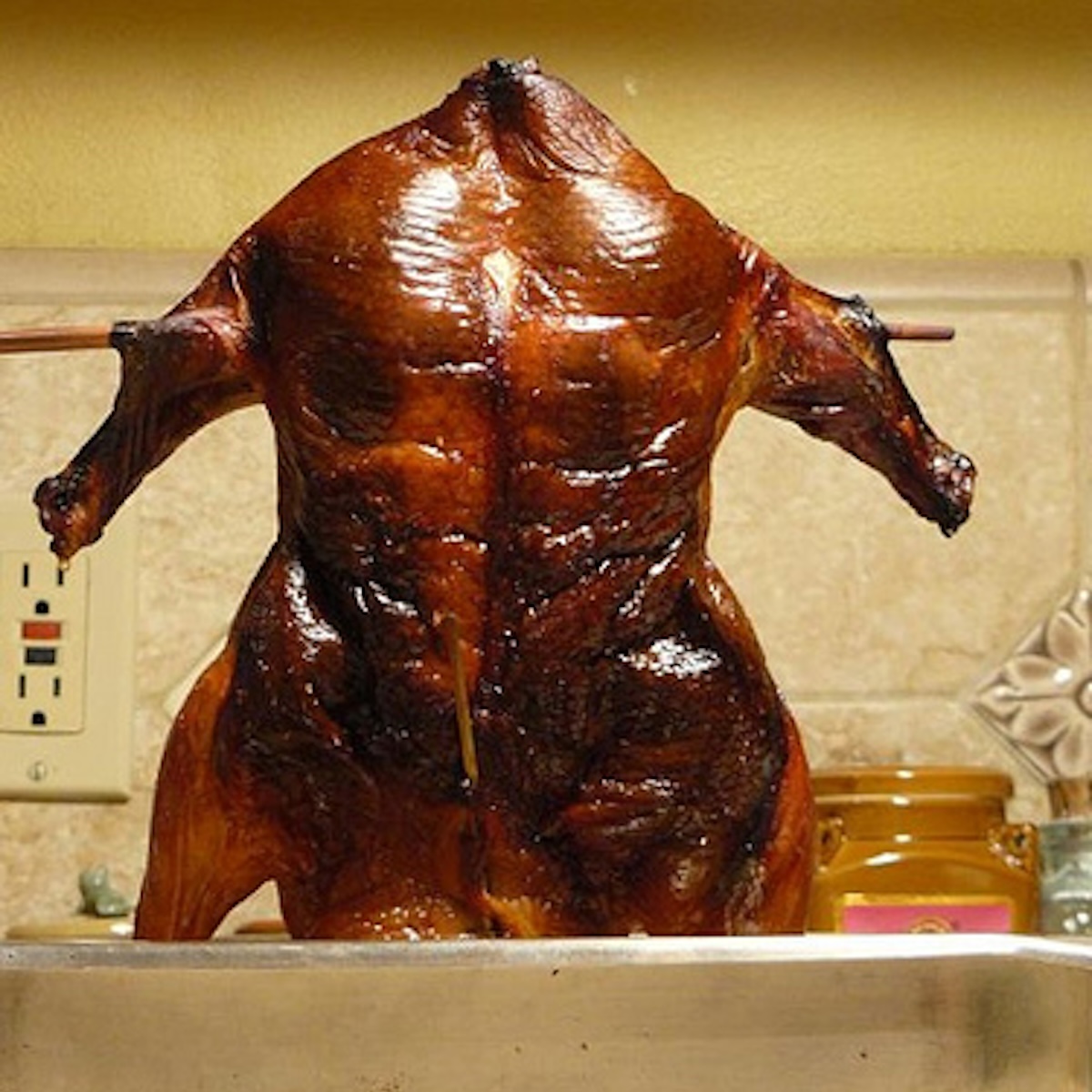
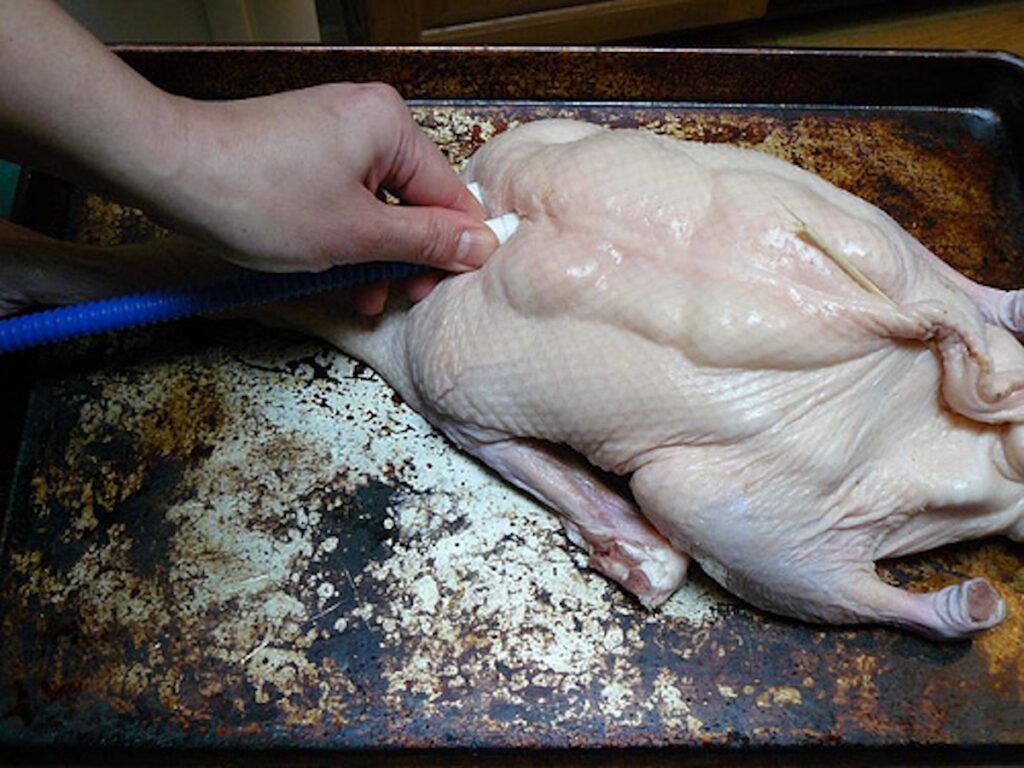
- Day 1, Step 1: Blow up the duck -- This may sound nonsensical but you do need to blow up the bird. The purpose of blowing up the duck is to loosen the skin from the flesh so the skin will crisp during roasting. If the skin is attached to the flesh then hot air cannot go through and melt the fat to crisp the skin. Cantonese ducks, in the main, do not get the blown up so the skin is attached to the flesh. The Peking duck technique is genius and required. On the blow up the duck page, you'll see my high tech and low tech options for taking care of this task. Maybe you'll have a new idea for doing it that you'll share! Get extra pointers for this step in Homemade Peking Duck Step 1: Blow up the Duck.
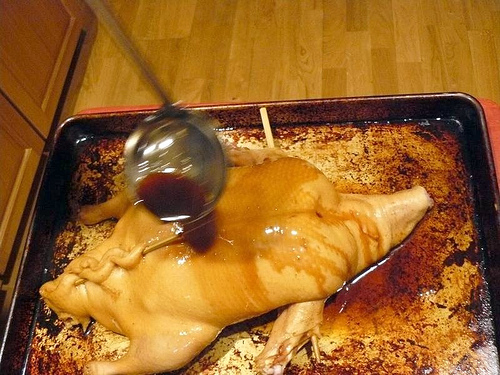
- Day 1, Step 2: Scald the duck and give it a tan -- This second step to preparing the duck should be done right after you blow it. That's because you're in the Peking duck zone and along with blowing up the duck you want to scald it and give it a tan. Scalding the duck tightens up the pores to facilitate drying in the fridge and later on, crisping in the oven. Tanning the duck sets the color and imparts a little spicy flavor to the skin too. Do not skip this step. For the full lowdown on how I arrived at the method and to Homemade Peking Duck Step 2: How to scald the duck and give it a tan.
- Day 2: Let the duck chill (this isn't really a step) By this point, you may need a rest and so does the duck. Let it hang out in the fridge to dry and develop rich color. If you have not, get the Mandarin pancakes recipe and make a batch. Plus, prep the sauce in the duck feast recipe that follows the mandarin pancakes. Your homemade duck will be superior to the shortcut hacks offered in that post. Trust me.
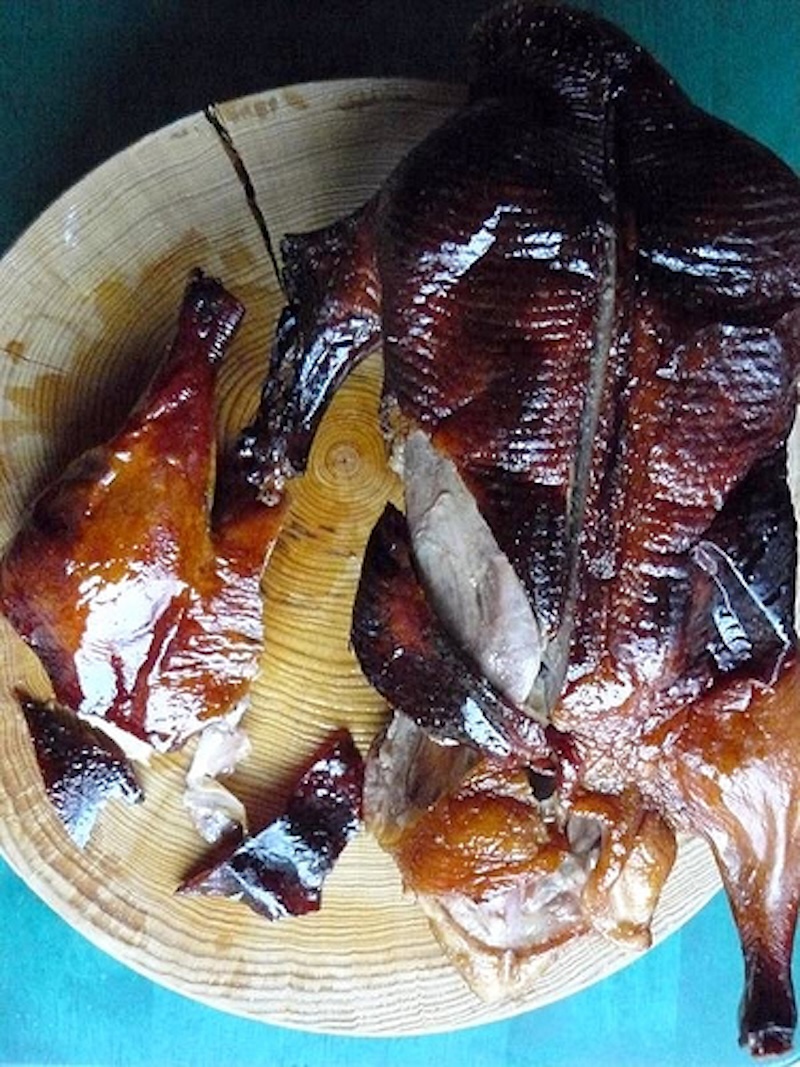
- Day 3, Step 3: Roast the duck and eat -- Home cooks have tried many methods to roasting the duck to mimic what Chinese professional cooks do. The true Peking duck shops in China use wood. I've not graduated to that level but through a series of experiments I have an exceptional method. You'll need something to stand the duck up. I use a vertical roaster but you could try a beer can chicken roaster. If you'd like the lowdown on roasting Peking Duck, check out the post titled, Homemade Peking Duck Step 3: How to Roast the Duck.
Peking Duck
Equipment
- 1 vertical roaster
- 1 air pump
Ingredients
- 1 (4 ¼ pound | 2kg ) duck, with head and feet intact
- 2 tablespoons fine sea salt
- .75L | 3 cups water
- 160 ml | ⅔ cup Shaoxing rice wine or dry sherry
- 3 tablespoons brown rice syrup or honey
- 1 tablespoon regular soy sauce
- 1 ½ teaspoons plus 1 tablespoon dark soy sauce
Sauce
- 80 ml | ⅓ cup sweet bean sauce or hoisin sauce
- 1 tablespoon Shaoxing rice wine or dry sherry
- 1 tablespoon water
- 1 teaspoon sugar optional
- 1 ½ teaspoons sesame oil optional
Accompaniments
- 4 or 5 slender scallions cut lengthwise into thin strips about 3 inches (7.5cm) long, soak in ice water for 10 minutes
- 1 small English or 2 Armenian cucumbers, quartered lengthwise, seeded and sliced into thin strips
- 16 to 20 Mandarin Pancakes see Notes for link to recipe
Instructions
- Refresh the duck: Remove any excess fat in the body cavity near the rear opening. To refresh the duck, vigorously rub the salt into its cavity and on its skin. Rinse, drain, and pat dry with paper towel. Put the duck, breast side up, on a baking sheet. Sew up the duck's abdominal cavity with a bamboo skewer; break off the protruding long section, if you like.
- Blow up/inflate the duck: To inflate the duck, use the tip of a paring knife to pierce a hole at the bottom of the duck's neck. Aim for the firm center of wish bones (like the human clavicle/collar bone).
- Wash the nozzle of an air pump (or bicycle pump or air compressor) before inserting the nozzle under the skin. Inflate the duck, directing air to one side, then the other. The duck should puff up to reveal a six-pack abs like structure. If the duck just puffs, then you may be pumping air into the cavity and not under the skin. Reposition the nozzle higher. If there is an air leak in the skin, make a new hole below the original one and retry. Flip the duck over and inflate its back side, making a hole at top of the spine. Expect the duck to lose some air once you remove the pump nozzle.
- Trim the duck: Put the duck on a cutting board and use a heavy cleaver or knife to cut off its legs, right below the knee joint. Then cut off the first two joints of its wings. Finally cut off its neck, leaving about 2 inches attached to the body. Cut off the head and discard. Refrigerate the remaining spare parts for the soup broth. Put the duck, breast side up, on a rack placed on a baking sheet and set near the stove.
- Scald the duck and give it tan: In a saucepan, combine the water, rice wine, honey, light soy sauce, and 1 ½ teaspoons of the dark soy sauce. Bring to a boil, then lower the heat to simmer. Because the duck will darken more on the breast than legs during roasting, tan the duck lighter on its upper part than its lower part. Slowly ladle ⅔ of the mixture to bathe the duck from the top of its thighs to the top of its neck. Part way through flip the duck over and repeat on its backside.
- Now add the remaining 1 tablespoon of dark soy sauce to the leftover tanning mixture, stir and ladle the liquid over the lower portion of the duck. It's okay if some of this darker liquid runs to the upper part.
- Chill the duck: Lift the duck off the rack and set aside briefly. Discard the tanning liquid and wash the rack and baking sheet. Replace the rack in the baking sheet, then put the duck on top, breast side up. Slide the duck into the refrigerator and let it air chill, uncovered for 1 ½ days, roughly 36 hours. Expect the skin to darken as it dries and feel somewhat like parchment paper. Meanwhile, make the mandarin pancakes.
- Roast the duck: Return the duck to room temperature before roasting. Position a rack in the lower third or bottom of the oven to allow the duck to roast upright in the middle of the oven; the top of its neck should be about 3 inches from the broiler element.
- Preheat the oven to 450°F (230°C) for 30 minutes. If needed, lightly spray or oil a vertical roaster (or similar tool). Turn and pull the bamboo skewer out to open the duck's body cavity by about 3 inches. Insert the vertical roaster. It's okay if the luck leans forward or slouches a bit. Place in a roasting pan, add a good ¼ inch of water, then slide the pan into the oven.
- Roast for 15 minutes, then lower the temperature to 350°F (175°C) and continue roasting for 1 to 1 ¼ hours until the skin is crisp, richly browned and shiny. Turn the pan if the skin browns unevenly. When done, tap on the skin and it should sound hollow.
- Prep the sauce and accompaniments: For the sauce, whisk together the bean sauce, rice wine, and water in a small bowl. Taste and add sugar and/or sesame oil. The sauce is ready to use.
- Put the scallion and cucumber on one or two plates. Set the sauce and vegetable garnishes at the table. Ready the steamer and Mandarin pancakes for reheating.
- Carve and serve: When the duck is done, remove from the oven and let rest for 10 to 15 minutes. Twist and pull the chopstick and skewer out. To remove the skin without it getting soggy, keep the duck on the roaster. Visualize the duck skin as four long quadrants. Now use a knife to cut downward through the skin, first to split the breast, then down the two sides and the back. Pry and peel away the large pieces skin. You will have to make some additional horizontal cuts to remove the skin. Set the skin aside on a plate as you work.
- Remove the vertical roaster from the skinless duck, then disassemble the carcass, cutting and/or pulling the flesh off the bones. Hold on a plate and tent with foil, if not serving right away.
- To serve, cut the skin into pieces about 1 by 2 inches (2.5 by 5cm) big, and arrange on a platter. Include the duck meat or present it separately. At the table, invite guests to take a pancake, smear on some sauce, top with a piece of skin, piece of meat, and a few scallion and cucumber strips. Fold or roll up the pancake and eat.

Leave a Reply