




"This ain't my mother's chiffon cake!" Eve exclaimed when she spied the brilliant green interior of this pandan chiffon cake. "Why is it so green?"
I explained to Eve that pandan leaves (bai toey in Thai, la dua in Vietnamese) was a common staple in Southeast Asia where its herby flavor and cheery color were well-loved. I'd been waiting for the right occasion to make the chiffon cake for months. I had a supply of frozen pandan leaves leftover from the Asian Market Shopper app and need to use them up.
While chiffon cakes are an old-fashioned American sweet, it got a tropical treatment in Southeast Asia with the use of pandan. This kind of chiffon cakes is particularly popular in Singapore and Malaysia. In Vietnam, people gravitate towards the pandan and coconut tapioca cake (banh bo nuong). The chiffon cake has a more tender crumb, though its green color is not as brilliant.
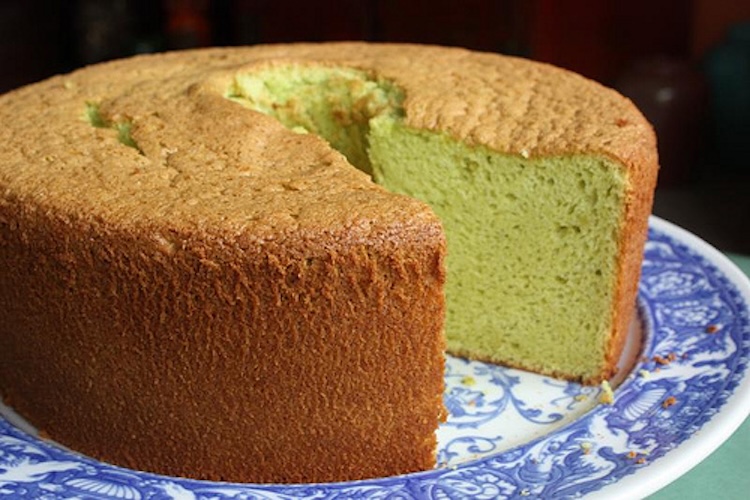
Even though Eve and her husband Michael were good sports about trying new foods, the couple eyed me with slight suspicion when I explained that pandan leaves have a perfume and color similar to wheat grass. The rest of the menu included Indonesian beef rendang, Malaysian turmeric celebration rice, and long beans stir-fried with shrimp paste. "Of course, we were going to make this same meal tonight but figured that you'd cook it instead," Michael said sarcastically. LOL.
When I later served the cake, both of them remarked how it was just a really nice slice of cake. That's all I wanted to hear.
Bonus pointers
- Check the pandan leaf guide to find out more about pandan.
- Remember to use a tube pan with a removable bottom. That kind of pan, the same as what's used for angel food cake, helps the cake to rise well and brown evenly. Mine is nonstick.
- It's a little tricky to invert the cake at the end because the pan will still be a little warm. But you have to do it to make the cake easier to unmold.
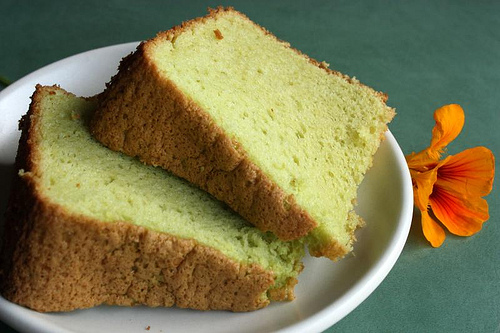
Pandan Chiffon Cake
Ingredients
- 300 to 360 g | 10 to 12 ounces frozen pandan leaves thawed
- 80 ml | ⅓ cup coconut milk
- 225 g | 8 ounces cake flour, or 210g | 7 ounces all-purpose bleached flour plus 1 ounce cornstarch
- ½ teaspoon fine sea salt
- 2 teaspoons baking powder
- 315 g | 10 ½ ounces sugar
- 7 large egg yolks
- 120 ml | ½ cup canola or vegetable oil
- 1 to 2 teaspoons vanilla, optional
- 8 large egg whites, at room temperature
- 1 teaspoon cream of tartar
Instructions
- Position a rack in the middle of the oven and preheat to 350F degrees. Have an ungreased round tube cake pan handy.
- Use scissors to cut the pandan leaves into short pieces, no more than 1 inch long. In 2 batches, blend the cut leaves with the coconut milk (use half of the milk at a time) in a food processor until it looks like bits of grass. Pause and push it down as needed. Transfer to a thin cloth, such as a piece of muslin.
- Firmly squeeze to render the opaque green liquid into a measuring cup. Discard the solids. When done with both batches, you should have about 14 tablespoons total. Add extra water, if needed to get that quantity. Or, remove some of the liquid if you have too much.
- In a large bowl, whisk together the flour, salt, baking powder, and all but ¼ cup of the sugar. In another bowl, whisk together the pandan-and-coconut liquid, egg yolks, and oil. Whisk the liquid into the dry ingredients until well blended and smooth. Taste the batter, and if you like, add the vanilla. Set aside.
- Using an electric mixer on low speed, beat the egg whites for about 15 seconds to break them up and get them a bit frothy. Then sprinkle in the cream of tartar as the machine runs. Increase the speed to medium, then gradually add the sugar.
- When the sugar has been added, increase the speed to high and beat the egg whites until stiff peaks start to form. Stop the machine to check.

- Take about ¼ of the egg whites, and swiftly stir with a spatula to blend and lighten the batter a bit. Now scoop the remaining egg whites onto the batter. Use cut-and-fold motions to combine the ingredients. A few thin streaks of white in the batter are okay.
- Pour the very green batter into the pan and shake it a bit to smooth out the top. Slide the pan into the oven and bake for 55 to 60 minutes, until a bamboo skewer inserted comes out clean.

- Cool the cake on a rack for 5 minutes. Meanwhile find two bowls or jars that can be used to support the can pan in an upside down position. They have to be at least as tall as the part of the tube pan that extends beyond the rim!
- Without much hesitation take the pan and invert it, positioning the rim on the bowls or jars so that the pan is elevated. Let the cake cool for 1 hour, before running an icing spatula around the edges (inner and outer) and unmolding. Slice and serve.

Have your own recipe for chiffon cake or pandan chiffon cake? How is it different from the one above? We served the cake with an orange sorbet. Something tropical would be terrific too. Or, just serve it as it. Have any serving suggestions?
Anne says
When visitors are freaked out by pandan, I explain that it's the Asian equivalent of vanilla -- I think there are a lot of similarities. Works a treat, though I haven't been able to convince my brother to try green pandan soy milk!
Belinda @zomppa says
I love this cake!! So fluffy, so gorgeous!
Xuanie says
Yay! I've been waiting for you to make pandan chiffon cake, and the recipe is finally here. On a related note, do you think I can substitute in the pandan extract (small bottle; I've seen both gel and liquid extracts) instead of making the pandan liquid from leaves? And if so, do you have a preference between the gel and the liquid extract? I've tried adding pandan liquid directly into cake batter (made from your Banh Bong Lan recipe), but it didn't turn out too good 🙁
Teresa F. says
I got some pandan extract at a market a while back. What are your opinions on the extract? I realized afterwards that it is artificial and clear (instead of green). Should I just stick with trying to find the leaves?
This cake looks lovely. Even though I've never tasted pandan, I can imagine that this tastes good.
Have you ever tried making the kind of Malaysian steamed cake that is available at dim sum places? I've been curious as to how to make that cake.
Lastly, a big thank you for the Asian Dumplings book. I really enjoy the baked bao recipe in there. I've even stuffed them with Mexican marinaded adobada, small smokey links, and Chinese sausage. The buns compliment each extremely well! It occurred to me, the dough is much like a light brioche dough. I just love it!
Andrea Nguyen says
Ladies, I don't use pandan extract but what I would do here is that the extracted pandan is about 7 1/2 tablespoons of liquid. It is a little thicker than water. Add the 1/3 cup (5 Tbl + 1tsp) of coconut milk and you arrive at 13 to 14 tablespoons. (That is why it says "about 14 tablespoons"). That is your goal.
So, measure the coconut milk, then add the extract liquid or gel to get an intense flavor and color. Add some water and alternate between the pandan extract or gel and water until you get the quantity needed. To make up for the difference in thickness, aim for about 7 1/2 tablespoons of extract/gel and water. Does that make sense? You are just backing up into the quantity needed.
dmreed says
for Malaysian or Chinese steamed cake recipes, just do a Google search!
Andrea Nguyen says
Teresa F: thanks for sharing your experience with Asian Dumplings! I am glad that the book has been informative! 🙂
Laura says
This cake recipe looks great and perfect for the summer. I plan to make it soon to justify the purchase of my new angel food cake pan!
The new cover for the upcoming Asian tofu cookbook looks even better, and I can't wait for it to be published!
Elizabeth says
Hi Andrea,
I always thought it was green tea in those cakes! In Vietnam, and in markets here, I've also seen a chiffon that is bright pink--I assume it is food coloring but now I'm wondering if there's another traditional flavoring in these?
Thanks, I especially love when you do dessert posts!
Andrea Nguyen says
Laura: The color and flavor of the chiffon cake are rather stunning! Indeed, perfect for a summer affair.
Thanks for the comments on the Asian Tofu cover. The tofu looks kinda elegant street, huh?!
Andrea Nguyen says
Elizabeth: LOL-- not a bad idea in the green tea cake! Red? Wow. I'd have to taste that by off the top of my head I'd use grenadine or maraschino cherry syrup. But the flavor would just be sweeeeet. Pandan has a unique flavor.
Extras.co says
Great post! Keep doing post like this, very informative and have helpful information. Keep up the good work!
==========
domain market
Helen says
Could we possibly have the recipes for the green beans and the rendang? My hub and I just got back from Amsterdam and I would love to be able to make a ristafel for him!
Christina says
I have tried baking Green tea chiffon cake using matcha tea powder. The recipe is similar to the pandan recipe and just as delectable with a modified red bean frosting . Just goggle it and you will find several recipes available. The pandan cake is still my fave given the distinctive taste and aroma of the pandan (screwpine) leaves. Incomparable. Love your blog...great recipes and articles. I just made the cake using your recipe and so far its the best.
Andrea Nguyen says
Helen: My recipes for rendang came from "Cradle of Flavor" by James Oseland. It's a great book and totally worth getting. I'll post the green bean recipe next time I get the beans! Thanks for the request.
Andrea Nguyen says
Christina: Red bean frosting? How did you make that? I'd love to know. Thanks for the feedback on this recipe!
Italy villas says
yep...it looks delicious and i'm hungry now(half in jest).
i'm sorry that i'm not able to cook but the biggest characteristic i have is eating . eating is also full of knowlege. but now i'm eger to learn how to make a good breakfast . and you give me a good choice.
mbt online says
That was my thought,too.
Bruce says
This cake looks totally delicious.
Red Bottom shoes sale says
Work makes the workman.
Canada Goose says
The unexamined life is not worth living.
red bottom shoes says
you are the best! you are the greatest! you are invincible
Canada Goose Parka sale says
Whatever you do, do with all your might.
Amy says
Is your tube pan nonstick? I bought one similar to yours,(by chicago metallic) and my cake fell out of the pan when I flipped it.
Charlene says
Andrea, the young woman who does my nails is from Viet Nam. I dont know what part but she has been very kind to me and in talking me into doing my eyebrows, not only do I look ten years younger but it was the start of me starting to get back into life again. I want to make her a cake that will bring her happiness. I am thinking of your pan dan cake. I am a specialty cake baker and use fondant. Can I make this cake in a round or square (non bundt) type pan? Also, how would you describe the taste of this cake? Sweet or more of a vegetable taste? Do you think I could use it as the cake for a fondant cake? Thank you so much.
marlon says
The recipe is similar to the pandan recipe and just as delectable with a modified red bean frosting .
Mr. Cooking Grill says
That is great! Congratulations. This book must be highly interesting.
marlon says
This cake looks lovely. Even though I've never tasted pandan, I can imagine that this tastes good.
Buy Instagram Followers says
Hi, yummy dish it just tends me to prepare it now and I like to do it for my birthday party coming next week.