


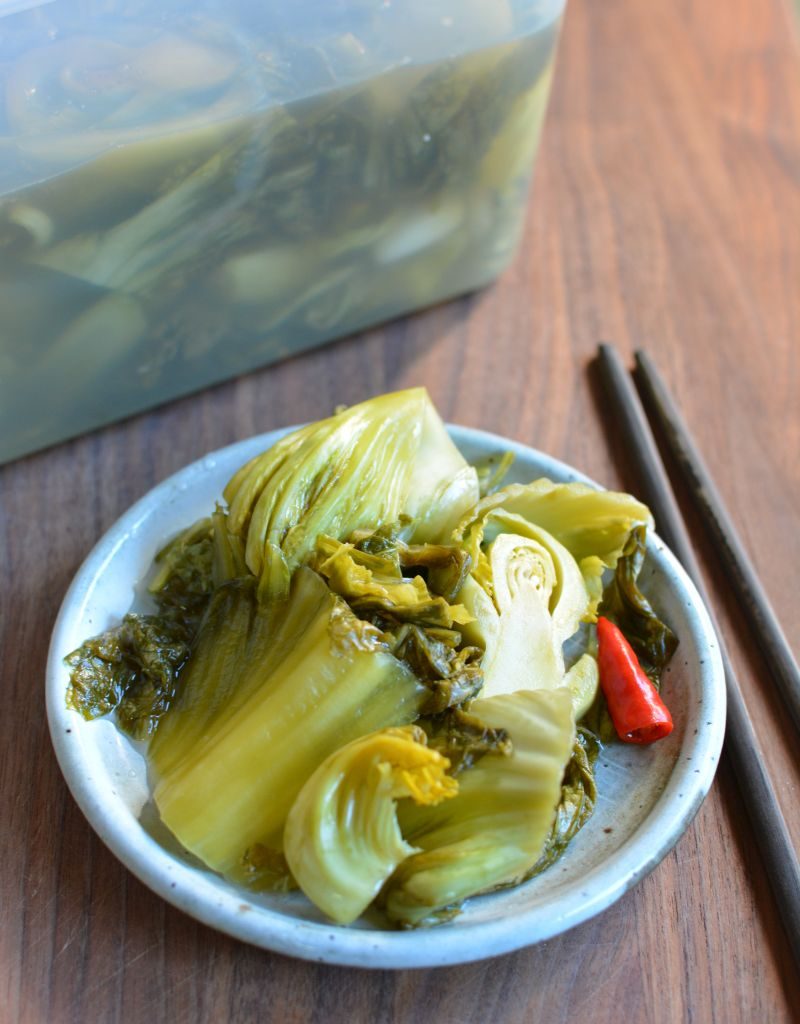
I've had fermented Chinese mustard greens on my mind ever since I received this email from MB: "My mother is Vietnamese but has no fondness for cooking, especially cooking Asian food as she says it's too much work. Anyways I was hoping to find a recipe for Dua Cai Chua on your blog, as my mom is a no go for recipes and doesn't have any close family I could ask either. I tried the pickled mustard greens for the first time very recently and have been hooked! Getting back on track, could you please direct me into finding a good recipe for dua cai chua? It would be very much appreciated."
Fermented Chinese mustard greens are not exclusive to Viet people who know it as dua cai chua (literally sour mustard greens/cabbage). I've enjoyed the preserved vegetables in porky Chinese and Viet braises, Thai khao soi noodle soup, and as a side to rice plates. There are many ways to eat because the greens have a wonderful tart, spicy, funky quality. Think of the fermented Chinese mustard greens as Asian sauerkraut.
If you've bought them at Chinese markets, chances are you've purchased pouches of Thai-made som pak gaat; they're inexpensive and usually contain a small among of mustard greens and a lot of liquid plus food coloring. Commercially-made fermented Chinese mustard greens (also referred to as pickled mustard greens) unfortunately have a mild flavor. They're fine in a pinch or when you don't need much for a recipe, but if you're really into the fermented mustard greens, make them yourself.
Finding a Suitable Recipe
Not knowing how MB's mom makes hers, and my mom has her own rendition, I looked for a Thai recipe to equalize things out. I settled on a recipe from Hawker Fare, a soulful cookbook memoir from Michelin star chef and restaurateur James Syhabout, based in San Francisco and Oakland. His recipe is based on Lao Isan Thai flavors, and also reflects his mother's approach.

It is wonderfully gutsy with garlic and chiles, plus extra umami rich, thanks to an optional hit of MSG, which I added at the end after trying out the recipe without MSG. The greens were good but I wanted to see what would happen with the extra boost. The mustard greens became super delicious. It's up to you whether or not to include the flavor enhancer but as you know, I keep the magical crystals around and occasionally tinker with MSG in pho and other dishes like fried rice.
Selecting Chinese Mustard Greens
The hardest part of making fermented Chinese mustard greens is buying the vegetable. Don't use the delicate frilly mustard greens seen at regular supermarkets. Seriously. At a Chinese or Southeast Asian market, look for gai choy in the produce department. The mustard greens are curved, curled and bodacious looking. Sometimes you'll find mature "big gai choy" which is huge with thick stems and bases; the flavor can be very spicy, a bit like horseradish. Sometimes you'll see small gai choi, which are more tender and sweet-spicy.
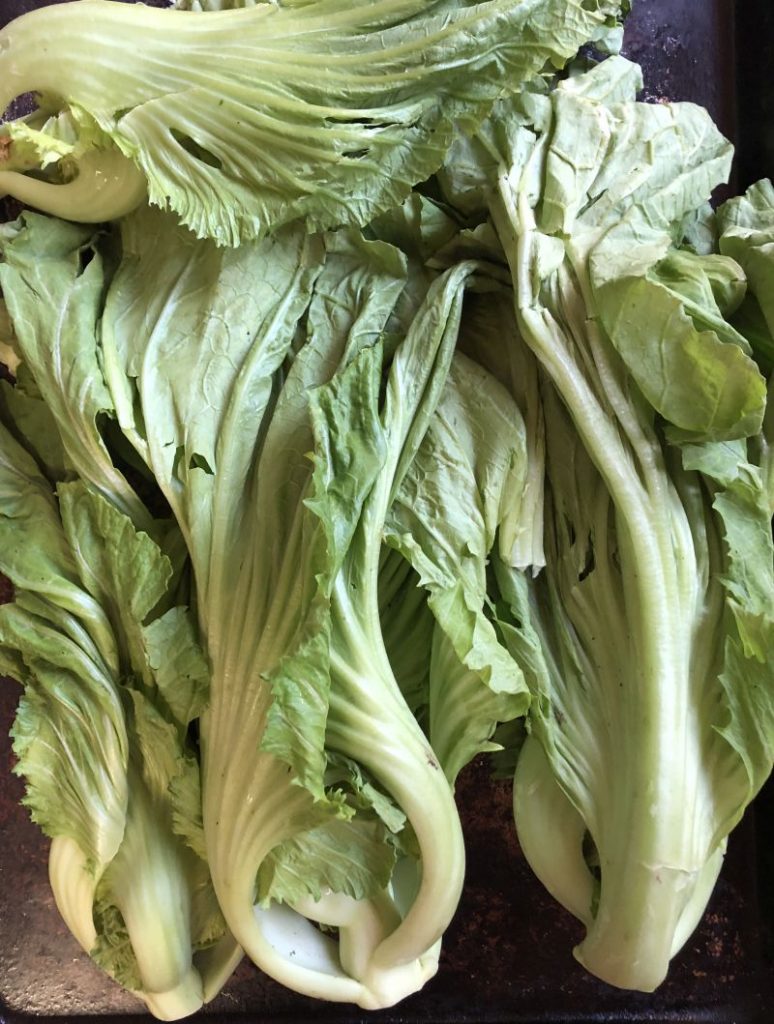
To hedge my bets, I went with medium gai choy, each of which was about 3 ½ inches wide at the bulbous bottom. Gai choy is often sold pre-bagged so dive in to select a bag of perky looking vegetables. Coincidentally, the bag I bought weighed 2 pounds, which was perfect for a batch of Syhabout's greens!
Ferment with Care
The recipe below includes metric precision because Syhabout is a chef. Hit his level of precision with a digital scale to ensure success. Moreover, remember to pack the vegetables into the fermentation container so that all the solids are submerged in the brine. Otherwise, things will rot and spoil.
The rice brine helps to activate fermentation; in this Thai recipe, I learned that some people use sticky rice, sugar, or the water from rinsing rice to push the fermentation. I like using regular cooked rice because I often have it around.
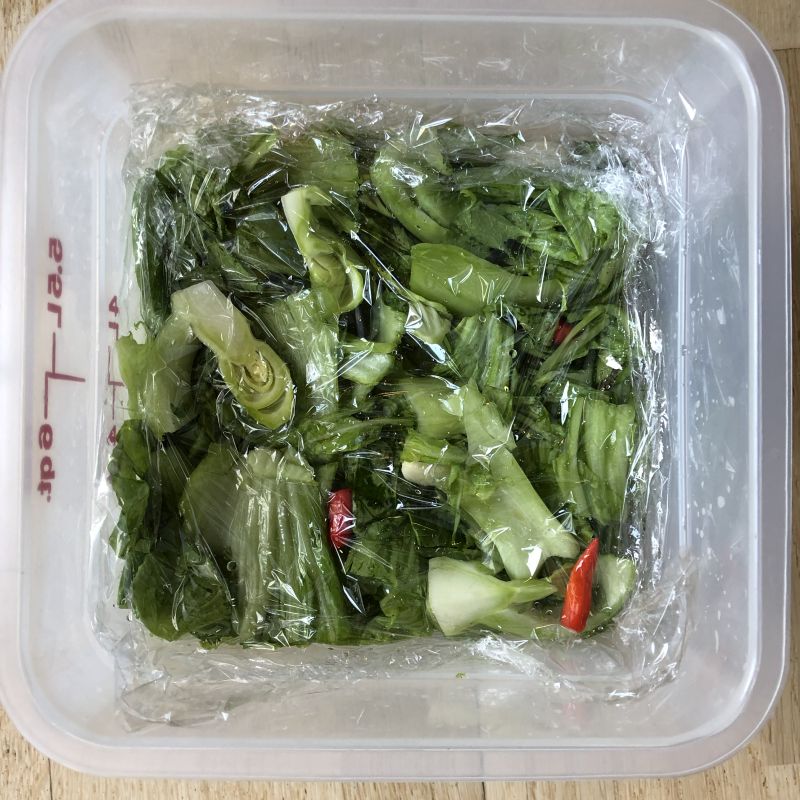
You need a large glass container or bowl for this recipe. I opted for a 6-quart Cambro (a heavy-duty plastic container used in professional kitchens and also home bread baking) because the heavy plate I used to press down on the green fit into the container. The Cambro now smells a little like fermented Chinese mustard greens. That's not a bad thing and it will go away, eventually.
How much fermentation time is enough?
It depends on your room temperature and the size of the vegetable pieces. The recipe suggests 3 days of undisturbed rest in a cool dark spot. I chose my pantry/hall closet. Our home was about 70F.
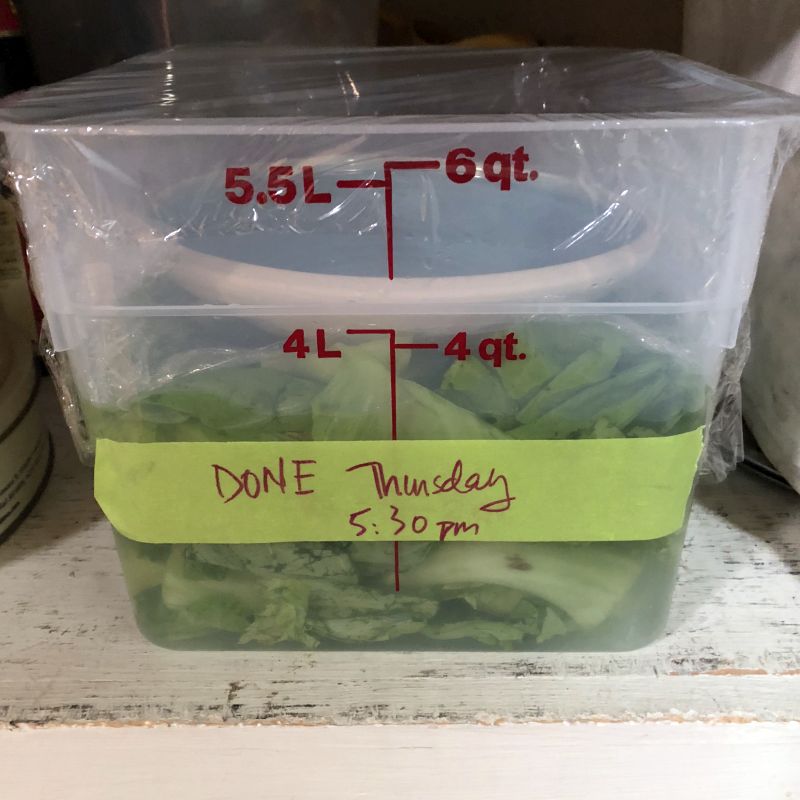
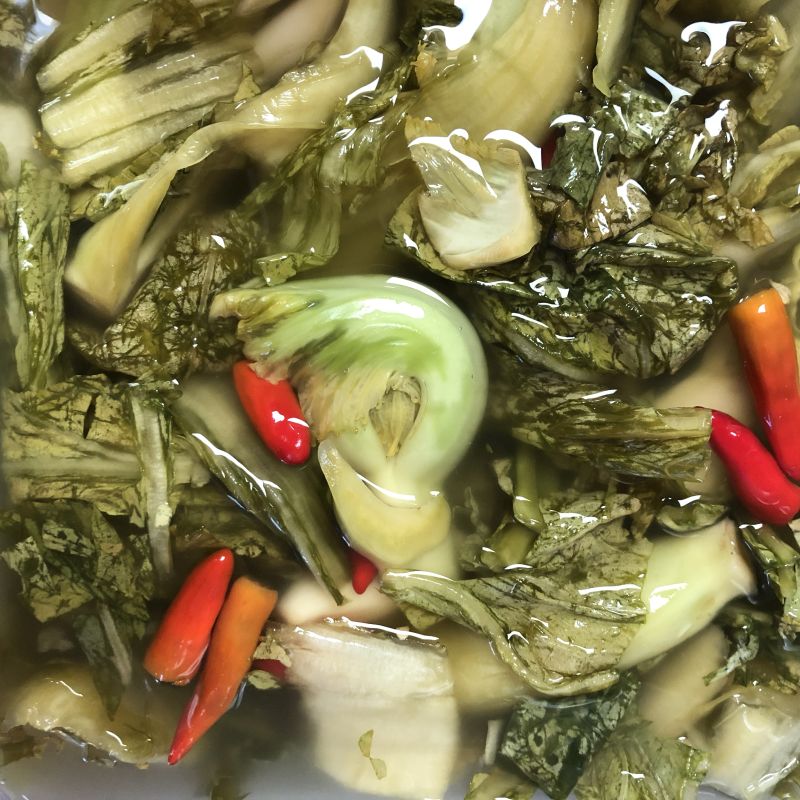
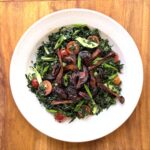
On the third day, I stirred up the vegetables and tasted the Chinese mustard greens. They were good but there were a few pieces that were still a bit rawish green looking (see the photo directly above). I may have cut the pieces too big. I also wondered about the MSG so added it and then let the mustard greens rest overnight, submerged under plastic wrap with the weight. Then they were perfectly done.
How to eat Fermented Mustard Greens
Frankly, I've just been eating them on the side like a pickled vegetable. They are absolutely delicious. I have enough to cook with too!
Fall is the season for fermenting Chinese mustard greens, and now MB and you have a recipe to play with. Enjoy! Thanks MB for prompting this recipe.
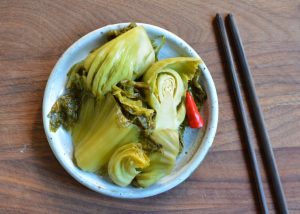
Fermented Chinese Mustard Greens in Rice Brine
Yield 3 quarts
Ingredients
- 2 pounds (907 grams) large Chinese mustard greens (dai gai choi)
- ¼ cup (50 grams) garlic cloves
- 8 Thai chiles (12 grams)
- 7 ½ cups cold water
- 3 tablespoons (33 grams) kosher salt
- 3 tablespoons (45 grams) cooked jasmine rice
- 1 teaspoon (4 grams) MSG (optional)
Instructions
Trim the ends, then cut the mustard greens into large bite-size pieces, wash, then drain well. Transfer to a large mixing bowl and combine with the garlic and chiles. Pack everything into a large class glass jar, or non-reactive bowl, pressing down to pack tightly. Set aside.
Pour water into a separate large mixing bowl (or pot), add the salt, and stir to combine. Add the rice and let soak for 30 minutes. Position a mesh strainer on the container of mustard greens and pour the water through (or strain into separate container and then pour over the mustard greens). Press on the rice to expel as much water as possible.
Lay a sheet of plastic wrap directly on the surface of the mixture; set a clean weight (such as a heavy plate) on top of the plastic to keep everything submerged. Cover the container with another sheet of plastic wrap.
Set the container in a dark spot at room temperature, away from sunlight. Let ferment, undisturbed for 3 days. On the third day, taste a piece of the greens-it should have a tart aroma and sharp, tangy flavor. If you like, add the MSG and let ferment an extra day for more flavor. When the mustard greens are done, transfer to an airtight container, store in the refrigerator for up to 6 weeks.
Notes
Adapted from Hawker Fare by James Syhabout with John Birdsall (Anthony Bourdain/Ecco, 2018)
Cuisine Asian, Thai, Lao

Oanh says
Thanks for the recipe, Andrea! This was one of my favorite pickles growing up -- I have no idea why I'd never thought of making these myself. Seems like an overdue cooking project for me. 🙂
Question -- Ione of my tasks as a kid was to lay out the mustard greens out in the sun to dry for a few days before fermenting. Any thoughts on what this step might add? Also, I think my mom just added scallions only to her batches -- no garlic or chiles. I'm curious how the aromatics will change the flavor profile.
Jill says
Hello there! I have tried this recipe with my own home grown red mustard. After the 3 days they were still like crunchy/raw. This is my 1st attempt at fermentation. 3 days didn’t sound enough. A friend has been fermenting veggies for years & his take 23 days! Would you please be so kind to offer some guidance? It’s been 6 days. I just checked again, still just seem raw, things are bubbly & smell amazing, submerged & aren’t moldy or anything. Help!
Andrea Nguyen says
I'd just keep it going. Sorry I missed your question from a while ago. So hopefully, it will have done its fermentation thing. It all depends on the temperature and vegetable. I hope it turned out well.
Oanh says
This was one of my favorite pickles growing up -- I have no idea why I'd never thought of making these myself. Seems like an overdue cooking project for me. 🙂 Thanks for the recipe!
Question -- Ione of my tasks as a kid was to lay out the mustard greens out in the sun to dry for a few days before fermenting. Any thoughts on what this step might add? Also, I think my mom just added scallions only to her batches -- no garlic or chiles. I'm curious how the aromatics will change the flavor profile.
Bear says
Onah, three guesses about your mother's sun drying the mustard, based on years of making naturally fermented sauerkraut;
1. Since you are using a liquid brine to control the fermentation of Chinese mustard, the less water that can be drawn from the mustard, the more consistent the salt levels in the brine and the better control you can maintain of the bacteria that can grow and "cook" your food for you.
2. With transfering less water from your veggies, the final brine will tend to have stronger flavors and require less flavorings to be added to the brine to achieve the desired final flavor due to lower dilution.
3. Drier vegetables tend to absorb more flavor from the brine at the beginning of the fermentation, especially green, leafy vegetables. This tends to make reusing the brine more difficult (common in traditional Chinese fermented pickle making), but also makes better use of the flavorings in the batch you are working on.
Hope this is helpful.
Andrea Nguyen says
That totally makes sense. I've seen recipes that call for drying the large mustard greens (gai choy). But overall, this is not overly ferment-y in flavor profile. People have different approaches. You could eat the thick part of the stem as a vegetable and ferment the leafier parts. It all turns out well at the end, thank goodness.
Oanh says
This was one of my favorite pickles growing up -- I have no idea why I'd never thought of making these myself. Seems like an overdue cooking project for me. 🙂 Thanks for the recipe!
Question - one of my tasks as a kid was to lay out the mustard greens out in the sun to dry for a few days before fermenting. Any thoughts on what this step might add? Also, I think my mom just added scallions only to her batches -- no garlic or chiles. I'm curious how the aromatics will change the flavor profile.
Jessica Hoong says
Thank you Andrea! I too grew up with and LOVE pickled mustard greens but have not had home made versions since my mom has passed. I can't wait to try this recipe out so I can share with my siblings, whom I'm sure miss it too. I've followed many recipes on this website and my Pho cookbook and all have turned out great and are easy to prepare.
Andrea Nguyen says
You're so very welcome, Jessica! I hope this recipe inspires you to come up with a version to match what your mom made. It's a fun project and easy, too!
Vicki Maltsev says
Hi! What is the purpose of the rice? Can this recipe work without it?
Thank you!
Andrea Nguyen says
The rice kickstarts the fermentation. I think you can omit it but don't know. Sorry to not be of more help. Different recipes use different formulas. You can always try it without the rice and see. Wouldn't hurt. It would just take a little longer.
Carlos Gutierrez says
I want to try this recipe but can't find mustard greens in Argentina. Do you think I could maybe use dill instead? Thanks.
Andrea Nguyen says
Dill is not the same. Try a leafy green in the mustard family. Is there kale and collards in Argetina?
Andrea Nguyen says
Dill is not the same. Try a leafy green in the mustard family. Is there kale and collards in Argentina?
Carlos Gutierrez says
I can't find any mustard greens where I am at, could maybe use fennel instead?
Andrea Nguyen says
I have no idea. Those are different plants. Try it and see.
ferment says
do these produce gas as they ferment, like kimchi does? i want to try making this in a glass jar, but im worried about pressure building up inside and a possible fermentation explosion, lol
Andrea Nguyen says
Not much gas like kimchi.
Stephen says
Just made my second batch. They are so delicious!
Andrea Nguyen says
The greens are so good and handy to have around! Thanks for making the recipe!