

One of the most interesting Asian cookbooks released this year had no color photographs. Yes, no food porn was in The Hakka Cookbook by Linda Lau Anusasananan. In an era where readers love to cook with their eyes, it was a gutsy move on UC Press to publish a cookbook only graced by simple watercolors. Without photos to distract, you have to read and flip each page (imagine that!), following the author’s journey through a cuisine and culture.
The Hakka Cookbook may seem like it’s for Chinese food geeks -- there are maps, Chinese characters and Romanized pinyin Mandarin. The book begs you to spend time with it. Once that you start looking at it, you’ll be stuck in your chair for at least a good hour. You’ll pick out familiar dishes seen on Chinese restaurant menus.
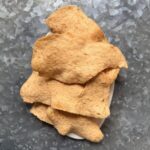
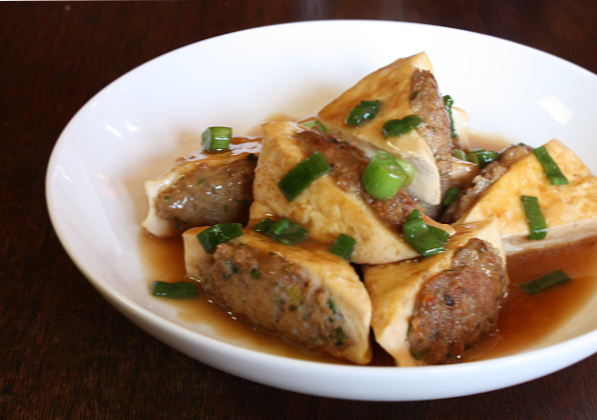
For example, the panfried stuffed tofu served at dim sum, food hawker stalls, and made at home are foundationally Hakka. It's a classic and I checked in with Linda while developing the recipe in Asian Tofu (below).
Who are the Hakka?
I first encountered the Hakka in Hong Kong when I was student there in the early 1990s. The older Hakka women often farmed while wearing their distinctive hats. My friend at the time, Melanie, told me that the women were tough. That scared me a little, especially because my Cantonese was nonexistent and my Mandarin was rough.
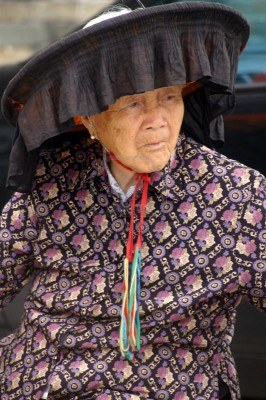
So it’s taken nearly 20 years for me to finally get in depth knowledge of the Hakka people and their food. The Hakka are a group of Han Chinese people that have migrated from their home in China to inhabit many far corners of the globe, influencing Asian cooking wherever they go.
Moreover, the Hakka are the resourceful masters of fusion cooking simply because they found themselves far from home. They cooked and adapted their foodways to their circumstances. Those are among the points that Linda aims to show you in her book.
An Anticipated Book
She’s Hakka and the book details how she traveled and connected with people all over for her collection of recipes in The Hakka Cookbook. She is curious, skeptical, and many times comically honest in her assessment of what she experiences along the way. A former food editor of Sunset magazine, Linda’s recipe writing is straightforward. There’s little fuss and waste. In other words, she’s a pro. I’ve been waiting for Linda’s book for many years and without hesitation wrote an endorsement blurb for the cover.
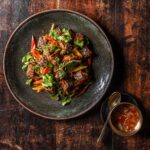
When I recently sat down with the final book, I paged through and was instantly attracted to this Chinese-Indian chicken dish. It seems similar to a homey Viet recipe I read in Lam Bep Gioi, the Joy of Cooking equivalent in 1940s Vietnam. It’s also akin to the chicken and ginger in caramel sauce recipe in Into the Vietnamese Kitchen.
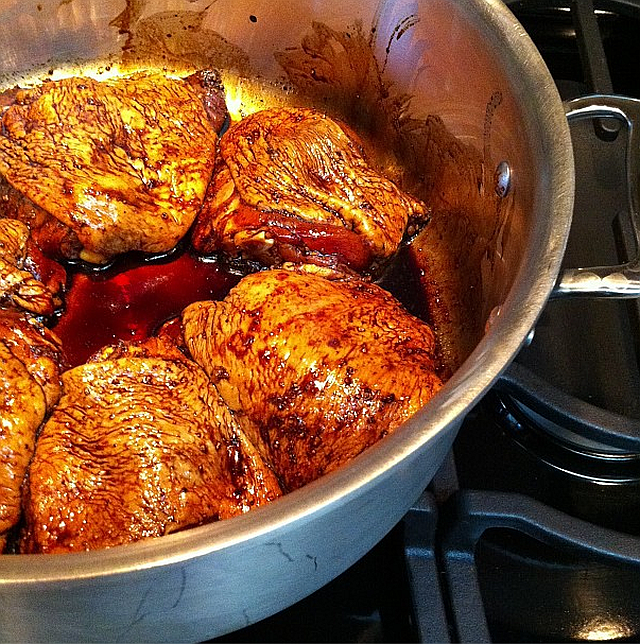
In all instances, the idea is simple: simply season the chicken and let it gently cook in its own juices. With this dish, which Linda got from a Chinese family that lived in India for years, the total
cooking time is about 45 minutes, after which the chicken is imbued  with flavor. With just a handful of ingredients involved, I was double sold.
And if you’re wondering about Chinese-Indian food – you should pick up a copy of The
Hakka Cookbook. You’ll get the answer and lots more -- personal stories and a terrific collection of recipes to cook from.
The recipe below was adapted from The Hakka Cookbook (UC Press, 2012). The original recipe called for 6 chicken thighs but I threw in a drumstick to see what would happen. It was fine. The thighs cook more evenly because of their flatter shape.
RECIPE
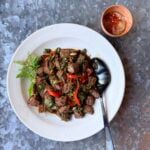
Soy-Glazed Black Pepper Chicken
Yields 3 servings as a main dish, 4 to 6 with as part of a multicourse meal.
Ingredients
- 2 pounds / 1 kg total bone-in, skin-on chicken thighs or combination of thighs and drumsticks
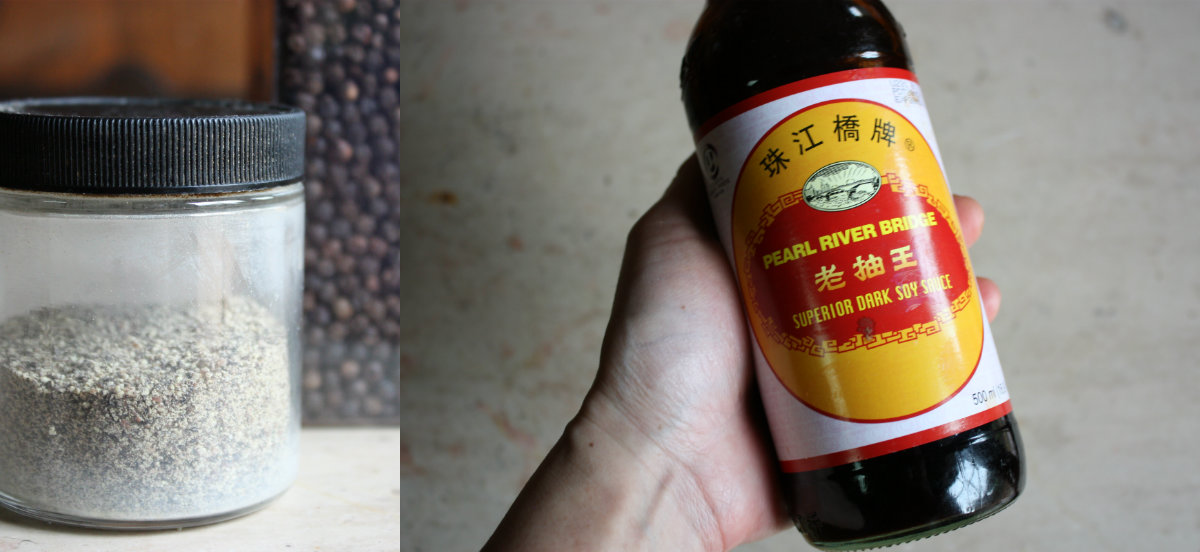
- 1 tablespoon freshly ground or cracked black pepper
- 2 tablespoons dark soy sauce
- Cilantro leaves, for garnish
Instructions
- Trim any large pads of fat or excessive flaps of skin each thigh. Rinse and pat dry.
- Find a large pot or deep large skillet that will fit all the chicken in one layer. In that pot or skillet, mix the pepper and soy sauce. Add the chicken, and use your hands to coat each piece with the
seasonings. Peel back the skin to swab the flesh with seasonings too. Arrange the chicken, skin side down, in one layer. The bottom should be nearly covered. - Cover and set over medium-low heat. When you hear light bubbling, lower the heat slightly and cook for about 15 minutes, until the skin has turned dark brown. Turn the chicken over and continue cooking gently for 20 to 25 minutes, until done (cut or poke with a knife to test).
Check on progress during cooking to ensure there’s liquid in the pot, adding a little water if things are dry. - Transfer the chicken to a plate. Skim off the fat from the pan juices, then pour the dark liquid over the chicken. Garnish with cilantro and serve.
Note:
The chicken was great hot, warm, or cold. The pan juices were great mixed into rice. I used a tablespoon of the skimmed fat for stir-frying green beans for dinner, adding a splash of the pan juices for seasoning.
Have any experience with Hakka people, food or cooking?Â
More recipes from 2012 Asian Cookbooks:
- Homemade Bun Rice Noodles from Vietnamese Home Cooking by Charles Phan
- Faux Viet Crab Noodle Soup from Vietnamese Street Food by Tracey Lister and Andres Pohl
- Fried Ginger Chicken from Japanese Farm Food by Nancy Hachisu
- Pork Belly, Pickled Mustard Greens and Tofu from Burma by Naomi Duguid

Leah says
This is so easy. Thanks for giving me an idea for tonight's dinner. Will this work on chicken breasts?
Andrea Nguyen says
I don't see why not, Leah. Watch the moisture in the pot and add water as needed to keep the cooking going until they're done.
Michelle says
My dad side of the family is Hakka so I grew up eating Hakka food. My grandma use to make this dish and adds potatoes to it. She also adds a little fish sauce. 🙂 It's a simple dish but so delicious. I'm going to have to check this cookbook up! It's so nice to see Hakka cooking being appreciated.
Linda Anusasananan says
Thanks Andrea for a great review. Just looking at your photo, made me think about cooking it for dinner tonight. It's one of my favorite recipes in The Hakka Cookbook. For those who can't find dark soy sauce (also called black soy sauce), try this simple alternative. Mix 2 parts all-purpose soy sauce (Kikkoman or similar) with 1 part molasses.
Maggie says
Thanks, Andrea. I love simple recipes like this
TinCook says
Looks like this is where Shoyu chicken comes from.
Interesting that it covers Chinese-Indian food. I usually think about Tibeten/Nepalese food when it comes to Chinese-Indian fusion, not Chinese diaspora. I'm a big fan of the combination of cumin and soy.
Judith van Praag says
Andrea,
Wonderful review of a lovely cook book. Interesting point you make about the cook books of today, I say today, because many of the cook books in my library have hardly any photos, and those added are often an after thought, and some not even that appealing. Yes, my interest in the genre goes way back 🙂
Linda, Seeing you mention molasses, your recipe and the black or dark soy sauce makes me think of kip ketjap, the Indonesian-Dutch syrupy variation, made by adding gula jawa or palm sugar and molasses to soy sauce. Many recipes call for ketjap manis which contains ginger, chili pepper and garlic.
Food storage says
Pretty Much post it is. I enjoyed very much. If you want to know about “Food Storage” please visit: http://www.efoodsdirect.com
Debra says
Simply delicious! Thank your,
Debra says
Simply delicious! Thank you!
Saucy Spatula says
This is such a great post! I'm a Hakka and my ancestors had settled in Hong Kong a long time ago. I found out about The Hakka Cookbook while browsing online, and now I'm wanting to get it through Amazon!
My whole family has always been about cooking and working in the kitchen. Matter of fact, we used to own a restaurant, and would serve some Hakka dishes.
Thanks again for the great write-up!