


I've had Vietnamese bun round rice noodles on my mind lately. The dried ones are what I
mostly buy and stock up on in my house. But when fresh ones are around, they can
be incredible. Bun noodles are used
in rice noodle bowls, noodle soups, and to wrap up in lettuce with grilled or
fried morsels; read more in the bun rice noodle primer.
I didn't think about making my own bun until Binh asked me about it on
Twitter. Then Seattle and chef/restaurateur Eric Banh expressed how much he
loves to serve fresh bun rice noodles
at his restaurants. While perusing Charles Phan's new cookbook, Vietnamese Home Cooking, I came across a
bun rice noodle recipe (called "rice noodles" on page 172).
It was karmic right? I had to try making my own.
First off, know that making fresh noodles is basically a thing that most Viet
people leave to the professionals. Just like in Italy, you can go to a local
pasta shop, in Asia, there are fresh noodle vendors. In the US, fresh rice
noodles are sold at many Chinese and Southeast Asian markets. Bun rice noodles are particular to Viet
enclaves. In his recipe introduction, Phan admitted that few people make bun at
home but encouraged cooks to try since it's a fun project.
In the span of about a week, I tackled Phan's fresh
rice noodle recipe three (3) times with mixed results. However, I wanted to
report to you on how to make bun rice
noodles, and if you're game, give it a whirl and report back on your outcomes and insights.
Together we can come up with a workable recipe.
Note: A
piece of equipment that you'll need is a potato
ricer to extrude the dough. (Germans use ricers for wheat flour noodles so
why can't we use the kitchen tool for rice noodles? It's ironic that it's called a rice, despite its use for mashed potatoes.) Look for one that will extrude
from the bottom only and has steel plates to produce round strings. Mine was
basic and cost about $20 at Sur La Table.
This is my first time at doing a group recipe
project on VWK. Sound good? Here we go.
DRAFT RECIPE
Homemade Bun
Rice Noodles
Below are my proportions and method. They vary slightly
from Phan's as they reflect what worked in my home kitchen; for example, his recipe called for 4 cups of rice flour and 1 cup of tapioca starch which I translated into a weights for accuracy. Read the draft
recipe and note my prompts for your tinkering. The fermentation step is where I
fell down twice so read that section well.
Yield: about
3 pounds / 1.4 kg
Ingredients:
- 1 pound / 454 g rice flour, plus more as needed
(use a Thai brand, such as Elephant or Flying Horse) - 3 ½ cups / 840 ml water
- 3 tablespoons canola oil
- 4 ounces / 112 g tapioca starch
- Salt
Method:
Make a
fermented rice batter. In a bowl, whisk together the rice flour and water
until smooth. Cover with plastic wrap and set in a cold oven with the light on
for 24 hours. This allows for the development of a slight tangy in the noodles;
if that doesn't happen, your noodles won't be ruined.
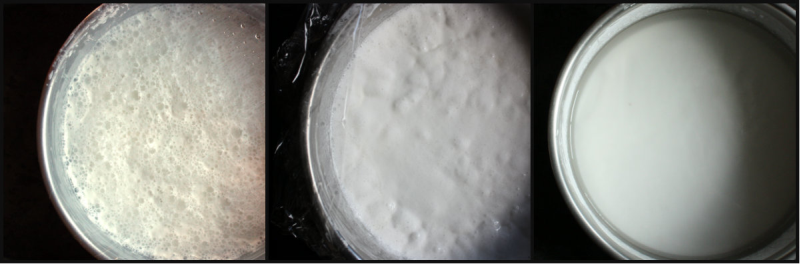
[The first two times that I made the noodles, I
over fermented the batter. Phan's recipe didn't give cues on what fermentation was
suppose to be like; additionally, it prescribed leaving the batter at room
temperature for 4 days, which I imagine was about 75F / 24 C -- the temp in my
oven with the light on. Alas, after two nights in the oven, the batter picked
up a horrid bilious (think vomit) smell. I could not cook or rinse out that
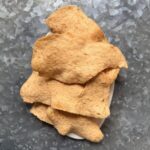
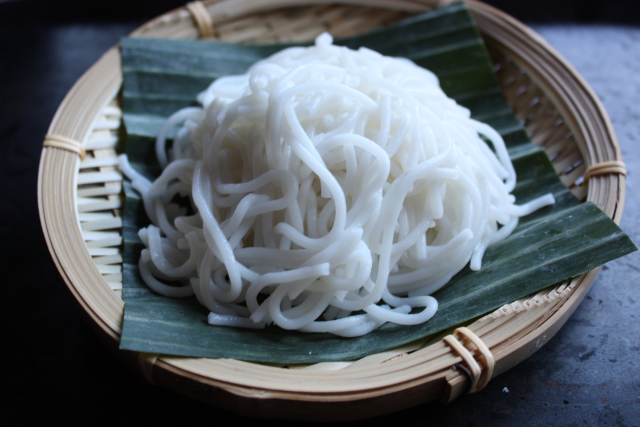
smell from the vomit noodles and threw the entire batch out. The noodles are at the top of this post. They looked great and had a good texture but smelled awful.
The second time, after 30 hours in the oven, I got
sludge and slight vomit so I didn't make the noodles. The third time I left the
dough out for 48 hours at room temp (about 63F / 17 C in my house) and there
was no distinguishable change in the batter; fearing over-fermentation, I made
the dough per Phan's instructions. The noodles were okay but the dough was a
little too firm/dry to extrude easily into lovely, long strands. If I were you,
I'd aim to let the batter ferment for about 24 hours in the oven, then let it
sit at room temperature till you're ready to make the dough and noodles.]
Turn the
batter into dough. The rice should settle in the bottom of the bowl. Pour
off the water at the top. There should be about 1 ½ cups / 360 ml. Add ⅓
cup / 90 ml of new water to the bowl. Stir to create a smooth, silky batter.
[Phan's
recipe called for pouring off 1 ½ cups and adding ¼ cup of new water but I
felt like the dough was too stiff. I'm suggesting to you to go with ⅓ cup
water. Do something in between, if you like and add water as you see fit. I
could even see pouring off 1 ¼ cups of water and adding ⅓ cup.]
Put the oil in a large saucepan (3 or 4 quart / 3
or 4 L) and heat over high heat until shimmering. Have a wooden spatula handy.
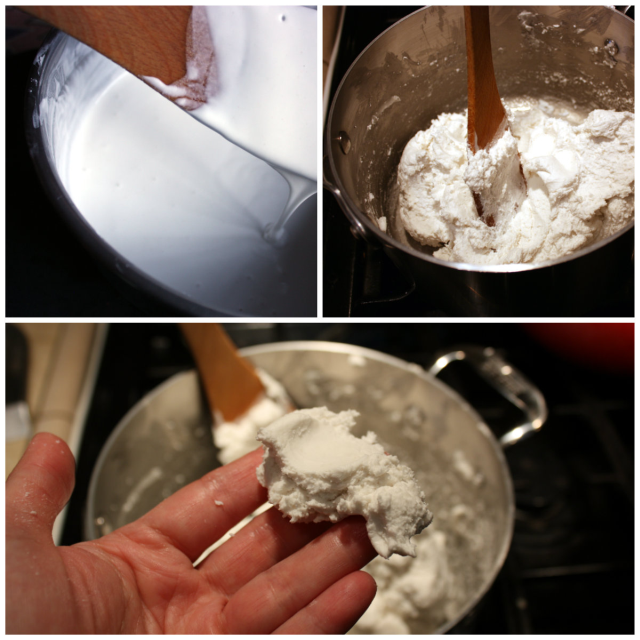
When the oil is hot enough, pour in the rice batter. It will sizzle. The oil
will rise up the walls. Reduce the heat to medium. Start stirring, scraping the
bottom and the sides of the pan. Holding on to the pot handle, stir and cook
for 5 to 8 minutes, reducing the heat as the batter thickens into a white
paste. It will become tougher to stir as you go along. When the paste is stiff
enough for the spatula to stand up in it, it's done.
Leaving paste bits on the wall and bottom of the
saucepan, transfer the dough to a stand mixer and add tapioca starch. Use the
dough hook or paddle attachment to mix the ingredients on medium (speed 3) for
a few minutes. Aim to form a dough that you can pinch and does not stick to
your hands. Add water by the tablespoon, if necessary, to coax the paste and
starch together.
[Phan's recipe suggests using a dough hook on
medium for about 10 minutes. I followed his instructions and there wasn't a
change in the dough texture in last 5 minutes. There's no gluten in the dough so the
hook doesn't seem to do much. I think the paddle attachment would have made
fast work of the task. Additionally, there's a photo in Vietnamese Home Cooking of a person working the paste and starch by
hand so feel free to put the paste into a bowl, adding the starch and kneading
the two together. ]
Put the dough on your work surface, adding a
dusting of rice flour if it's sticky. Knead the dough into a smooth mass, about
1 minute. Shape into a 12-inch / 30cm log. Cover with plastic wrap to prevent
drying.
Extrude,
cook and ice down.
Fill an 8-quart / 8 liter stockpot with water.
Throw in a good tablespoon of salt. Bring the pot to a boil. Use a booster
burner, like I did and it'll happen quickly. If not, get the stockpot of water
heating before you cook up the paste
into dough. In any event, get an ice water bath ready and set near the stove.
Get the ricer out and outfit it with a plate with
small holes about ⅛-inch / 3 mm wide. Cut the dough crosswise into 4 pieces
(about 8 oz / 225 g). To make the noodles, put a piece of dough into the ricer.
Hold the ricer over the pot, squeeze the noodles out. Lower the ricer close to
the water surface and wiggle and jiggle the ricer to detach the noodles. Watch
this video for what I did:
I struggle a bit in the video because the dough
was on the stiff side. It may have been my cheapie ricer too. If this happens
to you, try wetting your hands and knead the moisture into the dough to soften
it; let the dough hydrate for 5 minutes before you extrude it.
Regardless, wait for the noodles to bob to the top
and gather at the side of the pot. Scoop them out with a strainer and put them
into the ice bath. Repeat with the remaining dough. When done, drain the
noodles and rinse in cool water to remove excess starch. Drain well. Keep at
room temperature and eat the noodles day you make them. They can be
refrigerated overnight and reheated in the microwave oven but won't as be as
good.
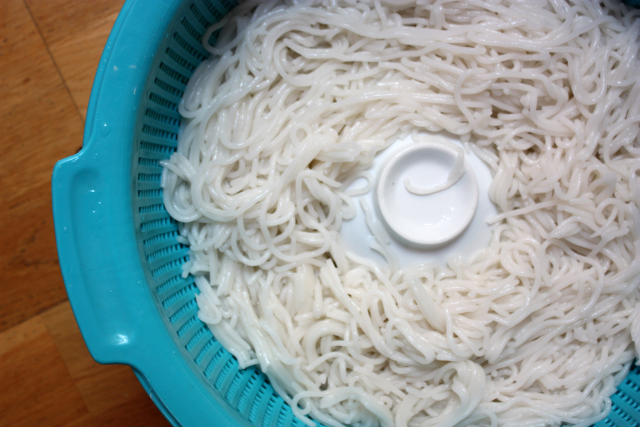
Were the bun noodles as good as what the pros
make? I had some stumbles - like my noodles came out as short lengths, sometimes
clumped, and were never be as long as what a noodle factory turned out. That's
because there's some finessing to be done with the dough. Also, a potato ricer
can only hold so much in its well so you can only get noodles of a certain
length. You cannot over stuff the well or the ricer won't work well.
So that's how I made the noodles from Vietnamese Home Cooking. Are bun rice noodles worth making at home? Yes,
because at the end of the day, you just made fresh noodles! I'm not sure if I'd
make this a regular thing because I'd have to plan for the fermentation.
However, it can be done hours in advance of serving. If you're a DIY type of
cook, fresh bun noodles are something
to try out. Otherwise, stick to dried noodles and keep your eyes out for fresh
ones at the Asian market.
Please share your comments or insights -- particularly if you make these noodles!
Related
posts:
- Vietnamese Noodles 101: Banh Hoi Fine Rice Noodles
- Vietnamese Noodles 101 - Bun
Rice Noodles - Vietnamese Noodles 101: Banh
Pho Flat Rice Noodles - How Banh Cuon Rice Noodle Rolls
are Made (+ video) - Book Review: Vietnamese Home Cooking by Charles Phan
More recipes from 2012 Asian Cookbooks:
- Faux Viet Crab
Noodle Soup from Vietnamese
Street Food by Tracey Lister and Andreas Pohl - Fried Ginger
Chicken from Japanese Farm
Food by
Nancy Hachisu - Pork
Belly, Pickled Mustard Greens and Tofu from Burma by Naomi Duguid - Soy-Glazed Black
Pepper Chicken from The Hakka Cookbook by Linda Anusasananan
Robyn says
Hi Andrea
Fun project.
I make sourdough bread. When establishing a new wheat flour starter, some of the first 'bugs' to become active in the presence of water produce offensive vomit-like odours, however as the pH of the solution begins to drop (because of the activity of the various microorganisms present) the 'smell generators' become less active (they don't grow well in acid conditions) and the stink goes away. In the case of wheat flour at room temperature (21°Cish), the offensive stage is around day 3 ~ 4. As a means of bypassing the stink, pineapple juice can be used instead of water as a mildly acid buffer in the first few days when getting a sourdough starter underway. In developing a starter for bread we seek the best conditions for the growth of both yeasts and acid (lactic acid and acetic acid) producing bacteria. I don't like strongly sour bread and maintain my bread starter in a manner which favours the lactic acid producing bacteria. My bread is wheaty, with a mild lactic note.
[If you want to learn more about the use of PJ in establishing a sourdough starter a couple of useful links:
http://www.thefreshloaf.com/node/10856/pineapple-juice-solution-part-1
http://www.thefreshloaf.com/node/10901/pineapple-juice-solution-part-2 ]
I have not eaten fresh bun noodles, so have no idea how sour they are or what type of acid note they have. Nor do I know how manipulating a rice flour solution (heat, time acidity etc) would alter the developing microorganism culture. I'd like to offer to have a play with this but I'm not sure what to aim for....... I don't know how important the sour note is in making good bun noodles, but if you would like me to do some experimentation, please give me a bit more of an idea of what to aim for as regard sourness.
Cheers, Robyn
Robyn says
Me again. I was thinking of the Rick Stein shots taken in a Cambodian village where they were making rice noodles. Took a nosey on YouTube and found it. If the link doesn't work it is Far Eastern Odyssey Episode 1 Part 4. The section starts at 1 min 38 seconds. . It is not clear from this whether they normally have a fermentation stage in their process. I imagine you have seen this before but you might find it interesting to look at the texture of their dough at the various stages.
Robyn
Robyn says
ohps here's the link:
http://www.youtube.com/watch?v=LiYJ8DNdhPM
Maggie says
They look like spaghetti - how do they differ from rice vermicelli and the flat noodles used for Kway Teow, other than the shape? I never realised there was a fermentation process involved in making rice noodles, so thanks for that.
Andrea Nguyen says
Hi Robyn,
Terrific insights. I've made bread starter from the scratch and the sour smell is not like this. The addition of pineapple juice would kickstart the fermentation. Peter Reinhart uses PJ in his book, Artisan Bread Everyday.
I've seen the tangy rice starter in small bowls at a banh trang rice paper shop in Vietnam and they mixed it in with new batches of batter. In fresh bun noodles, the tanginess is very very mild, in my opinion. However, in banh hoi, there tends a little more tangy taste. So, frankly, I don't think it's that important. You certainly don't taste it in the dried ones.
Andrea Nguyen says
When I was in Seattle at the Viet noodle factory with Eric Banh, the owners said they didn't let their batter sour. However, they did let it sit around. Their products didn't have a tangy taste.
There may be some old "mother" dough that they mix in with newer batches. I'd have to spend a lot more time on this to get to the bottom of it...
Andrea Nguyen says
Thanks for noticing that! They're bigger because they're pushed through bigger holes than the vermicelli (somen in Japanese). Flat rice noodles for Kway Teow are actually cut from rice sheets that have been steamed. You're talking about these:
http://www.vietworldkitchen.com/blog/2010/03/vietnamese-noodles-101-banh-pho-flat-rice-noodles.html
Pretty much the same dough, though for the round ones, there seems to be more tapioca starch added. I imagine it's because of the cooking method used.
Vijitha says
In South Indian we make rice noodles too. It's made with plain rice flour and the dough is squeezed through a cylindrical sieve. I love your version too.
Andrea Nguyen says
Fascinating, Vijitha. Thank you! I'll look for the gadget next time I'm at an Indian market.
Diane says
I was going to suggest what Vijatha said. The South Indian press should work great because it is made for making rice noodles. Oh - and I got all kinds of extra security screening when I brought mine back from India. Apparently a non-x-rayable brass cylinder looks like a bomb...!
http://www.aayisrecipes.com/2006/08/07/rice-noodles-with-sweet-coconut-milk-shevayisevai-and-rosu/
I have the small cylinder (chajkli) press shown in the link above, but the big one looks the way to go if you were to do this a lot.
Diane says
sorry for typo - "Vijitha" not "Vijatha."
Andrea Nguyen says
So interesting, Diane. The methods are so similar. I suppose that if you have a lot of rice, you find ways to make lots of delicious foods from it! My parents found some interesting info that I'll check out too! Thank you.
Senka says
Hi,
We've recently launched the site RecipesUS.com, where users can search through hundreds of thousands of recipes from American food sites and blogs. We noticed that you have a lot of delicious recipes on your blog and we would like to suggest you have a look at our site: http://www.recipesus.com/.
If you want to add your food blog to the list and have your recipes indexed on RecipesUS.com, all you have to do is follow these instructions: http://www.recipesus.com/add-your-food-blog.
Hopefully your food blog will be up there in the top!
Kind regards,
Senka
http://www.recipesus.com
Bil says
Hi Andrea
I just watched a Thai Street Vendor video at ImportFood.com on making "wide rice noodles" http://importfood.com/videos/Fresh-Wide-Rice-Noodles.html
Will definitely try and report back. They are not fermented like yours. It looks like a pretty accessible recipe however I'm sure it's not as easy to get the noodles off the cloth as she makes it look.
Bil
Steve says
What do you think of using a pasta extruder like the kitchenaid attachment?
Granny says
Hi, did you ever try this with your kitchenaid?
Best Shirataki Noodles says
Nice Blog..with lovely pics & yummy recipe!
Binh says
Whoa, I forgot to check your blog after our conversation. This is brilliant -- thank you for the research.
Noelle Vo says
Hi Andrea, I want to make bun noodle but the potato ricer seems pretty intimidating! Does the dough have the same texture as the pasta dough? I am thinking about using the KitchenAid pasta machine to extrude the dough. How do you think? Thanks!
Noelle says
Hi Steve, I am thiking th same. Have you tried?
Guillermo Alciso says
Hi Andrea how are you, I want to learn how to make RICE NODLE can you tell me how I do it? I'm from Manila, Philippines and now I live in California I want Vienamese nodle. I appreciate very much any help you can do. Call me Gil,
Guillermo Alciso says
Hi Andrea how are you, I want to learn how to make RICE NODLE can you tell me how I do it? I'm from Manila, Philippines and now I live in California I want Vienamese nodle. I appreciate very much any help you can do. Call me Gil,
Guillermo Alciso says
Hi Andrea how are you, I want to learn how to make RICE NODLE can you tell me how I do it? I'm from Manila, Philippines and now I live in California I want Vienamese nodle. I appreciate very much any help you can do. Call me Gil,
Guillermo Alciso says
Hi Andrea how are you, I want to learn how to make RICE NODLE can you tell me how I do it? I'm from Manila, Philippines and now I live in California I want Vienamese nodle. I appreciate very much any help you can do. Call me Gil,
Guillermo Alciso says
Hi Andrea how are you, I want to learn how to make RICE NODLE can you tell me how I do it? I'm from Manila, Philippines and now I live in California I want Vienamese nodle. I appreciate very much any help you can do. Call me Gil,
Jim Qualls says
What machine to use to make bun noodles
Where to buy machine
Which machine you think makes the best bun noodle
Thank you,
Jim
Andrea Nguyen says
I've heard that Philips is good. Let me know if you get one.