



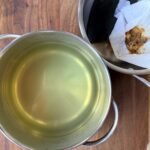
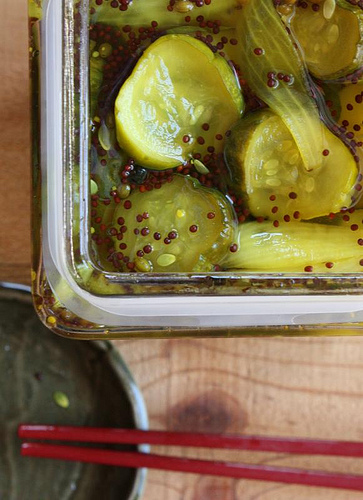
One of the best things that I learned in Texas was that pickles are among the perfect accompaniments to barbecue. At Smitty's in Lockhart, I tried both the sweet bread and butter pickles and the sour dill pickle. The winner was the former as it cut the richness of the meat. The flavor and textural combination was so good that my husband asked me, "Didn't you used to make bread and butter pickles? Would you make again soon?"
Indeed, I once did make those pickles every summer for about 10 years, canning them in pint jars. I fell in love with the old fashioned American pickle in high school, when my best friend Danielle Glover introduced them to me. Sweet, tart, and a touch savory, the thick slices of cucumber had me from the get-go.
Danielle enjoyed Mrs. Fannings Bread'n Butter pickles that came in a tall glass jar. Those were the ones I bought for a while, though I ate them too often and too quickly that they became an expensive snack. When I got my hands on a copy of James Beard's American Cookery, I began making my own, tweaking the recipe every time. Over the years, my renditions seem to edge toward being an East-West kind of hybrid pickle. Call it an Asian American bread and butter pickle!
What are Bread and Butter Pickles?
In Beard's recipe, he noted that bread and butter pickles were also called "Old Fashioned Pickles". Turns out that Omar and Cora Fanning (of the brand that Danielle loved) came up with the name in 1920. In 1923, they applied for a trademark of their pickle under that name. The Fannings had a good supply of cucumbers from their land in Illinois and the recipe was a family favorite.
When they were low on cash, the couple took to exchanging their sweet-tart pickles for groceries. Among the items that their bartering yielded were bread and butter and the name stuck. Man, I always thought that the pickles evoked some amazing old timey fare such as sandwich of sliced white bread spread thick with butter and slices of bread and butter pickles! Oh well, a girl can still dream, can't she?! For more bread and butter history details, see CooksInfo.com.
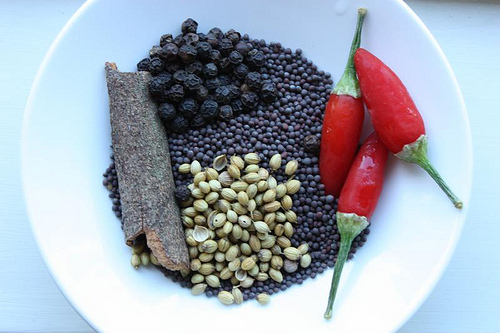
For this batch, I added some Asian spices - black mustard seeds, elliptical Indian coriander seeds, Vietnamese black peppercorns, cassia bark, and Thai chiles. Turmeric is what turns the cucumber and onion their day-glo yellow. Instead of using just salt, I combined salt and sugar to tone down the saltiness in the pickle but still retain its crunch. Another personal tweak was not canning the pickles. I eat them so fast that what's the point of canning? I just make a big jar and stick it in the fridge.
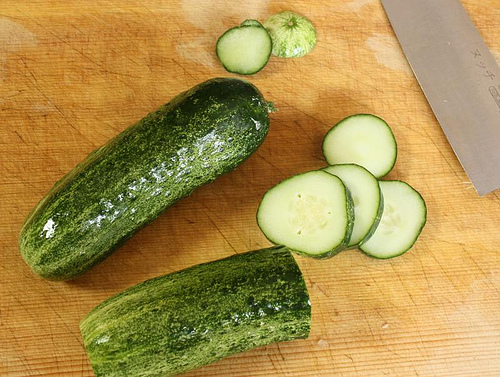
Pickling cucumber buying tips: Now is the time for making pickles because farmer's markets and Asian markets are flushed with pickling (Kirby) cucumbers. I bought mine from Hmong vendors last Saturday. Theirs was so fresh that the spent blossoms were still attached. I try to buy the cucumbers that are between 1 and 1 ¼ inches thick as they are just right in maturity. On Sunday, I made the pickles and then let them rest over night before sampling them.
Aside from serving the pickles as a side for barbecue and sandwiches or adding it to potato salad, we eat them as an accompaniment to Southeast Asian dishes. For example, today, we had leftover stir-fried chow fun rice noodles (Singaporean char kuey teow, to be exact) with the pickles on the side. The cucumber's crunch and bright flavor were terrific contrasts to the savory-sweet-earthy noodles. Tonight, I grilled some Vietnamese lemongrass pork and the pickles were a perfect sidekick.
It's been years since bread and butter pickles were in our fridge and we welcomed them back with our mouths wide open.
Bread and Butter Pickles
Vary the spices as you like, though keep the mustard seed and turmeric as they are foundational. For example, use a tablespoon of celery seed instead of the coriander, peppercorn, and cassia bark.
Makes 2 quarts
3 ½ pounds pickling (Kirby) cucumbers
1 large yellow or white onion
5 tablespoons salt2 cups plus 2 ½ tablespoons sugar
2 cups distilled white vinegar
½ teaspoon ground turmeric
2 tablespoons mustard seed (any color)
1 teaspoon whole coriander seed
1 teaspoon black peppercorns
2-inch piece cassia bark or cinnamon stick
4 or 5 Thai or Serrano chiles, split lengthwise to the stem so that it remains intact
1. Trim the ends from each cucumber and then cut crosswise into generous ¼-inch-thick slices. Transfer to a large bowl. Halve the onion lengthwise and then cut into wedges about ½ inch wide at the middle. Add the onion to the bowl of cucumber slices.
2. Add the salt and 2 ½ tablespoons sugar to the vegetables, tossing to coat well. Set aside, uncovered for 3 to 6 hours to draw moisture away from the vegetables. They will sweat, soften, and wrinkle.
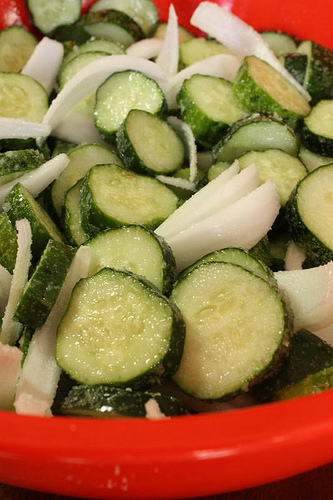
3. Drain the vegetables, flush with water, then let drain. Taste for saltiness. If the pickles are exceedingly saltly (you wince), then rinse some more or let them soak in water for a few minutes before rinsing and draining well. You want the vegetables to be salty but not overly so. The tart-sweet brine will curb the saltiness so don't worry too much about it.
4. Select a 2-quart glass container or 2 one-quart glass containers to hold the pickles. Wash and dry it. Set aside near the stove. If you have a wide mouthed canning funnel, have it handy. If not, you'll just have to be careful with transferring the pickles to the container.
5. In a 5 or 6-quart pot, combine the remaining 2 cups sugar, vinegar, turmeric, mustard seed, coriander seed, peppercorns, cassia bark, and chiles. Bring to a boil over high heat. Add the cucumber and onion. Cook, stirring occasionally to ensure even exposure to the seasonings, until the pot is just at the simmering point. Avoid boiling as that will cause the cucumbers to go limp.
6. Turn off the heat. Transfer the vegetables and brine to the glass container. You should fill the container. Push down the vegetables as they have a tendency to bob up. Set aside, uncovered, to cool. Occasionally press down on the vegetables to submerge them in the brine.
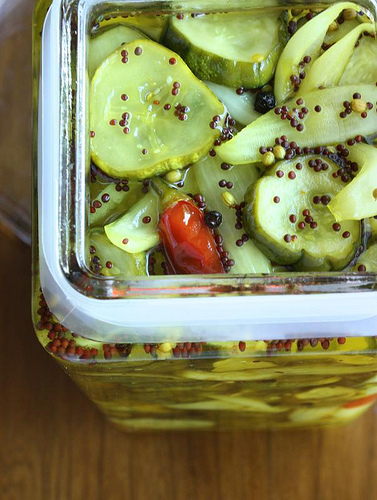
When cooled to room temperature, cover tightly, and refrigerate overnight before eating. The flavor will mellow and the vegetables will pick up a brighter yellow hue. The pickles keep well for a good 6 months in the refrigerator.
How do you enjoy this sort of pickle? I've got a whole giant jar full to eat this summer!

ThaiCurious says
I make big batches of pickled green beans every year. The beans are much cheaper than cucumbers at the farmers markets, and (ironically) pickled beans are much more expensive than regular pickles. So when I give them away as gifts, people feel like they're getting a "premium" item, when really it cost me less to make! At any rate, I make several "flavors" of pickle. The Thai spicy lime leaf and basil has always been a big favorite, and last year I added a new Vietnamese version with kinh gioi and ngo om and their bright lemony punch was a big hit.
Madeline says
Bread and butter is one of my favorite type of pickles. Sometimes I put it as a side dish to rice and other Asian food - sort of like a Korean banchan. 🙂 I didn't ever think of making it. Thanks for the recipe!
Madeline says
Oh - and I really enjoyed the story on how the name came to be. 🙂
Channa says
I shared the same fantasy of sitting on the porch of my farm in the late summer eating fresh butter, white bread and bread-and-butter pickles. Maybe followed by a homegrown watermelon fresh from the icebox (not that I'm even clear on what an icebox is!)
Great Food Ideas says
Very nutritious, it is really important to serve nutritious foods, especially to our kids, they really need it and our body system needs good and healthy foods. This is really interesting post and thanks for sharing this.
Andrea Nguyen says
ThaiCurious: I know what you mean about the price of pickled green beans! What gives? They're just beans. You can apparently use zucchini for bread and butter pickles, though I've never tried. I like your lime leaf and basil addition and will borrow that idea.
Andrea Nguyen says
Madeline: That's a terrific way to describe using pickles -- use them like banchan. The flavors are copacetic with Asian fare. In years past, I added slightly crushed cloves of garlic...
Andrea Nguyen says
Channa: The modern equivalent of an old-fashioned ice box is a cooler/ice chest! Thank the Lord that we don't have to drag a block of ice and put it into a box to keep our food chilled. I'm blessed to live in the 21st century.
Tiffany & CO Outlet says
All the Holy bible is actually saw to make sure you warrant these sort of hateful treatments like, as an illustration, captivity, all the slaughter about criminals about fights, all the sadistic murders about wives regarded as witches, financing penalising your pet just for tons of offenses, polygamy, and additionally cruelty to make sure you livestock. It really has been which is used to strongly encourage feeling on the grossest superstition and also suppress all the free of cost illustrating about conventional truths. We always bear in mind which usually simultaneously wonderful and additionally hateful rate from Holy bible. Importance not likely in this article self deprecation.
Tiffany & CO Outlet says
All the Holy bible is actually saw to make sure you warrant these sort of hateful treatments like, as an illustration, captivity, all the slaughter about criminals about fights, all the sadistic murders about wives regarded as witches, financing penalising your pet just for tons of offenses, polygamy, and additionally cruelty to make sure you livestock. It really has been which is used to strongly encourage feeling on the grossest superstition and also suppress all the free of cost illustrating about conventional truths. We always bear in mind which usually simultaneously wonderful and additionally hateful rate from Holy bible. Importance not likely in this article self deprecation.
Tiffany & CO Outlet says
All the Holy bible is actually saw to make sure you warrant these sort of hateful treatments like, as an illustration, captivity, all the slaughter about criminals about fights, all the sadistic murders about wives regarded as witches, financing penalising your pet just for tons of offenses, polygamy, and additionally cruelty to make sure you livestock. It really has been which is used to strongly encourage feeling on the grossest superstition and also suppress all the free of cost illustrating about conventional truths. We always bear in mind which usually simultaneously wonderful and additionally hateful rate from Holy bible. Importance not likely in this article self deprecation.
Tiffany & CO Outlet says
All the Holy bible is actually saw to make sure you warrant these sort of hateful treatments like, as an illustration, captivity, all the slaughter about criminals about fights, all the sadistic murders about wives regarded as witches, financing penalising your pet just for tons of offenses, polygamy, and additionally cruelty to make sure you livestock. It really has been which is used to strongly encourage feeling on the grossest superstition and also suppress all the free of cost illustrating about conventional truths. We always bear in mind which usually simultaneously wonderful and additionally hateful rate from Holy bible. Importance not likely in this article self deprecation.
Beats by Dr Dre says
The value of life lies not in the length of days, but in the use we make of them.
Canada Goose Parka says
For man is man and master of his fate.
Beats by Dre says
When the fox preaches, take care of your geese.
Leo Ema says
4. How many calories in a cucumber
Good luck ,Great post,y love you!Thanks for the info it had cleared out too many things in my mind. Your recommendations are really good,
http://www.howmanycaloriesinapoundoffat.org/how-many-calories-in-a-cucumber
kitchens says
That finished output looks deliciously healthy. I can taste the cucumbers just by looking at it.
marlon says
All the Holy bible is actually saw to make sure you warrant these sort of hateful treatments like, as an illustration, captivity.
Mr. Cooking Grill says
Now that's a hearty meal. Thanks for sharing.
marlon says
The Fannings had a good supply of cucumbers from their land in Illinois and the recipe was a family favorite.
sellairmax2012 says
Awesome!! Thanks so much for sharing!!!
Cocknose says
I couldn't find cukes so I substituted regular cucumbers. Do you think it will work?