
People love to talk about 1970s fashion, music, and décor but few savor the flavors of the disco era. A few weeks ago, I spent 24 hours cooking from and perusing James Beard's American Cookery, originally published in 1972 and recently re-released with a foreword by Tom Colicchio. The classic cookbook is among my favorites, full of no-nonsense instructions, history, wisdom, and wit. Whenever I open the book, I learn something new.
On this last occasion, I was curious about Beard's coverage of Asian recipes and ingredients. He was into recording and expanding the diversity of the American table. American Cookery contained a handful of curry (ied) dishes but they were "mild as May" as Beard described Fanny Farmer's 'early version of lamb curry' on page 390.
What was identifiably Asian was indexed as Chinese. Beard was raised on the food of a cantankerous Chinese cook named Let, who was deft in both Eastern and Western fare. Regarding "Mrs. Rorer's Chinese Lamb," Beard wrote: "Mrs. Rorer probably calls this Chinese lamb because someone's Chinese cook prepared it…Otherwise it has little relation to Chinese cookery." Fanny Farmer and Mrs. Rorer were icon figures in American cooking. Beard's tepid comments were balanced with encouragement to try new things.
For example, Chinese cabbage (Napa cabbage) along with arugula, corn salad (lamb's lettuce, mache) and iceberg lettuce were all potential salad greens. Cooks should treat "Snow Peas, Mangetout, or Chinese Peas" like other peas but not shell them; keep them crisp and serve them with butter or toasted almonds or peanuts. In the Chinese almond cookie recipe, Beard informed readers that they'd been a favorite West Coast sweet for nearly 100 years, as if to say, "Try them out!"
Understanding Egg Foo Yung
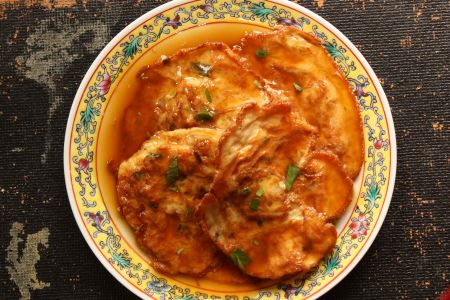
What caught my attention was the "eggs [SIC] foo yung" recipe. I had never eaten that dish before because most versions are large flat omelets smothered by thick brown sauce. But upon reading Beard's egg foo yung recipe (page 110), I realized that it was originally made as small fried egg pancakes with slightly crisp, frilled edges. I grew up on a Vietnamese rendition called trung chien tom (egg, shrimp, and scallion pancakes) and ate it with fish sauce. (There's a recipe for it in Into the Vietnamese Kitchen.)
Beard explained that egg foo yung was a Chinese dish that had been "pretty thoroughly Americanized." Chinese chefs cooking for logging camps and railroad gangs during the 19th and early 20th centuries were likely responsible for introducing egg foo yung to America.
I tried Beard's recipe, doubling the bean sprouts as he was likely using canned stuff. The egg pancakes were terrific tasting and held together well with Beard's unusual technique of cooking the vegetables and seafood first with flour.
The sauce, however, was just like the stuff I saw at the restaurants. It was serviceable but not great. Beard must have used very mild soy sauce as he called for ½ cup; I only used 2 tablespoons. At the end of the recipe, he suggested varying the protein and seasonings, as if to hedge his bets on the recipe's outcome.
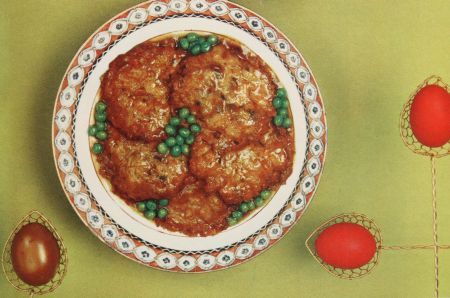 This is a photo of Time Life's photo of their version of egg foo yung.
When Beard wrote American Cookery, there were plenty of egg foo yung recipes around. Between Time Life's The Cooking of China (1968), Jim Lee's Chinese Cookbook (Harper and Row, 1968), and An Encyclopedia of Chinese Food and Cooking (Crown, 1970), I counted thirteen (13). Some were sauced while others not.
Denver (Western) Omelet or Sandwich
Beard's recipe stood out because he took a multicultural stance, saying that egg foo yung may have inspired the Western (Denver) omelet or sandwich. Sliding fried eggs between bread slices wasn't too farfetched for Chinese cooks trying to hastily feed hungry workers.
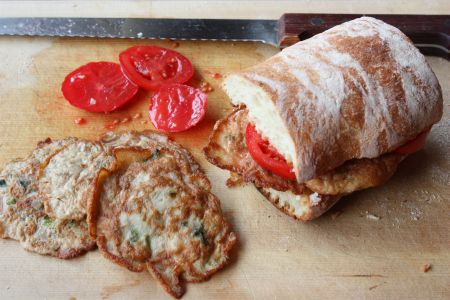
When I used the leftover egg foo yung (without sauce) to make a Western (Denver) sandwich, I followed Beard's suggestions on page 109 and took liberties with the recipe, lavishly spreading mayonnaise instead of butter on the toasted bread. It was super tasty.
Later that week, I met two retired anthropologists from Michigan. They recounted how in 1970, when they'd moved from the Bay Area to the Midwest, they were greatly disappointed at the Chinese restaurants. It was mostly egg foo yung, they said, adding that the eggs were sometimes oddly served with bread. It still goes on somewhere in the South, they told me.
It turns out that when a sandwich features a Denver omelet, it's called a Denver or Western sandwich. But when egg foo yung is between the slices of white bread, the concoction is a St. Paul Sandwich. It is not related to Minnesota. In American Gastronomy, culinary historian Evan Jones wrote that the original Denver/Western sandwich likely contained egg foo yung. The sandwich's origin remains murky but you can order it at Chinese-American chop suey-type restaurants in the St. Louis, Missouri, area.
Making these sorts of discoveries is why I love American Cookery. Beard knew America and his readership well. Nearly forty years later, his prescient work still leads us on amazing culinary journeys.
If you don't own a copy of American Cookery, add it to your collection! If you have it already , what were your experiences like? Or perhaps you'd care to share your experience with eating Asian food in the 1970s?!
- Egg foo yung recipe
- St. Paul sandwich (egg foo yung sandwich) recipe

Shuku says
Well. In the 1970s, I was around 5-6 years old and given I was living -in- Asia at the time, maybe this doesn't count! I did eat egg foo yung - in fact, in Cantonese we have called it 'foo yoong dan' for as long as I can remember. It's basically small fried omelettes, much like pancakes, but with different sorts of fillings and definitely no sauce. Common fillings included just onions, or onions and meat, and a great many also included prawns as well. The ones I -hated- were those that had sliced up long beans in them - yet another common filling which I refused to eat and still won't!
Given I lived in Malaysia at the time, a lot of our food was fusion - Malay, Indian and Chinese food, and the Straits Chinese Baba-Nyonya cuisine. I can tell where the fusion comes in now, but back then, I just ate it. Capati, thosai, murtabak, mee goreng, rojak, rice porridge...those were my eating experiences growing up in those early 1970 days and they haven't changed much all the way til today either.
Mzungu says
Sometimes it's good to go all retro .......
Susan says
In the '70's I worked at my boyfriend's stepfather chinese restaurant in NJ. Fortunately I learned a few interesting tidbits on how chinese restaurants processed ingredients into their yummy finished products.
I've always considered Egg Foo Young as my comfort food and I am always seeking a restaurant that makes it to my standard. All food, regardless of its ethnicity is to taste. I seek the taste, the flavor, the smell that gives me the comfortable "Ah" feeling when it's found amd this means that it was fried in rendered pork fat. Every Tuesday the meat was delived to the restaurant. The large pieces of pork, which included the ribs, etc., were butchered for bbq marinade and smoking. All the fat trimmings were rendered for use in cooking dishes and frying oil.
I loved frying up the foo young. I'd grab a pot, crack a couple eggs in, add mong bean sprouts, chopped onion, scallions and chopped bbq smoked pork. Stir it all up and slowly lower big spoonfuls of the mixture in the hot fat. After they cook you have to squeeze the fat out. Then cover with gravy. Serve with white rice. Yum!
The only way to kill my comfort moment is to make the gravy with 5-spice in it. I hate 5-spice!
Diane says
Sadly, my mom made waaaaaay too much egg foo young in the 1970's and I got really sick of it. I still don't care for it, but maybe I should give it another try and attempt to eat it with fresh expectations.
Andrea Nguyen says
Shuku -- Thanks so much for sharing your experiences. Long beans?!
OMG -- Chinese five-spice in the gravy is a bit much, Susan.
Diane -- Give it a try. I just posted a recipe to follow-up on this post. I bet you can put a new 21st century spin on the ol' EFY!
Andrea Nguyen says
Expanding egg foo yung to other parts of the world, Robyn in New Zealand emailed this comment:
In the early 70s take away Chinese involved taking a pot or two from our student flat's kitchen down to the Hong Kong restaurant and they would fill them up for us to take home. Egg Fuu Young (NZ version!)
with rice was a popular choice of my flatmates.
In those days when you arrived at a Chinese restaurant, along with the menu, they would bring a plate piled high with buttered spongy white
sandwich bread (people refer to this nostalgically these days). We liked to ask if they could prepare something not on the menu, something the staff liked to eat. They always responded generously
with delicious food. Now I shamefully think what an imposition!
Little did I know then that I would spend so many years living in Asia or how easy it would be now to eat authentic food from many Asian countries here or that Asian ingredients would be so widely available.
I like to make Kani Tama (かに玉ーcrab egg) a Japanese version of Egg Foo Yung, served over rice it becomes 天津飯, Tenshinhan (Japanese-Chinese food)。Generalising, in western Japan it is served
with a soy based sauce, but in eastern Japan they use ketchup. (there are shrimp, mince etc versions too)
http://ja.wikipedia.org/wiki/天津飯
Shuku says
Andrea, I think they're called french beans and snake beans. The varieties are different, but I don't eat either of 'em; perhaps I got overdosed as a child! It is still a very common practice to slice french beans or snake beans into egg foo yung (or fried rice). Needless to say, I won't touch them!
Robyn says
Every Sunday in our house was pizza, Chinese, or pancakes for dinner, the first two take-out. If it was Chinese my mother never failed to order egg foo yung, and she ate it all herself. I refused to try it because of the gross, glossy brown gravy. She grew up in southern CA and says she fell in love with it there.
My mom cooked extensively from JB, and I still have her original copy (held together with duct tape), which she gave me when I got my first apartment (and kitchen) in college.
The first meal I ever made for Dave came partly from that book -- a fruit chutney to go with a chicken curry from a recipe my 'sophisticated' NYC-dwelling sister gave me (used generic curry powder). He says he married me partly because that bowled him over, to have a girl actually make chutney for him. He thought it only came from a jar.
In Malaysia egg foo yung is a sort of omelet. It's folded over and relatively 'dry', not very oily. It might have bean sprouts and whatever protein in it. Doesn't come with a sauce other than the usual soy sauce with chopped chilies in it.
Andrea Nguyen says
Robyn: Man, we have to get you a new copy of JB but it won't compare with the duct tape on the one your mom gifted you.
The other night I made "Brown Fricassee" from JB and it was thrillingly good, in an old fashioned way. He had you put nutmeg in the sauce. There are no pictures in JB's book so you learn to imagine flavors and textures. More importantly, to cook by instinct.
Sjwoodin says
I've had this cookbook since it first came out, and it's still on my short list of "go-to" cookbooks. Beard knew his America. His comments are illuminating, and the recipes themselves are as close to fool-proof as I've seen.
Andrea Nguyen says
Swoodin: You're my kind of cook. Long live JB!
shop taobao china says
oh I liked your post
London escorts says
These all are good to sharing with us. In all these there are so many things which is great to know about it. All these receipes are really very wonderful.
Ugg Joslyn Boots says
Can someone please stone Yasmin Alibhai-Brown to death? I shan't tell Amnesty if you don't. It would be a blessing, really.
Replica Christian Louboutin Shoes says
The happiest is the person who suffers the least pain; the most miserable who enjoys the least pleasure!
Steve from St. Louis says
The author says about St. Paul sandwiches, "you can order it at Chinese-American chop suey-type restaurants in the St. Louis, Missouri, area". I live in the St. Louis, Missouri area, and sure enough, they are still made in the local Chinese eateries, but not all of them. My wife and I had a couple of these sandwiches last night -- they were made as described, and they are tasty as described.
Cheap Jordans says
It calls for love, joy, optimism, confidence, serenity, poise, faith, courage, cheerfulness, imagination, initiative, tolerance, honesty, humility, patience, and enthusiasm!
Coach Bags Outlet says
It's a code word we use to positively identify you in case you lose your passbook or there is some other need for positive identification .
Cheap Coach Bags says
The report says a major goal for kindergarten through eighth grade should be understanding fractions!
ClubPenguinCheats says
The varieties are different, but I don't eat either of 'em; perhaps I got overdosed as a child!
Canada Goose Danmark says
But his sober assurance was arresting.
Beats by Dr Dre says
You will have it if it belongs to you,whereas you don't kvetch for it if it doesn't appear in your life.
Beats by dr dre says
The great difficulty in education is to get experience out of ideas.
marlon says
Beard explained that egg foo yung was a Chinese dish that had been “pretty thoroughly Americanized.”
steve hill says
I love egg fu young . im not Chinese but have alwayw eaten Chinese food . an early memory is of eating food from a downtown st paul [ minn} restaurant called the mei chu . ithink that's how it was spelled , there were not all that many restrs in the twin cities then {1960s} it seemed like .I remember my sister and I always ate the white chicken in foil and the white rice . I think these were likely steamed items . the flavors were unique and I remember them fondly to this day . steamed rice is better than boiled any day . egg fu which I have eaten all my adult life is the best thing you can eat , the inside of the patty looks like curtains and looks boiled I guess , ive cooked various quisenes and have tried to cook egg fu young it turns out ok . some restuarants include peanut butter in the gravy wich is ok but I prefer just the brown gravy ect ect , also some pattys are flat and some are thick, do you suppose they use there dippers for a sort of mold diping in the hot oil then in the egg mixture then back ibto the boiling oil or fat to form the thicker patties ,worth trying . I can make a doppelganger pad thai and also the sort of stews are easy to get right like chiken ding ,chop sui . ect