


One of the questions that renowned Japanese food expert and author Elizabeth Andoh asked me when I visited her in Tokyo last month was this: "Have you ever made my soy sauce concentrate? Come on, tell me the truth."
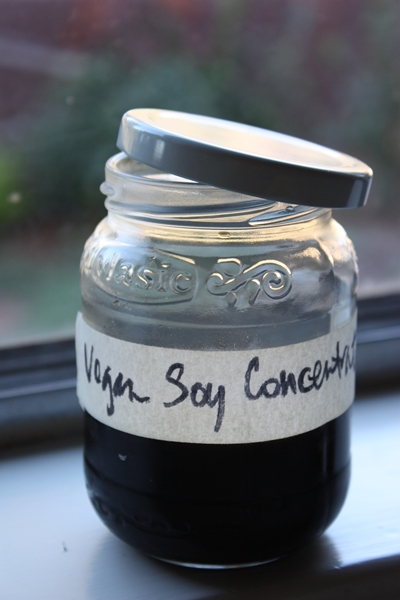
Yikes, talk about putting someone on the spot. And there I was, a guest in her home. I truthfully responded that I'd never made it from her earlier book, award-winning Washoku, though I had studied the recipe several times. Elizabeth, the consummate teacher and provocateur, pulled out a couple of small bottles of inky, slightly syrupy sauces from her fridge. One contained dried fish and the other was vegan, she explained.
She had me taste both. Wow. I was sold. The soy concentrates, brewed at home, were savory sweet and delectable. I wanted to lick the spoon but stopped short of acting improperly.
The concentrates were addictively good, thanks to a fair amount of umami in the liquid. Japanese cuisine is much about laying an umami foundation. For the concentrates, glutamate-rich ingredients such as dried kelp, fish, and shiitake mushroom are used. They're rehydrated and then simmered with soy sauce and other ingredients to create flavor bomb.
I like both versions that Elizabeth had me taste in Tokyo, but the vegan version published her new cookbook, Kansha, is easy to prepare from ingredients available at specialty markets or health food stores. I now keep the seasoned soy concentrate in my fridge to add instant flavor boosts to marinades or cook foods. You can use it as a finishing or dipping sauce.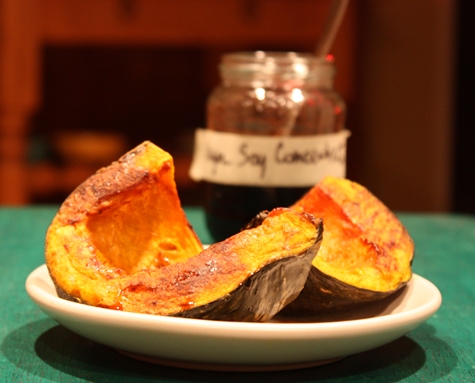
In fact, the Japanese seasoned soy concentrate works like magic to make food super tasty. For example, last week, I hacked up a kabocha squash, rubbed oil all over the flesh and roasted the pieces, cut side down, at 400F for about 45 minutes, until it was soft and cooked through. I served it with a heavy drizzle of the soy concentrate. A great autumnal vegetable side. I ate half of the squash.
It's so cool that you can brew your own soy sauce. Today, I'm wonderinfg if this Japanese seasoned soy sauce can be used for a vegetarian 'nuoc mam'? We've discussed and ruled out commercially made veggie fish sauce so maybe this may be the ticket? I'm going back into the kitchen to tinker.
RECIPE
Japanese Seasoned Soy Concentrate
Shojin Tsuyu No Moto
The recipe below was adapted from Kansha, a term that means appreciation in Japanese. It denotes a resourceful and clever approach to cooking. That is, respect and make the most of what you have. (If you want to learn more, check out the online Kansha Cooking workshop.)
To that end, when making this soy concentrate, feel free to use regular dried kelp that you'd use for dashi. Once you get the hang of it, step up to a high-glutamate variety, such as ma kombu, available at Japanese markets. As Elizabeth also suggests, you can even use old soy sauce (Japanese shoyu) that's been sitting around and gotten super salty! The point to Kansha is: Don't throw stuff away so easily. Repurpose it well.
Makes about ¼ cup
Ingredients
12 square inches dried kelp (kombu)
4 or 5 stems dried shiitake mushrooms, or 1 large dried shiitake mushroom
⅓ to ½ cup Japanese soy sauce (shoyu)
2 ½ to 3 tablespoons sugar
1 ½ to 2 tablespoons sake
1 tablespoon mirin or maple syrup (optional)
Method
1. Put the kombu, mushroom stems, and soy sauce in a small deep saucepan. Cover and let stand at room temperature for at least 1 hour or up to 12 hours.
2. Add the sugar and sake to the pan and place over low heat. Cook, stirring occasionally, until the liquid begins simmering. Taste, and if very salty, add the mirin to mellow the flavor. Adjust the heat to maintain a slow, steady simmer. Expect the sauce to foam.
Simmer for 3 to 4 minutes, or until reduced by nearly half, and the sauce has become a bit syrupy. Remove from the heat and let the sauce cool naturally to room temperature.
3. Pour the cooled concentrate into a small glass jar, leaving the kombu and mushroom stems behind. Cap the jar tightly and refrigerate for up to 1 month.
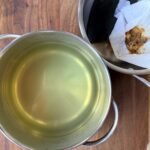
Note: To recycle the kombu and mushroom, add 2 to 3 cups of cold water to the pan. Let it all soak in for 10 minutes, then simmer for 10 to 30 minutes to produce a stock for soup, etc. Strain and discard the solids.
From: Kansha: Celebrating Japan's Vegan and Vegetarian Traditions by Elizabeth Andoh (Ten Speed Press, 2010)

Serge Lescouarnec says
Had the pleasure to interview Elizabeth Andoh on Monday.
Published the results as 'A Kansha Kitchen Conversation with Elizabeth Andoh, Using Vegetables from Head to Toe' on 'Serge the Concierge', October 27.
Here is the link
http://www.sergetheconcierge.com/2010/10/grateful-and-mindful-getting-a-kansha-education-with-elizabeth-andoh.html
Serge
Alisa says
Now this is something I must try! I have to admit, sake is one of those ingredients that makes me shy away from good Asian recipes. We don't purchase alcohol for the home and I really have no experience in what to buy to cook with. Is there a type of sake you recommend using for cooking? Can you use a less expensive version (kind of like cooking wine vs drinking wine)? Any advice would be great to help me get over this mental block. Thanks!
Shuku says
I came across your blog when I was trying to figure out what on earth com was, having seen it in Hanoi when I was there last week. This is a wonderful resource! It's the reason why I am now the proud owner of a large bottle of genuine Phu Quoc fish sauce that I hauled back in my luggage, and a precious pack of Com Vong. Thank you so much for sharing your knowledge; I'm really enjoying going through older posts.
Canadian Drugs Online says
Here all these things are really very wonderful in all these there are so many things which is great to know about it. It is one of the wonderful resource these all are great to know about it.
Air Jordans says
EO EO EO EO.....I WANT THE SWEET LOVE.....
vegan in seattle says
I just stumbled upon your site looking for a vegan soy concentrate recipe. I have her "non-vegan" edition. Thank you sooo much for posting and all the other helpful info!
cheap supra shoes says
At 9 or 10 on the scale, the anger has led to major problems/crime. Maybe they are in prison for some crime committed during an outburst of anger. They may need major deliverance from an obvious demonic problem.
Beats by Dr Dre says
It is no use doing what you like ; you have got to like what you do.
lacleMelp says
qVo dallas cowboys jerseys uDh http://uggboots1217.sosblogs.com/ugg-boots-b1/green-bay-packers-jerseys-b1-p3.htm
Berbedgecib says
PFLLSABQAJ canada goose trillium parka LBTIYDTXFH http://hunterbauer615.insanejournal.com/381.html
marlon says
Now this is something I must try! I have to admit, sake is one of those ingredients that makes me shy away from good Asian recipes. We don't purchase alcohol for the home and I really have no experience in what to buy to cook with.
Harriet says
I've been using a lot of Ume Vinegar (fermented plum) and love the finish it gives to almost everything...then discovered it has 1050mg sodium per tsp. I'm supposed to limit my salt. (The brand I used to get at the supermarket didn't list the sodium content. Eden does.)
Although it's specifically called *soy* concentrate, perhaps I'll try this with Bragg Liquid Aminos, 320mg sodium per tsp. instead of Shoyu. Might be disastrous, but I'm desperate.