
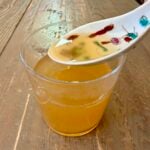
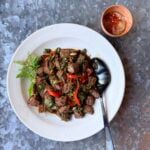
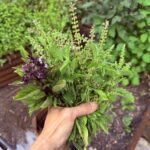

[Note to reader: I'm traveling but have been wanted to post this recipe. I thought I had a photo of this chicken and rice soup but cannot find it for the life of me! So imagine, if you will, a rice bowl filled with hot, velvety white soup, garnished with whisps of cilantro and a few scallion rings. On the side is a plate of poached chicken with a small dipping sauce dish filled with zesty ginger-lime dipping sauce. That's what I would have presented to you. Perhaps these words will feed your senses?]
Despite the calendar saying that it's spring, I'm feeling like we're the shoulder season between winter and spring. The air is lightly brisk and I find myself grabbing a light sweater to keep warm. One of the foods that comfort me in this kind of weather is cháo, Vietnam's version of simple rice soup. In other parts of Asia, this kind of soup can be called jook, juk, and congee. I've often seen it described in English as porridge - as if it's only for the old and infirm. Surely, cháo is a great panacea for all kinds of ills, particularly tummy aches and hangovers, I've found, but I also love it when I'm healthy! In fact, cháo rice soup is all-weather fare, and can be enjoyed at all times of the day. In hot, humid climates like that of Saigon (in the 90s these days), I'd eat this kind of congee in the morning, when it's cooler, as I would pho noodle soup.
All cháo is rice and water or stock simmered until the rice grains release their starches so that the liquid becomes thick and creamy. The finished texture is not pasty, mind you. It's quite elegant, though made from a handful of humble, homey ingredients. There are many approaches to cooking up congee in Asia, and people have told me that they've used medium grain rice, broken jasmine rice, and regular long grain rice. I've sometimes thrown leftover cooked rice into a pot of water for a 'shortcut' version. The message here is this: use what you've got.
There are a number of versions of cháo gà (pronounced "chow gah") in the Vietnamese repertoire. You can just cook up the soup and add a flavorful stirfried chicken mixture at the end. That's what I typically make at home. There's also a more complex version, what you'd get at a market stand or joint specializing in cháo. The idea is that you cut up a whole fresh chicken and simmer it for the stock. The solids are strained out and you add rice and cook further until the rice breaks down. The chicken is cut up and served as a side to the soup, with a bracing ginger lime dipping sauce. You dip some chicken into the sauce and eat the rice soup. The rice, chicken, and dip concept is sort of a soupy relative of Hainan chicken and rice, no?
Below is a recipe for the fanciful version of cháo gà. However, to save time, I use homemade stock I have in the freezer and chicken legs as their meat is rich and succulent. In a pinch, you can opt for a shortcut chicken stock, if you like. Or, you could use a couple of duck legs and/or duck stock.
RECIPE
Chicken and Rice Soup with Ginger Dipping Sauce
Cháo Gà
Makes about 8 cups, to serve 4 as a light lunch or 6 with 2 or 3 other dishes
¾ cup long-grain rice
2 scallions
10 cups chicken stock, homemade or shortcut version
4 quarter-sized slices unpeeled fresh ginger
2 chicken leg quarters
Salt
Chopped cilantro or rau ram (Vietnamese coriander), for garnish
⅔ cup Ginger Lime Dipping Sauce (Nuoc Mam Gung)
1. Put the rice in a heavy-bottomed 4-quart saucepan and add enough water to cover by 1 inch. Stir the rice with your hand 8 to 10 times around and then let the rice settle. Carefully pour out the milky water. Repeat this rinsing but without stirring the rice. These two rinsings remove some of the starch from the rice.
2. Remove the white and pale green part from the scallions and set aside. Cut the green part into thin rings and set aside.
3. Add the scallion white parts, stock, ginger, and chicken to the pot containing the rice. Bring to a boil over high heat. Lower the heat to a vigorous simmer, and then cover partially. To loosen but not lose its starch, the rice should bounce in the bubbling water without the water boiling over the pan sides. Let the soup cook for 5 minutes. Stir the rice to make sure none has stuck to the bottom and lower the heat to a gentle simmer.
4. Re-cover partially and continue cooking for 1 hour. After 15 minutes, the chicken should be done (poke it with a knife tip to test). Remove the chicken from the pot and put into a bowl of ice water. Leave for a few minutes, drain, and set aside to cool.
The soup is done with the soup is thick, creamy white, and there is only a little separation between the rice and liquid. If you stir the soup, the rice should be suspended in the liquid.
5. Discard the ginger and scallion. Taste and add salt as necessary; the amount will depend on what liquid you used to make the soup. You can make the soup several days in advance and reheat it over medium heat with the chicken and a bit of extra water to prevent scorching.
6. To serve, cut the chicken into bite size pieces, keeping the skin intact, if you like. Place on a plate. Ladle the soup into bowls, garnish with cilantro and scallion rings, and serve the chicken on the side with the ginger lime dipping dipping sauce. To eat, dip the chicken into the sauce and then eat with some soup.
Kimberlea says
This sounds so good! Especially for the dreary weather in Seattle right now. I think I'll make some tonight. It is so true that it's the cure all for everything...at the first sight of a cold, my mom would make this, but add tons of shallots and beat an egg into the boiling chao to "break the cold".
Btw Andrea, I love your website! I discovered after getting your cookbook for a Christmas present. Can't wait to get the Asian Dumplings book.
Andrea Nguyen says
Hi Kimberlea, thanks for the awfully kind words. Yes, this is the time for a warm bowl of chao rice soup. It's satisfying but light so you don't feel weighed down. Enjoy!
Andrea
Dennis M Reed says
The "short cut" version of chicken stock links to the herbs page???
Andrea Nguyen says
Fixed Dennis!
Joel says
It sounds almost identical to the Chinese relative chicken congee hehe. Cantonese styles have several varieties: most of the home style congees soup involve the chicken, with bones, chopped into pieces and thrown into the pot for the cooking. Chopsticks must be handy alongside spoons as the utensils because you will have to pick the chicken pieces and chew the bones.
The more elaborate ones served in the congee shops or restaurants will be a bit similar to the one described by Andrea, except that when the chicken is removed from the pot, the cook will bone the chicken, and cut or tear the meat and skin into long strips, which are then thrown back into the congee to boil then served.
Chicken congees served in Eastern China (primarily around Shanghai and Zhejiang province) is almost identical to chao ga, except the chicken is served with a soy sauce and sesame oil dip instead of nuoc mam gung. Sesame oil is brushed onto the chicken skin after cooled by cold water and before it is carved, which I'm not sure of the rationale behind this.
Alice says
I've got a bad cold right now (which I've generously given to my husband) and this sounds so good! Thanks for the recipe (and all the other ones!), I will try to make it tomorrow.
Andrea Nguyen says
Hope you feel better!
coach suitcase says
These are the days in which it takes two salaries for each home,but divorces increase; these are times of finer houses,but more broken homes; why?
Nike Sb Blazer Low says
I think I would throw some coconut in there as well. Have you ever tried melting all the white chocolate first and then whisking in the matcha, pour and cool
Our store offers you all kinds of favourite products like Nike Sb Blazer Low
nike shox NZ says
Write your blog is very good! You are willing to share with me your experience it? Very proud to see this article ah
chanel bags says
Carl Corey awakes in a medical clinic, with little to no knowledge of who he is or how he got there.
buy from taobao says
oh I liked your post
Nike 6.0 says
One thorn of experience is worth a whole wilderness of warning. him
Christian Louboutin shoes says
Difficult circumstances serve as a textbook of life for people.
Monster Beats sale says
From small beginnings comes great things.
beijing opera show says
Always good to come across a really thoughtful site,LIKE YOUR BLOG. LOVE LOVE LOVE IT!
Beats by Dre says
Never embark on what comes after without having mastered what goes before.
marlon says
Difficult circumstances serve as a textbook of life for people.
Helen Nguyen says
Hi Andrea,
What is a good brand of long grain rice I can use?
Thanks