

April 2020: I just updated information on how to make Vietnamese caramel sauce by making a recipe video! Check it out on this post. I hope it facilitates your Viet cooking journey.
If you're going to delve deeply into cooking Vietnamese food, get over your fear of heat and make some caramel sauce! It's not as difficult as you may think. Just get some sugar, water and a saucepan. Once you've mastered it, it will quickly become your stealth ingredient. All you're doing is nearly burning sugar.
Caramel sauce (nuoc mau, pronounced "nook mao") is one of the cornerstones of Vietnamese cooking. It's primarily used in kho dishes to simmer savory foods such as whole fish, pork, shrimp, chicken, eggs and tofu -- homey foods that are the soul of Vietnamese cooking. The color and flavor of caramel sauce are transformative, making food not only look beautifully amber but also delectable.
The term nuoc mau was originally coined in South Vietnam. People in North Vietnam called the same ingredient nuoc hang ("nook hahng"), literally translated as 'merchandising water', probably because it was so often used by food hawkers to enhance the appearance of their wares. Think of how molasses add to the flavor of barbecued foods.
The traditional method of making this sauce requires you to add boiling water to the caramelized sugar, which starts a dramatic reaction that's not for the faint of heart. The point of doing this is to arrest the cooking process so that the sugar doesn't burn to a bitter black stage. I find it easier to place the pan bottom into a sink filled with water and then adding the remaining water to dilute the sugar. The result of both approaches is the same bittersweet inky sauce that's a staple in every Vietnamese kitchen.
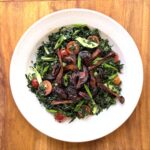
Use caramel sauce for Viet kho dishes, or as a little cheat in your marinades for foods that will go on the grill so that they color nicely. Don't put it on ice cream or other desserts. Its sweet, dark coffee flavor will taste yucky bad. Finally, select a light-colored saucepan to monitor the caramelization, and make sure it's clean.
Resist buying the heinous tasting pre-fab caramel sauce at the Vietnamese market that's labeled "coconut thin sauce". You're better off doing it yourself! The photos below are for encouragement.
Makes 1 cup
1 cup sugar
¼ cup plus ½ cup water
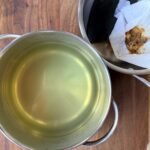
Fill the sink with enough water to come halfway up the side of a 1-quart,
heavy-bottomed saucepan. Place the sugar and ¼ cup of the water into the saucepan and cook over medium-low heat. Stir until the sugar dissolves, about 2 to 3 minutes.
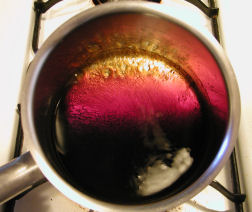
As the sugar melts, the mixture will go from opaque to clear. Small bubbles will form at the edge and gradually grow larger, moving toward the center of the pan. Eventually, bubbles will cover the entire surface. After about 15 minutes, the sugar will begin to caramelize and turn in color. You'll see a progression from champagne yellow to light tea to dark tea.
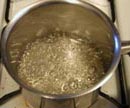
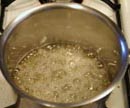
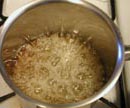
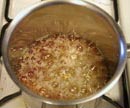
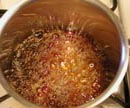
When smoke starts rising, remove the saucepan from the heat and slowly swirl it around. Watch the sugar closely as it will turn darker by the second; a reddish cast will set in (think the color of a big and bold red wine) as the bubbles become a lovely burnt orange. Pay attention to the color of the caramel underneath the bubbles. When the caramel color is that of black coffee or molasses, place the pan in the sink to stop the cooking process. The hot pan bottom will sizzle upon contact and the bubble action will subside.
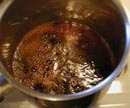
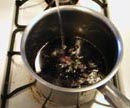
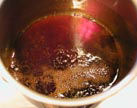
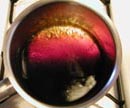
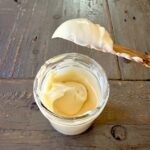
Add the remaining ½ cup of water (there may be a small dramatic reaction) and place the saucepan back on the stove over medium heat, stirring until the caramel has dissolved into the water. The result will be slightly viscous; flavor-wise, it will be bittersweet. Pour the caramel sauce into a small glass jar and let it cool; it will thicken further. Store indefinitely in your kitchen cupboard.
Recipe from: Into the Vietnamese Kitchen: Treasured Foodways, Modern Flavors (Ten Speed Press, 2006) by Andrea Nguyen.
Related recipe:
Michelle says
Cool! Thanks for the detailed photo breakdown of how to make this.
Kevin says
I'm a huge fan, as previously mentioned, and I really appreciate the photos. I actually posted about it last week! http://kevinkossowan.blogspot.com/2007/09/did-it-again.html
steamy kitchen says
I was all set to make the caramel sauce...and then realized I STILL HAVE NOT BOUGHT SUGAR. Ran out last week.
Can I use palm sugar or the rock sugar?
Andrea Nguyen says
I've never tried it with palm sugar but it should work as long as there aren't any impurities in the sugar. Export-quality palm sugar is pretty high quality. Try melting a big hunk of it with water and then see what happens. As for rock sugar, I'm not sure how that would work. There's molasses in it. But it wouldn't harm to try. I'd shoot for 25% more than what the recipe calls for because rock sugar isn't as sweet as regular white sugar. I've used raw can sugar and it was just fine. That's why
Anonymous says
Hey, thanks Kevin for the posting!
Steamy Kitchen says
btw, I just read your article in the latest Saveur. You write so beautifully and elegantly, really capturing the spirit, hardwork and the humbleness of the family.
xoxo
jaden
Andrea Nguyen says
Thanks Jaden. The avocado feature was fun and lots of research, but the Hmong farmer story is one that I've wanted to write for years. The Xiongs were exceptional in many ways.
Anh says
This is cool! I will link to this post when I post any nuoc mau/nuoc hang related recipe from now on. For a non-Vietnamese cook, this process can be daunting you see? 🙂
Pikky says
It looks so easy to make and we can't miss this caramel sauce in any of the Tet simmer dish..!!
Thank you
Pikky says
How long can we keep if we couldn't finish it?
Can we put in the fridge of the remain?
Thank you
Andrea Nguyen says
Pikky,
Yep, just give it a whirl. It's just sugar and water. You can keep the caramel sauce in the cupboard indefinitely. I have a jar that I just keep replenishing over time. I've never refrigerated it, and it's has never gone bad. However, you certainly can put it in the fridge.
Andrea
Tam says
My mom usually adds dark soy sauce. The thick stuff that's comes in a jar to her nuoc mau to make it have a more complex sweet taste
Andrea Nguyen says
Tam, like Indonesian kecap manis? That's a good idea. Usually, I mix a some sugar in with the nuoc mau, along with nuoc mam fish sauce. The quantity of sugar depends on what the dish is that I'm going to simmer.
Your mom has taken an extra step to cut down her work later on!
Dotty says
Aii! I am a very expeerienced cook but had nothing but trouble with this caramel sauce - I attribute it to the fact I was cooking in the rocky mtn foothills at ~8400' elevation.
In my first attempt, the sugar never dissolved, and withiin moments went from a murky syrup to a glob of crystalized sugar. I quickly added hot water and it became a clear syrup - "a step in the right direction" I thought.
But in a relatively short while, the water again boiled away and I had the crystalized volume aga
Andrea Nguyen says
Dotty, It may be your altitude, though I'm not 100% sure. I've experienced crystallization when (1) I hadn't cleaned my saucepan well enough or (2) my sugar was old and/or been exposed to moisture due to poor storage.
Sorry you had trouble but you pulled the pulled pork off! If I hear anything, I'll let you know.
Minh-nhu Nguyen says
Hi Andrea
Just read your book last night ( till 4AM) love the recipes, love the family history which is similar but different to mine.
We're in Australia though!
Vietnamese food is just taking off in leaps and bounds over here as well. Good to have a book that's so grassroots!
keep up the good work
Minh-Nhu
Perth Aus
Andrea Nguyen says
Minh-Nhu,
Sorry to have kept you up so late. Thanks for the awfully kind words. I'm thrilled that Vietnamese food is thriving in Australia. I must visit some day!
O.Nguyen says
Hi Andrea! I just got your book a week ago and I've been greedily devouring it... literally!
I gave the sauce a try today, because i'm going to attempt the lemongrass riblets tomorrow and want to marinate them.
I started as you said, with the 1/4 cup water + the sugar, and stirred it until it was opaque. Maybe the heat was too low, but mine took a *lot* longer than yours (about half an hour), before things started happening. First it dissolved into a clear liquid, it bubbled, just as you said. B
Andrea Nguyen says
Hi O, yep, there are many factors in cooking and yes, it sounds like it could have been your heat. But you got the stuff to caramelize in the end, which is fabulous! You don't want to stir the sugar after the initial stirring because you can introduce alien bits into it and the sugar reacts poorly. However, you can swirl the pan, if there are hot spots.
Glad to know you're enjoying the book so much!
P.S. Your blog at http://Chocolateshavings.com is great! Keep up the beautiful work.
O.Nguyen says
Hi Andrea,
Yeah that makes sense. I imagine if you stir too much the sugar that crystalises on the sides of the pan at the beginning can get dissolved late in the process and not caramelize... leaving a sauce that is too sweet.
Thanks for visiting the blog! I just posted the riblets (http://chocolateshavings.ca/?p=150) if you want to take a look.
Dotty says
Hey Andrea - Dotty in Colorado here again.
So I tried to make the Caramel Sauce at 5280'. Same thing happened - a crystallized pan of sugar. Ug.
I looked in a high altitude baking book and found a recipe for Burnt Sugar ~ looked similar so I tried it. Yippee! I was able to make the Caramel Sauce!
It is basically the same as your sauce, only no water with the initial sugar. Just melt it in a pan (takes a while!) and when it gets to that lovely, dark, espresso color add water. It was great.
Andrea Nguyen says
Dotty, Whoah! It was the water that made the difference in the Mile High State. Thanks for sharing the insight. I'm sure many others will benefit from your persistence! Love it.
Andrea
Mary-Anne says
I noticed that you listed la lot as Pepper leaf, wild betel leaf, ye-thoei (Thai)and I always thought la lot and shaa ploo/chaa phluu (Thai) were the same. I use these leaves for Miang kam bai chaa phluu (Thai) and for the Vietnamese wrapped ground meats. I have one small vine potted in the greenhouse window. I am hoping to find additional plants and plant out in the greenhouse under the wood slat tables.
I use this recipe of long time friend Kasma Loha-unchit and have it listed on my site at
XCB says
is it suppose to taste bitter and slightly sweet?
or sweet and slightly bitter??
most caramel i tasted is in ice-cream. so it always taste sweet..but never bitter.
Mary says
This is going back to the questions about high altitude -- Thank you Dotty!! I live at just over 3000 feet and barely qualify as high altitude; very few of my recipes have ever needed adjusting. But I ruined batch after batch of this caramel sauce until I finally realized the problem. Thank you for the solution!
Andrea Nguyen says
Love it that caramel sauce is being made in your high-altitude kitchen. The sky's the limit once you have the bittersweet gem in your cupboard.
Yolanda says
Hi Andrea,
Thanks so much for your Web site! I've been able to use your recipes while away at college and come home to surprise my Vietnamese parents with newly acquired cooking skills!
I also had the same problem as Dotty with the nuoc mau---my sugar would melt and bubble to the clear-syrup state, but then crystallize completely. This happened to me twice, unfortunately, even though I'm not at high altitude. So I followed Dotty's advice: Did not add 1/4 cup of water at the beginning, melted sug
Pam says
I am about to use the caramel sauce which I've kept in the cupboard but it is crystallized and somewhat solid. Did I do something wrong or am I supposed to just reheat (?in the microwave) to use it again??
Loan says
I actually have another/"lazy" way to make "nuoc mau"
In the pot that I am about to cook whatever may need coloring (ca kho), I put in a little bit of oil and dump in about a couple spoonfuls of sugar (regular white granulated sugar) and wait for the oil to heat up. Make sure to stir the sugar, otherwise it'll stick to the bottom, it should caramalize pretty quickly. Don't let it cool down otherwise it'll turn hard (but if you are cooking a dish and you eventually will add another liquid in it,
John says
Hi Andrea,
Do you ever used the pre-made nuoc mau that comes in a bottle? I've used that couple of times and it came out pretty good.
Just wondering...
John
John says
Hi Andrea,
Do you ever use the pre-made nuoc mau that comes in a bottle? I've used it a couple of times and it comes out pretty good.
Thank you,
John
Andrea Nguyen says
Hi John -- I've tried the pre-made stuff and found it to be very bitter -- even after diluting it and adding sugar to tweak it. What did you do?
Ngân says
Salut cô Andrea,
I have been following your blog from Lyon, France. I truly appreciate your effort in making Vietnamese cooking more accessible to a wider audience.
I attempted to make nÜÖc màu last week and it didn't turn out well. I got scared when I started to see some smoke rising and I think I removed the pot a few minutes too early. I am going to try again this weekend. Do you have advice about the smoke? How much smoke is smokey enough?
Cám Ön cô!
Ngân
Queen Elizabeth says
Miss Saigon Restaurant in Rockville, MD, serves a fantastic caramel sauce on many dishes that appears to have black pepper and some type of chili in it. Can you comment on how I might incorporate these into your recipe, since I am desperate to replicate that sauce in my kitchen!
watch smallville Online says
I loved the type ad commenting system very clean and very efficient.
Love to read more from you on the topic above
watch smallville Online says
I loved the type ad commenting system very clean and very efficient.
Love to read more from you on the topic above
Maggie says
I tried this twice and ended up with giant crystalized rocks both times. The second time, I didn't stir it at all. I don't know what I'm doing wrong.
Andrea Nguyen says
Maggie -- Try adding a drop of lemon or lime juice to the sugar and water before heating it up. That should help to prevent the crystallization, which happens if there's a smidgen of detergent/alien in the pot or sugar. Let me know how you fare. Thanks for reporting/sharing your frustration.
generic propecia says
i like this part of the post:"The traditional method of making this sauce requires you to add boiling water to the caramelized sugar, which starts a dramatic reaction that's not for the faint of heart." is very good
Connie says
i have the same problem with the sauce not carmelizing and getting crystalized sugar - though not at high altitude. What are the other possibilities - you mention sugar with moisture and how "clean" does your sauce pan need to be?
Andrea Nguyen says
Connie -- it's tricky. Clean pan plus sugar that's not corrupted by strange bits. Usually homecooks don't have the sugar corruption problem.
Try adding a few drops of lemon or lime juice right at the beginning. That should do it.
Tessa says
HELP! I need to figure out the science of this I guess, but I could not get my sugar to caramelize. Is it b/c I only have non-stick pots? I also used an organic sugar..evaporated can juice, not white? It kept crystallizing, the whole mass. So I would add water to liquefy it again, and just kept repeating this vicious cycle and playing with the heat (increasing it). After 45 minutes...I gave up. I guess it is shrimp in spicy tamarind sauce tonight instead! Can you buy caramel sauce? BTW.
Andrea Nguyen says
Tessa, I've made caramel sauce before with C&H Organic sugar and it was fine. Try adding a few drops of lime or lemon juice to the pan when you put the sugar and water in there. The use of a nonstick pot shouldn't affect things. Go for it again! Please.
Jenna Schrock says
Hmmm… can I also use this for crème caramel? I love that dessert, especially the caramel syrup. I'm actually looking for its recipe.
Cheap Sunglasses 2011 says
A home without books is like a house without windows; no man has the right to bring up children without books to surround them.
job online says
I amm intrigued! Now I just need to cook it! i guess it will taste delcicious with caramelized apples
Gareth Davies says
I've made two batches of this now and I'm a bit worried that it's not particularly viscous, it's a nice dark rich colour but it just seems a little runnier than I'd expected. What sort of consistency should it be?
corkclavals says
buy ambien online pharmacy http://exclusiverx.com/products/azulfidine.htm cambodia pharmacy
Hemfleert says
christian fisherman social network http://facesepicentre.com/ makeup social network [url=http://facesepicentre.com/%5Dcliques social networks[/url]
PypeUphophy says
fight back pdf download for educators http://directfastdownloads.info/mp3/future-x-girlfriend-mp3 the giver free download [url=http://directfastdownloads.info/game/lunia-game%5Ddownload java 1.2.4 05[/url]
safari download manager wont work http://directfastdownloads.info/torrent/ba
Regan says
I just made this, and I'm worried that maybe it's not right. This is my first time making caramel sauce.
Is it normal to smell/ taste a little burnt? When I tasted it, I was worried it tasted burnt and not 'bittersweet' (although it still has a hint a sweetness.) My whole house stinks! lol
I have to use this recipe for a pulled pork recipe, and i don't want the dish to get ruined! As far as looks go, it looks like your pictures. This should not be so hard for me, but it is!
Thanks for any he
Mr. Cooking Grill says
it's already gorgeous looking!! Love your work (and research), you're a true food writer whom I absolutely look up to. 🙂
marlon says
It is basically the same as your sauce, only no water with the initial sugar.
recipes for dinner says
Your articles help me a lot in all mediums of subjects.
Justin Jones says
I guess I haven’t read such unique material anywhere else online.
deviled-eggs-recipe
dui laws in says
I feel pleasure to read the content that you are posting.
Mike says
Is cow broth a staple at all for Asian culture? Isn't the cow greatly respected spiritually?
payday advance says
Keep it up; keep posting more n more n more.
pork chop recipes says
I like all details that you provide in your articles.
Andrew Sweet says
I tried this recipe three times (I own your book) and every time it crystallized. The sugar has been stored in an air-tight container, so it couldn't have absorbed moisture prior to using it in the recipe. What am I doing wrong?
B says
FYI, I did a little research, and if you're measuring the temperature of the sugar 390-400F/200-205C is the eye of the needle between still too sweet and burnt. Luckily also -- and the photos are greatly helpful here -- this is also where the chemical reactions occur, turning the sauce a deep molasses color.
As a side question, do you ever make more than 1 cup/250mL at a time? I'd like to fill a jar double that size, but am thinking it's probably better to do two batches. Thanks.
Andrea Nguyen says
Thanks for the temp insights! You can certainly make a double batch but on occassion, I find that the amount of time required is roughly the same. But you'd only have to wash the pot once!
B says
Thanks, and success on my first attempt with a double batch. I didn't pull out the candy thermometer, but used an IR one. With this I was reading 375-380F when it hit the black coffee color and I pulled it; the steam coming off may be the reason for the lower reading. Overall the color change was the best indicator, though measuring the temperature was helpful.
This was done on an electric stove, which is less than ideal. As the burner cycles on and off, I had to put it at a higher setting (then dial it back down) to bring it up to temperature, and slow the rise as we got close.
Lastly, the final product has the right color and a great taste. It isn't exactly watery, nor is it the consistency of the kind of caramel sauce you'd put on ice cream. I'd probably describe it as more like a thick syrup that flows nicely -- easy to pour into a measuring cup or spoon. Is this to thin, or just about right? Thanks.
Andrea Nguyen says
Hoooray!!! You've just earned a bunch of stars in the Viet food arena.
Thick syrup is perfect. You don't want it to misinterpreted as a dessert treat. So happy. High fives!
Joan Morris says
I am trying to make this sauce on a glass topped electric stove. It will not work as you directed, I’m sorry to,say. Finally it just crystallized and evaporated. What can I do to,change that.
Andrea Nguyen says
Make sure to use cane sugar, not beet sugar. Plus add 1/8 teaspoon vinegar or fresh lime or lemon juice to avoid crystalization. Hope that does the trick!