









I may date myself by asking this: What happened to the live seafood tanks at our local supermarkets? I grew up with them and around this time of the year, they'd be filled with Maine lobsters - ready for romantic Valentine's Day feasts.
My local Whole Foods market opened with a live tank but did away with it because there wasn't enough demand. Over the weekend, my husband and I drove down to the harbor only to find out that that our usual source of live Dungeness crab had gone out of business. There was a sign advertising live crab from a local fisherman but no one was around to sell them. My husband and I were disappointed and pissed. There were plenty of cooked crab on sale at our local markets but live ones were not to be found.
Understandably, people either don't have time or are squeamish about handling live crabs and lobsters. I don't blame them. Lobsters look like bizarre giant bugs and crabs look crabby all the time. On the other hand, if you buy pre-cooked a pre-cooked crab or lobster, how do you know when or how it was cooked? If you plunge ahead and get kick-ass, live ones, you'll be in greater control and deliciously rewarded.
Unless you're a vegetarian or allergic to shellfish, this is a great time for scoring excellent crab and lobster. I hope these tips help you master live those crustaceans:
Where to buy live crab and lobster
My most reliable sources are Chinese and Southeast Asian markets. That's where we ended up this weekend for our lobster and two Dungeness crabs- Lion Supermarket in San Jose. Asian cooks appreciate fresh seafood, whether they pick it out of a tank at a restaurant or market. Asian markets will have lots of seafood on ice but they'll also have tanks and basins full of live seafood too. The high demand and turnover means solid quality. If you're new to shopping at an Asian market, try the following:
- Go in the morning or early afternoon to avoid the midday or pre-dinner rush.
- Shop on a weekday if you want to browse.
- If the counter is crowded, get a number as soon as you can!
- Smile and show enthusiasm and appreciation to the fishmonger, who may be tired.
- Follow the fishmonger to the tank - even if you can't see what he or she is doing, to show that you care what's selected.
- Buy the live seafood last, before you pay. No lingering afterward.
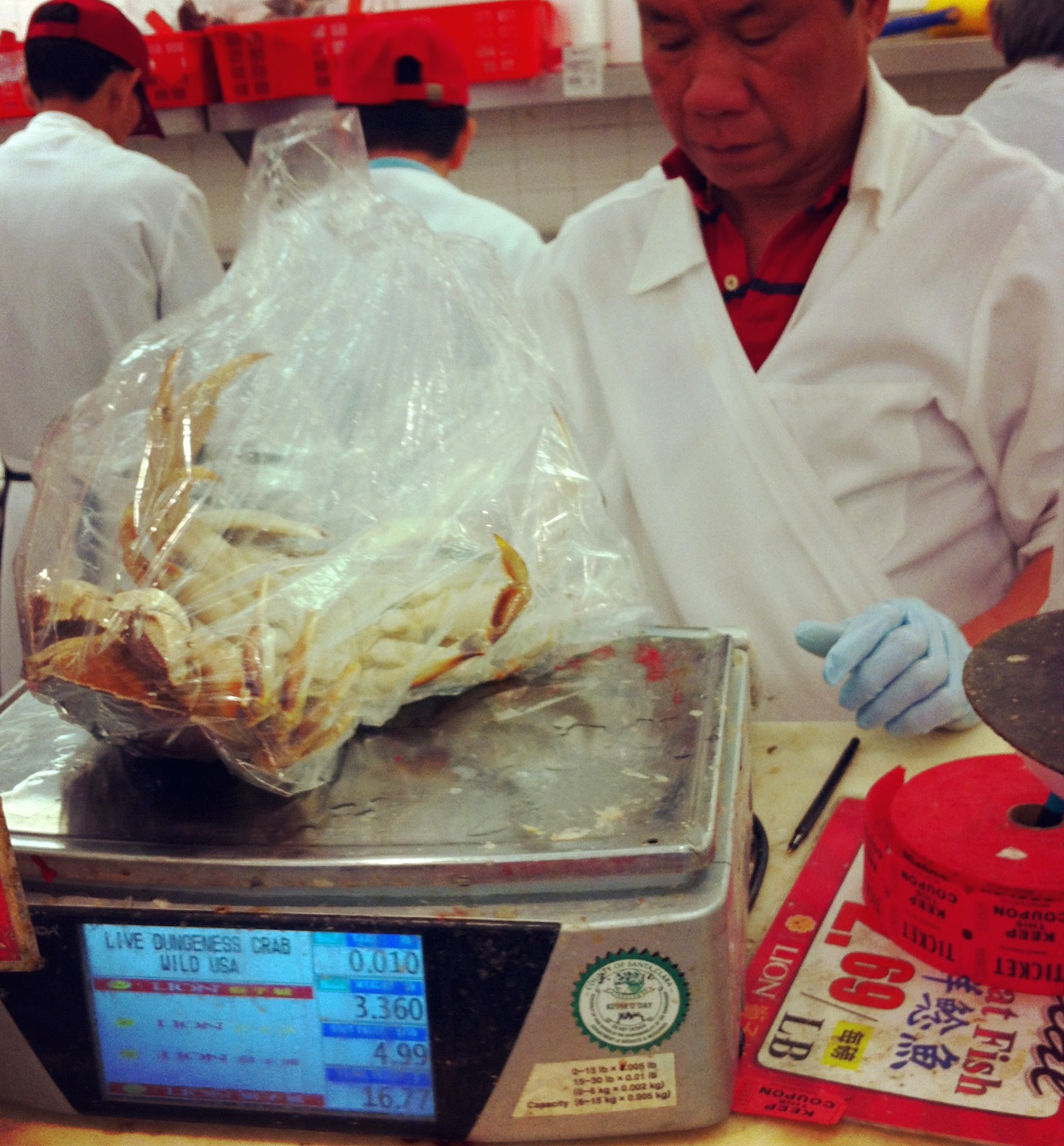
Bring a bucket. Seriously. Take it into the store with you and have the fishmonger put the live crab or lobster inside. When I held up my 5-gallon Home Depot bucket (it says "all-purpose"!), the fishmonger at the top of this post smiled. Then he took his time to go through the tank and find me the liveliest crabs and lobster. "Ah, I know what to do," he told me. After weighing the crabs in the plastic bag, he handed me the price sticker and dumped them into the bucket.
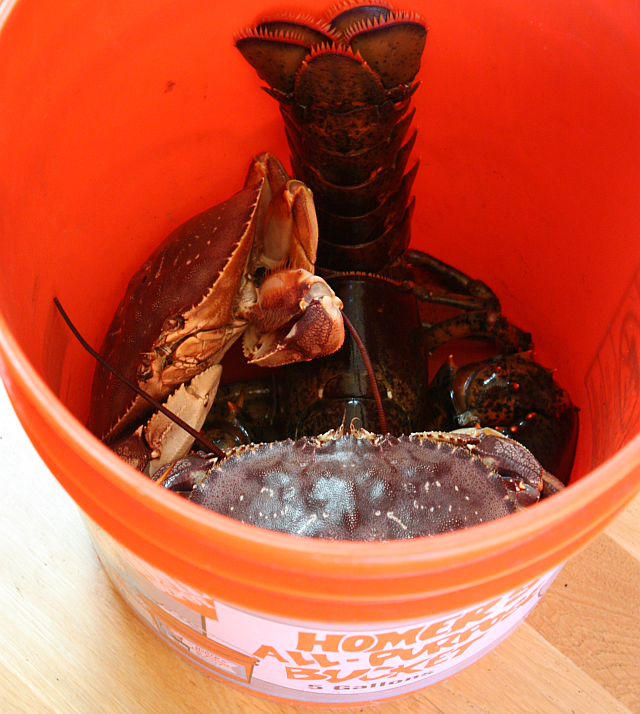
Once in the bucket, the crustaceans settle down. They go into sleep mode. To keep them calm in the car, we put a canvas bag over the top. It's spa-like, eh?
Drive home ASAP. You want to cook live seafood quickly, especially after you've invested time and money in them. A good hour is all I give myself for getting the critters home. Two hours tops before they are dealt with.
Stun the crab and lobster. Asian cookbooks are full of instructions on stabbing and hacking at live crustacean. My mother loves to steam them but they can fight off a
Chinese steamer lid - something that scarred me long ago. I prefer a boil. Once you get home, bring the bucket inside and put on a pot of lightly salted water. The crab and lobster are lightly salty on their own, having been swimming a saltwater up until they were put into your bucket.
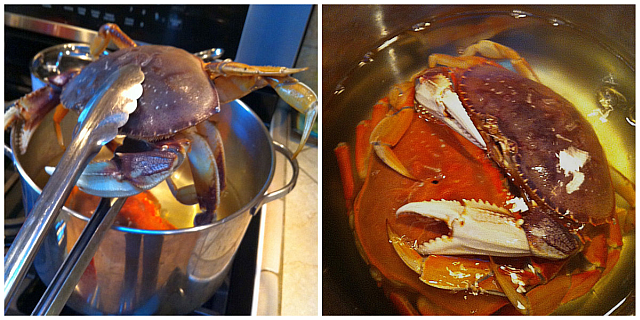
When the water comes to a boil, use tongs to grab the crab from the behind and stick it head first into the hot water. It'll go easier that way. This is not how to do it because the crab can grab your tongs or the edge of the pot: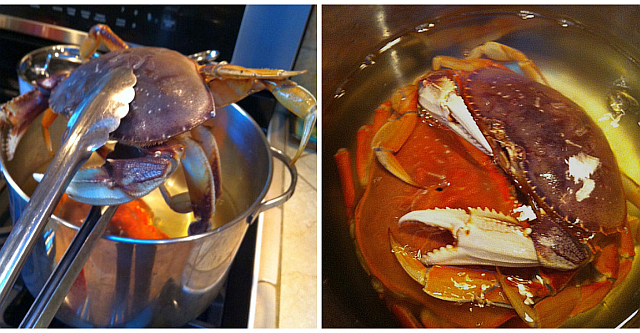
I cook two at a time for 6 to 8 minutes a pound, counting from the moment the water returns to a gentle boil.
With the lobster, use your tongs to put it in the sink. Once it seems calm, firmly grab a claw (use a potholder for protection) and twist it off. Do the same with the other claw. Now remove the rubber band. I hate the taste of the rubber band in the cooking water, especially if I'm going to reuse the cooking water for soup later on.
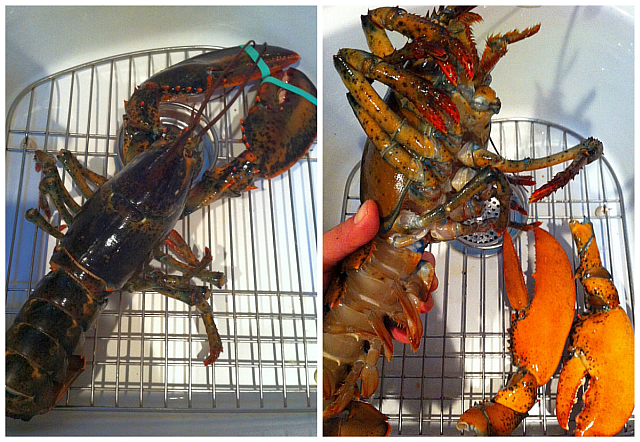
Without the menacing claws, you can grab the lobster by its tail section. (The photo above looks a little film noire-ish.) Stick the lobster head-first into the pot of hot water to cook; I boil lobster for about 8 minutes a pound to cook it all the way through.
If you're going to stir-fry the crab or lobster, just leave it in the pot for about 5 minutes, until it stops moving. I've tried stunning crab and lobster with hot water from the faucet but frankly, it's mess to hack at super raw shellfish. There's a lot of water inside that splatters all over.
It's not easy to kill a live animal for your meal but if you do the deed, you gain greater appreciation for what you're going to cook and eat. As a huge bonus, your crab and lobster dish will be superb.
Related posts:
- Vietnamese crab in beer broth with garlic and chile (cua hap bia)
- Salt,Pepper and Lime dip (muoi tieu chanh) - what Viet people adore with crab
- Vietnamese faux crab noodle soup (bun rieu cua chay) - if live crab is just not for you, this is a vegetarian alternative to bun rieu cua (see Into the Vietnamese Kitchen, page 215)



Littauer says
You might want to check out Dave Arnold's piece on anesthetizing crustaceans with clove oil before cooking. Less stress on you (and apparently on the critter) AND with better taste.
http://www.cookingissues.com/2012/07/04/how-to-become-a-seafood-anesthesiologist-and-kill-your-4th-of-july-lobster/
Maggie says
Please read this if you like to eat lobster and crab:
http://www.theatlantic.com/health/archive/2009/07/how-to-kill-a-lobster-humanely/21339/
The specimens that make it to the pot are magnificent creatures that have taken years, perhaps decades, to reach the size they are. Smaller crustacea may die fairly quickly when plunged into boiling water, but the larger ones take some minutes to die. Whilst the debate continues as to whether they feel pain, it's kinder and at no cost to us to dispatch them as humanely as possible:
"place the crab or lobster in the freezer for 15 or 20 minutes to slow its metabolism and dull its senses, then flip it over and split the main body section of the animal in half with the swift stroke of a large kitchen knife."
Yun Ho says
Hi Andrea:
Knifing in the head of lobster does the trick quickly. Try lobster tail sashimi by boiling lobster tail for no more than 30 seconds then quickly chilling it in ice water. You should be able to de-shell the lobster tail easily.
Joel says
Andrea, I get all of my live crab (when not out fishing myself) from the Pillar Point Harbor in Half Moon Bay: http://www.yelp.com/biz/half-moon-bay-crab-boats-half-moon-bay. There's even a Fishfone number (650-726-8724) you can call to make sure crab are being sold each day leading up to your trip out. You can also reserve crab by getting a crabbing boat's card and calling ahead.
Linds Plyem says
Lucky Seafood on East 12th Street in Oakland is also a good place for live seafood.
Abbe@This is How I Cook says
Oh my. All these different ways to slay a lobster. 5 cooks, 6 opinions. I love shell fish. But it is never easy to do the deed.
Andrea Nguyen says
Talk about a spa-like experience, Littauer! Thanks for the link.
Andrea Nguyen says
Great idea, Maggie. My freezer is unfortunately full most of the time. Indeed, if you're going the lobster with a knife, do it fast. Sharpen your knife first.
Andrea Nguyen says
That's a nifty trick, Yun Ho. Raw lobster meat sticks to the shell, darn hard to extract!
Andrea Nguyen says
Bless you Joel, for this local information! I was shocked when our Santa Cruz source shuttered. And reservations too. How civilized. 🙂
Andrea Nguyen says
Thanks, Linds for the East Bay source.
Andrea Nguyen says
At the end of the day, you just have to slay a lobster your own way. 😉
Joel says
Anytime, Andrea. Not knowing where you live, there might be a closer source for crab (and other tasty sea critters) for you at Moss Landing and Monterey: http://chowhound.chow.com/topics/878242
Teresa F. says
Great post. Crabs are the only food that I dispatch myself. It's not easy, but I do thank them for the meal they are about to provide us before I dispatch them. Fresh crab is just so delectable that it barely needs any accompaniment. I do like to dip mine in a little mayo, sort of like a crab salad I suppose.
Diane says
I still can't bring myself to do this, but I eat them with gusto!
here's a link to a nice article on buying fish in Chinatown, which I do enjoy doing (unlike crab, which makes me squeamish).
http://eastbayethniceats.com/2013/02/13/how-to-buy-a-live-fish-in-oakland-chinatown-for-chinese-new-year/
Rita says
Congratulations on the Piglet win, Andrea! You deserved it.
Sarah M. says
Andrea, just saw this post. We bought live crab for our Superbowl boil from Stagnaros Bros wholesale on Washington St in Santa Cruz. Huge dungeness crabs and a bit cheaper than the crabs we saw at Ranch 99.
engineering dissertation says
These types of blog post How to Buy and Cook Live Crab and Lobster are always attractive and I am pleased to find so many excellent point here in the blog post, writing is just great, appreciation for sharing.