





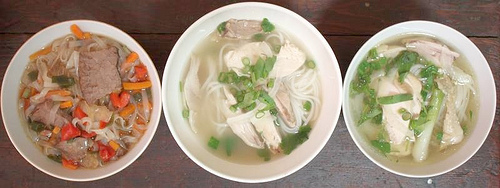
One of the above bowls of pho was homemade and the other two were made from instant pho products. Guess which was which? I’ve written about packaged pho that I keep around for super quick pho fixes. They’re from Vietnam (see the Vifon sample in the photo below) and contain MSG. Nevertheless, they are quite serviceable when you want a bowl in say, 3 to 5 minutes. Not bad for about 50 cents at an Asian market.
Since that post, several other convenience pho products have become available. Pacific Foods, maker of boxed broths and soups, sent me their new chicken pho soup base. Trader Joe’s recently announced a frozen beef pho so I added that to my must-try list. I also found the Happy Pho kit in a box at Whole Foods.
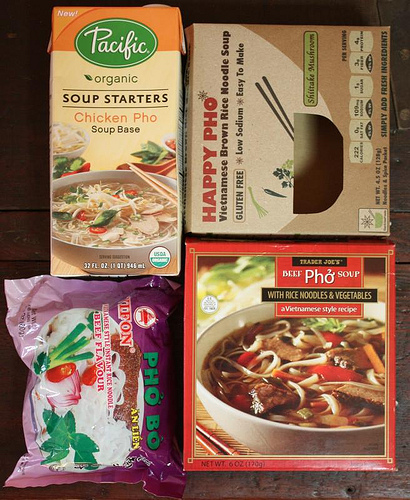
It was too tempting. I had to check them all out – side by side with homemade chicken pho, which I made earlier this week. I already knew that the homemade would be better but my question was this: Are there good instant or quick-an-easy pho products sold at mainstream markets that come close to the real thing?
I made them up and had my homemade chicken pho as backup in case the convenience stuff wasn’t great. My husband, food stylist Karen Shinto (she drove down to plan the tofu video shoot and was willing to do pho tasting duties too) and I sampled them. Here are our notes:
Trader Joe’s Beef Pho Soup
This pho product is designed to be a complete meal in a plastic bowl. No extra ingredient is needed. If you lunched in an office or lived in a dorm, this may be the pho for you. Inside the handsome box is a plastic bowl containing rice noodles, sliced beef (brisket, I think), thick dark sauce, and lots of vegetables:
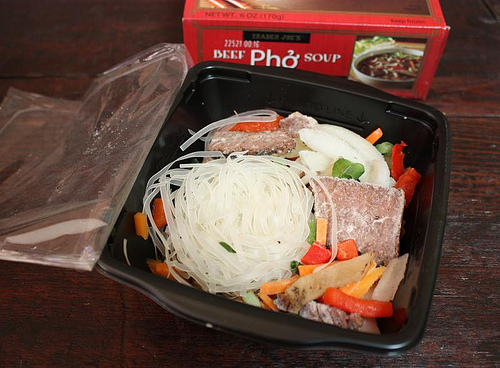
What’s with the carrot and red bell pepper? I’m not sure. Trader Joe’s is careful to say that their pho (note the correct use of accent marks) is based on “a Vietnamese style recipe.” It’s inspired by something, though I’m not clear what. Maybe it’s a ‘complete meal’ concept and all food groups are covered.
Vegetables aside, it boiled down to the flavor. Instead of microwaving the bowl, I cooked the soup contents up in a saucepan with water, per the instructions. My husband took the first slurp and said, “This reminds me of strange airline food. It has a root beer flavor. The beef is good though.”
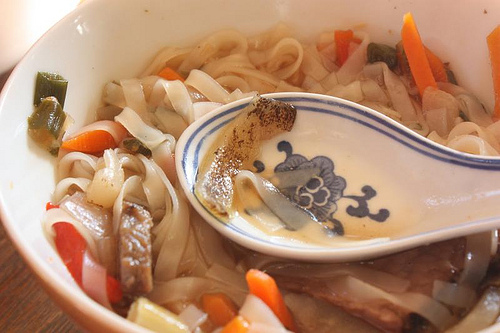
He was damning it with faint praise. The Trader Joe’s beef pho confounded me too. The broth looked hearty and rich but the flavor was mildly sweet-tart, probably from “extractive of lime.” There’s no fish sauce used, perhaps because it’s a ‘scary-sounding’ ingredient? The flavorless pieces of roast onion looked somewhat dirty and didn’t make sense:
The other convenience pho products we tried required additional ingredients to create fresher, personalized pho. Trader Joe’s aimed to offer a simple one-box, one-bowl solution but the result was lackluster. If that was my first taste of Vietnamese food, I would be disappointed.
Pacific Foods Organic Chicken Pho Soup Base
Despite the name of this convenience food, it is not a concentrate. It’s just the broth and you’re instructed to use it straight from the container. There were few ingredients listed so I was both curious and hopeful. Unfortunately, the broth was overpowered by star anise, sugar, and lime oil. You smell those elements after opening the container. So much so that it was hard to detect a chicken taste. Shots of fish sauce did not help. Among the seasonings of this product were garlic powder, onion powder, and rosemary(?).
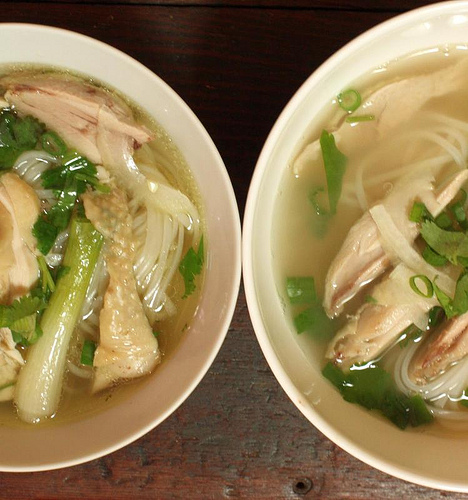
The soup base was cloudy, which normally wouldn’t matter much, but for pho broth advertised as being “prepared in the traditional way – slowly simmered for hours…” we were expecting clarity. In the photo above, the one on the right is Pacific Food’s organic broth and the one on the left is my homemade (I leave a little fat for richness, which explains the shimmer).
Pacific Food’s soup base is meant to liberate cooks from having to brew the broth. All you do is cook the rice noodles and add some chicken and garnishes (bean sprouts, fresh herbs, hoisin, Sriracha, jalapenos, green onion are suggested). Sadly, the broth needs more thought. Pacific Foods is a smart company that should tweak a few things to produce a better chicken pho soup base. (There are beef and vegetarian versions, which I didn’t try. If you have, please weigh in.)
Star Anise Foods Happy Pho
The Happy Pho kit is made by Star Anise Foods, a Vietnamese-American owned company. The spice blend, according to the package, is based on a family recipe developed long ago outside of Hanoi, in the town of Nam Dinh where pho is said to have originated. Star Anise Food’s modern twist was to grind up the spices and combine it with dried green onion for the “spice packet.” They also use a novel dried brown rice noodle made with green tea. The strategy is that they provide the foundation, you add stock, protein, and herbs, then season to taste. The box packaging is eco-friendly (100% recycle).
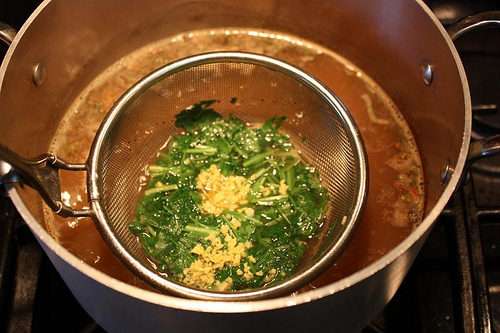
The instructions mandated that 1 cup of cilantro and smidgen of minced ginger be added to the soup. To avoid having too much cilantro floating about, I used a noodle strainer to simmer those elements, then I discarded them. I deboned and sliced chicken legs for the meat. This is what I produced:
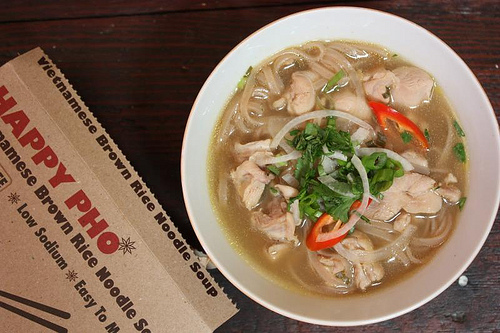
Karen Shinto and I both thought that Happy chicken pho was decent. A bit heavy on the star anise and cinnamon, the natural rust color of the ground spice mixture turned the stock a murky brown. The noodles added to that brown cast.
We gave Happy Pho a pass for appearances, because unlike the other pho products, it wasn’t totally off tasting. I was relieved that there was no lime or lemon juice in the product. Diners can add tartness at the table, if they wish. Adding tartness to the broth beforehand ruins the flavor balance.
Along with salt and pepper, I veered from the instructions and gave the soup a bit of fish sauce, and garnished the bowls with sliced onion, green onion, and fresh cilantro. Karen opened and sniffed the Pacific Foods broth and demurred from trying it.
Conclusion
Admittedly, my husband, Karen and I feasted on homemade chicken pho after tasting the various instant pho products. We gained an even greater appreciation for the scratch method. Nevertheless, it was good to know that there are options out there.
If you don’t want to commit to brewing pho broth and just want to doctor up storebought stock, try Happy Pho. Can’t find it? Consider Bon Appetit magazine’s “faux pho” recipe in the December 2011 issue. It employs instant ramen, whole spices, lots of fresh ginger, and beef broth.
If you’re near a Vietnamese or Chinese market, look for instant pho packages. Don’t use the entire seasoning package to avoid MSG overkill. Add leftover meat, fresh scallion, onion, and cilantro for a simple pho snack.
Or, simmer a pot of pho, then freeze the broth and cooked meat for future meals. Bank your efforts via that DIY instant pho kit.
Have product tips or tricks for quick pho fixes? Please share!
Related posts:
- Instant Pho Packages: The Low Down
- Faux Pho: What is it and does it matter?
- Pho in a box (I bought this in 2008 at Saigon’s Tan Son Nhat airport)
- Chicken pho noodle soup recipe
- Beef pho noodle soup recipe



Lori
I love your side-by-side taste tests! My daughter and I love pho but sometimes we just don't want to go out. I am going to try your chicken pho recipe soon! In the meantime, I'll pick up some instant packages and maybe Happy Pho as well. :O)
Andrea Nguyen
Delighted to have informed and inspired you, Lori!
Laura McCarthy
Hi Andrea,
Thank you for this post! I had a coupon for the Pacific Foods Chicken Pho soup base and thought I might have died and gone to heaven! Sometimes if something is too good to be true....it is! I really appreciate your assessment of these products in your post. My conclusion is that I defer to you on all things pho!
Andrea Nguyen
Laura: Shoot -- if you have a coupon for the pho soup base, try it out and let us know what you think. You may like it.
Debra Hartmann
Thanks for the faux pho recipe! Do you think you could use different noodles with that recipe? I'm not a fan of dried ramen.
Suganya
Hi Andrea,
Nice Post. I've not seen any of these products in markets near us. I was wondering about the Pho broth cubes we get in Asian stores. any thoughts on them ?
Eve
I thought the rightmost pho had to be the homemade one, because no pho shop has ever served me a carroty or cloudy bowl, and I guessed right!
Reading this made me hungry. Maybe I'll go to Tuan & Lan Pho Vietnam for lunch today...
Eve
Also, I have to admire the restraint of the manufacturers in avoiding juvenile "pho kit" puns.
Lili
I saw the Trader Joe's beef pho last weekend and I thought of you, Andrea. I figured that at some point you would try it out and tell us. Thank you. You saved me from a bad experience, though I was tempted. Carrots and bell peppers, huh? Well at least they had the proper punctuation.
Andrea Nguyen
Debra: Now that you asked about those ramen noodles in the Bon Appetit faux pho recipe... get flat rice noodles (sometimes called rice sticks or pad Thai noodles) if you can for a better faux effect. The narrower (think linguine) the better, soak them until opaque, drain, then add them to the pot like they say in the recipe. If you cannot get those rice noodles, use some other Asian noodle.
Andrea Nguyen
Suganya: I've not tried those little pho cubes. I see them as I walk though my Asian market, then I forget about buying them. Now that you mention it, I'll make a mental note to get one.
slammie
Vietnamese neighbor told me about this pho broth (powdered) that she found at 99 Ranch. I plan on going this week and will see if I can find it. She swears that it's almost like homemade and she's quite picky.
wireless router reviews
Of all the colors in the spectrum, blue is an appetite suppressant.
anh
Of all the quick fixes for pho out there, I find that Quoc Viet's soup bases have worked best for me. They don't supply you with meats,noodles, or veggies so you've got to get those yourself, but it does turn out a very tasty broth akin to those in the pho shops in Little Saigon. I think those folks at that company should put together a "pho kit" with some noodles.
Mr. Cooking Grill
do you have a tutorial of this? 🙂 i love your recipe and it is useful to our food-house..
marlon
The spice blend, according to the package, is based on a family recipe developed long ago outside of Hanoi, in the town of Nam Dinh where pho is said to have originated.
Nickle
Wow! i want a very hot soup to sip it.. 🙂
leah
I know this is an old topic, but after moving from D.C., I couldn't find a convenient place for pho in ATL, so I followed your recipe and made a great pho for my family. Now that I've moved to Houston, I don't have to search for pho. There are so many places around me that sell it I feel like I've died and gone to pho heaven, but I still have your recipe for pho bookmarked.
LO FAN DON
Andrea, I buy VIFON instant pho packages (the same ones in your photo) by the case for my qiuck pho fixes. I discard the spice packet and use only the dried noodles and oil packet. For the liquid, instead of water, I use a homemade chicken stock and add about 20% of a concentrated pho flavoring base which I have homemade too. I put the stock and concentrate into a donabe on the stove and while its heating up prepare all the other ingredients. When the stock comes to a boil, I add the oil, drop in the noodles, meat and bean sprouts and carry the donabe to the table where I then add all the garnishes. The donabe will keep the soup boiling for a minute or two between the stove and the table and the meat, noodles and bean sprouts serve to cool the broth. Cleanup couldn't be easier! Quick, easy and not half bad at all...
Andrea Nguyen
Thanks for sharing, Don!