

Months ago while having lunch at a Korean restaurant in Oakland, California, I noticed some skinny long crystals in a container of salt at the table. It was MSG mixed with salt. I asked my lunch companion, Linda (a Korea-born American) about the seasoning combination. Her response was, "Eh, there's MSG in lots of Korean food. It's everywhere."
Then I received several care packages from Yun Ho Rhee, a Seoul-based friend and frequent visitor to this site. Yun Ho was traveling to the U.S. and volunteered to pick up some Korean ingredients that he thought I'd find interesting. "Have you had MSG salt? It's kind of good," he remarked in an email. Yun Ho uses regular salt too.
I'm not one to use chemically produced MSG in my cooking. Naturally-occurring glutamates can be found in ingredients such as soy sauce, fish sauce, ripe tomato, dried kelp (kombu), and dried shiitake mushroom, for example. But heck, Yun Ho had tucked a bag of the white granules into one of his care packages and I had to try it out. I found it to be tasty on its own, rather savory sweet.
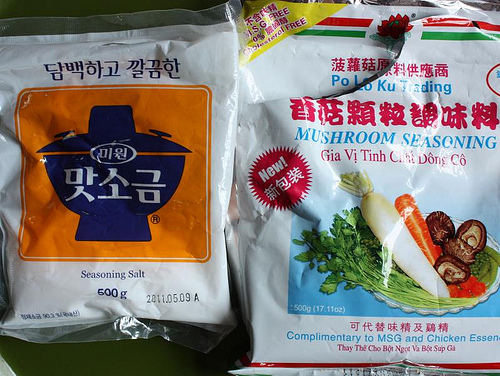
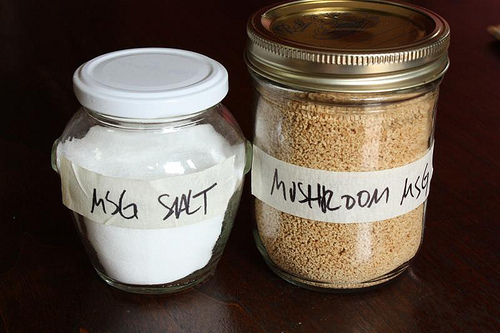
There was only Korean Hangul (above, left) characters on the plastic packaging and Yun Ho explained that the Korean MSG salt was comprised of 90% salt and 10% MSG. Made by Daesang in Korea, the salt is coated with MSG. At the Oakland restaurant, regular salt was simply mixed with regular MSG.
The funny thing about both of the Korean MSG salts was that I didn't taste the saltiness when I sprinkled them onto foods. They had a subtle effect on food. I kept putting more on, perhaps because of the effect of the MSG, or because the salt just wasn't as salty as I am used to. We train our palates to react in certain ways over time.
I found myself using more of the MSG salt when I used it during the cooking process. It's probably better as a finishing salt for sprinkling on right before serving or at the table for guests to help themselves.
Using the Korean salt led me to pick up a bag of Taiwanese Mushroom Seasoning (above, right), sold at Chinese and Southeast Asian markets. Manufacturer Po Lo Ku Trading touts the seasoning as a substitute for MSG and chicken essence, which many people use in their cooking. "No salt or monosodium glutamate is needed with this product is used," it claims. There's Chinese, English, and Vietnamese language on the packaging, signaling that they market to a broad audience of cooks.
The mushroom "MSG" is made of mushroom powder, salt, mushroom extract, calcium powder, and B (Vitamin B?). Whereas the white grains of MSG salt looks just like salt, the beige grains of mushroom seasoning remind me of malt powder but the flavor is nothing like it!
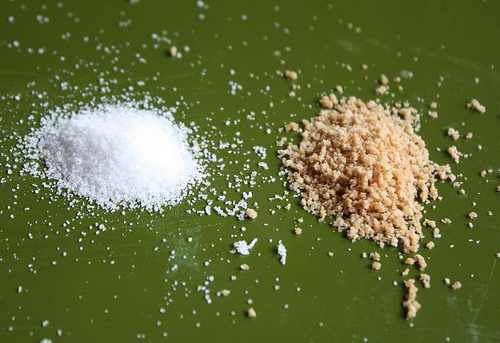
I've had the mushroom MSG in the cupboard for months and every once in a while, when I'm making a quick noodle soup in which no broth is used, I'll add some of the mushroom seasoning to the water (it usually contains some sautéed onion and other vegetables).
The effect is remarkably good, better than the asparagus-based fake MSG that I wrote about earlier. You sense that it's not full of the chicken-y goodness of a long-simmered broth. Hey, it's a semi-homemade way to cook. For example, I often have dried Chinese egg noodles on hand for a fast meal. The noodles are 'instant' but they don't come with 'flavoring' packages, which basically contain MSG, salt, and sugar. My work around is the mushroom seasoning. The drawback is that the stuff comes in 500g (17 ounce) bags, which is a lot to use. Thank god, the manufacturer says that the seasoning lasts for 3 years!
Because I had so much, I gave some to my mom, who uses a touch of MSG in her food. She looked at the white and beige seasonings with skepticism. Hopefully, she'll give them a whirl but she's a diehard traditionalist. Just the old-fashioned MSG, please!
As for me, I like both of these flavor-enhancing seasonings but they won't become go-to seasonings in my pantry. They are interesting and fun to try, however, as it's good to understand how other people cook and flavor their food.
Any experience with Korean MSG salt or Taiwanese mushroom seasoning? Share them below.
Related posts:
- MSG, Fake MSG & Umami: How bad is MSG and what is umami?
- Chile Salt for Fruit and Veggies (Bot Muoi Ot)


Madeline says
Very informative post. I'm interested in checking out the mushroom msg. I enjoy the flavor that MSG adds, but I'm sensitive to it - it leaves that unpleasant thirsty after feeling in my mouth.
saeyoung vu says
HI,
I am a Korean-American (born in Korea but lived in the US for 25 years) foodie in LA. I recently discovered Mushroom MSG through a u-tube post teaching how to make Gia-ya. I used in in my spring rolls first and it added that Umami taste. Then I started using it on my Korean Kimchi Soups, Tofu Soups and sea food stews that we called Jchi-gae. It is better than using Hondashi which is another form of MSG that is used in Japanese cooking. I feel it does not have that side effect of puffiness and drowsiness that I get when I eat MSG. THe most of Korean restaurants in K town in LA use MSG although they claim they don't. I have a bad reaction to it so I know. But the mushroom MSG tent to cause no reaction and it adds the extra flavor that we are seeking in many of the Asian recipes.
I just want to thank you for writing a wonderful book on Dumplings. I have tried a couple recipes and so far it has been delicious. I am going to write you again after I try more recipes from you book.
Jennifer says
Interesting that you bring this up today. I was shopping at my local Korean supermarket yesterday and I saw something called "Flavor Salt". The packaging was actually really gorgeous, that's what caught my eye.
I don't have issues with MSG, so next time I'm there I may pick up a bag.
Andrea Nguyen says
Saeyoung: Thanks for the low-down on K-town restaurants using MSG, despite their claims. I agree that the Mushroom Seasoning is a nice substitute for Hondashi in chigae. I've recently found hondashi that contains no MSG and will write about it soon. I often make dashi from scratch and keep it in the fridge for several days to use whenever I need it. But I realize that some times you just need a quick (and when possible, natural) source for umami.
Andrea Nguyen says
Jennifer: I bet that "Flavor Salt" was Korean MSG salt. It is kinda crazy good. Salt is in these days but interesting salts from Asia don't get enough play. Glad you're checking it out!
Andrea Nguyen says
P.S... Saeyoung: Thank you for the kind words on the Asian Dumplings cookbook! I'm delighted that it's part of your kitchen.:)
Oanh says
Hi Andrea - I love that mushroom MSG powder! I use it to add depth to vegetarian dishes where I have to forego fish sauce. I've also used it to enhance bland restaurant stir fry noodles. An excellent condiment. There's another product called Taste #5 Umami Paste, which is largely mushroom based (with other 'umami' contributors as well) -- I've been thinking about picking up a tube to see how it compares to the mushroom powder (the powder is significantly more economical, though!).
Miriam Alonso says
I love the mushroom powder so much I use it as a broth
Andrea Nguyen says
That's great, Miriam!
Andrea Nguyen says
Hi Oanh: Thanks for the tips on using the Mushroom 'MSG' especially for vegetarian fare. I imagine that gluten-free people could use it too. I'll have to look for the Umami Paste!
Yun Ho Rhee says
Hi Andrea, as you pointed out MSG salt is usually used to season food almost at the final stage of cooking. Many of the restaurants abuse the use of MSG since it brings out "extra flavor" instantly. I too am very reactive to MSG abuses as I get a bad migraine every time a restaurant overuses MSG. If MSG is used in moderation, it is a very good flavor enhancer. This is why I use MSG Salt because the content of MSG salt only has 10% MSG, a lot less than what restaurants use in their foods.
If you check the ingredients of most of the snack foods such as Doritos, they too use MSG but you don't hear many people complaining about side effects of MSG after eating Doritos. Hence, it is the abusive use of MSG that people are having problems with.
If you are allergic to even a hint of MSG, Many Korean households now make natural seasonings by milling dried anchovies, dried shiitake mushrooms, konbu (sea kelp)and dried mussels and use this powder to flavor soups and chigae. These seasonings should now be available commerically in Korean markets since they have been out in the market for several years here in Korea.
Yun Ho Rhee says
Aah, I always seem to forget an ingredient when I post a recipe on your blog...Dried Shrimp is also milled with above ingredients.
Linda Wunder says
Another recent source of Umami flavor that I've come upon lately is nutritional yeast. This is also good for vegetarian diets and can be bought at some health food stores. Perhaps they carry it in oriental markets as well. I haven't checked yet. Red Star is a brand that makes it and can be googled and ordered over the internet. See the following link.
http://store.veganessentials.com/red-star-nutritional-yeast-p734.aspx?utm_medium=cse&utm_source=googlebase
Rob says
Wow, I am really disappointed to find this thread. Why not focus on making your food taste good than adding neuroexciters that trick people into thinking they taste good? You could probably sprinkle crack on your food and all chat up how nice you felt afterwards too.
Parcke says
Excellent point Rob. Monosodium Glutamate(MSG) is a man made substance synthesized from a natural ingredient from garlic. However, the MSG can be toxic short term such as causing headaches, and possibly seizures(convulsions) to those which are prone to seizure activity. People don't realise the long term effects of MSG or Disodium Inosinatae + Disodium Guanylate in the brain.
I'd rather use natural salt, a natural gift from God made for everyday use, and enjoyment(within reasonable amounts) and best for your overall health in whatever proportions needed for your body.
I would not be surprised if there is a connection with MSG and some forms of dementia or vascular disease for longterm use. But anyone can do a Startpage, DuckDuckGo, Bing or google search to find out more. Of course, there will be nay sayers, but it still doesn't negate the reality of the known and potential health problems of it.
I used to be a Korean resident, but I ate mainly wholesome natural foods everyday.
Andrea Nguyen says
Thanks for writing. You may find this recent post to be of interest: https://www.vietworldkitchen.com/blog/2017/11/msg-in-pho-and-what-to-do-about-it.html
gouchout says
@Rob - except they wouldn't - they'd just be all hyped up & gurning probably & would lose their appetites almost instantly.
These days I never see MSG used as an ingredient in the UK.
Bap says
I'm dubious as far as the mushroom powder is concerned. The mushroom culture is probably "fed" with MSG or MSG compounds (generally speaking), and at maturity, dried and powdered.
Darren Kohl says
Mushroom Seasoning adds lots of depth to food.
Huong says
My mom makes faux nuoc mam cham using the mushroom seasoning when she makes her vegan fare for the Buddhist temple.
Submariner 116610LN says
MSG is very bad for you. It lowers childrens' IQ who grow up on processed foods containing this stuff, which virtually all processed foods do.
Do yourself a favor and cook without it at all costs while still enjoying good and tasty food.
Cheers from Toronto!
Haliwaime says
fC ugg boot uk rT http://iartistas.org/elgg/pg/blog/read/36849/real-ugg-boots-uk-80ny yD scarpe hogan sO http://rezoelgg.nim80.com/pg/blog/read/112887/sito-ufficiale-hogan-94xf
lacleMelp says
aPh chicago blackhawks jersey sXw http://hoganoutlet4576.beep.com/greenbaypackers.htm
christian louboutin says
It is the combination of these two simultaneous disruptions that have provoked the growth of hard-discount stores.
Red Bottom shoes says
Love at first sight.
Christian Louboutin says
Once a thief, always a thief.
marlon says
The effect is remarkably good, better than the asparagus-based fake MSG that I wrote about earlier.
Mr. Cooking Grill says
I totally loved it! This is my favorite recipe. You have done mind blowing.
jolizt88 says
Friends across 50 different databases to identify where your child has online accounts, identify who your child is friends with,
http://www.mcitpmcts.com/mcitp.html
http://mcitp70-620.com
http://www.mcitpmcts.com/mcsa.html
http://mcitp70-640.com
http://www.mcitpmcts.com/mcts.html
malyka88 says
screen for posts with at-risk content, and view photos your child has posted or others have posted that include your child.
http://mcitp70-647.com
http://www.mcitpmcts.com/mcpd.html
http://mcitp70-646.com
http://www.mcitpmcts.com/mcse.html
http://www.antisnoringdevicesstore.com
Meeno says
Source please?
pate chaud says
My (Vietnamese) Mom has been using this mushroom seasoning as a secret ingredient for a while! Partially because she wanted to cut down on sodium intake (I guess it has much less sodium than salt?) and secondly because she is one of those rare Viets who dislikes the overpowering flavor/smell of fish sauce. I've been skeptical because I love fish sauce and prefer to build flavors more organically, but she's convinced all of my sisters to get into it...has tried to push bags on me but I always politely decline. This past weekend, my sister wanted me to throw together a quick canh to go with dinner and as I was going for the fish sauce, she urged me to use the mushroom seasoning instead - so I did, and it tasted shockingly GREAT! And must be partly how my mom's able to throw together the most delicious dishes in minutes. But I've come to this page out of googling skepticism.. what exactly is IN the mushroom powder? Does it really have less sodium than salt? Are we sure it's not MSG or some sort of chemical?
Chris says
Why not just make your own version using dried shaitaki and other natural Kombu, salt garlic etc.?
Andrea Nguyen says
Because when I tried something like that, the flavor comes out saying "I"m shiitake." Have you had luck making your own? Let me know, if you have! I'd love to know.
The commercial stuff is formulated to produce umami flavor bursts. It is tricked out stuff. However, use too much of it and it can take over the flavor of food. MSG has a flavor.
I'd rather just focus on making food with good ingredients and techniques.
Linda says
I have been using the mushroom powder to avoid MSG, sorry I’m confused are you saying it still contains some MSG or is just a good flavour. Thank you
Andrea Nguyen says
Hi Linda -- it depends on the brand of mushroom powder that you have purchased. Some have MSG while others do not. The brands I suggest here do not. If your brand has MSG and you've not suffered allergic reactions from it, keep using it.
Carolyn says
I love the Taiwanese Mushroom Seasoning (above, right), sold at Chinese and Southeast Asian markets. Manufacturer Po Lo Ku Trading and found a good price on posharpstore.com for $13.99, cheaper than Amazon. I use it in soup whenever I don't use chicken broth and in moc Pho. Nice to have a seasoning without MSG.
Andrea Nguyen says
What a great tip!!! Thank you!
Margo says
There is a lot of misconception regarding MSG, MSG is naturally occurring in many vegetables mushrooms, ripe tomatoes, various seaweeds. The mushroom msg is made from vegetables and mushrooms.
So for those of you commenting comparing this to adding crack to your food is insane.
Lowering of IQ’s? I don’t want to encourage prejudices but Asian students are smart and we (Yes I’m part Asian) ALL grew up with MSG in EVERYTHING in some form.
I’m not saying go crazy with it. Nor am I saying all MSG is created equally but if you are afraid to use the powdered form such as this mushroom MSG which I use quite often and no one has ever complained or reacted to them research foods with naturally occurring MSG such as anchovies to add for extra umami flavor.
Andrea Nguyen says
There are so many myths about MSG, goodness. I love your humorous approach to debunking and discussing, it, Margo. Right on!
Fred Cline says
I don't use MSG because I typically cook food to share and so many people have adverse reactions to MSG. So when I saw the mushroom seasoning in a chinatown grocery store, I picked up a package to try. It really delivers on flavor. Notjust with saltiness, but with a rich umami flavor that is also vegetarian. I usually add it to whatever other spices I plan to use and grind the mixture into a fine powder. It is especially useful for dusting toasted nuts, pizza crusts, etc. to give those items more flavor.