



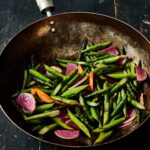
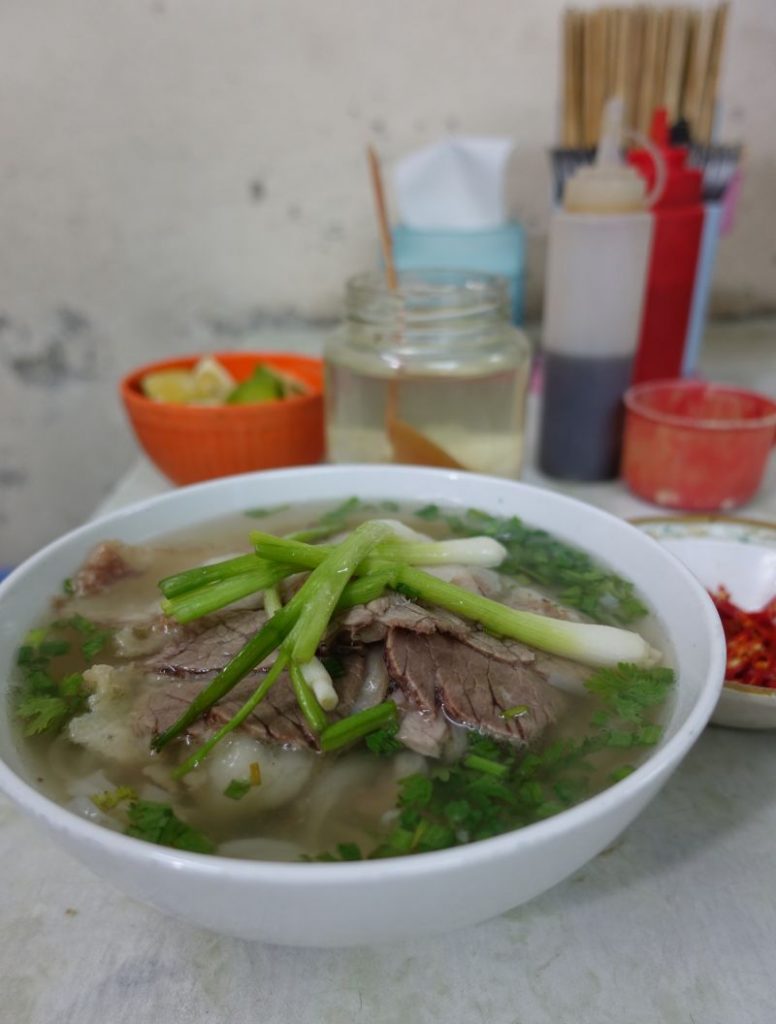
Let me head this off at the pass - the word faux goes so well with pho. Faux is French for fake and putting faux near food is a nice way to denote inauthentic, wrong, not genuine food. Mon Dieu, there's also the 'shame on you' French term faux pas. I've been simmering on the notion of faux pho (which has a whole host of wordplays that you probably already know) ever since I did a public radio interview with the Kojo Nnamdi show on the vibrant pho scene in Washington, D.C., and Virginia. One of the guests said that a local, critically acclaimed chef had prepared a faux pho.
Though I chuckled along with the other participants on the interview, in my mind I was thinking: What exactly is faux pho? There's a whole industrial category of faux food that is used for displays; check out Fake-foods.com. In Asia, the Japanese excel at manufacturing fake plastic food. But I'm talking about the edible stuff that people are describing as faux pho. We're not talking window display here.
Among Asians, we love to make the call on whether or not food has been correctly prepared. I've heard people stridently proclaim that a dish is wrongly prepared. That can sometimes come off like an attack but it can also be a good thing. Last week, I posted the Thai pork belly stir-fry and incorrectly named the recipe, which confused several people. They said that the recipe name was wrong and I fact checked through my book sand saw the error of my ways. I made the correction. So having a foundation of knowledge of what's what in a cuisine is important.
We've had lengthy discussions here on authenticity in Asian food, but the word faux seems different, despite the fact that it means inauthentic. Attaching faux to pho seems to give a pass to a dish that had deviated from classic approaches. Here are a few faux pho that I came across online:
- Faux pho recipe (Foodgeeks.com): The recipe was taken from a published Gourmet recipe and renamed faux pho. It calls for adding snow peas and using roast beef.
- Faux pho or The Real Thing? (Aminglingoftastes.com): A really interesting read of this blogger's 2006 experience making pho from a different Gourmet, epicurious.com pho recipe than the one above. The recipe is missing a few key elements but is close. The blogger, Julie O'Hara, painstaking makes the pho but demurs at the end, labeling her rendition faux pho.
- Faux pho (Marvelousrecipes.com): Calls for capellini (angel-hair pasta), watercress, radishes, tamari and sesame oil. Sounds like a noodle soup but how close does it come to being pho?
- Faux pho with seitan (Veganplanet): Author, blogger Robin Robertson comes out front with defining why her pho is faux: it contains seitan. There is also linguine and miso. She also adds hoisin and soy sauce to the broth for a nice savory quality. The result looks like a nice East Asian noodle soup.
- Conquering College Cooking - Faux Pho (SF Examiner): Cleverly uses Top Ramen.
I'm not passing judgment on any of these recipes because if you've made and/or eaten at enough pho joints, you realize the following:
- Pho originally started out simply. During the pho's century-plus history, it went from being just noodles and cooked meat to covering all the major food groups. Pho isn't a fixed entity.
- Pho is THE "have it your way" food. It's perfect for picky, post-modern, 21st century diners.
- Pho comes in many versions. At Vietnamese pho restaurants, you may find beef (northern or southern Vietnamese versions), chicken, pork, seafood, vegetarian pho on pho menus.
Pho either tastes good or it doesn't. Whether or not the pho tastes like your ideal embodiment of pho has to do with how closely it stuck to classic pho cooking techniques. For example, if you add vegetables other than onion and ginger to the broth, then that's more like a pot au feu than pho. (The Viet-Franco relationship is historically questionable.)
I've had instant pho imported from Vietnam and it's okay, certainly servicable. I wouldn't call it faux pho, but rather see it as a convenience food. Understandably, people attach "faux" to "pho" because it sounds cool and practically rolls off your tongue. But I don't see a need to apologize for food that you think tastes good but isn't 100% the real thing.
What are your thoughts on what faux pho is and not? Do you have a pho-ish or pho-inspired version of pho?
Related VWK links:

chau says
Recently our department was interviewing some potential candidates and i and one other took this person to lunch to a restaurant, part of the hospital. On the menu, there was a vegetable pho and beef pho. I hesitated to order this knowing it won't be what I am used to. Once the beef pho, ordered by the applicant came by, i was relieved I didn't order it because it was nothing like I imagined (sliced thin beef with mung bean sprouts, thai basil, medium rice noodles immersed in a beef broth along with juices of lime, thai chili sauce and other "beef" items which go along with a nice bowl of beef pho. My mother makes beef pho with beef short ribs and what the applicant had was more along the line of soupy pad thai (the rice noodle was actually vermicelli noodle used for eating with "bun bo," or spring rolls. Deeply disappointed...
Anh says
I really dislike it when pho comes out as not pho. I mean, ok, if they use the fat rice noodles, I would say it's acceptable. But using something else, what's the point?
I don't like it. No. Actually, I have strong detest about this whole faux pho!
Amanda T. says
My sister and I have a special term for "faux pho." Whenever we go to a restaurant that's not quite authentically Vietnamese, we say, "oh, this is FO not FER." Comes from a funny online cartoon we love.
Just as there's a place for beef with broccoli and crab rangoon, there's a place and time for faux pho.
Leela says
Andrea,
I'm with Anh.
There's got to be a point where pho ceases to be pho. The line *must* be drawn somewhere. I also think that people are now feeling the pressure of referring to a dish by its name, e.g. chow fun, pho, lo mein, banh mi. (To call something Asian this or oriental that is considered uncool at best and ignorant at worst.) Unfortunately, an ability to memorize the name of a dish is much easier to obtain than an ability to understand what constitutes that dish much less how to actually create a recognizable version of it.
Based on some of the examples you have cited, it seems "pho" is a new and much cooler version of "oriental noodle," , i.e. if it's noodly and brothy, it must be pho!
You've got to come visit a noodle joint near where I live. We'll be slurping a bowl of noodles, comprising rice sticks and tooth-achingly sweet tom yam-flavored coconut milk-based broth, and discussing why it's called Tom Yam Pho. I wonder why they didn't name it Tom Yam Ramen. I mean, what stopped them?
I followed the link to the previous discussion on authenticity of Asian food and I have to say some people have convinced me to rethink my use of the word "authentic." I'm beginning to think "traditional" may be a better word. But then if one asks, "authentic by whose standard?," one can ask, "traditional by whose standard?" as well.
Apparently, there are many who think along the lines of, "I know it's not a traditional X, but it works for me," "I know X is supposed to be a stir-fry, but I'm turning all the ingredients into a meatloaf and as long as the flavors are all there, I consider it X," or "I don't care if you don't consider it X; I'm calling it X since neither one of us has the right to determine the authenticity of X." I'm not entirely comfortable with the idea that X can take on any form as long as you call it X. If X can be anything, or become anything any time in the future, then X doesn't really have any real identity to begin with, does it?
The question I ask myself in regards to the authenticity of any dish is, "What is/are the sine qua non ingredient(s) or method(s) of preparation?" What is it without which X will no longer be X?
For me, tom yam must have the flavors of lemongrass, galangal, and kaffir lime leaves. Without these three things, tom yam ceases to be tom yam to me. There are people who make it with salt or soy sauce instead of fish sauce, and there are some who sour it with vinegar instead of lime juice. It makes me cringe, but as long as the herbal trinity is there and there's some kind of broth involved, I won't cry heresy.
But if I see -- and I certainly have seen -- a tom yam recipe that calls for ginger instead of galangal, lemon rind instead of lemongrass, or regular lime leaves instead of kaffir lime leaves, I personally don't consider that authentic or traditional. That's where tom yam ceases to be tom yam to me. That's where I draw the line.
To be clear, I am not opposed to creativity. I don't have problem with people playing with different flavor combinations. Sure, if they don't like to use those three herbs and want to go with something else, that's fine. But why not come up with a new name for it as well?
Back to the subject at hand, what then would you say constitutes pho?
Jai says
The food world today is taking tradition and turning it on it's head. Experimenting with ingredients, flavor, texture and presentation. Is this a good thing? Not sure. There a place for tradition and creativity. How do you explain the phenomena of nose to tail eating and molecular gastronomy? Good food is good food.
Eleanor Hoh (WokStar) says
I think it depends a lot on 'time' and circumstances. As a busy entrepreneur, weekday dinners are quick, one-dish meals when I'm short on time. But on weekends and holidays, I have more time to spend prepping and cooking more complicated dishes together with family and friends and enjoy it. Often, flavor is not compromised. This approach is actually what I teach in my class.
Robbie Nicolaisen says
In todays society, we often find ourselves just too busy. Sometimes short cuts are taken and passed off as "the real thing". But, on the other hand, I'm a classicly trained chef and have been taught when making a stock, for example, certain ingredients play a specific role in bringing out specific flavors, aromatics, hues, etc. Therefore, I add additional ingredients to certain traditional stocks and sauces in effort to enhance the flavors I'm trying to achieve. People, chefs, foodies, build on "traditional" recipes everyday. That's what gives every eatery, on the face of the planet, its own identity. In addition, everyone has their own opinion of what is authentic and what is "faux". Just because something may not be to a persons particular liking, doesn't mean its necessarily "fake". I think its important to know the basics, history, and tradition of food styles, but I have no problem with experimenting and trying to bring something new. Remember the "classics" were new at one point in time.
Andrea Nguyen says
Leela -- you ask what I think constitutes pho? Okay, here are the essential/signature elements:
- Clear broth made from simmering X bones or dried mushrooms
- Aromatics in the form of toasted spices of some blend
- Roasted onion and ginger
- Fish sauce (soy sauce can be used for vegetarian versions)
- Yellow rock sugar to round out the flavors and impart umami
- Flat rice noodles, preferably skinny or medium-with ones
- Scallion
- Herb of some kind, e.g., cilantro, mint, basil, culantro, rau ram
You can play around with the rest but yes, let's draw a line in the sand with a foundation with some kind of common understanding of what something is. Even when I make instant pho, I garnish it with some thinly sliced scallion and chopped cilantro just to make it fit my pho definition.
For example a hamburger is a sandwich but not all sandwiches are hamburgers. So what defines a hamburger?
What we're discussing here is part of the struggle of introducing new dishes to the western repertoire. You gotta hold on to some of your roots, huh?
Krissy @ The Food Addicts says
Even though I'm Vietnamese, I can't really tell the difference between pho dishes at various restaurants. Some people can really tell the difference in broth! I guess I need to distinguish what I eat more. But at the end of the day, when I'm starving and craving Pho, a decent bowl will satisfy me, whether it's fake or not.
Danny Bloom says
may i post this link to my new article about loan words in Vietnam from France, maybe some readers here will enjoy it and maybe more words will surface as a result. Andrea really helped me on this. thanks.
http://zippy1300.blogspot.com
Danny Bloom says
http://zippy1300.blogspot.com/2010/03/french-loan-words-in-vietnam-today.html
Above is the link to the main article. First draft only. More to come. Early days research. Floating it for now.
Danny Bloom says
it's titled
French loan words in Vietnam today memorialize colonial days in Indochina
IN REMEMBRANCE OF LOAN WORDS PAST
sally says
I have to say, ever since my first visit to Veitnam two years ago, i have been utterly obsessed with Pho. I returned from the country craving the comforting noodles slipping between my chopsticks, and the light soothing broth. After searching unsucessfully, i dedicated endless weekends to trying to re-create this morning staple. I made decent, and satisfying Pho--or at least i thought.
Last week i returned from my second trip to the country i fell in love with years ago. While there, i was reminded that my efforts at home might have satisfyed my hunger, but not my craving. During my latest trip, i sat on the small plastic stools on the street, in the heat of Vietnam, with a steaming bowl in front of me, and a pile of fresh herbs...i was smiling--big! Maybe it is the smell of the bustling streets packed with motorbikes, or maybe it's the herbs we simply cannot find in the states; or maybe it is in the patience it takes to produce the broth i simply have yet to find in restaurants here. Bottom line, not all Pho is the same, and i was loving the bowl in front of me.
However you satisfy your craving for Pho is important...it can be very personal...
for me, at the end of the day i miss the taste that penetrates deep through my stomach into my soul...the Pho that i have found in the country far away in miles, but right inside my heart, the Pho that brings a smile to whoever is slurping it.
Thanks for this great post!
celia says
To me, there are only beef pho (pho bo) or chicken pho (pho ga). There is no such thing as a seafood pho. In Vietnam, a seafood noodle soup using a similar flat rice noodle is called "hu tiu" not "pho".
I agree with the analogy of "hamburger is a sandwich, but not all sandwiches are hamburgers".
"Pho" is a noodle soup, but not all noodle soups can be called pho.
What defines pho is the stock. The essential ingredients that make a stock a "pho" stock are roasted ginger, roasted yellow onion, and toasted star anise. Some cooks would add cinnamon. Without these ingredients, the stock (made with beef bones for a beef pho, or chicken bones for a chicken pho) would not have the distinct flavor and scent of pho.
There may be room for creativity in cooking, but calling all kind of noodle soups "pho" is like calling all soups "consomme'"
Andrea Nguyen says
Nice thoughts, Danny, Sally and Celia. I like your clarity as it reflects the clarity of pho broth!
Danny's comments about French loan words in the Vietnamese language brings up this other point, is FAUX more easily attached to PHO because of the French colonial past?
Viet food is what it is and what it is is much more than a tropical version of French cooking.
Theresa Hall says
Faux is a form of fusion which as is American as the melting pot. I don't mind faux anything as long as it tastes good. In some Atlanta-area Vietnamese pho shops, Mexican culantro is used when cilantro is out of season. It's all good as long as there's decent broth, fresh lime and herbs. (A squirt of rooster sauce, Sriracha, is a must for me).
My mother and aunts have modified the cooking method of beef hotpot (authentic name?). Rather than the traditional fondue pot with broth and onions, we cook the meat on a tabletop grilled (powered by a small fuel canister). We throw in some shrimps and sometimes squid. The setup still includes copious amounts of rice paper with lettuce, green apple, raw banana, pineapple, and traditional herbs to wrap it all up in.
Now that my mom has passed, the hosting duties have passed on to me and I continue her style using the tabletop grill. It's a hit with friends whose exposure to Vietnamese food is pho or cha gio (which is both mispronounced).
They love it, can't get enough, and really enjoy the communal cooking. Though it includes meat, they comment on the freshness and overall healthiness of this dish. One British couple loved it so much they purchased the same tabletop burner and round grill (from an International market down the street) to replicate the meal at their home.
Andrea Nguyen says
Theresa -- Beef hot pot would be called lau bo. I love that you're carrying on the cooking after your mom's passing. You're obviously making her very proud and making your family happy!
In Atlanta, there's a wealth of cheap culantro because of the Caribbean ingredients nearby. I was amazed at the price and quantity of the tropical ingredients at the markets. Lucky you and your friends too! Thank you for contributing.
travesti says
but not glary
how to get her back says
Hi, I like our article. You have focused on good topic. I don't like that pho have been changed.
artfulcodger says
I have a vietnamese friend who I always enjoy going to lunch with. He knows how much I like Pho and insists on ordering for me - not from the menu, not in english. What a treat when the waiter brings out all the bowls of food for us to try.
supra shoes says
Speech is the image of actions.
Channon says
for lunch today I made my own version of an asian noodle soup that we were calling faux pho, simply because it is the only noodle soup name I could think of. It was so funny to see it here when i went lookin for a true pho recipe (thank you btw). This is what I did:
1 cube Sup Nam
4 cups water
1 Tbs Fish sauce
1 Tbs minced ginger
1 bunch bean threads
Dry bean curd
handful of each: julienned broccoli stems, bean sprouts, chopped gai choy
I simmered the first four ingredients for about 15 minutes, then added the bean threads and let them soak for 2-3 minutes. Next I stirred in the vetables saving the gai choy for last. I reheated the soup for about 2 minutes and served topped with bean curd.
It was very nice, refreshing and light.
Andrea Nguyen says
Channon: Great idea. Thanks for sharing it with us! It's a simple, satisfying noodle soup.
ebridalgowns says
For those of you who are purchasing ebridalgowns,we realize that this is one of the most important purchasing decisions you will make.
Justin Bieber Supra says
I just got off the phone for something unrelated and we were talking about the self-service revolution in the workplace, How can a customer care rep comments on a restructure or capital raising?
The falafel, the hummus, the whole weird wonderful waffleizer idea. Love this, yes I do.
Canada Goose Jakker says
Canada Goose parka er ligesom en flamme, der kan gøre os varme hele vinteren.
marlon says
There a place for tradition and creativity. How do you explain the phenomena of nose to tail eating and molecular gastronomy? Good food is good food.
marlon says
I have a vietnamese friend who I always enjoy going to lunch with
Alana says
Hi Amanda!
I am an anthropology student researching Vietnamese food and shifting notions of culinary authenticity- I was wondering if you have the link to the cartoon you talk about? It sounds great!