







After getting through deep-fried Sichuan duck, I wanted to see if I can make decent Peking duck at home. The elaborate process takes days so I hope you'll join in the process and see what happens along the way. You'll either laugh, cry, and/or get hungry. First up is to purchase a whole duck. The pointers below go with the Peking Duck Master Recipe and Plan for Success. Yes, you can do this!
Tools needed
I blew up a duck before for the very crispy Sichuan duck but this time I wanted to make sure I did things right. Once home I studied up again on Peking duck cookery. The key to getting crisp skin on Peking duck is apparently to blow air in between the skin and flesh so as to separate them, allowing the fat to melt away during roasting. I have a feeling there are a few other things involved but blowing up the duck was my first step and a major obstacle. How to do it? I wasn't quite sure. I did a fair amount of research in my cookbook library, and a few of you contributed tips. Tools for blowing up the duck included:
- Bamboo tube: Chinese cooks originally used a large bamboo tube and human wind power to blow up the duck but seemed like you'd need very strong lungs. That wasn't for me.
- Air compressor: There's an informative YouTube video of Ming Tsai's Peking duck on Iron Chef battle duck. I watched it again and was about to go over to my neighbor's house to borrow his. However, my problem is that I'm not good with home improvement machinery. Give me a paint brush and I'm okay but no power tools. What if I set the compressor on high and blow the duck into smithereens? I'd have to drive 45 minutes to get another duck!
- Bicycle pump: I don't have one and didn't think that my friends would lend me theirs. Ducks and tires are not the same to them but if you have one, use it!
- McGyver the pump: Any kind of pump will do. I happen to have an exercise ball pump. If this wimpy pump can do the deed, I will achieve my goal of showing you that you can do this.
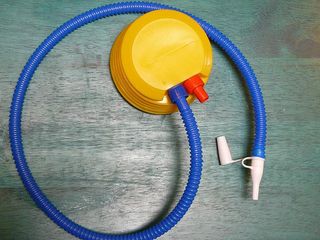
Blueprint for pumping up the duck
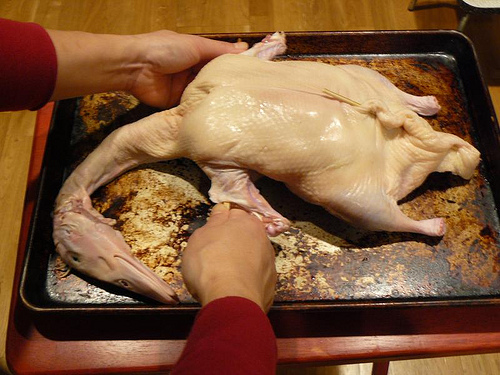
My husband agreed to help me. He washed the pump while I prepped the duck. The photos here walk you through what we did. They represent two (2) Peking duck experiments. The first time I cut off the wing joints and feet and the duck blew up just fine. You have to cut them off with minimal skin tearing to ensure that the duck inflates like a balloon. It's wiser to chop off the appendages after blowing up the duck, which is what I did the second time and prescribe below. If the image of the duck is devoid feet and wingless, pretend that they are there! To review, the purpose of blowing up the duck is to loosen the skin from the flesh so the skin will crisp during roasting.
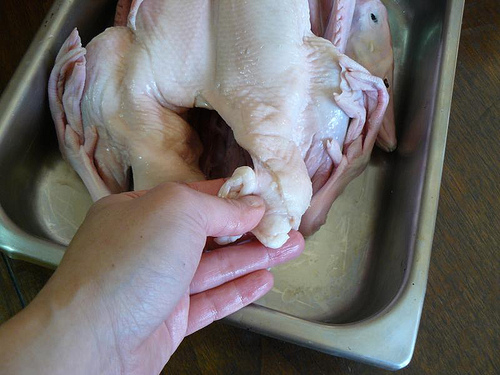
- 1. I first pulled out the excess fat in the body cavity near the rear opening. Then, following a tip from Eileen Yin Fei Lo in Mastering the Art of Chinese Cooking, I scrubbed down the duck with table salt, rinsing it well and patting it dry with paper towel. This refreshes the duck.
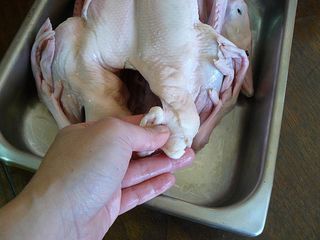
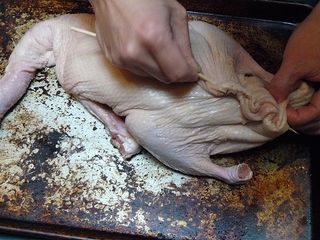
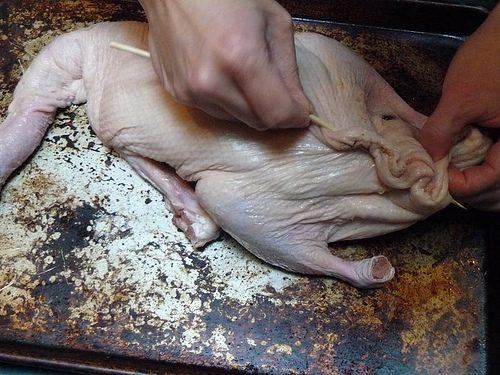
- 2. We set the duck, breast side up, on a baking sheet atop a folding table. I sewed up the duck's abdominal cavity with a bamboo skewer, breaking it to prevent it from getting unwieldy. The duck needs to be more or less sealed for the air to travel well.
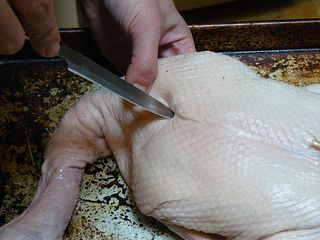
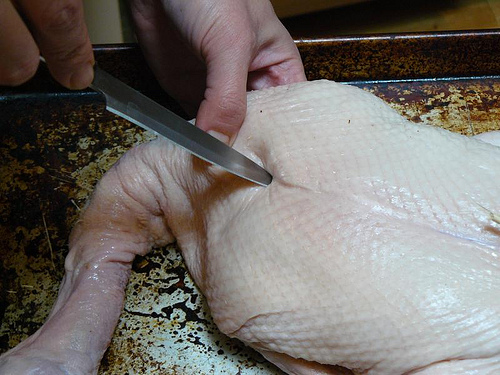
- 3. You need a hole to stick the pump in so I gave the duck a tracheotomy, piercing a hole at the bottom of its neck with a paring knife.
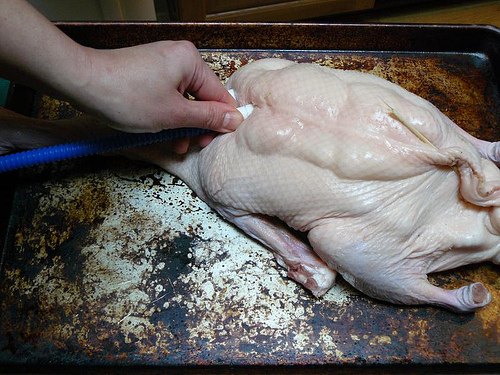
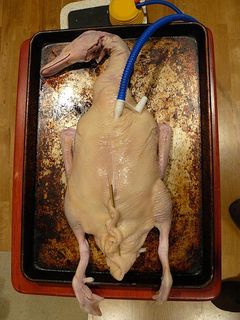
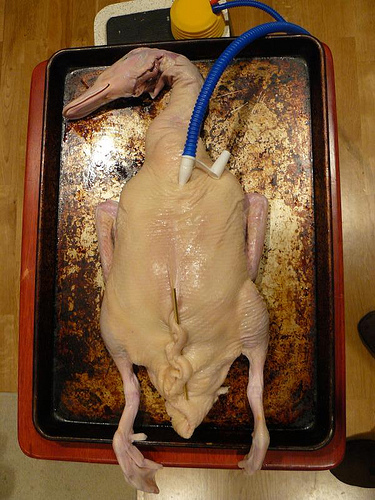
- 4. Then, Rory worked the pump with his foot while I held on to the pump and directed the air flow, first left, then right. The duck inflated, showing some rather interesting 6-pack abs (see top of this post). Who would have thought that ducky was such an athlete?
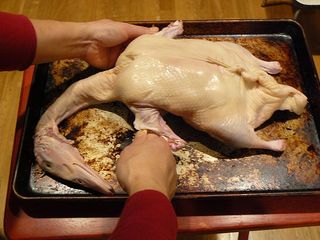
- 5. What about the back side? Nothing was happening there. So I flipped over the duck, made another incision near the nape (bottom of the neck), and we blew more air into the back area. Peking duck is all about skin so why not loosen all that we can?
- 6. Some air is released once the pump is removed but it remained kinda puffy. I then cut off the first two-joints of the wings and the lower part of the leg, just below the duck's knees. With fewer dangling appendages, the duck is easier to manipulate.
- 7. Finally, per Eileen's suggestion, I stuck a bamboo chopstick from one wing to the next in order to make the duck spread its arms out. That arrangement facilitates even cooking later on.
Step 2 and beyond
After blowing up the duck, segue into Step 2: Scald the duck and give it a tan! It's truly as fun as it sounds.
If you want to review, skip ahead, or research options, check out these posts
- Peking Duck Master Recipe and Plan for Success
- Step 3: How to roast the duck
- Mandarin Pancake Mini Class and shortcut duck feast (at Pass the Fish Sauce, my newsletter)
- Chinese steamed rolls (on Asiandumplingtips.com)
- Fragrant and crispy duck recipe (deep-fried Sichuan alternative to Peking duck)
- Fragrant and very crispy duck recipe (another version of the deep-fried Sichuan duck)

sunflower says
Hi Andrea,
To get a proper duck for this, the duck must not have a cut at its bottom end and also not a cut at its neck. The innards are removed via a cut through one of its armpit. Then water is pumped in to clean it, then drain and the cut sewn to seal. Once this is done a tube is inserted via the mouth down its neck and air is blown in till the duck is very puffy.
If you get a duck from the market you won't get this. So what my mum usually did was sew up the bottom cut with needle and thread to ensure tight seal. Then blow air from the little cut on top of the neck where blood is normally drawn when slaughtering the bird. If you blow air from the top of the neck, air can travel to both sides of the body. We used a manual bicycle pumps years ago before little air compressor was invented.
Then the fun part is to hang the duck on top the wok and giving it a hot shower with near boiling water mixed with maltose and vinegar. If you lay the duck in the hot water this may damage the air sac.
Then the hours of air drying. When the skin is partially dried, rub the skin with a little maltose mixed with some black vinegar to give it a dark mahogany colour when roasted. Then continue to dry till the duck skin is dried like paper.
Final step is roasting.
Andrea Nguyen says
Sunflower -- I love the detail reporting on how Peking duck is properly made. Does your family make Peking duck often?
What does the vinegar do in the scalding? No one talks about the purpose of the vinegar. Maltose or honey can be used for the sugar part of the process. I'd love your insights.
This is my first time at this and I'm sure it won't be my last. With input from folks like you, we'll nail down a nice Peking duck technique for home cooks! Thanks so much!
Joel says
Hi Andrea, I would have thought vinegar and maltose mixture is only used for Cantonese-style roast duck/goose. Peking style duck only uses maltose and water as the rub.
The principle is the same for both types of rub: once it is hang-dried with natural air, the skin becomes cripsy when the duck is roasted, and the cripsiness comes from the rub.
Andrea Nguyen says
Joel -- you are too cool for school to know the Cantonese vs. Mandarin approach. Thanks!
Esme says
I honestly do not know if I would have the nerve to make this-although I appreciate your instructions.
sunflower says
Hi Andrea
I have never made Peking duck myself. I live in UK it is very difficult to get a suitable duck to experiment with.
From what my mum told me, vinegar helps the skin crispy because it degreases the skin and draws out moisture to keep the skin dry.
I am not too sure and no experience how the real thing is made. I only go by what my mum did and told me. I am Cantonese probably mum used the Cantonese method for Peking duck. My mum's method probably not that authentic but it worked, lovely crispy duck. We used both vinegar and maltose for both Cantonese roast duck and Peking duck.
I found this video quite useful. http://www.tudou.com/programs/view/u_YByVjXVn4/, the video is in Mandarin, if you want more explanation I can translate, here is a brief.
- how to remove the innards through the armpit (no cut on the bottom of duck), remove feet and part of the wing (the middle and end bit) then insert a bamboo stick across its chest to keep its shape, before cleaning the duck.
- then brow air through the top part of the neck.
- scald the duck by pouring with the hot water onto the body. Then it is coated with diluted maltose.
- dry in ventilated area then put in cold storage to cool the duck before roasting.
- When the duck is ready for roasting, put a pipe through its butt hole and fill the duck from the armpit with boiling water. Seal the armpit. This boiling water acts as hot steam to keep the skin puffy while roasting so it can be very crispy.
- There are two methods of roasting shown, one with open fire with wood logs and the other is a gas oven. Open fire is most popular and much better flavour, from what I read somewhere else the logs are specially selected to add flavour to the duck.
- When the duck is roasted, remove the butt hole pipe to release the water inside.
- then ready for the table for carving.
So it is not that easy if you really want to go all the way.
Happy duck roasting to you. Looking forward to your final result.
Jai says
#1 That is the best title for a post that I've read in years. LOL
#2 That is a major undertaking but, I know your up for the challenge.
#3 sunflower knows her stuff!
#4 Have you ever considered a career as a surgeon?
Can't wait to see the how your duck turned out.
Andrea Nguyen says
Sunflower -- You rock! Thank you for the translation -- particularly about sticking the pipe in the butt hole. How else could you describe the rear of the duck?
The vinegar is interesting and I can also see it being used for ridding the duck of any ducky/gamey smells. The vinegar is also anti-bacterial and that duck traditionally hangs around for a while before getting roasted.
Yes, true Peking duck needs to be roasted over a log fire. That is totally old school and imparts an amazing flavor and aroma. I've seen it roasted that way in Kuala Lumpur.
Homemade Peking duck will not be as good as what a professionally trained chef can do but I'm wondering if we can come up with a close approximation.
ask a doctor says
Nice tips, very helpful indeed.. I just love peking duck..
Andrea Nguyen says
My apology for the ridiculous spam comment that someone copy/pasted here. Many thanks to Tammy for reporting the comment.
If you're going to add spam comments, for crying out loud, made it a little pertinent!
Lynn says
that is so cool that you use a pump for this dish! awesome!
Truth about Abs says
Homemade Peking Duck: How to Blow up a Duck--That's what I was looking for!
Shox NZ Shoes says
butchered with the head and feet still attached. Don’t be turned off as that is how they traditionally come. Do your best to find an unblemished duck and check the packed date. They are gutted and cleaned already. The price for a 4 1/4 pound duck was just under $11 so it was a deal. Specialty grocers
air yeezy says
I love you with all my heart!!
Extenze says
I can also see it being used for ridding the duck of any smells.
Cyclist Jerseys Angela says
I love peking duck. I went to Thailand a year ago and they cook the best peking duck in the world. For me though.
Gucci outlet online says
One more strategy to prevent hunting like a good spammer will be currently taking time for you to review on a internet site. As a substitute from submitting a lot of responses all at once concerning many articles or blog posts, check out primarily dual or three, consequently bookmarking typically the internet site to go back to later on. The fact that blog site writer might probable be quite satisfied to have added subject material introduced into Gucci outlet online discussion.
cheap beats by dr dre says
Don't make the choice if you dislike, once you make the decision, please hold on.
Canada Goose Jakker says
Many people believe that capital punishment deters crime . But although criminologists have conducted exhaustive research regarding the subject , little evidence exists to support the claim .
proxy list says
I’m a long time watcher and I just believed I’d drop by and say hello there for your very first time.
http://realbooster.com/seo-services/free-proxy-list-tool/
Red Bottom shoes says
Example is better than precept.
marlon says
Nice tips, very helpful indeed.. I just love peking duck. I’m a long time watcher and I just believed I’d drop by and say hello there for your very first time.
Rena says
Andrea, Thank you so much for your many pages of wonderful instructions. I did it! I found fresh whole duck (well no head or feet) at Costco in Mtn View this past week. I couldn't believe it. The label said something about being Halal and naturally raised. It was $15 for a 5+lb bird. I couldn't resist, so I picked one up, remembering your duck adventures a few years ago.
My good-natured husband actually managed to blow up the duck with a straw (he is a woodwind player, so that helps). We doused it in the sink with a kettle of boiling water, then rubbed it with hoisin, 5-spice, wine, honey. Then let it sit in the fridge for 2 days. What a sight it was to open up the fridge and have "Donald" greeting us! Made my oldest son scream! We just ate it tonight with your lovely soft steamed buns from your dumpling book. What a great time we had preparing it and roasting it and eating it - lots of fun! Having never made duck before, I am so glad that I did it. Thank you for your writing - I would never have even bought it at the store if it weren't for your enthusiastic and detailed instructions.