

Several people have emailed asking about how to cook dried bamboo shoot. I looked up the familiar Asian ingredient in all my books but for some reason, dried bamboo shoot is seldom mentioned in Asian cookbooks. It is a terrific and standard ingredient sold at Chinese and Vietnamese markets. Dried bamboo shoot is shelved at Asian grocery stores alongside other dried foodstuffs, such as dried mushroom, seaweed, turnip, squid, beans, etc. In Vietnam, the shoots are simmered along with pork, duck, or chicken for a classic rice noodle soup called bun mang. Such preparations are traditionally saved for special occasions, such as the Lunar New Year - Tet Nguyen Dan. Since Tet is coming up (in 2010, it falls on Valentine's Day!), I cooked up a bunch of dried bamboo shoot today in preparation for the holiday cooking ahead.
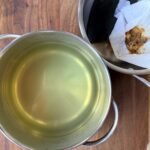
What is the difference between fresh and dried bamboo shoot? Fresh has a crispness whereas dried has a meaty quality. Both have that musty bamboo funk but since bamboo shoot has to be cooked for a long time, the funk disappears. Bamboo shoot is called mang ("mahng") in Vietnamese and dried bamboo shoot is mang kho ("mahng koh"). Dried bamboo shoots are not hard, but rather leathery. Once reconstituted and boiled until chewy-tender, dried bamboo shoots have a chewy-tenderness and pleasant sweetness that's not found in fresh or canned bamboo. Whenever I cook dried bamboo shoot, I marvel at how it transforms its cooking broth into a perfumy brew. If you've had Japanese ramen noodle soup, chances are that you've had dried bamboo shoot (called menma) as a topping.
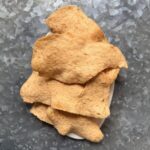
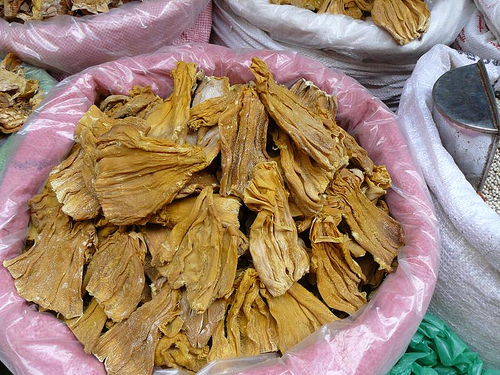
How to buy dried bamboo shoot? There are many brands and kinds of dried bamboo shoots sold. Vietnamese expatriates like me often return from a trip to the motherland with dried bamboo shoot in our luggage as part of our Vietnam travel food souvenirs. I typically buy mine from Cholon in Saigon and pay a little extra for the premium stuff (photo at the top of this post). Ask when you buy. I learned from the Cholon vendor that the so called prised pig's tongue (luoi lon) variety of dried bamboo shoot wasn't good as it takes forever to cook and smells extra funky. The woman steered me toward the higher priced bamboo, which cost roughly $14 for a kilo. That's a lot of bamboo shoot. They expand to 2 to 3 times their dessicated selves.
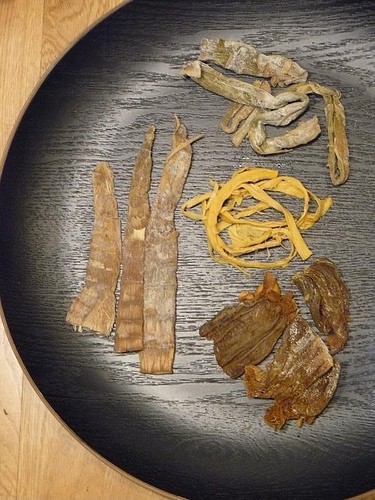
To closely match the bamboo shoot in Vietnam, look for shoots that are butterscotch in color, have been processed as small pieces (about 1-inch wide and 3 or 4 inches long), and have not been salted. The salted variety is not as stinky and its flavor is delicate, almost grassy. It can be used for Vietnamese dishes but the result is milder tasting than the unsalted variety.
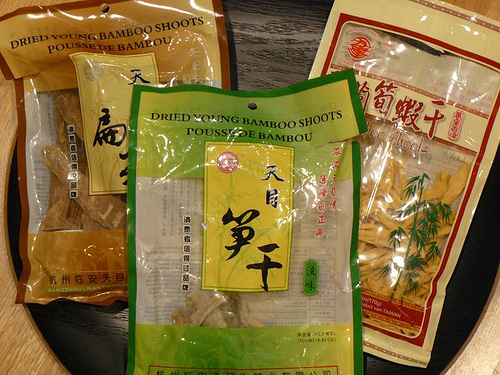
Avoid long, big dried bamboo shoot, which is super tough and requires more cooking time. I cooked four types of dried bamboo for this recipe and the one that worked well was the Vietnamese stuff was from K.L.Y. Trading Company, a standard source for dried Chinese foodstuffs. The 6-ounce packages are sold in clear plastic and labeled in red and yellow with a logo of two carp facing a gold coin (or sun over some water depending on your interpretation). The photo above is of a few other varieties that are nice too! They all for about $3 per package.
Storing dried bamboo shoot: In a zip top bag in a dark, cool place. The bamboo shoot will last indefinitely.
Substituting fresh or canned for dried bamboo shoot: Yes, you can swap fresh or canned bamboo shoot for the dried bamboo shoot. However, the flavor and texture will be different. Remember to cut down the cooking time for the fresh or dried. Dried bamboo shoot is not used in lieu of fresh or canned bamboo shoot.
Recipe
Dried Bamboo shoot
3 or 4 ounces dried bamboo shoot
1. Rinse the bamboo shoot well under water, squeezing it to remove excess funk and mustiness. Put in a bowl and add water to cover by 2 inches. Set aside for at least 6 hours or overnight, until soft enough to bend easily. If the water turns cloudy during the soaking, change it. Drain and rinse well, squeezing again as you work.
2. Put into a pot of water and add water to cover by 2 to 3 inches. Bring to a boil and cook for 1 hour, replenishing the water as needed. Drain the water and rinse. Some bamboo may be soft enough at this point to eat but most will not. Replace the water in the pot and repeat the boiling for about 1 hour to soften more. The bamboo is ready when it is chewy tender or tender; you should be able to press on it with a slight resistance. Tips will be very tender and parts that are more than ¼ inch thick may still be chewy. Don't worry because you will cook it further with the pork. When the bamboo is ready, drain, rinse, and set aside to cool.
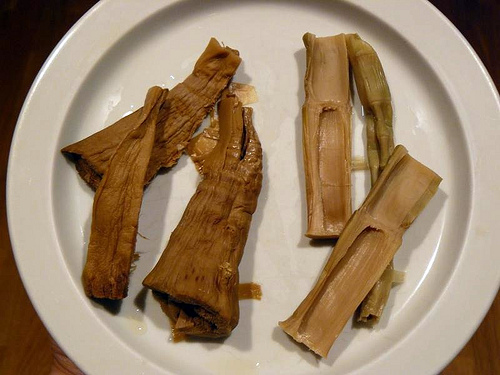
After hours of cooking, dried bamboo shoot looks like bamboo!
3. Cut the bamboo and or hand shred it long narrow pieces, about the size of a skinny index finger. Discard any part that feel super tough; bite into it to test. Set aside or refrigerate for up to 2 days. Freeze in zip top bags for up to 6 months.

online consultation says
First time I saw this kind of food bamboo shoot is one of my favorite specially if you added some coconut milk from it.
Joel says
I don't think dried bamboo shoots are that well liked among Cantonese-speaking parts of China. Primarily it is because the varieties commonly produced in China have that fermented foodstuff sourness taste - too strong for most Cantonese origin people in HK. Cooks from Teochew (Chaozhou), as do Fujian in China and Taiwan, like them though.
A common Taiwanese (which they call it 酸筍, literally "sour bamboo shoots") use of dried fermented type of bamboo shoots is in slow-cooked/stewed soups, especially with ingredients containing lots of fat like pork spare ribs. Another common preparation is to stew with lard, chilli, rock sugar, and dark soy sauce. Apparently because of its tartness, it needs a bit of saturated fat to provide sufficient balance in taste.
Teochewese cooks (which they call it 筍蝦, or "bamboo shoot shrimps", presumably because they look like dried shrimp?) like to prepare a stew of pork belly with dried bamboo shoots (Chinese:筍蝦炆豬肉, seun ha mang chu yuk, or "stew of pork with dried bamboo shoots). Apparently you have to soak the dried bamboo shoots by 2 days, julienne by hand, dry using a plain unseasoned wok, and in the preparation pork belly must be used for its fat, ginger, shallots, garlic cloves. Pretty strong seasonings like red fermented beancurd, oyster sauce, rock sugar, and soy sauce must be used to offset the strong dried bamboo shoot taste. Once again it is the saturated fat and sugar that helps compensate the strong flavour of the bamboo shoots.
Andrea Nguyen says
Joel -- THANK YOU for contributing this information. Until now, I hadn't found much info on dried bamboo shoot. You need fatty stuff to go with the shoots as they'd otherwise be very lean tasting. The use of red fermented beancurd with the bamboo shoots (which can be terribly funky dunky) is unusual but completely makes sense.
Shower Stall says
Thanks for the recipe Im going to try this out this weekend.
telefision says
Tv indir, Canli Tv izle, Online tv seyret
Yummy Food Recipes says
For the First time I saw this kind of food bamboo shoot ...
http://www.facebook.com/pages/Viva-Magazine-Your-Premium-Womens-Natural-Health-Magazine/262734921452?ref=ts
e cig says
Looks really tasty.
Twinkle says
Printing out the instructions so I can make your bun mang ga next weekend. I'm so excited! Plus it means I finally know how to prepare menma for Japanese style ramen.
bariatric surgery says
My first time here, reading this recipe makes me think I should go home and prepare Dry Fried shredded Chicken with bamboo shoots.Lovely pics.
gold eagle coins says
Nice chow for the day. Dried products are still a hit.
Tam says
I've tried looking for the young bamboo shoots locally here in Seattle and having a hard time finding. Do you know any reputable online shops that will sell them to consumers?
mary says
thanks so much for posting this! I bought some dried bamboo and couldn't figure out how to cook it! this is just great!
Otaota says
Tried cooking but anyone knows how to get rid of the 'acidity' of dried bamboo shoot?
Olivia says
Hey everyone, we have dried bamboo shoot in Uganda, its locally known as "Malewa" and i guess we cook it different than any other part of the world, when its tender, we add peanut butter to the already cooked bambboo shoots peanut butter is ready, it tastes really yummy it has a taste similar to dry fish in peanut.
We cook al ot with peanut anyway.
Cheap Burberry Bags says
The traveler was active ; he went strenuously in search of people, of adventure, of experience. The tourist is passive ; he expects interesting things to happen to him. He goes “sight–seeing”.——Daniel J. Boorstin
Red Bottom shoes says
If your Riches are yours , why don't you take them with you to the other world ?
red bottom shoes says
you are the best! I’m the greatest! you are invincible
Beats by Dr Dre says
That achievement is at bottom empty? That the efforts of men and women are of no significance alongside the force of movements and events now not all success, obviously, is worth esteeming, nor all ambition worth cultivating. Which are and which are not is something one soon enough learns on one’s own.
Sue says
I was served dried bamboo dish last weekend. It was the first time I ever tasted and it was delicious! Now I have to find a store that sells dried bamboo shoots.
Thanks for the article.
Nike Air Foamposite says
Thanks for this article. I certainly agree with that which you are declaring.
marlon says
I bought some dried bamboo and couldn't figure out how to cook it! this is just great!
Gem says
Hi Otaota,
If you want to get rid of the 'acidity' of dried bamboo shoot, you should soak them into hog-wash (rice washed water) that will make the bamboo shoot cleaner and no more acidity.
Gem says
Hi Otaota,
If you want to get rid of the 'acidity' of dried bamboo shoot, you should soak them into hog-wash (rice washed water) that will make the bamboo shoot cleaner and no more acidity
Grace says
I just bought some young dried bamboo shoots from Hanoi. I notice that they have a strong 'smoky' smell, even after soaking, boiling and cooking. Is this common? I have cooked dried bamboo shoots from China but it does not have this smell.
Andrea Nguyen says
It depends on the kind of dried bamboo. Some are very strong smelling. I bought some in Saigon and the vendor steered me to less strong smelling stuff. So I think it's all relative. The Chinese dried bamboo I've bought at Chinese markets is mild by comparison.