


Get your noggin around noodles! There are innumerable types of noodles in the Vietnamese repertoire. To help dispel confusion, I'm starting a short series on Vietnamese noodles, the various types, and how to enjoy them. Think of this as a mini glossary on Vietnamese noodles. The first one to tackle is bun - round rice noodles. These are one of the most commonly seen and eaten noodles. In fact, a Vietnamese kitchen would be incomplete without bun (pronounced as "boon?"). You've had them in rice paper rolls (goi cuon, aka summer rolls), bun salad bowls, and bun noodle soups. In Vietnam, they are always freshly prepared but abroad, freshly made bun are hard to find. We use mostly dried bun noodles in the States, and here is the low down on them:
What are bun noodles made of?
Basically rice and water but some elasticity is added by way of a bit of the older batch of dough. The soft dough is pushed through a perforated container into a pot of boiling water to cook, then fished out the water and rinsed quickly to cool. The result is chewy-soft. Dried bun noodles contain some tapioca starch to mimic the chewy texture.
Where and how to buy bun noodles
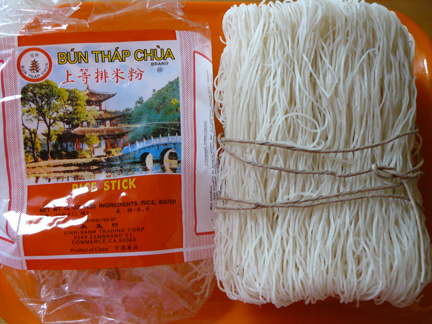
At a Chinese or Southeast Asian market, look for packages of bun noodles (about $1.25) in the dried noodle aisle. Reliable brands to look for:
2. Sailing Boat brand - mimics the Pagoda labeling and is pretty good
3. Jiangxi Rice Vermicelli noodles
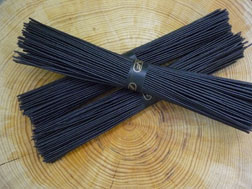
The first two packages have small dried noodles -- slightly larger than angel hair pasta -- that look wiry; they're good for rice noodle bowls and rice paper rolls as they're small. Jiangxi rice vermicelli noodles really look like sticks (think of a translucent version of the black ones below), and come in small, medium, large, and extra large. The package, which you can see through, will indicate a size. Large and extra large resemble spaghetti noodle. (Note: Sometimes Jiangxi noodles are called Guilin noodles.) The maifun noodles sold at regular American supermarkets are expensive and taste awful. Please avoid if you can.
I typically buy large or extra large Jiangxi noodles for bun bo Hue spicy beef noodle soup. Store dried bun noodles indefinitely in the cupboard. There's also black bun noodles but they're pricey ($4 for 8 ounces), though spectacular looking:
At well stocked Vietnamese markets, look for fresh bun in Styrofoam trays, usually near the baguettes and other rice noodles. Use them the day you buy them.
How to break up bun rice noodles without making a mess
Packages such as Pagoda brand will go flying if you're not careful when opening up the package. Open up the package carefully using scissors to cut it open all the way so that the plastic lies perfectly flat. Extraneous bits will fall onto the plastic. If there is string holding the flats of dried rice noodles together, remove it and discard. Gently pry apart the flats. Usually for 2 people, I use 1 flat of noodles. If I want 1 ½ flats, I take a flat, slide it into a gallon zip-top bag or plastic produce bag. Flying rice noodles fall into the bag, and you can store the unused portion in the plastic bag too.
How to cook bun noodles
Dried noodles should be cooked in lots of boiling water for 3 to 5 minutes (for small noodles) and up to 12 minutes for extra large noodles. Watch the foaming water as bun noodles can over boil in a pot. Moderate the temperature and/or add some fresh water to the pot while it's going fast and furious. Drain in a colander (put an inverted rice bowl at the bottom to prevent clumping) and flush with lots of cold water. Set aside to cool. The cooled noodles will get tacky and take on a resilient texture.

How to use bun noodles
These are THE noodles for rice paper rolls (a.k.a. summer rolls, salad rolls, goi cuon); do not mistakenly use cellophane noodles (glass noodles, mien) which I've seen in a number of mainstream publications. Soaked and uncooked cellophane noodles tastes like fiber optic lines and are unfortunately the wrong noodles to wrap in rice paper rolls -- unless the rolls are later fried for cha gio.
Once the bun rice noodles are cooled, use and serve them (1) on a platter (arranged in small 2-3-inch clumps for easy pick up) at room temperature. Or, (2) put the cool rice noodles directly into a bun rice noodle bowl. For (3) noodle soup, bun rice noodles are typically reheated first in a saucepan of boiling water.
Storing cooked bun noodles
Put them in a zip-top bag or plastic container. Briefly plunge them into boiling water to soften, refresh, then drain and cool. For small quantities, put them in a bowl and pour some just-boiled water over them, let them sit for 1-2 minutes, then drain well, and cool.
Related information:
Bun Salad Bowls -- recipe and ideas for using leftovers
Noodles Every Day -- by acclaimed author Corinne Trang is great new book on pan-Asian noodles

Tuty says
Thank you so much for teaching us about Vietnamese Noodles. I guess I've been using the "wrong" noodles for fresh summer rolls. I used the Wai Wai brand, which is produced in China (I think...) and they are thinner.
I look forward to reading your next post on this 101 series.
jason says
Can pho rice noodles be stored in the fridge like you describe for these? It would make preparing my breakfast pho much faster!
Andrea Nguyen says
Tuty -- Wai Wai brand is fine and not as toothsome. Make the switch and see how you like it!
Jason -- Oh, yeah you can store pho in the fridge. Those noodles are up next. How'd you read my mind?
Binh says
Andrea, I soaked mine in water first until soft, then dumped in boiling water for about 45 sec - 1 min, and rinse quickly under cold water. It turns out just right, and not too starchy.
Lân says
You description of uncooked cellophane noodles made me laugh. I am surprised some people have tried to eat them raw.
Home remodeling says
Oh my! My most favorite Vietnamese dish. Banh hoi is absolutely delicious and fun to eat. There’re few places in Orange County, Westminster (Little Saigon) that served this wonderful Vietnamese classic. Anyone know where I can get this in New York?
lam nguyen says
hello everyone! you guys can check out my pages for more info and pics about the Hue's traditional dish. Thank you for visiting my site..
lam nguyen says
hello everyone! you guys can check out my pages http://www.kimlongquan.com for more info and pics about the Hue's traditional dish. Thank you for visiting my site.. (sorry admin, i forgot to add the link for my site)
Jordans 7 says
Drinking strong drinks fly the boy in this global warming and the dark days of waste disposal, we are concerned about the environment need a savior to clean our world
coach bags says
[ This is good ]
coach bags says
Like the look and shape of the
Bentail Dancer Crankbait.
Can anyone tell me who the CAN.
Distributor is?.
Merrill,
Old Dad Taylor Tackle
Edmonton,Alberta
dindBeant says
9BkcE1NedC4 ghd 3NjtX5AycL1 http://rezoelgg.nim80.com/pg/blog/read/106042/ghd-stockists-uk-bw52jc
Berbedgecib says
CYXDSXHMNA canada goose parka ZVOWHHBOJS http://durkeagevomyzurta.bandvista.com/?post_id=105930
Oretssota says
UPFEBBWFBU uggs on sale ZSUTZSHRCF http://BiermkuasenAdelaizeda.newsvine.com/_news/2011/12/23/9650030-invest-in-reputable-ugg-sheepskin-boots-ugg-overshoes-on-uggs-for-sale
Beats by Dr Dre says
I feel strongly that I can make it.
waste management services says
Thank you for sharing your tips on how to cook these bun rice noodles. I can't wait to try it on my own. Wish me luck!
[email protected] says
I hope someone can help me. I have a Filipino friend who made a dish one time that was wonderful. It had noodles that looks like the bun noodles, cooked chicken and green onions and maybe a few other vegetables. Does anyone know what this may have been and how to make it?
Carolyn says
Look for recipes for pancit. It's great!
marlon says
Thank you for sharing your tips on how to cook these bun rice noodles.