


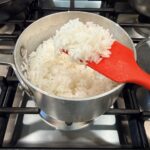



I admit that I'm somewhat of a Luddite when it comes to cooking rice. I do it in a pot. All my friends look at me and laugh as if I'm a fool. Why bother with such an old-fashioned method when a fuzzy logic rice cooker will make perfect rice every time?
It's simple. The rice cooker takes up too much space on my counter and cooking rice in a pot keeps me on my game. Each pot is a little different but the fun challenge is honing your intuition to get is right for each meal. Plus, the kitchen smells great when a pot of rice is cooking. But many people have dreadful fears about cooking rice. With just two ingredients, it's the simplest thing to make but also the easiest thing to mess up. And, all the bizarre myths about the cooking process are enough to drive someone to a box of Uncle Ben's converted rice!
Rice was the first thing I learned to cook, and over the decades, I have had a number of revelations. Here they are to help you shine:
Note: The pointers below apply to cooking polished long-grain rice.
Should rice be rinsed before cooking?
Definitely. Get rid of natural-living notions that you are washing away precious nutrients when you rinse rice. The amount lost is minimal. Rinsing rice actually rids the grains of surface starches, prevents clumping, and yields a clean, fresh taste. Whether you are rinsing the rice in a pan, a rice cooker insert, or a bowl, use plenty of water and always start by stirring the rice in circles with your fingers or by rubbing it gently between your palms to loosen the starches.
Should rice be rinsed until the water runs clear?
No. The water actually NEVER gets clear. It starts out opaque and cloudy and becomes less murky. Aim to repeatedly rinse the rice with fresh water until the water is nearly clear. If you use a precise water-to-rice ratio, drain the rice in a sieve before putting it in the pan.
Can you lift the lid during cooking?
Yes! The rice won't be ruined. You can lift the lid several times during the cooking process to check on how things are doing. If the rice cooks up dry, flick in a little water with your fingers and replace the lid. The rice will cook up a little more. I imagine that in the past, pots were not well insulated and lids didn't fit tightly. Lifting the lid may have released too much heat. Our pots and pans today are not the ones that our parents or grandparents cooked on in the past.
Does measuring the water level with your finger work?
No, unless it happens that you have just the right amount of rice in just the right size pot. I currently cook 1 cup of rice in a 1 quart pan and use my finger to measure the water level. When the finger is inserted into the pot so that it touches the top surface of the rice, the water level reaches only half way up the first knuckle of my finger. If I measures using the full knuckle approach, I'd end up with glue.
The best way to measure the water is to cook your rice in more or less the same pot every day. You'll learn to eyeball and measure the water level over time. Start out first with a precise measurement using measuring cups and when you're confident, use the finger.
How much water should you use?
There is no set rule on how much water to use. The proportions depend on the amount rice you are cooking, the type of rice, and how you like your rice cooked. In general, I find that the
1 ¼ cups water for each cup of long-grain rice yields firm, chewy, dry rice. Rice labeled new crop is from a fairly recent harvest, which means that it has not had as much time to dry. Because of its relatively high moisture content, it typically requires slightly less water.
If the packaging provides a ratio, try it, but I caution you against using a 2:1 or 3:2 ratio of water to polished rice. It will be mushy. Continue to experiment with your favorite pan or rice cooker insert until you arrive at a formula that works for you.
Should rice be salted?
Only by way of stock and other seasonings, if you happen to be using them for something special. Otherwise, there's no need to add salt to everyday rice. There's plenty of salt in Asian foods to flavor the rice.
What is steamed rice?
Sticky rice is steamed, and once in a rare while, I run across a recipe for steaming long grain rice. But the process of cooking rice is technically boiling. It's not glamorous sounding but it's the truth. Long-grain rice is not typically cooked over moist steam heat. in a steamer. It's put into a pot with the water.
Have any tips to add or questions to ask? Feel free to chime in!
Related information: How to cook perfect rice (step-by-step instructions)


Lips says
my late father prefered steamed rice to boiled/rice cooker rice. he said it produces perfectly cooked rice ie. individual grains which are seperated and no burnt bottom. I'm just too lazy, I use the rice cooker and live with 'mushed up' rice 🙂
Andrea Nguyen says
Oh Lips, I'm working on instructions/a recipe for how to make really good rice -- like what your father gets from the steamer. Check back in a few days.
Barb says
I also cook in a pot on my stovetop. I used a rice cooker for a while, but I didn't like having another appliance and went back to the method I'd learned growing up. Funnily, my mom and sisters swear by their cookers and laugh at my old fashioned ways. 😀
Also, I stopped washing my rice long ago and figured it was what made my rice clump together, which I actually prefer. 😉 I
Billy says
Omg, I like my rice sticky too, that's why I almost never rinse it! 🙂
Tuty says
Andrea,
Before the proliferation of rice cooker hit my home country of Indonesia, we cooked rice in two stages. First, we boiled the rice in a regular pot until the most water is absorbed (at this point the rice is still al dente). Then, we transfered the rice into a steamer to finish the cooking. The traditional steamer is clay jug with a bamboo cone insert while a more modern steamer looks like pasta pot with the insert.
My friend's mother who used to own a cafe in the island of Bali told me that her regular customers almost had a "mutiny" when she changed her old way of cooking rice using the wood fire, clay jug, and bamboo cone insert. They said that the texture and aroma of rice are different when using rice cooker (which I believe).
Having said that, I have to admit that I am a lazy cook... thus, I prefer the use of rice cooker where I can set it and forget it 😉
Robyn says
Some rice benefits from soaking. I followed instructions for cooking basmati rice in Alford/Duguid's 'Mangoes and Curry Leaves' - soaked for about an hour in the same water in which it cooked - and it was the best batch of basmati ever to come out of my kitchen. Used a rice cooker.
Joel says
I remember when I was a boy, preparing rice using soak steaming method in a claypot was already considered a demanding character-building exercise. It requires good quick intuitions, judgment, memory, and most importantly, perseverance to succeed, because there is nil chance you will do it intentionally right the first time round. Even during the Qing dynasty there were already folklore food records that soak steaming method was hard to master.
I must confess that I never tried doing it myself until I was 26, and to be frank it is a very frustrating exercise. There are too many potential hiccups: just one tablespoon extra of water (even more so than cooking in rice cooker) or soaking the rice 10 minutes longer can make or break the rice, on top of other matters Andrea already outlined.
Tuty, the method you described is also used in Chinese circles especially for preparing rice for 100's of people in a single meal. But the downside compared to the more difficult soak steam method is the rice is probably not as flavourful. Still, it has got a much higher chance of making rice successfully than the soak boiling method.
Binh says
I once read this article on properly preparing rice, and I tried it out. Have been doing it since. The rice is so much different than just rinsing.
http://www.japanesefoodreport.com/2007/10/how-to-cook-rice-or-the-essenc.html
Andrea Nguyen says
This is amazing info everyone. Thanks for sharing info on the soaking and steaming. Makes me think of how my mom said they had would burn lots of rice straw and put a claypot of water on to boil. Then, the rice was added to the boiling water, the pot was covered and removed from the fire. She said it was a pain in the butt. Well, not in those words but you get my drift.
Binh, I'll have to try out the Japanese method. I've been eating some medium-grain Japanese rice that's had 50% of its bran removed and I wonder how it would do with the method from Harris Salat's site.
Diane says
I was a Luddite for a long time. I used to boil rice (badly). Then I used to steam my medium grain rice in a "low tech rice cooker" - ie steamer. Wash rice as usual. Set rice in a bowl. Cover with boiling water to one knuckle above top of rice. Steam until done. And actually you can keep it in steamer indefinitely and it doesn't get overdone.
I stopped doing this because a) I wanted that extra burner for stuff and b) every Asian person I knew had a rice cooker, and I figured they couldn't all be wrong. So, now I use the trusty rice cooker. I think the steam method is still better, but this is way easier.
Diane says
Here is my primer on making perfect steamed rice. Dead easy, and very tasty.
http://www.thaifoodandtravel.com/recipes/jasrice.html
Andrea Nguyen says
Diane, thanks for reminding me about Kasma Loha-unchit's page. She does love her steamed rice!
Johnny says
I'm a rice cooker person...
But, when I do travel to Vietnam, I like to go to a favorite restaurant of mine that cooks and serves the rice from a clay pot. We all fight for the burnt rice on the bottom!
Robyn says
Hey Andrea - That place we took you to eat on Sunday in KL steams their rice, and I think it really makes a difference. Of course, it might also be that it's cooked over a wood fire....
Kithcen Guy says
Andrea: Thanks for all the great tips. My biggest problem when cooking rice is that it ALWAYS comes out sticky. I have played with a few diffrent recipies and no luck. Hopefully your tips will help guide me to the perfect rice!
victor says
hi andrea, victor from santa monica here. i agree with you. i still use an old pot to make my rice. that's how mom and dad taught us! strangely, mom and dad started using rice cookers when they became available! i never thought, at the time, to ask them why. but it was the "great new invention" and i guess everyone had to be modern. and all three of my sisters use rice cookers too! i do use the knuckle method however. mom told me that it works with any size pot and any amount of rice. and it seems to work pretty well for me except for very small amounts of rice.
oanh says
After the rice is cooked, I take it off the heat and slip a clean tea towel under the lid. Then I let the rice sit for about 5-10 minutes (this is very flexible actually). This allows my rice to fluff up nicely without drying out. I find not adding the tea towel yields mushier rice, whereas adding the tea towel seems to do the trick.
I explain more here: http://uniqueschmuck.wordpress.com/2008/06/28/weekend-wokking-ii-tuber-coconut-curry/
Andrea Nguyen says
Nice idea, Oanh. Thanks for sharing!
Sandy says
When I was growing up, we always cooked rice on the stovetop. I always liked the quick rice soup from the rice on the bottom of the pan. I think my parents only used the rice cooker when they were cooking big meals so that the rice didn't take one of the burners.
You have a good point about using the same pot for rice when it comes to measuring water. I use a rice cooker most of the time, and for the few times that I cook it on the stove, the texture of the rice has been inconsistent.
Juicy Couture Outlet says
Afterwards he searches the castle and in the library finds a pack of the Trumps and also an old servant friend.
Red Bottom shoes says
The book is a living voice.
Canada Goose says
Discontent is the first step in progress.
Canada Goose says
Sow the wind and reap the whirlwind.
Jay says
Even with a rice cooker, you shouldn't be getting "mushed" rice... That might mean you are using too much water.
N L Gutierrez says
My mother told me never un cover and never stir. Years ago, a Vietnamese uncovered, stirred and actually rinsed during the cooking! The rice was great!
Gary says
Thanks for the knowledge that the rinse water never becomes completely clear! I have rinsed and drained as many as six times, but it never is 100% clear. And I've worried that it removes flavor, so now I never go beyond five waters, and usually no more than four.
Great website, my compliments.
Andrea Nguyen says
Thank you and love that we share the same rice observations!
Kimi Wei says
I love Joel's comment so much! His story is very funny.
T King says
You say cooking rice in a pot "keeps me on my game", but cooking rice is hardly a challenge. Myself, I have.many better things to do than make a game out of cooking rice. And the smell? My picky asian father in law scoffed at my (third) fuzzy logic rice cooker. But the scoffing stopped when the heavenly smell of umami rice reached the living room. And he sheepishly mentioned several times how good it was. Respectfully, your friends laugh because they know something you do not.
Andrea Nguyen says
Good for you. I like cooking rice in the pot on a stove because it's a great way to communicate with ingredients and the cooking process. Each person cooks differently. Appliances are convenient, but if you know how to cook rice in a pot on the stove, you can also trouble shoot with different rice cookers or machines like the Instant Pot. I see value in mastering old and new methods.
vanessa says
No need to guess or eyeball the water quantity. 2 cups of water for 1 cup of rice, that simple. and if you are making white rice with no Asian ingredients, yes add salt. Saute olive oil, chopped onions, chopped garlic and salt.
Andrea Nguyen says
Each cook has a water ratio that reflects personal taste. Thanks for sharing yours.
Alex Avedikian says
Andrea, Maybe in other countries where they don’t have an FDA to require that rice be fortified with nutrients including iron and niacin what you said about rinsing might be true., but that’s not the case in this country. When you rinse any rice that’s sold in the US you are rinsing away the FDA required nutrients that have been sprayed on the rice. The WHO has also advocated that rice in other (especially 3rd world) countries be fortified to help tackle iron deficiency and other prevalent issues.
Andrea Nguyen says
Alex -- Thanks for sharing your insights. Rinsing makes for good tasting rice. The people who've argued against it to me lead healthy lives by eating lots of different kinds of foods. They are not malnourished but they do wonder why my rice tastes the way it does.
Then there's the cooking method. One method advocated in cooking magazines calls for boiling rice and then draining it like pasta. I've tried it and the soul of beautiful rice grains goes down the drain. Asian folks use a rice cooker or a pot; no draining involved. I imagine that the draining method -- which normally doesn't call for rinsing of the raw grains, rids rice of a lot of nutrients.
I'm all for nutrient-enhanced rice to deal with malnutrition due to a lack of micronutrients. Folks in developing countries need healthier rice and organizations like the International Rice Research Institute are doing marvelous work. What I've read from IRRI signals that the nutrients are not necessarily sprayed onto the grains. They're making efforts to breed biofortified rice:
https://www.irri.org/our-work/outcome-themes/improving-health-through-safe-and-nutritionally-enhanced-rice
In the U.S., I hope that people get nutrients from grains as well as other food sources to have healthy lives. And since so much of rice's nutrients is eating it as a whole grain, I'm in support of brown rice. Thankfully, there's fantastic brown rice nowadays. I love Thai-grown brown jasmine rice. I recently had amazing organic brown Kohuho Rose grown by Koda Farms in California.
Thanks again and happy 2020! May good rice be with you in the new year.
Alexandria Tyler says
Hi this is probably an old topic but I couldn't resist commenting, I'm in the UK and a retired chef and have cooked my long grain rice this way for years no matter whether in a work setting or domestic
First off I put a kettle on to boil and my stove top crock pot on to heat, as soon as kettle boils I put 1 or 2 cups of rice in pan and pour on the boiling water, I then let it simmer for maximum 5 minutes I then drain it and rinse a couple of times with running cold water
I then put it back on the stove and again add boiling water from the kettle and stir occasionally, I don't worry about the quantity of water as long as its at least an inch above the rice
I cook for approximately 20 minutes but checking that its cooked to my liking at the end as I don't like even a trace of hardness but I don't like it soft either
I do add salt because I personally think it adds to the flavour, this process has never let me down yet and I have cooked tons of rice of all different varieties
Andrea Nguyen says
Thank you for sharing your experience and tips, Alexandria!
Barbara says
White rice is enriched with folate, niacin, and thiamine that is sprayed on. Rinsing will definitely remove these.
Andrea Nguyen says
But for many folks, they're getting nutrients from other sources food sources too. You don't have to rinse your rice but if you do, the flavor will be better.
Ogn Dulk says
I think it's a 2 qt. stainless steel pot with a fitted lid--1 cup medium grain rice, 1 and 1/2 cup cold water. Electric stove, highest heat until just beginning to boil, turn heat down to 2, then cook untouched 20 minutes covered. There's always a bottom layer of stuck rice kernels, but they should not be burnt.
NO RINSING. I'm talking about US produced retail size bags--5, 10 lb. sizes, not bulk foreign produced rice.
Rinsing rice removes much of the enriched vitamins sprayed onto the rice grain surface during manufacture. Rinsing removed 77% of folate, 57% of niacin and 54% of thiamin from polished and parboiled rice. Rinsing had almost no effect on vitamins in whole grain brown rice.Nov 2, 2015
Andrea Nguyen says
There's a lot of issues surrounding rinsing rice. If you're lacking nutrition, don't rinse it. I and many other people rinse for flavor. We're fortunate to have balanced diets. Thanks for weighing in.
Dollface says
Never runs clear? I beg to differ. Asian born and raised in Hawaii. My rice water is crystal clear. And people remark on why it tastes so good.
Andrea Nguyen says
What kind and brand of rice do you use? Brown rice runs clear. White rice stays somewhat cloudy. It's also a matter of perception.