

Last Wednesday, I was in Los Angeles on business and one of the things I found myself doing was watching a group of very recent Asian and Latino immigrants clamor for cheap produce at a discount market. Prices were incredibly good --
- Asian pears - 2 pounds/$1
- Yellow onions - 4 pounds/$1
- Green bell peppers - 4 pounds/$1
I immersed myself in the scene, trying to stand still to observe people as grocery carts were being pushed up against my butt. These were people fighting for the best selection and cheapest produce. They clearly knew what to look for, quickly examining every specimen before putting it into their plastic produce bags. The thought that went through my mind was, "Man, these people sure know how to shop and eat well."
When I got back to my hotel, there was a message from journalist Andrew Lam asking me to comment on how immigrant food traditions are perfect for weathering our current economic crisis. The stock market may be bearish on mortgage-backed securities, but I'm bullish on home cooking. A good home cooked meal is always a safe bet, in good and bad times. And these days when people are cooking fewer real meals at home (getting takeout and eating it at the dining table is not really 'eating-in'), the value of home cooking is even stronger.
Take a read of Andrew's piece, The Cultural Defense: Frugality is Healthy and Wise (New American Media). One of the things I mentioned in the piece was a CNN segment where a reporter tries to eat on less than $6.50 a day. That's the amount of money allowed on food stamps. The reporter was buying a bunch of processed foods -- canned soup, for instance, and admitted that he has lost weight by the end of the experiment. It was more a case of not having home cooking survival strategies.
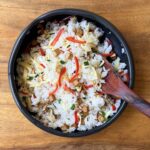
I thought that I could get by on that amount of money with some rice, fish sauce, fresh vegetables, tofu, inexpensive cuts of meat (e.g., ground pork) and small fish (e.g., smelts, sardines). For example, a pot of rice could be enjoyed the first day with other dishes, made into fried rice the second day with leftovers, and simmered into creamy chao soup for a third meal. A batch of marinara sauce could be served on spaghetti one day, used for pizza the next and transformed into soup on the third day.
I'd scan weekly grocery store ads, look at overripe, nearly spent discount produce at the supermarket. In other words, I'd revert back to the way my family and I ate when we first got here. Call it scrappy immigrant cooking. Actually, I carried on that practice in college too. I'd get by quite deliciously and nutritiously.
And, given that food stamps are suppose to be supplemental, let's say you had $10 total a day. I could include liquor in that budget!
So how do you imagine eating on $6.50 a day? What about $10/day? What kinds of strategies would you deploy?
Robyn says
Andrea, I've been thinking about posting on just that. Since we moved we're within 3 minutes of a morning wet market and, on Sundays, even closer to an evening wet market; we're also close to a 'mini-mart' that has a nice selection of fresh produce. When Dave was working and we shared a car I could really only get to am markets on the wknds and that, combined with just being real busy, meant that I was shopping at grocery stores more than I wanted. The upshot was that we were eating more Western food and our food bills were alot higher.
We're now eating Asian food 6-7 nights a week, and eating really well I might add. It's hard to judge bec prices there are certainly higher than here, but many nights we're spending U$3 max on a good meal. It's made me think that eating Asian must be much cheaper in the US than not.
The thing is though, many of our meals are tofu or seafood-based. There's a good part of America that doesn't appreciate fish, and an even larger part that doesn't like tofu! When Gourmet started running a 'meatless meals' page last year they introduced the concept as if it was something from Mars. My folks, for one, would just never eat a dinner without meat. Also, many folks don't like to eat alot of vegetables. Or appreciate dried legumes. Or like to eat meat with bones in it (which lend needed flavor to a stew or soup).
I think I could totally eat deliciously on $6.50 a day ... but as the CNN piece points out, many folks are dependent on canned/prepared foods. To get people to eat well on $6.50 a day first you'd need to change the way many people eat, which seems like such a monumental task. It would be interesting to see, in this recession, what people are giving up when they go to the grocery store. Are they really buying more of the good, healthy, and cheap stuff, ie changing their diets? Or are they going for generic brands of the bad stuff and cutting down on, say, chips and other snacks?
Harmony says
My husband and I discovered about a year ago that we could cut our grocery budget down significantly - perhaps as much as 25% - by eating Asian food (primarily Korean) instead of American. We cook all our food from scratch anyway, but by switching from the meat-heavy American diet to a more vegetable/tofu/cheap meat diet we definitely saw a difference.
Now, it was more work. There are fewer 1-pot meals in Korean cuisine, so there is a lot more prep involved. But if it came down to it, we could eat very well on $6.50 a day, maybe even less. And $10 a day is a luxury beyond even what we're spending now on American food; our weekly food budget is about $50.
Kevin Kossowan says
I must be an anomaly. I figure we run about $7/day for a family of 4 - granted one is a newborn. How. Gardening, and butchering our own meats would make up most of the difference between us and what others spend. Plus, no prepared foods. Oddly, I'd have a pretty good argument for 'the less you spend, the better you can eat'.
Andrea Nguyen says
Wow. Listen to all of us. Prepared foods has become the bane of modern eating and I hope the economic crisis forces people to slow down and reconsider how and what they eat. There are health, environmental and economic reasons for cooking at home. An Asian diet that's low in animal protein and high in vegetables and fiber is smart and health.
Indeed, there's more prep involved in Asian cooking but there's great payoff in flavor and satisfaction. Once in a while, let someone else do the dishes by going out but in the main, doing it yourself is bes.
Kevin, you are an amazing role model. Growing and butchering your own food is quite a feat! Dang, $7/day.
Jeff D says
Just off the top of my head:
Breakfast would be oatmeal, maybe with some frozen fruit thrown in at the end to thaw and help flavor it. The oatmeal is very inexpensive, the fruit (I'm thinking of Trader Joes mixed berries) could easily be stretched over 4-5 breakfasts.
I would have sandwiches for lunch, preferably a fresh baked loaf that I could use for soup later in the week if it got stale. The cheap topping would be peanut butter and jelly but I'd try to do something less processed.
Dinner would include a large serving of rice and probably fish or tofu. There is a fish market on the weekends in downtown Boston where you could easily get a week's worth of servings for a few dollars.
Simon Bao says
Fortunately, cold water is cheap. And a bit of cold water is sometimes needed for speculative discussions about how cheaply an American family can eat... "if they really want to, if they just *try* harder..."
IF you live in a major city and IF you have easy access to transportation - your own car, or top-notch public transit - you're going to be able to eat affordably. Major cities offer competing Big Name supermarkets, discount supermarkets, cheapie storefront produce markets, low-cost ethnic markets, farmers markets (in season), and perhaps one or more City of Public markets.
But if that's NOT where you live, uh oh.
In a city like Camden, NJ or Chester, PA, there are NO supermarkets. None. They left long ago. Not even the discount chains are present. There's nothing but high-price corner stores. All those affordable shopping options I just mentioned above? Nope, not there.
And forget about growing one's own produce in Camden or Chester. There's no land for gardens, what vacant land exists is infertile Brownfields, CSA plots are rare and have years-long waiting lists.
Outside the cities, there may be supermarkets but there's no transportation for poor Americans. We have counties where it could take a shopper an entire day and two buses just to get to a supermarket, shop, and get home. Counties where there are 2-3 supermarkets, at most. And food prices that would shock a Philadelphian. And they don't carry brown rice, tofu, or inexpensive fish.
Being poor, and eating poor, varies dramatically from place to place. But in most of America, the options found in Phila, LA, SF, NYC, Boston, Chicago, etc.... those options are something one hears of and never sees.
Michelle says
In our house when we need to save money (when do we not?), we base our menus off of Filipino and Vietnamese staples. CHEAP CHEAP CHEAP... and tasty too! I found out by accident once that we could eat disgustingly well at our Asian grocery store for about $30 ~ 40/week. Lots of vegetables, some starch, stretch the protein. Now we do about a 75/25 split between Asian groceries and American groceries (there are certain things I won't buy at an Asian store, like milk and cheese) which saves us a ton.
Diane says
I cook lots of Asian food (Thai, Indian mostly), and I can easily eat on $6.50 a day - and that includes meat and fish. My monthly grocery bill - excluding wine which I consider "entertainment" expense - is now around $6/day. I shop at local markets, Asian markets and farmers markets. I cook from scratch, almost never buy prepared foods, and like cheap proteins like squid, flat fish, cuttlefish, and organ meats. I eat fried rice and savory foods for breakfast - never boxed cereal.
It's not hard at all to eat at this cost - and eat very well - but you have to know how to cook, and have access to markets with fresh food.
Diane says
I also agree with Kevin - "the less you spend the better you eat." Of course there is a point at which that equation diminishes to absurdity, and cutting to - say $1 a day? - will make you eat very badly indeed. But eating at $5 - $6/day, if you focus on basic ingredients and not prepped/processed empty foods, will give you an excellent diet. I eat both a varied and healthy diet for that cost.
Dyson says
Yes,prepared foods will certainly blow your food budget.I cook for my family of 4 (with 2 grown children) and can easily manage with $6.50 per day.I shop at the Chinese supermarkets and if you look at these prices you will know what I mean (all per lb in Canadian $)
Baby Bok choy- 69c
Flank (beef)- $2.99
Chicken quarters 99c
Medium shrimps( 20/25) $3.99
Small white pomfret $2.
Andrea Nguyen says
Dyson -- you Canadians eat well for cheap! Damn.
Eating fresh is really the best way to go. But in food deserts like what Simon described above, I'd shop in bulk. Get in my car once a week or every other week and stock up. My family used to do that when we first arrived in the U.S.
Call it hoarding (remember the rice shortage early last year?) but when you want to feed your family in an affordable way, you learn to shop smart. If good tasting food matters to you, you do what's necessary to seek it out -- that includes moving to where there's better access to ingredients.
anh says
Whoa, Simon's post reminds me that I most likely will not be able to survive in smaller towns because so much of what we do as a family surrounds food. But certain members of my family do just what Andrea proposes - they hoard! My cousins live in Wichita Falls, TX and every month they would make the 3-4 hour drive to Houston to pick up Vietnamese dried goods and groceries for the upcoming month. Fortunately they still have grocery stores in their area so the situation isn't as dire.
As for myself, I am fortunate enough to live near (20 min drive) to Viet, Korean, Chinese, and Middle Eastern markets. Living on $6.50 a day isn't impossible for us, but if I lived even closer to Little Saigon I would be sorely tempted to eat out more...Some pho shops are selling their bowls for $2.50 (not gourmet, but definitely better than cup o noodle) and of course there's the infamous $1.99 restaurant that I used to frequent as a student. Ethnic foods can be quite friendly to the pocket book in these tough times.
Von says
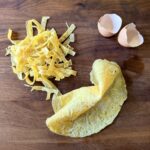
My family loves hummus that I make from canned chickpeas ($.78 cents a can at Wal-mart). Packages of ramen noodles for a quick meal but giving it some nutrition by throwing in some yu-choy as well as some boiled eggs for protein. For comfort food, we like to use eggs and make them into thin omelets, cut them into thin strips and eat it with brown rice and cut up Spam.
christina says
So glad I found your blog!! I just started to teach myself Asian cooking & shopping. I live Local and shop mostly around 82nd Ave.
Christina
http://www.saving4myfamily.blogspot.com
Lips says
My family of 3 adults eat very well on 6.50 US dollars a day in Malaysia including organic veg. 6.50 ringgit is another story altogether. But if we have to try, it would mean mean some bread/bananas/rice congee for breakfast, fried rice for lunch & rice + veg + egg/tofu for dinner. Forget about meat, fish and anything fancy. Depressing 🙁
jaden says
I could eat pretty grand on $10 a day! Lots of veggies for sure.
I bet I would totally be healthier too - hmmm- maybe I need to think about doing this for budget and health benefit!
Andrea Nguyen says
Anh -- $2.50 pho? I thought I was having it good with $6 big bowls of pho last week in L.A. Competition must be really stiff in Little Saigon these days! And the $1.99 point point joints... oh my.
Von, thanks for reminding me of Top Ramen. I used to shop at Lucky's for them -- 8 packs for $1. I think it's an 8-pack for $2 now.
Lips, if we had 6.50USD worth of ringgits, could we feed a family of 12?
Jaden, you could do it for less in Florida!
Simon Bao says
A suggestion, for every person who thinks that eating a balanced healthy diet on Food Stamps would be a snap. A "piece of cake."
There is a well known "Food Stamp Challenge" that a great number of Americans have taken. The challenge takes the idea of subsisting on Food Stamps out of the realm of armchair fantasy for the well-fed and well-to-do, and makes it real, concrete. Participants find out what their monthly Food Stamp allotment would be, based on their state and number of people in their household. And then for 30 or 60 days, that's what they spend on food. That and nothing more.
And they also voluntarily restrict and control their access to the their kitchen pantries, which in middle and upper class American households tend to be quite extravagant and could sustain Burundi for a month.
And they have to remember that Food Stamp recipients typically don't have cars that they can use to shop daily, or to drive all over town at whim so as to save money on specials. Those taking the Food Stamp Challenge would do well to limit themselves to shopping on foot, by bicycle, or by bus. Or one car trip per week. Makes it all a little more real.
I think anyone taking the Food Stamp Challenge should also be encouraged to try to make use of their local Emergency Food Cupboard, so they can see what that is actually like. And can stop imagining that is some miracle wonder resource that also solves all problems...
Lips says
yeah i think USD 6.50 can feed a family of 12. lots of rice, fresh vegetables, tofu/beans, small fishes and meat once in a blue moon, streched in some way or another @ meatloaf style. i think with 12 there's bulk discount as well so it should work. eat what's in season and what's cheap. when the budget runs out, it's rice and soya sauce till the end of the month!!
Most people would balk at the idea though except for those who really have no choice. For the average Msian, not having a dish of meat (or fish, seafood, chicken) for lunch/dinner seems unthinkable.
Rose-Marie says
It is quite easy to live cheaply... as long as you have enough money to start with: money to have a car to shop with; a freezer or at least a reliable fridge to store the food and enough cash to be able to pay for heating fuel! It *is* cheaper to buy, say, a 10kg bag of rice than small individual packets but for many people it is easier to find the small amount of money needed to buy a small item than a large one. Similarly, it is easier to find the money to buy 4 drumsticks than the money to buy the large packets on special or several packets of meat at the same time. So-called "cheaper" meat cuts or dry beans (foods often recommended to people on a tight budget) were cheap in the olden days of wood-stove or fireplaces when they could simmer all day long but are no longer so if one takes into account the 2-3 hours of simmering needed to tenderize these items.
USD 6.50 sounds like a lot to some, especially with a well-furnished kitchen and garden but not to the out-of-work, the struggling student etc...
anh says
In Little Saigon there are a couple of $2.50 pho restaurants that have popped up recently. They usually will have the 50% off sign on their windows. One particular popular resto is Vinh Ky II which touts 50% off on their pho bo (Beef), but not their chicken pho. Open from 7am - 3am they always seem to have a steady stream of customers especially in the after hours when people roll out of clubs and bars.
Pho Vie and Pho Thanh(open 24 hrs) on the other hand, have the same special on their pho ga. So depending upon what type of pho you want you can hit up either of these places. Recession proof yes, tastewise not so good, but passable.
1.99 has two locations, and can be somewhat of a misnomer since their most popular offering (com ga-- an order of 1/2 of a chicken fried crispy served with pickled cabbage and tomatoe rice)is now priced at $3.25. Still crazy cheap but not as advertised. They do however have a list of other items that do comform to the advertised naming convention. My favorites outside of the infamous chicken rice dish are their Hu Tieu My Tho and Com Suon Nuong. Be forewarded though that portion size is a bit meager (think bowls in VN)and surroundings aren't stellar, but food is still tasty.
Andrea Nguyen says
Simon, bus, bike, walk, yes to all if you don't have a car and on food stamps. Forage if you can and must. This isn't an elite kind of discussion. None of us would want to be on food stamps because you could indeed be in a dire situation. The discussion here has been about how to eat nutritiously and well on a low budget.
The U.S. federal government's food stamp program now has a new name -- Supplemental Nutrition Assistance Program (SNAP). Please note the word "supplement" as SNAP doesn't claim to be covering your entire food costs. The eligibility requirements give us all a picture of someone on the program:
http://www.fns.usda.gov/FSP/applicant_recipients/eligibility.htm
I'm not sure what the education component is in SNAP, but there are 'nutritional' restrictions in that you can't buy alcohol, pet food, medicine, hot prepared food at point-of-purchase sales, cigarettes, and non-food items. That's leaves us with food. Now one of the things that got me started on this discussion is the difference between buying processed/packaged food vs. cooking from scratch.
Does SNAP at the local level provide education to recipients who may not know how to cook resourcefully? I don't know and kind of doubt it. Cooking is at core, a survival skill -- not a Food Network fantasy. That skill for survival is slipping away these days and frankly, that frightens me.
Case in point, yesterday at Safeway, I noticed that the mainstream 'cheese' section was loaded with about 12 feet of pre-shredded cheese. Perhaps a Rachel Ray fallout, but wouldn't it be more cost effective to grate your own cheese?
There was a period when my family had government processed cheese products. It was not pretty but we learned to use that very large log of cheese to feed 7 people.
foreplay tricks says
There are many ways to eat healthy, economical and easy to prepare fast food often choose to favor us in any health
coach outlet says
Um...like the style of your writing.
Coach Outlet Factory says
The goal is to get citizens designing and discussing facilities. The project does not address system design, but you could use the same model.
If citizens addressed system design in this project it would probably be useful for discussion purposes only, though, as professionals have more tools and knowledge to create good designs. By crowdsourcing bus stop designs, they are gathering ideas that otherwise might not surface.
Carol says
Wow! I never thought I could survive the whole day with just $6.50 in my pocket for food. Not to mention that it's healthy.
how to cook lamb says
I'm actually of the opinion that as America's obsession with food grows - as evidenced by the popularity of all the cook off reality shows - we'll see smaller, local restaurants give the chains a run for the money. Small chef-owned restaurants with smaller, focused menus are serving up great casual food using locally sourced ingredients.