







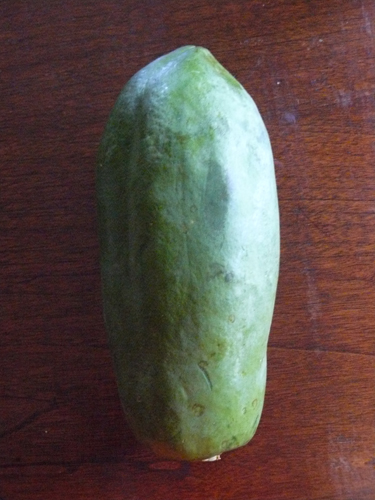
Walk through rural parts of Vietnam and you'll see papaya trees. They resemble small, thin palm trees of sort and chances are, there's a green papaya dangling from the tree. Papayas grow so well in tropical Asian climates like that of Vietnam that people use them both as fruit when they're fully ripe, and as a vegetable, when they're still green and crunchy. Most westerners are unfamiliar with green papaya. What is it? It's just an unripe papaya, and looks like a green football. The firm, pale green flesh is more or less tasteless and can be rendered into pickles or shredded up into salads. The one above measured about 9 inches long, 4 inches wide and weighed 2 ⅓ pounds.
How to buy green papaya
Green papaya is sold in produce sections of Chinese and Southeast Asian markets. They're usually not with leafy greens but rather with taro, sweet potato and the like. Select a firm one, with no blotchy areas, or soft spots - signs of old age or poor storage. Once home, store it on a plastic produce bag in the fridge. Wrap a paper towel around the fruit to absorb extra moisture, if you plan to keep it for longer than a 3 or 4 days. It will keep for about 2 weeks.
At Vietnamese markets, green papaya is also available pre-shredded for salads. Use it the day you buy it, or it will get soggy and slimy. You can also use the salt/sugar method to squeeze out excess liquid; see the green papaya salad recipe for details.
Prepping tips for green papaya
You must peel green papaya before using it. I just use a vegetable peeler and then cut off the stem. If you have a medium or large green papaya (more than 2 pounds), cut the stem off first, stand the green papaya on its cut end and go at it with the vegetable peeler. Halve the papaya lengthwise and use a spoon to scoop out and discard the seeds. Note how it looks somewhat space alien-like inside. The white seeds eventually turn black during the ripening process.

Cut each half lengthwise into quarters, and then use a knife (or grapefruit knife or melon baller) to remove the thin white layer lining the cavity. Then cut it further to whatever shape or size you need. The kom kom Thai miracle knife is handy for prepping papaya too.
What if you don't have green papaya?
You can use one that's on the yellow side - it's not fully ripe. I've found such mid-ripe papayas at Latino markets and they have worked fine for Vietnamese green papaya salad. The flesh is pale yellow-orange but it's still firm.
Use papain enzyme for mini facial
This sounds weird but when you are expelling moisture from green papaya, that slightly slimy liquid contains papain enzyme, a great digestive and skin exfoliant. I sometimes rub my face with it and let it dry before rinsing. A mini facial while cooking. How's that for multitasking?
Have any papaya tips or question? Just add them below
Related links:

Carolyn Jung says
My gawd, no wonder your skin always looks so good! And here, I thought it was some expensive moisturizer from Nordstrom's! And it's just plain ol' papaya goo. 😉
nintendo ds r4 says
For us vegans. We were excited about trying this location out since we’re big fans of Green Papaya and their long list of actual vegan options. Green Papaya was always overlooked on our lunch walks.
Andrea Nguyen says
Nintendo ds r4-- please read before you post as you're coming off very poorly informed. This page is about the fruit, not a restaurant near your office!
Carte ds says
I thought it was some expensive moisturizer from Nordstrom's!
Agreed
Juicy Couture Handbags says
Using a Trump, Corwin then attempts to contact his father Oberon
ugg outlet says
O, it came o'er my ear like the sweet south,
That breathes upon a bank of violets,
Stealing and giving odour
tinnitus treatment says
If we can find some worthy for reading everyday, we can not only kill time but also learn something. In your site, I learn something that can be inply in our daily life, thank you.
air-jordan-1 says
For us vegans. We were excited about trying this location out since we’re big fans of Green Papaya and their long list of actual vegan options. Green Papaya was always overlooked on our lunch walks.
oakley sunglasses says
87*/*There are thankfully no monkeys on Pulau Hantu. ideas for Shayna, leave a comment! ''&
Christian Louboutin Shoes says
Even if I could get married, every asset I gained from then til the
oakley sunglasses says
I started it the night before, liked it well enough to want to finish it, but didn't get so hooked that I needed to stay up late to read the whole thing. It was when I picked it up the next morning that I ran into trouble -- that was when I hit the 100-page mark, and suddenly a book about a girl who's desperate for her father's love and approval yet very cautious about guys partly because of her father's past behavior turned into a sisterly-bonding-through-burglary-with-exploration-into-family-history-and-romantic-roadtrip story. **-**-*
oakley outlet says
^@^it was indeed delicious! I'll confess, I made a few adaptations... wanting to use what was in the fridge... I used fresh dug parsnips and carrots instead of the recommended peppers,^*^
coach handbags says
I loved the kettle caramel flavor, so did my boyfriend. The popcorn is crunchy since it is covered with caramel. It sounds wierd but it is worth the try!Check these guys out for really good, and unique, flavors. The cheese course duo is one of my favorites, but I've liked everything I've tried. Too bad they're in Scottsdale. Time for a trip back.
coach handbags says
I loved the kettle caramel flavor, so did my boyfriend. The popcorn is crunchy since it is covered with caramel. It sounds wierd but it is worth the try!Check these guys out for really good, and unique, flavors. The cheese course duo is one of my favorites, but I've liked everything I've tried. Too bad they're in Scottsdale. Time for a trip back.
Moncler outlet says
All sentences are about a little something or another person. The a little something or anyone that the sentence is about is called the topic on the sentence. From your blog, I see that, and study a thing I'd like. Thanks for sharing.
marlon says
That breathes upon a bank of violets,
Stealing and giving odour.
Annemaree says
Can I prep green papaya day before for the salad ... will it go brown and should I store it in fridge in water to keep it fresh and crunchy
Andrea Nguyen says
Prep the ingredients a day in head but toss it before serving. It will not go brown.
Kia says
Have you ever experienced the cooked papaya chunks turning harder while cooking (simmering) an hour in the soup broth? Impossible to eat... such a freakish thing hapoened
Andrea Nguyen says
I've never cooked green papaya but can totally see that happening. It's a dense fruit when it's green.
Christine says
Thanks Miss Nguyen for this post, you are a lifesaver. Thanks especially for the comment about the shredded papaya keeping a day in the fridge without turning brown. I'm preparing our first papaya salad for tonight & that's very helpful to know. BTW, we live in Central Florida and have two clumps of papaya trees that spontaneously grew out of compost piles. They are FULL of papayas! Have only recently found out from a Filipino friend that the green ones can be eaten as a veggie. So I've experimented with them & found that roasting cubed green papayas in the oven (tossed with olive oil & spices) is absolutely delicious! Thanks again for your blog, I'll definitely be exploring it for recipes.
princess says
Hi! I cooked ginger soup with green papaya and it so happened that the green papaya tasted so bitter. I scooped out the thin white layer inside the green papaya as well as used a veg peeler to peel the skin. I always cook ginger soup with green papaya and this is the first time it so happened that the green papaya was bitter. Is there any explanation to that? And, can I still do something to remove the bitter taste with the green papaya I cooked?
Andrea Nguyen says
Yikes, I've never had that happen before. Can anyone help Princess?
Russell says
Is red pawpaw and yellow both ok to use for green pawpaw salad
Andrea Nguyen says
I have little experience with pawpaw. I know it's a popular fruit in certain parts. Sorry to not be of greater help.