











 Let's face it, finding and selecting Asian ingredients can be a test of endurance. I've had readers, friends, chefs, and little Asian ladies tell me how confusing Asian markets and ingredients can be. Some have carried my books to the market while others have used this website as a mobile resource. Add to that the countless times that I've asked and been asked about which brand to buy or where to find something.
Those factors seeded the Asian Market Shopper (AMS) app, a nifty new multimedia resource that helps you understand, navigate, and use Asian ingredients. I've been working with San Francisco-based Chronicle Books to develop this app for about a year. It's been a lot of fun and a real learning experience, combined with a few beads of sweat and drops of tears. Finally, it's here!
Chronicle Books is launching the AMS this week. In this initial rollout, the app is for Apple products -- iPhone, iTouch, iPads. The Android version will come later.

I'm extremely delighted to have this information in a mobile format. Who can remember all the types of Japanese miso, Thai curry pastes, and grades for dried kelp (kombu)? Or what their foreign names are? The AMS is a shopping buddy for you at the market. As a handy problem solver, it helps you to explore and understand Asian ingredients for your cooking needs.
What content is in the app?
At core, the Asian Market Shopper is a reference tool that contains 100 ingredient entries. Each entry comes with a photo and in-depth background information. There are details on how to select, store, and use these ingredients too. You can enlarge the photos and show them to a store clerk. Tap the audio icon (right side, at the top) and you'll hear me pronounce the ingredient's name in a foreign language!
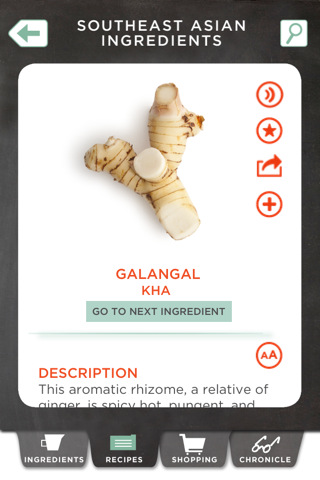 Not only will the photo and audio help you find the ingredient, but you'll definitely make new friends at Asian markets. They'll be flummoxed by your fluency. I did the voice recordings in a neutral tone to help non-native speakers master the terms. Ask native speakers for the inflections and they'll get a kick out of your earnest curiosity.
 But wait, there is more! To help people use the staples, the Asian Market Shopper app also contains 25 recipes that link back to the ingredient entries. The recipes represented are iconic classics such as kung pao chicken, shaking beef, and pad Thai. I developed these recipes (they've all been tested) so you can easily make these favorites. (Many thanks to testers Diane Carlson, Candace Grover, Doug Grover, Sue Holt, Dave Weinstein, and Lea Yancey.)
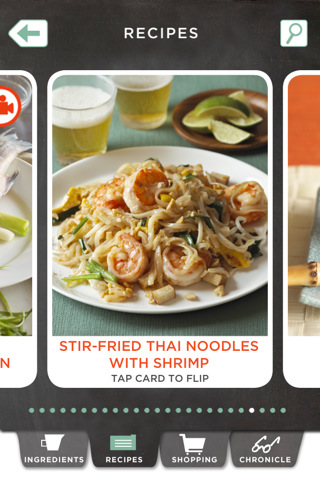
As with the ingredient entries, each recipe comes with an audio pronunciation of the dish in its native language. People often ask me how to pronounce something because it's part of appreciating and mastering a dish.

Linked in the recipes are short videos on foundational Asian cooking tips and techniques. You'll see me discussing how to break down a crab, buy fresh fish, and make perfect rice. The videos are not intended to be recipe specific, instead, they present elemental, takeaway cooking concepts. In the recorded audio "Introductions" you'll get extra pointers. And, the shopping tab lets you create personal shopping lists to keep you organized at the market.
In short, the Asian Market Shopper is designed as a nimble reference tool. While the app contains a terrific collection of authentic recipes, it was also written and designed to work in partnership with cookbooks or recipes that are already in your collection. Had we included a large collection of recipes, then it would be a cookbook and not a shopping reference tool.
How were the 100 ingredients selected?
I cross-referenced cookbooks and other sources to compile a list of the 100 most commonly used staples in Asian kitchens - which include East Asia, Southeast Asian, and South Asia. I also considered the kinds of Asian markets where most people shop. For example, Chinese, Korean, and Indian markets offer different inventories, though there is a little overlap.
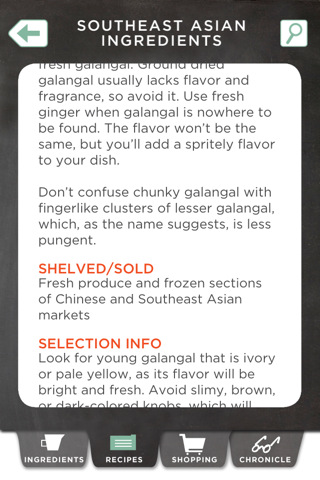
In writing the ingredient descriptions, I tried to pack as much information in the text without overwhelming the user - who is trying to get through the market. For example the entry for bamboo shoots covers canned, frozen, and fresh bamboo. Coconut milk includes a discussion of coconut cream and the differences between canned, frozen, dried, and boxed. Japanese fermented soybean paste (miso) includes information about Korean doenjang paste.
As I did the research, I learned new bits of information too, such as how Sichuan peppercorn is widely used in many parts of Asia. I hope you spend a little time reading the entries because they're chock full of details. Even if you don't use them all, you'll amaze people with your knowledge!
Where do you buy the app?
It's a click away at the Apple App store, selling for $3.99 - the price of a decent cup of coffee. Check it out, pass it around, and share your reactions. [9/29/11 Update: Just posted a demo video of the Asian Market Shopper app in action at a Chinese market!]
Reviews:
"Never be Lost in an Asian Grocery Again"
-- Lynn Andriani, Food Editor, Opraph.com, read full review
"I read about the Market Shopper App on your blog the day before my new Ipad arrived. Perfect timing! It was the first app that I purchased once I had it in my hands. What a brilliant idea! This is just what I needed. In the past I have been lucky to go to Chinatown with a Chinese or Japanese friend and learned a lot from them. I have also been approached by people in those markets that were totally confused and desperately looking for somebody who spoke English...The app is great and very useful."
-- N. Fischer, via email
"Just saw your article to win the Asian market app but alas it was too late I've already purchased it. I AM ALREADY A WINNER! A great app and highly recommend it to anyone out there. Like so many items from your cookbooks to your website are top notch and this app follows as well!"
-- T.G. Hansen, via email
"Our favorite apps, however, exist as stand-alone creations: The Asian Market Shopper ($4) app can act as an extension to any of your favorite Asian cookbooks. It helps users identify ingredients thanks to a gallery that includes photos and descriptions of 100 commonly used Asian staples, and its series of videos with preparation tips is like a cooking school in the palm of your hand."
-- Tasting Table National, read more
"I like the idea of approaching a grocery store employee and saying, 'I'm looking for . . .' and then whipping out a phone, rather than standing there for five minutes butchering the pronunciation and getting a blank stare."
-- Michelle Woo, OCWeekly.com, read more
"Learning how to cook Asian food is not that difficult. But you are going to need the right ingredients to get started. Having someone show you how to prepare your food wouldn't be too bad either. Asian Market Shopper is an awesome application for anyone into Asian food."
-- iPhoneappsfinder.com (rating: 8.8/10), read more
"Asian Market Shopper serves as a great introduction to Asian cuisine… A great addition to someone's iOS virtual bookshelf."
-- Jennifer Allen (rating: 3.67 stars out of 5), read more
"Asian Market Shopper from Asian culinary expert Andrea Nguyen is the ultimate resource for understanding and buying Asian ingredients with 100 quick reference guides to the most commonly used ingredients in Asian cuisine at your fingertips from fish sauce and Sriracha to tamarind."
-- Everythinghapa.com, read more
Related VWK posts:
- Asian Market Shopper Resources - Links to databases for finding markets in America and information on Asian chain markets. You may be surprised where they are!
- How to find Asian markets and ingredients - Useful pointers for getting what you need to cook with!
- A Tipsy Baker Cooks from Into the Vietnamese Kitchen - From Sunset magazine, this is a story about a Marin-based blogger who brought my hefty book on a shopping trip to a San Francisco Asian market.


VeenasMarket says
That sounds fantastic! I'm waiting for the Android version.
grow lights says
This Asian Market Shopper application helps you to understand use Asian ingredients.And its really one of the interesting thing.Its very Advanced applications i really impressed with it.
Eve says
This app looks INCREDIBLY useful and I really want to buy it, but I have to ask - does it work offline, or does it require an active internet connection? I have an iPod Touch rather than an iPhone, and there is no wifi at my local Vietnamese market.
John Taliaferro says
Cannot wait to see this and use it. Thank you
Andrea Nguyen says
Hi Eve: It totally works offline, no need to have a wireless connection. The AMS is a big app so try downloading it to your PC and then sync the app to your iTouch. You're right -- how many Viet markets have WIFI? LOL.
Veenas and John: Thanks for the interest and support!
Mytah says
I just got this app and it's GREAT. I would love to see the Vietnamese Herb Primer incorporated into this or even a separate app 🙂 Having the audio is fantastic. Thank you Andrea, you rawk 🙂
Andrea Nguyen says
Mytah: Thanks so much! I know...the Viet herb primer. I had to make room for the other Asian cuisines in my 100. Great idea. You and I had a mind meld!
Karen Tran says
Can't wait for the Android version! Thank you!
Erica Peters says
Awesome idea, Andrea!
Andrea Nguyen says
Karen: My pleasure! Hope the Android version comes out soon for you and many other folks!
Erica: Thanks for the support!
Nate @ House of Annie says
Awesome resource, Andrea!
Chelsea says
Fabulous!! Thank you so much Andrea. Off I go to get my app -!
cheap customized jerseys says
The AMS is a big app so try downloading it to your PC and then sync the app to your iTouch. You're right -- how many Viet markets have WIFI? LOL.
Howard Leight ear plugs says
Its very great thing you have described over here its all about the Market shopper Applications.I like to read its review.
florence says
Very informative article. You have both insight as well as courage to say the right thing in a proper manner
Andrea Nguyen says
Thank you Florence! Timing and courage are good things to maintain.
denny says
Please hurry with the android verson!
pendant watches says
Its such a great Asian Market Shopper Application and It gives us so many best things with the Asian ingredients which are useful for your cooking process.
EAR ear plugs says
Market Shopper Application plays such a fantastic role.And its helps you to understand and navigate the use Asian ingredients.and it contains great and wide cooking tips with the best stuff which i like the most.
casque monster says
SO DELICIOUS HOW I WANT TO EAT IT!
Krista says
Wonderful! So sad that I've only a Blackberry.
Andrea Nguyen says
Krista: I wish that the Asian Market Shopper was released for all smart phone platforms. Adding your comment here is like putting up a note on a bulletin board. It is duly noted. 😉
Angela says
Great idea. Would love to see an update that allows me to photograph an ingredient (especially produce) and then gives me the name and a recipe or 2. Good luck with this exciting app.
anuran says
At last! This is exactly what I need when I go to Fubon.
Laura says
Great idea1 looking forward to be able to see the results.
Lori says
I put together a major list of Vietnamese ingredients about a year ago (with correct vowels & tones) but no pics. Now I won't bother taking pics, I'll wait for the Android version. Yay! 🙂 Ok, so no offense, but I'll probably still keep my list too as a backup.
mike czyzewski says
When is the Android version due out?
Thanks!
Nicole says
This is such a fantastic idea! Cannot wait for the Android version
Sulfamic acid says
This is a very good point, one I have never really taken the time to think about. I will definitely have to test this out to see if I can benefit from this technique
Thanks
Baby Bullet says
The relative level of organization and negotiating power of buyers and sellers markedly affects the functioning of the market. Markets where price negotiations meet equilibrium though still do not arrive at desired outcomes for both sides are said to experience market failure. Thanks a lot.
Atlanta bankruptcy lawyer says
Markets of varying types can spontaneously arise whenever a party has interest in a good or service that some other party can provide. Hence there can be a market for cigarettes in correctional facilities, another for chewing gum in a playground, and yet another for contracts for the future delivery of a commodity. Thanks a lot.
Atlanta bankruptcy attorney says
Markets of varying types can spontaneously arise whenever a party has interest in a good or service that some other party can provide. Hence there can be a market for cigarettes in correctional facilities, another for chewing gum in a playground, and yet another for contracts for the future delivery of a commodity. Thanks.
dindBeant says
5OuhG6UguO2 ghd 0KgzB8ScqJ5 http://flissmedia.com/blogs/20/109/cheap-ghd-straighteners-na93pm
canada goose says
Towering genius disdains a beaten path. It seeks regions hitherto unexplored.
ime and tide wait for no man.
come on!!!!
Beats by Dr Dre says
But even the most cynical secretly admit that success exists; that achievement counts for a great deal; and that the true myth is that the actions of men and women are useless. To believe otherwise is to take on a point of view that is likely to be deranging. It is, in its implications, to remove all motives for competence, interest in attainment, and regard for posterity.
Beats by Dr Dre says
The world has changed, and we must change with it.
canada goose parka says
Those people who you place in the centre of your life, may just end up hurting you the most.
mikefast says
Great Asian Market Shopper Application and It gives us so many best things with the Asian ingredients
[email protected] says
Looks like a very helpful app. Looking forward for the android version.
Viola says
Ever since I heard about this app, I've wanted it and have been patiently waiting! I also need an Android app. I look forward to seeing it in the Android market soon.
Andrea Nguyen says
Viola and Thomas -- Oye -- I checked with Chronicle Books and the Asian Market Shopper *may* be available for the Android platform. They are not sure because the conversion process costs a fair amount.
I greatly appreciate your interest and support. Wish it could happen with a snap of my fingers. :-[
bop da says
Asian Market Shopper offers an introduction to Asian cooking for newbies to the cuisine. While it might lack a bit of depth for those who know what they’re doing, it makes for an ideal welcome to a particularly exciting way of cooking.
The layout is mostly focused on making it easy for users to find exactly what they need. Upon loading, the app divides everything up into regions or enables users to consult their favorites quickly or look things up alphabetically. Upon picking a region, users are then given an image of the ingredient along with a brief description of what the ingredient actually is and how it is typically used. Those wanting to know how to pronounce some of the more difficult to say ingredients can also hear a brief audio clip say it correctly. Following that is a rough idea of where it can be purchased as well as how to pick out the best of the bunch. Recipes linked to the ingredient then follow.
marlon says
I wish that the Asian Market Shopper was released for all smart phone platforms.
Mr. Cooking Grill says
That is great! Congratulations. This book must be highly interesting.
marlon says
it was also written and designed to work in partnership with cookbooks or recipes that are already in your collection.
marlon says
Its such a great Asian Market Shopper Application and It gives us so many best things with the Asian ingredients which are useful for your cooking process.
ashley says
Another vote here for the Android version! I'd love to have your app in hand as I wander the aisles of Uwajimaya!
Andrea Nguyen says
Thanks!
Andrea Nguyen says
It was suppose to work with many Asian cookbooks, not just mine! Thanks for asking.
Andrea Nguyen says
The iPhone sales have not been strong enough to warrant an Android version. I wish that the phone companies didn't operate on proprietary operating systems! It really makes it hard on end users and developers. My apologies. It's a drag.
f/Re says
Looks great, but still no Android, right?
Charlie Hulse says
Hi there i love the sound of this app and was wondering is it still useful to use it in England or is it mainly for America?
Andrea Nguyen says
Hello Charlie, I've had people use the app in Hong Kong. The useful thing for you in the UK would be the photos and pronunciation tool -- hold up the photo or tap on the voice icon and show the clerk. I use those functions when I shop at new markets.
Andrea Nguyen says
No Android version. I don't see it coming in the future as Chronicle Books seems to be shelving food apps. Sorry.
Amelia says
I just found about this app. Add me to the list for a vote on Android. When do you expect it to be available?
niki says
Andrea,
I don't see this in the Windows phone store. Is it under a different name?
Mary Jo Streator says
Do you have an estimated release date for Android? I have searched all over and kind not find it.
Mary Jo Streator says
I would like to buy the Android version...is it available yet?
asian money says
Well I sincerely enjoyed reading it. This tip that given by you for preparing the dish is very helpful.
Get More Instagram Followers says
Hi, Worthy stuff for MBA students and like to share it with my friends. Good discussion.
Anna Korn says
It is 20134. Has the Android version been released yet? Thank you.
Anna
LucyQ says
Android version pleeeeeeeeeeeeeeeeeeeeeeeeeeeeease! Thank you 🙂