

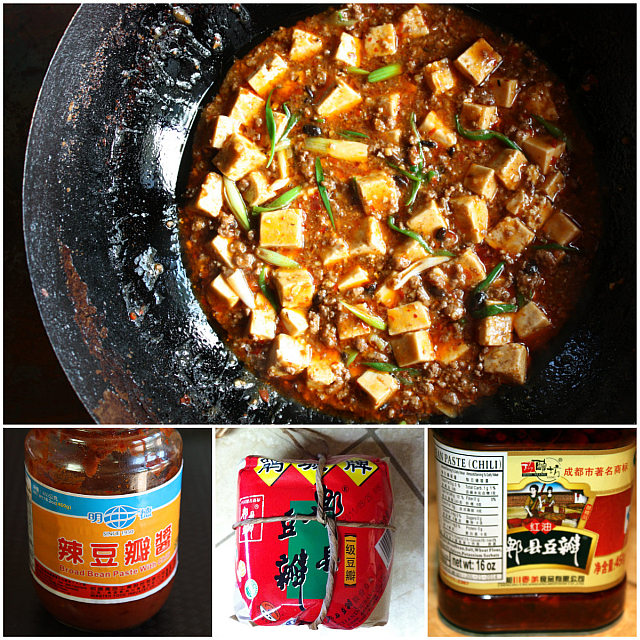
The first tofu dish that I really fell in love with was ma po dou fu (aka mapo tofu) a Chinese specialty made with ground meat, tofu, salty/hot/rich sauce and numbing Sichuan peppercorn. If you have Asian Tofu, the recipe headnote tells the story how as a teen permitted to tag along on an adult lunch, I quietly ate most of what was served while the adults socialized. I wasn’t anti-social. I’d discovered a ridiculously delicious dish.
Over the years, I’ve tried out countless mapo tofu recipes and finally went to Chengdu, the capital of Sichuan province, where the dish originated. It was a central part of my tofu field work because I was looking to explore tofu hot spots and iconic dishes. While I learned a lot about various renditions of mapo tofu – from home cooks and restaurants including Chen’s (a chain built on the original version), I gained insight into what makes truly excellent versions: Dou ban jiang (or doubanjiang), a seasoning sauce made with fermented broad beans (fava beans) and chile.
The brick-red sauce may seem mysterious but once you try it out in mapo tofu, it lends a wonderfully savory, fundamental funk like no other. If you’ve made mapo with other chile sauces or bean sauces, they’ll pale by comparison to the results made with dou ban jiang.
The problems is that dou ban jiang can be tricky to find in Asian markets because the product name and packaging varies. I’ve spent too much time in the condiment aisle looking for the “good” stuff, deciphering Chinese characters and then taking my chances. I hope the information below helps you find dou ban jiang that’s to your liking!
Where to find it: At Chinese markets in the condiment aisle or sometimes the Sichuan section. Look high and low and at end caps. Sichuan cooking is “hot” right now.
Names: This kills me. The main ingredients are chiles, fava beans (aka broad beans), and sometimes soy beans. Dou ban jiang can go by chile bean sauce, broad bean chile sauce/paste, dou ban jiang, or toban jhan.
Packaging: The Asian market may carry this seasoning in jars, soft plastic packages, or bamboo or twine wrapped packages.
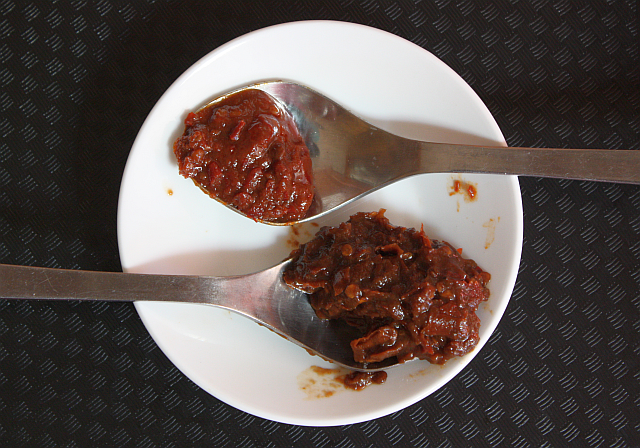
Coloring: The darker the sauce, the more mature (salty/spicy) it is. Some brands from Sichuan tout the time that their sauce has matured.
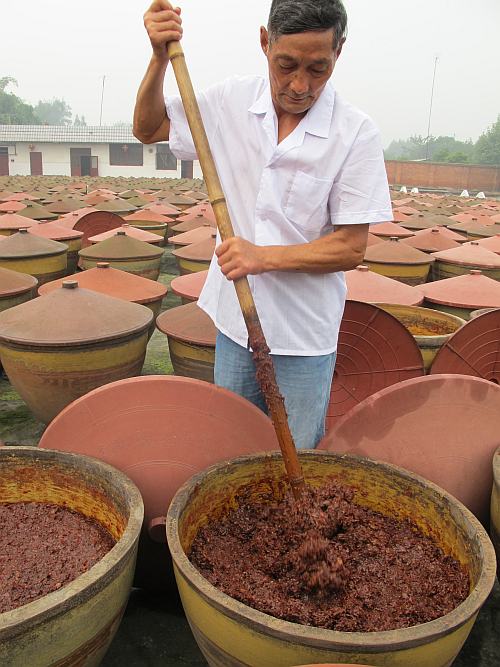
Pixian dou ban jiang: This is the preferred kind for mapo tofu since it’s made in the town of Pixian in Sichuan province. Uber Sichuan chef Yu Bo took my friends and me to a very old, well regarded artisanal producer of Pixian dou ban jiang. There was a baseball field full of urns in which beans and chiles fermented under the Sichuan elements. The mixture was turned by hand on a regular basis, as you see below.
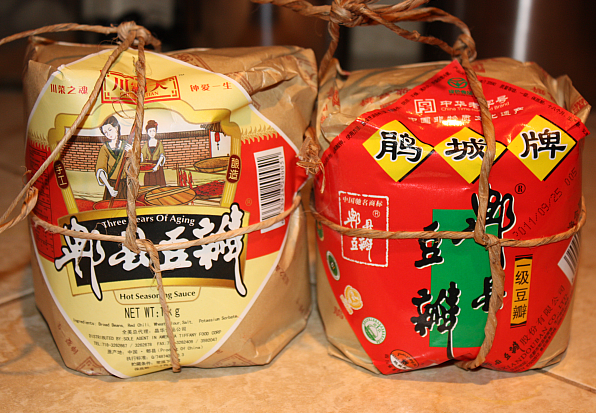
Brands to buy: Get the Pixian kind of chile bean sauce, if you can. The ones sold wrapped in paper and tied with twine are very good. If a kilo is too much to handle, get the kind in jars. (Or, how about sharing it with friends?)
Chile bean sauce is made outside of mainland China and there’s pretty good stuff. Taiwanese Minh Teh brand is terrific and less assertive (thanks to a little sugar and sesame oil) than its Sichuan-made cousins but look for the right name on the jar because the company’s labels tend to look the same. If all else fails, Lee Kum Kee’s Toban Jhan is typically carried at Asian markets; it’s decent stuff though not as complex as others.
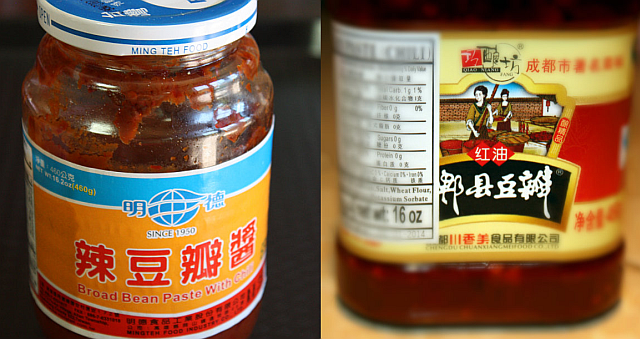
Sometimes, the pixian dou ban jian contains oil, which usually but not always an indication of a mellower flavor. When there’s oil, you’ll see the characters 红油 (hong you, literally red oil).
Storage: If the sauce didn’t come in a container, transfer it to a jar or airtight plastic tub. I’ve left it in the plastic bag for too long and it aged. Refrigerate indefinitely.
Finesse dou ban jiang in your cooking: There’s a flavor profile for chile bean sauce but each brand has its own level of heat and saltiness. Taste your and then gauge the usage in a recipe. Often times, you can gradually add the sauce to a dish like you would salt, soy sauce and fish sauce. Master the brand that you buy.
Dou ban jiang uses aside from ma po tofu? I use it mostly for Sichuan dishes like dressing pressed tofu and peanuts and to make a vegetarian favorite of mock bear paw tofu (see Asian Tofu for recipes on pages 138 and 159). Dou ban jiang perks up tofu exceptionally well because of its big umami attributes and bold flavors. On the other hand, it’s terrific in Chinese-style spicy beef noodle soup. (Here's an Instant Pot version too!)
If you’re familiar with dou ban jiang chile bean sauce, what’s your favorite brand and how do you use it?
Related post: High on Spice: 4 Kinds of Sichuan Peppercorns to Try

Matthew Amster-Burton
I love this stuff; the one I buy is the one-kilo sack on the left in the second-to-last photo, and I use it all the time.
Two things I'd add to this awesome post: (1) Aged doubanjiang from Sichuan usually needs to be chopped before use. The one I buy has big shreds of dried chile and whole fava beans. In Sichuan, I'm told, they mince it with a pair of cleavers on a cutting board; I just threw the whole kilo into the food processor and blended it up. (2) One of the best things you can make with doubanjiang, other than mapo tofu, is ants on a tree (aka ants climbing a tree), spicy bean thread noodles with ground pork. Here's a great recipe from Terry Durack, via me: http://www.culinate.com/books/collections/all_books/hungry_monkey/ants_on_a_tree ; by all means use more doubanjiang than the recipe calls for if you like it hot.
Susan
Do you mind providing your recipe for mapo tofu? It looks amazing!!!!
Diane
I use the Ming Teh stuff, as it's available at 99 Ranch. But I want to find that stuff in a sack!
Shirley
A timely post! I am learning to cook Sichuan dishes. So far I haven't found a favorite dou ban jiang. (There are so many of them at the market.) I will definitely try your suggestions. Thanks.
Lee Burns
I always have a hell of a time figuring out which chilli pasta to buy in my Chinese supermarket, this will really help. Thanks!
Rosa
That is such a wonderful dish and that sauce sounds amazing! I'll have to see if I can find that chile bean sauce as I am really intrigued by your description of dou ban jiang...
Cheers,
Rosa
Maria
I was excited to read about your book in the Wall Street Journal this week. I adore Mapo Tofu and, like the author, live in Northern California - specifically the Bay Area Peninsula. I've had a very hard time finding a restaurant that consistently cooks great Mapo. No sooner than I find a place, the restaurant comes under new ownership and the chefs move on. Does anyone have any recommendations? In the mean time, I'm excited that I can make it at home and have some guidance on Dou Ban Jiang. I've tried the Spicy Bean Sauce (with subtitle Ma Po Sauce) by Lee Kum Kee. Blech!!! Salty with horrible after taste.
Norio
Besides Mapo Doufu, I like to use it for Hui Guo Rou (Twice-cooked Pork) and Yuxiang Qiezi (Sichuan Eggplant).
I like Lian How brand.
Thanks for the info and pictures of the Pixian type. I know what I'm getting the next time I go to SF or 99 Ranch. =)
Andrea Nguyen
One of my favorite uses for dou ban jiang. I have a jar of Lian How brand and was wondering who else used it... 🙂
Andrea Nguyen
I was thinking of you when I posted this. I never thought of chopping it up because the stuff I get it not too chunky. Thanks for the tip, Matthew.
Andrea Nguyen
Susan, the recipe is in Asian Tofu, as well as in the Wall Street Journal story linked to above. For Asian Tofu, your library may have a copy of the book. Thanks for asking!
Andrea Nguyen
My pleasure, Rosa!
Andrea Nguyen
Maria, yeah, the LKK version is yucky bland.
Kris
I usually buy via online mail order. Here is a nice collection: http://posharpstore.com/en-us/bean-paste-doubanjiang-c121.aspx
Norio
Andrea,
Have you found a place to buy Pixian doubanjiang in the Bay Area? I've been looking in Sacramento, but haven't seen it. =(
Deb
I have been looking all over in my area for Lian How Chili sauce. Do you know where I could purchase it? Thank you.
Dennis M Reed
amazon.com seems to have some of the desired products