

Raise your hand if you dislike brown rice and love white
rice but know that white rice isn't the healthiest thing to eat all the time. If
you did, we are members of the same club. I've tried to like brown rice but
it's too heavy for most Asian foods and takes so long to cook.
Several years
ago, I discovered Japanese short-grain rice that was partially milled. It was
at Nijiya market, a small chain based in California that organically grows its
own rice in California. And, you could buy it at 100, 75, 50, 25 and 0 percent.
The 100 percent is white rice and 0 percent is brown. (The Nijiya online store doesn't carry a full selection.)
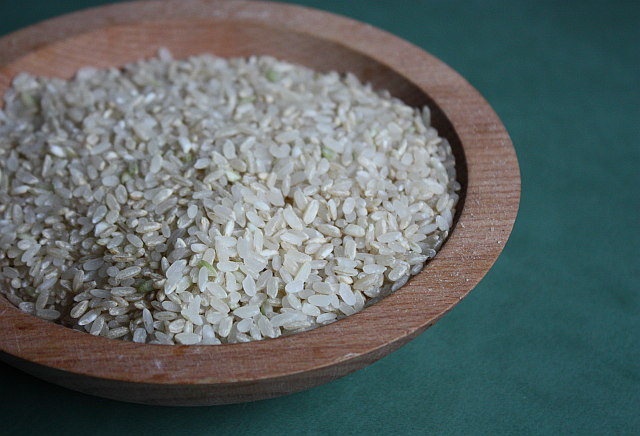
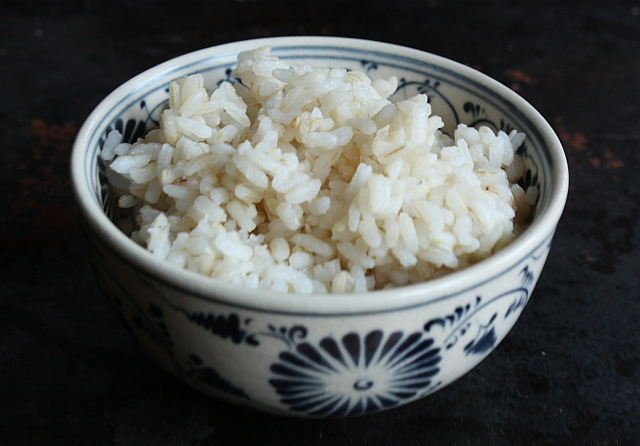
I bought the 50 percent Akitakomachi rice and found that it cooked up at the
same rate as regular white rice. Amazing and with half of the bran intact, the rice retained some of the healthy aspects of
brown rice. I wanted to call it brown rice but my husband coined the term "beige
rice." The rice was delicious - separate fluffy grains with a faint earthy sweetness.
We found ourselves eating more rice than we normally did. It was better for us, no?
Why did it take so long for me to share this? It's because I
thought that it was rice that could only be found at Nijiya market. Unless an
Asian ingredient is more or less widely distributed, I'm reluctant to
recommended to you. It would be a terrible tease.
But I had a revelation when I was in Tokyo in 2010 doing
research for the tofu book. One day, Japanese food authority Elizabeth Andoh
took me boutique food shopping at Takashimaya. Turns out that in Japan -- get
this - you can buy unmilled rice and specify to the vendor how much bran you
want removed! The vendor dials your request into a milling machine and you get
customized rice on the spot. I was floored and came back to the U.S. thinking that
Nijiya beige rice was an extra special Japanese experience to have in America.
That all changed late last year. Studying the rice area at a
Chinese market in San Jose, I realized that there was partially milled beige
rice. I just never spent enough time deciphering the Japanese rice bags to
identify the stuff. I decided to try Sun
Valley Rice's "Gen Ji Mai" rice, a medium-grain rice that promised more
nutrients than white rice.
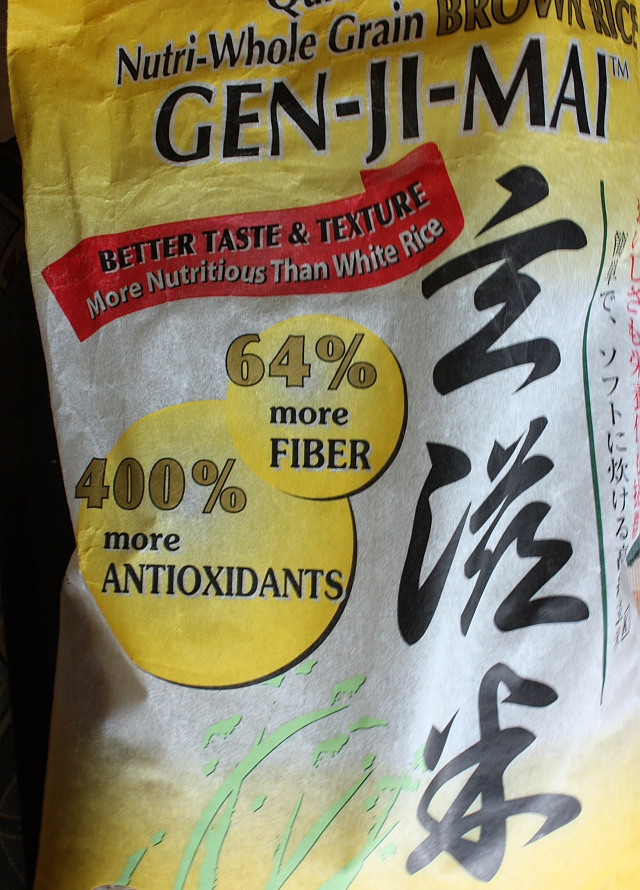
There was also Sukoyaka brand, among others, but the Sun
Valley was on sale. Labeled "brown rice," the bags can easily be dismissed as
regular brown rice. They're not. You'll notice that these rice are more
expensive than regular white and brown rice. My on-sale price was $14 for 15
pounds. The Nijiya market rice is about double that but you're paying for
organic. You pay a premium for the beige rice.
There are packaging claims that the rice contains outrageous
amounts of nutrients not found in white rice. I am not sure if I feel that much
impact but it's a great, more fiber packed alternative to white rice. As a side
note, when we do make white rice, it tastes extra extra good.
How do you cook beige
rice? In my limited experience, I've found that beige rice cooks up with
the same amount of water and in the same amount of time as white rice. That
said, for stove-top cooking:
- short-grain beige rice: 1 cup raw rice: 1 cup
plus 2 tablespoons water - medium-grain beige rice: 1 cup raw rice: 1 ¼
cups water
If the rice is "new crop" back off the water by about a
tablespoon. The cooking process remains the same. (See "How
to Cook Perfect Rice" for guidance.)
Where to buy beige rice? I found mine at Lion Market and
imagine that it's sold at Ranch 99 as well. Japanese markets, such as Mitsuwa,
Nijiya and Marukai will have it. Korean markets like H-Mart probably stock it
but I never noticed. It's also sold online but it's a little weird to buy rice
from Amazon. Watch the shipping costs.
If you already know
about this rice, what do you think of it? If you're new to beige rice, check it
out.
Related posts:

Katie says
Oh, it's killing me just to be reminded of Nijiya. I used to live about 1.5 miles from the one in Sunnyvale... but 2.5 years ago we moved to the East Coast. That place was amazing... and the rice was *so* good. I was wondering why the markets around here never had rice nearly as good. *sigh* And they had an amazing selection of onigiri and such.
Andrea Nguyen says
Ooh, sorry, Katie. There's a Nijiya in NY and Mitsuwa in New Jersey. I can spend a hour in each one of them and they're not even that big!
Naomi says
Partially-milled rice is called "haiga-mai" in Japanese. It's the "everyday" rice in our household!
Suzette says
Oh, I'll have to keep an eye out for this! My friend mixed brown and white rice (rice cooker) and my husband was not keen on it. Hubby clings dearly to white rice, but maybe if I slowly make the switch, he won't notice as much? 🙂
Andrea Nguyen says
Naomi -- I was hoping someone would reveal the Japanese name for partially-milled rice. It's misleading to call it "brown" rice. THANK YOU.
Andrea Nguyen says
Suzette, beige rice is a great in-between rice. I think your husband and my husband are like-minded rice men. Yours will dig the haiga-mai beige rice. Enjoy.
Suzette says
I think he gets it from his parents...they are particular about their rice and only eat new crop white. We have been tasked this weekend to go to Chinatown and pick up 7 bags for them! I'm facing an uphill battle for sure, but I'll check for the haiga-mai while I'm buying a carload of the new crop!
Michelle says
We're cutting down on carbs here (boo...) and try to eat brown when I do indulge but it's just not the same! The idea of being able to have my (almost) white rice with more nutrients is so intriguing. I've been seeing haiga rice at 99 Ranch but was unsure of what it was. Guess it's time to pick up a bag!!
Diane says
Yup - that's me. I know I should eat brown rice, but don't like it nearly as much.
Lately I've been doing 7-8 parts brown rice to one part black (either fobidden black rice, or black sticky rice), and soaking it all day before cooking it. It makes great - very flavorful - "purple" rice. Tastier than brown, for sure.
Pat says
Hey Andrea, Tamaki brand haigamai is available at Ranch 99 here in the Seattle area. I believe they're a California brand. I love it but it's pretty pricey so I don't buy it all the time. And I cook it the same as white rice. I have a claypot method on my blog that a Japanese cooking instructor taught me on my blog too: http://theasiangrandmotherscookbook.wordpress.com/2009/03/25/the-ritual-of-rice/
ann says
Our family prefers Gen-Ji-Mai brand. Other partially milled rice brands do not cook up the same way. Sometimes Gen-Ji-Mai partially milled rice goes on sale at Marukai for less than $12.
Diana says
Wow, good to know! I also have a hard time switching over to brown rice...the texture just isn't the same. Will have to look for this the next time I'm at Mitsuwa!
Andrea Nguyen says
God, I was in the dark for so long and not seen the "Haiga." Duh. Check it out.
Andrea Nguyen says
Sneak it in? Good luck.
Andrea Nguyen says
You're so committed, Diane. For my everyday rice, I'm too lazy to soak ahead. Good for you.
Andrea Nguyen says
Terrific link, Pat. Thanks. Part of my problem -- I'm beginning to realize -- is that my Chinese-Viet market doesn't label the rice as Haiga. I don't shop at Ranch 99 because it's not a great one. In Seattle, where Uwajimaya clearly communicates, I bet Ranch 99 does an extra good job to explain what something is.
Andrea Nguyen says
I like the Gen-Ji-Mai A LOT, mainly because it's a medium-grain rice. I'm not keen on short-grain because it is too chewy for my taste. Thanks for the Marukai price tip.
Andrea Nguyen says
Man, crossing the road to brown rice for everyday eating is so hard for me. Beige rice is a happy middle.
Rachelle says
Was trying to find this at HMart in Chicago yesterday and failed, I'll have to make a trip to Mitsuwa
jorgebob28 says
I've been eating Sukoyaka Genmai for a few years. I would like to keep eating white rice but I've got to watch my blood sugar. It's far better than brown rice because brown rice can go bad pretty quickly. My rice cooker has a setting for semi-brown rice and it cooks the rice quite well. You've got to lightly turn and mound the rice about 15 minutes after it gets done cooking then let it sit another 30 minutes before consuming.
I grew up on my grandmother's rice in Japan so our family is very picky about the quality of rice. Good rice (white or semi-brown) will cost between $1.50 and $2.00 per pound in 15-pound bags, normally. Quite often the stuff that's on sale is to clear the stock before the new crop comes in.
Laura Chau says
Hi Andrea - nice talking to you today at SLT. The beige rice that I like is Shirakiku Sukoyaka Genmai brown rice. If you miss the Nijiya sale, it's on sale at Mitsuwai - Feb 21 thru Feb 24. $18.99 for a 15# bag.
andrewau says
This rice sounds really good, but I haven't been able to find it in Adelaide, South Australia, even though I've looked in quite a few chinese supermarkets. Does anyone know of anywhere this can be obtained in Australia?
Scrapaloha says
In Seattle, Shoreline central market has this. We just picked some up. They are way better than Uwajis for price! We are going to try hapa (half and half) rice to start.
Robyn says
Hi Andrea
Not at home so can't check the label. Bought small stick packs of mixed grain to add to white rice to up nutrition, when I was in Japan, there was a myriad available 3 grain, 5 grain, 7 grain, 9 grain、some with many more. Very similar to what I do when making multi-grain bread. Still haven't used them all but when I run out plan to make up a jar. Think barley, amaranth, quinoa, millet,sorghum,oats, triticale, teff, etc etc.Rice prepared as usual, for 3 Japanese cups (180ml) of dry rice, 30g grain mixed with 50ml water is added and blended with rice and water, prior to cooking as usual. Such a small amount is almost undetectable in cooked rice.