


My friend Bee Yinn Low posted a recipe on how to make sweet tofu pudding on her site, RasaMalaysia.com. She asked me to give tips on doing it well because she had a little trouble with her sweet doufu hua recipe. Among the comments that Bee received were ones about what to use for coagulating soy milk to produce tofu. People were very confused and I fielded their questions. Obviously, they didn’t have my book, but more importantly, clarification is needed. So here we are.
To make tofu you need 3 ingredients: soybeans, water and coagulant. What are your coagulant options and how to choose and get them? I hope to answer your questions here.
What does a coagulant do to soy milk? It solidifies the protein and oil in hot soy milk.
Can you use agar agar or gelatin to coagulate soy milk? No, unless you want to produce soy milk gelatin. “Almond tofu†is gelled with agar agar or unflavored gelatin but it’s more of a jelly than a tofu. The term tofu is often used in China and Japan to denote many jelled things. Tofu is really a different animal. It’s not thickened with a starch or gelatin type of ingredient.
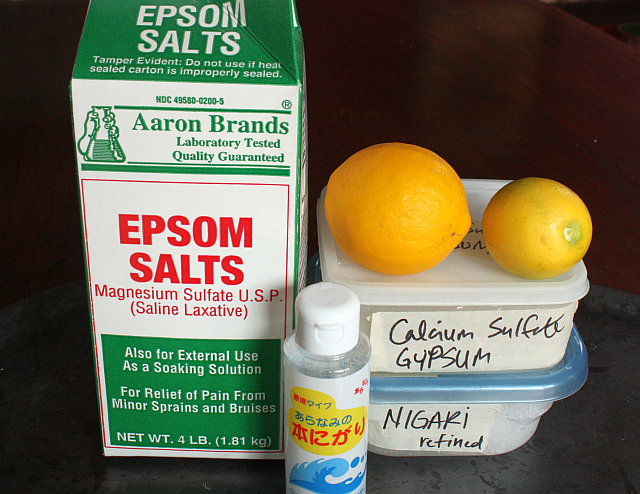
What can be used to coagulate soy milk for tofu: Many things, from everyday vinegar, lemon juice, and recycled/fermented whey to gypsum (calcium sulphate), Epsom salts (magnesium sulfate), nigari (magnesium
chloride), and glucono deltalactone (GDL).
Do Japanese tofu makers exclusively use nigari while Chinese tofu makers favor gypsum? No. I asked tofu makers in Taiwan, Japan, and China and it just depends on what they and their customers like. Look on tofu labels and you’ll see that some tofu is made with a combination of coagulants to get at the desired texture. GDL, for example, is added for a more jelly-like finish. There are ethnic divides (e.g., hardcore traditional Viet tofu shops such as Dong Phuong, portrayed in my Asian Tofu cookbook, use recycled whey) but they are also blurred.
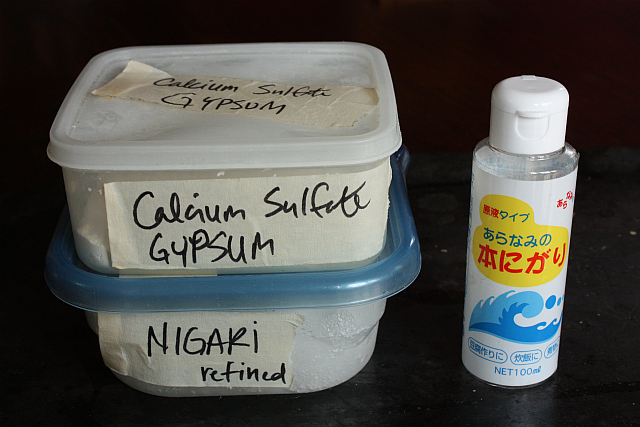
What tofu coagulant is easy for home cooks to use? Gypsum and nigari are the best (and equally good), with Epsom salts coming in third. An acid such as lemon juice or vinegar produces grainy tofu that’s slightly sour tasting. Go with a type of salt!
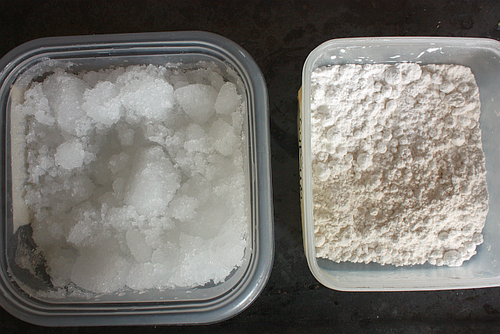
If you can have only one tofu coagulant, which should it be? As suggested in Asian Tofu, gypsum is the most versatile soy milk coagulant. It produces tofu that’s a little on the sweet side whereas nigari tends to be a touch bitter. The curds are a bit loftier with gypsum so you can coax soy milk into tender tofu. Nigari coagulates quicker but the curds can be smaller than those made with gypsum so your tofu is firmer. Pictured below are refined nigari (left) and gypsum (right).
Epsom salts yield slightly grainy results with flavor similar to that of gypsum. If you have room for two (2) tofu coagulants in your life, get gypsum and nigari. If you're in a desperate pinch, run to a drugstore for Epson salts.
How do I find gypsum, nigari or Epsom salts? Use food-grade gypsum (not the stuff in drywall!) to make tofu. It’s used by some brewers and winemakers to tweak pH. If you have a local home brewing supply shop, call and ask for gypsum. Food-grade gypsum can also be purchased online.
Nigari comes as a clear liquid in small bottles, as crystalline or granulated nigari that resembles wet sand, and as dry fine crystals. At Japanese markets, you’ll likely find nigari in small bottles that have little (okay, no) English. In Asian Tofu, I included a photo of the bottle (above) to help cooks find the right kind. Macrobiotic stores or sections in a health food store may have nigari too. Here's liquid nigari from North America and you may also purchase nigari crystals online too.
Epsom salts is widely sold in the United States at pharmacies and drugstores. Yes, it’s a laxative and muscle soother but it also works for tofu.
What do I keep around? The stuff I mostly use is gypsum and refined nigari. It’s handy and I can travel with it without TSA searching my carry-on. [Since writing this post, GDL has become available online but I'm not a fan of how it makes tofu jello-like.]
Any brands of coagulants to avoid? I had trouble with these pictured below.
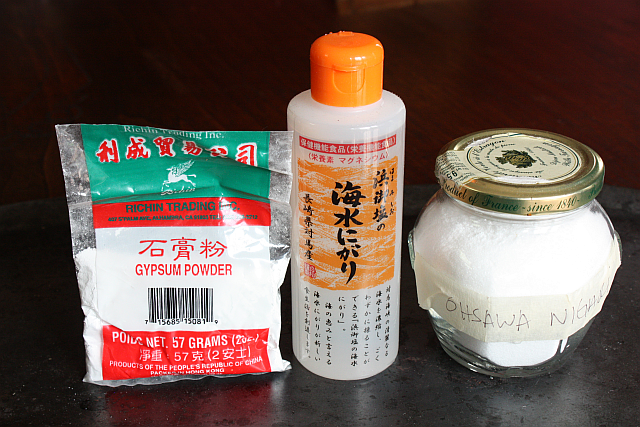
The gypsum in the small plastic bag came from a Chinese market. I opened it up, and it released a strange perfume. I didn’t want that smell in my tofu. If you have a Chinese brand that you like, use it. My preference is to get it from a reliable source. After taking time to make soy milk from scratch, why take chances on the coagulant?
For some weird reason, the liquid nigari in the orange-capped bottle produced very yucky tofu. One of the testers bought it and his soy milk didn’t coagulate quite right. I had the same experience when I used it. The bottle was stocked at Marukai. At other Japanese markets, I’ve mostly found smaller bottles with the white and blue label.
The last is very fine, dry nigari from Ohsawa, a producer of Macrobiotic ingredients. I got it at the Venice, CA, Whole Foods and the curds were finer than those made with chunkier grain, wetter nigari. I may be wrong as Amazon reviews of the Ohsawa nigari have successfully used it for tofu.
How to store tofu coagulants? I store my tofu coagulants in plastic tubs at room temperature. The liquid nigari bottles are kept at room temperature too, though they will form salt crystals if kept too long. The liquid still worked for making tofu.
Got any insights or questions about tofu making? Let me know...
Related information
- Homemade Tofu Recipe Videos and Tips to Succeed
- Is tofu healthy or harmful? - For those who question eating soy.
- Asian Tofu cookbook - My 2012 book on how to make different kinds of tofu and also tofu recipes that highlight the wonders of tofu in Asian cuisines. It's available as a hardcover book and as a Kindle ebook with video tutorials. If you're just into DIY tofu by going from bean to curds, check out the mini tofu making ebook!
- Soybeans Buying Guide -- here's a post that lays it all out!
- Tofu molds - choose from plastic or cypress (wood).

Suzette says
I laughed when I read "not the stuff in drywall." I remember after chowing down on tofu-fa as a child, my sister told me not to eat so much, as the coagulant is the same as what they use for casts on broken limbs! 🙂
Chris says
I have used Oshawa brand nigari many times and it works perfectly. Maybe you had a bad batch? I usually get away with using much less then recommended amount by tofu recipes for magnesium chloride so I assume it is pure and the real deal anyway.
One thing I have found with magnesium chloride is that it takes on moisture really easily and gets "wet" if not stored properly. A few hours on a tray in the toaster oven set on a low temp dries it out again and still works like a charm.
Andrea Nguyen says
Ha! The first time I asked a beer microbrewer about gypsum, he jokingly said, "You mean the drywall stuff, right?" Hardy har har. But then I realized that it was an issue for people...
Andrea Nguyen says
Chris, I'll try it again. The soy milk coagulated but it was a textural thing so I think that you are right about its concentration level. I didn't discard the Ohsawa nigari so I'm willing to try it again.
Ah, well, the wet magnesium chloride has been okay with me. As you see in the tub above, mine is always wet. It arrived wet. Great tip on drying it out. It's just a salt, right? 😉
Bee says
Andrea, this post is such a great resource. Thanks for posting this and clear up all the questions that many people have. You're awesome!
Pepy says
You're absolutely succeed to bring me look into more this post. Thanks for great posting!
Surely you've made me to dig my old memory on how to make tofu at one of classes when I was on school back home. Most Canadians that I know were not very enthusiast about tofu. But I always say buy Asian tofu not bule (an Indonesian slang term for Caucassian) tofu. You will taste the different. I enjoy tofu but my old time favorite is tempeh which needs a fermentation to make. Tempeh at the store here doesn't have the same taste.
terri says
Has anyone else had problems when using gypsum to make soft tofu? Sometimes I can detect a faint grittiness near the top, as if there are a few grains of gypsum that either remained undissolved or somehow precipitated out when the tofu was steamed. I'm wondering if the issue might be the hardness my water (I use filtered tap water) to make the soymilk and dissolve the gypsum. None of my taste-testers have complained about it, so perhaps I'm only noticing it because I love tofu so much that I can eat it with just a drizzle of soy sauce...
Diane says
I've used gypsum to make soft tofu and it worked brilliantly. I did stir obsessively just before adding it though and stirred as I poured it into its molds for steaming, so I'm sure it mixed in well.
I use mostly gypsum (have used nigari once or twice) and bought it in bulk at my local brewing supply store. Buying it was funny as the tiny $3 bottle of gypsum seemed like a ripoff so I asked if there were bigger amounts I could buy. "Oh sure, you can buy it in bulk," the nice sales guy said. So I bought a 1/2 lb. But I felt like I was conducting an illicit transaction as he hustled back to the back room to weigh out on the scale a quantity of white powder. Still, it was cheap, and will last me quite a while!
Andrea Nguyen says
I agree!
Andrea Nguyen says
Love your gypsum story, Diane! I know, the $3 little bottle seems like a rip off, huh? But sounds like you're hooked on homemade tofu. 🙂
Andrea Nguyen says
Hi Terri,
The gypsum that I've used is powdery -- like cornstarch in texture. That's why I've not experienced any grittiness. You do want to dissolve it well. We have awful water where I live and I use filtered tap too.
Sometimes with soft tofu, there are little bubbles at the top. Maybe you're sensing that texture. Another thing to try is to back off the gypsum a bit. If the soy milk is coagulating well to the tofu texture that you want, you can afford to reduce the quantity of gypsum.
Thanks for sharing. I learned a lot.
Andrea Nguyen says
You are too, Bee!
terri says
Mine is powdery, too. I did a little research, and gypsum is supposed to have a solubility of only 2.0-2.5g/liter at 25C (77F), but it becomes less soluble at higher temperatures. I'll try using less and see what happens...
yin says
Thanks for the informative post - have recently started making tofu and this has been very helpful. So far, i can only get crystalized nigari (which i will probably have to grind down to powder) - any advice on the proportion of powder to water? thanks 🙂
SophieQ says
Where to you buy your gypsum? So the soy milk has to be at 77F, is that right?
Douglas says
the soy milk should be close to boiling when you gradually stir your coagulant in. Stir in around 3/4 of the coagulant slowly. After 2 or 3 minutes check to see if there are milky areas left, if so add the rest of coagulant. Then pour curds into tofu mold.
Andrea Nguyen says
For big curds, I like to let the milk cool a bit. Thanks for your insights!
Hung says
How about making tofu with leftover whey from previous batch? Its the traditional Vietnamese way and I heard it gives more flavourful tofu. Just bought 2kg of soybean and will try to make tofu the first time ever soon.
Vậy còn cách dùng nước chua từ mẻ trước thì chất lượng đậu phụ như thế nào so với dùng muối cô nhỉ? Cháu nghe nói nó ngon hơn nhưng không biết cơ sở khoa học (nếu đúng nó ngon hơn thật) là như thế nào.
Andrea Nguyen says
In my book, Asian Tofu, I visit with a Viet tofu shop in Little Saigon. To make tofu with whey, you have to have a lot of it and let it ferment. It's tricky and requires careful calibration. I don't think it's a deal maker or breaker. Choosing good beans is super important. People make a big deal about the coagulant choice but when I talked to tofu makers in Asia and America, we discussed beans first. For home cooks, it's easier to buy coagulant.
Remittancegirl says
Have you any idea what any of the coagulants are called in Vietnamese? I live in HCMC, and there's a lady who makes fresh unsweetened soy milk on the next street over. I thought I'd have a go at making silken tofu, but I can't figure out how to ask for, or buy, the coagulants - magnesium chloride or gypsum
Gina says
I got your book and I'm so looking forward to getting the gypsum (had to special order it at the beermaking store) so I can make my own and use your recipes. I'll have to make my own mould though, because the online suppliers charge way too much to ship to Canada.
Thank you!
Gina
guest says
So where is the recipe for making tofu ?
john lee says
why did you say that tofu made with gypsum has a little sweet taste? How does it,the actual ingredient calcium sulfate ? magnesium chloride will produce bitter taste is true.
Andrea Nguyen says
When I did a side-by-side tasting of homemade tofu using the same beans but different coagulant, the one made with gypsum had a slightly sweet taste and the nigari one had the bitter taste. I'm not the only person who says this. Tofu makers I've spoken with agree. Some tofu makers mix gypsum with nigari.
Maricel joy perlas says
Where to find the exact measurement of each ingridients on making tofu
Andrea Nguyen says
In my book -- Asian Tofu, which your library may have. It's available at Amazon:
http://amzn.to/2ETx0Hs
Also, I have an ebook dedicated to making tofu: http://amzn.to/2F9xoAY
Thanks for your interest!
liska says
Hello and thank you for the clear and informative postings.
Could you write roughly how much of the top 3 coagulants one would use to say 1litre soymilk?
Tofu Blessings
Andrea Nguyen says
It depends and you need to finesse. I offer guidelines in my book Asian Tofu. There's also a small ebook just on making tofu too!
Here is the info for those publications:
Asian Tofu: https://amzn.to/2DlNIwk
Making Soy Milk and Tofu at Home ebook: https://amzn.to/2UHct0X
Karen says
Hi Andrea, thanks for your insight into the different coagulants and how they work. I'm glad to find out that Epsom salt can also work as a coagulant to replace gypsum powder. Epsom salt is more readily available for us to I would like to try that out with my recipe that calls for gypsum powder. Do you replace using 1:1 ratio, i.e., for 1tsp of gypsum powder, I can use 1 tsp of Epsom salt instead? Thanks for sharing.
Andrea Nguyen says
Karen -- This DIY tofu video recipe will help you: https://www.vietworldkitchen.com/blog/2020/04/homemade-tofu-recipe-video-and-tips.html
Serafina Singapuri says
Hello Andrea, Thank you very much for the clear instructions and explanations! I made a batch of tofu today using lemon juice as a coagulant. For the next batch, I would like to try fermented soy whey, as I have saved the whey. If you could guide me on how to ferment the whey and then any other instructions for using it as the coagulant, I would greatly appreciate it! (I haven’t been able to find this info anywhere!) Cheers, Serafina
Andrea Nguyen says
I don't know the ins and outs of fermenting whey. However, if you've used lemon juice and like it, then measure the PH level of fresh lemon juice and match that PH with whey that you've left out to mature, ferment and sour. That's what I would do to experiment. Seriously. I have no answer for you. It's a tricky thing to do that some tofu professionals, especiallly those in Vietnam, practice.
Susan Miller says
In my experience, making tofu with lemon juice produces small curds, and a crumbly, grainy tofu. I would like to try gypsum or nigari, or maybe even epsom salts.
Andrea Nguyen says
I had that with lemon juice too. I suppose it would depend on the type of lemons too -- Meyer is less acidic than Eureka, for example. Oh boy, you'd have to measure the pH level. Yikes!
Roger says
As an avid experimenter of foods from Bakery to Filipino Taho or Soybean dessert, I always look for a better approach to the process. I find Nigari as a coagulant so bitter in taste for a Soybean.milk coagulant. While I have success in using Gypsum, the suggestion of 2 Tsp of Gypsum does not really coagolate an 8 Cups of Soybean milk. I used 5 Tsp of Gympsum Sulfate and still did not get the desired result I wanted, a Silken Soybean dessert
What is really the best way to coagulate a Soybean milk and the amount of Gypsum needed. Any amswer is apprecoated, thank you.
Andrea Nguyen says
How much you use depends on the thickness of the soy milk and how much you measure a spoonful of coagulant. Just fiddle to get what you need. I used a quantity based on my formulation. Sounds like you have what works for you.
Egghead says
Somehow, tofu has become one of the most confounding groceries on the shelf. Luckily there are experts out there to tell us what tofu to buy, and how to keep it fresh at home.
Milly says
I tried making my own tofu and had an issue I'm hoping you can shed some light on? Before I added the coagulant, the milk (as I was heating it) thickened to the consistency similar to polenta/a very thick custard. Not sure if my heat was too high/heated for too long, if I didn't use a fine enough filter for the milk etc.
Any thoughts?
Andrea Nguyen says
Wow, that may have been due to particulates left in the milk. But did the soy milk coagulate? It's never happened to me before and I'm incredibly curious.