





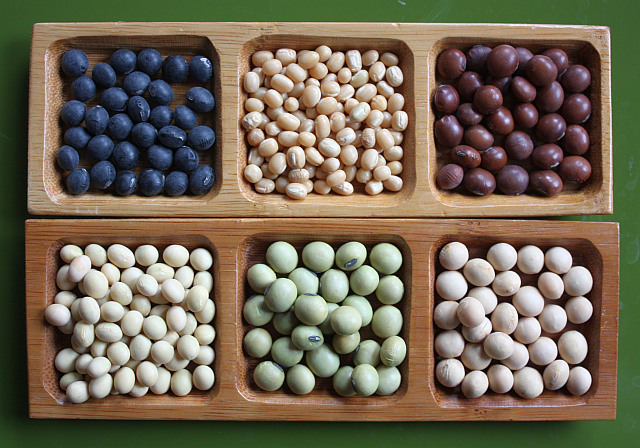
After the post on tofu coagulants, I got thinking about soybeans and dragged out my little collection of them. I imagine that you’re not surprised by my stash. I picked up different kinds while I was on the tofu trail. Some came from the health food market down the street while others were found at Asian markets and overseas. The other day while cleaning out my luggage I found a soybean I brought home from China. What’s with all the beans?
For one thing, there are so many ones! They are beautiful, with a wide array of colors and sizes. The little ones above are for making Japanese natto (slimy fermented soybeans), for example. Until I started working on the book, I had no idea that soybeans were that diverse. I just thought that they were yellow beans. Additionally, I wasn’t aware of their countless uses, from industrial uses to biodiesel.
I was mainly interested in finding good ones for soy milk and tofu. But when I started looking around for soybeans, I found out that even soybeans grown for human consumption vary.
For example, these soybeans from Kitazawa Seeds, for example, are not for drying and cooking up into tofu:
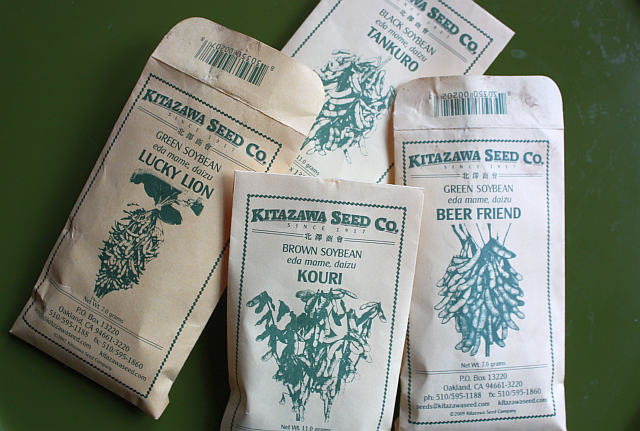
Grow those soybeans in your yard and you have soybeans for nibbling on. Such beans are more or less eaten as a green vegetable.
Want to grow your tofu from the ground up? That's extreme DIY tofu. Kitazawa sells a type of soybean that they say is great for making soy milk and tofu. It's called Shinonome. Note that they also have a Korean Black soybean that's suppose to be good for making fermented black beans.
So how do you judge a bean for your DIY tofu forays? It’s fairly easy, despite an early warning from 1970s tofu guru Bill Shurtleft that tofu makers were not willing disclose the source of their beans. I asked every tofu maker that I came across about their beans. The information below combines what I learned from them as well as my own personal experiences.
GMO, Non-GMO, Organic Soybeans
In the early stages of writing the book, I remember Naomi Duguid asking me, “What are you going to do about GMO beans?” My response was that I wasn’t going to worry about them. Non-GMO and organic beans are obtainable at many markets.
Indeed, there is a lot of scare about GMO soybeans because they are one of the major commodity crops in North America; the US exports soybeans to China and Taiwan. Here are U.S.-grown soybeans that I encountered in Japan:
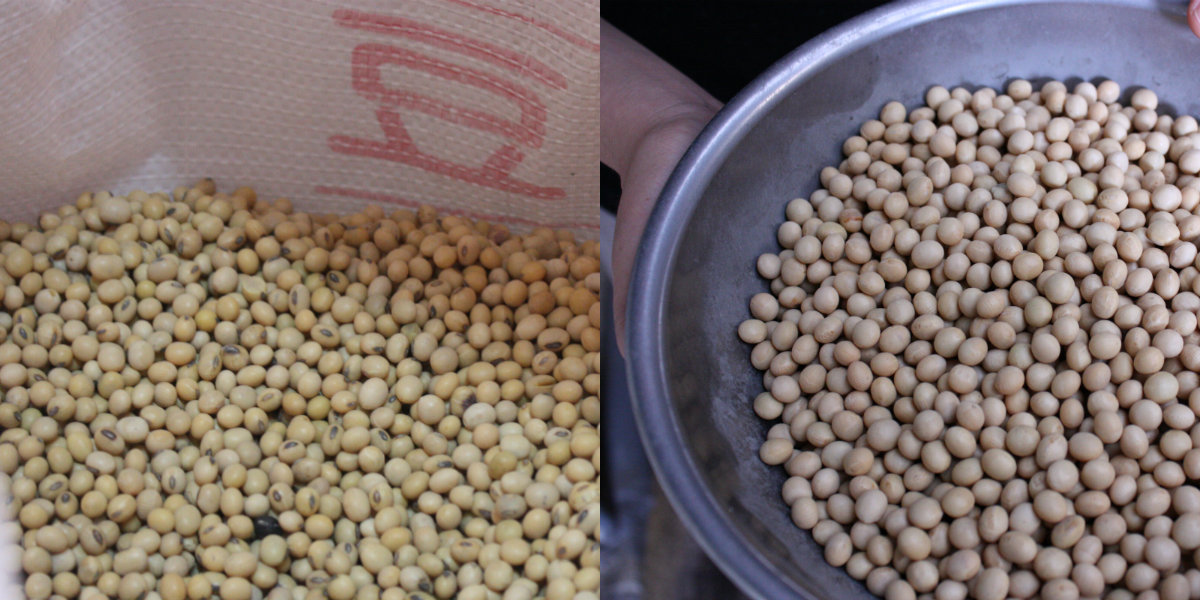
Soybeans bred for industrial uses (e.g., fabric, herbicides, printer toner), soybean meal for animals, nutrition bars and health supplements were not the kind of beans that I was looking to cooking with. The first batches of tofu that I made were fashioned from soybeans that I bought from Staff of Life, a hippie-era health food market in my neighborhood.
Do non-GMO soybeans make better tofu?
For me, yes. I’ve found that the flavor has been better. On the other hand, a Taiwanese tofumaker told me that he didn’t know where his soybeans came from. Non-GMO or not? The tofu maker didn’t know. Wang Fen Ji was a seventh generation tofu maker whose work employed the fresh spring water that flowed through his town located in the mountains outside of Taipei. His wife turned out to be Vietnamese. Double whammy for me.
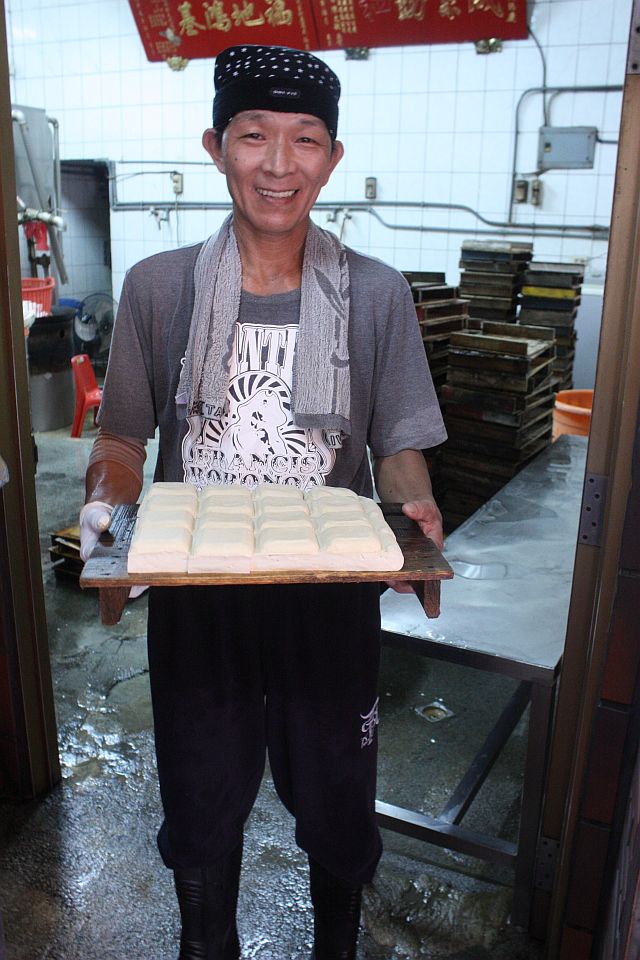
His tofu was amazingly tender and rich. The water was one of Wang’s secret weapons. His excellent tofu also depended on his craftsmanship.
That said, for us home cooks starting out, it helps to know how to pick your beans.
Looks Do Matter: How to choose your beans!
After experimenting with other soybeans, I realized that the ones from Staff of Life (a local health food store) weren’t great. I wanted to figure out how to judge a good bean from a bad one. All that you can do is look at them, right? As it turns out, looks do matter when it comes to selecting soybeans. Some tips:
Appearance: Choose handsome, clean beans with uniform size and shape. That means the beans were carefully grown and selected for your purchase.
Color: Despite the variety of colorful soybeans, the light beige or pale yellow soy beans are most commonly sold and used for making tofu.
Size: Look for large beans (think of a regular-size frozen pea) as they generally contain more protein and fat, which results in a higher yield. However, huge beans do not necessarily mean better tofu. When
comparing soybeans, peruse the nutritional label, if present, to determine differences between fat and protein content.
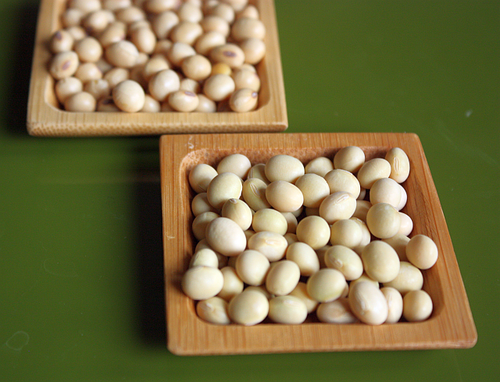
Hilum: Check for the soybean’s hilum, the “eye” that indicates where the seed had been attached to the pod. The hilum varies in color, but the choicest soybeans for making tofu typically have a nearly invisible hilum. You can hardly see it in the beans in the forefront of this photo below.
What do good soybeans taste like?
Raw, soaked soybeans are hard to digest. However, you can chew on one to taste it but just don’t swallow what’s in your mouth. Spit it out is what I was told to do during a tofu factory tour; I spit into a napkin. Good soybeans should have a pleasant, fresh flavor. They’ll also smell sweet when simmering on the stove.
Where to Buy Soybeans
Try different kinds of soybeans from a variety of sources. The price is reasonable so your experimentation won’t break the bank. Asian markets are great sources. I’ve even great beans at Chinese, Koreans and Japanese markets.
Mine health food markets, specialty grocers and supermarkets. Head to the bulk section to see what’s available. You may be surprised.
If you're really into knowing where your food comes from and want super fabulous tofu, consider buying soybeans directly from a single source grower. Iowa’s Fairview Farms cultivates Laura Soybeans, an excellent a non-GMO bean. It’s my favorite and if you’re into making your own soy milk or tofu, go for it. The best deal for home cooks is to buy 13 pounds.
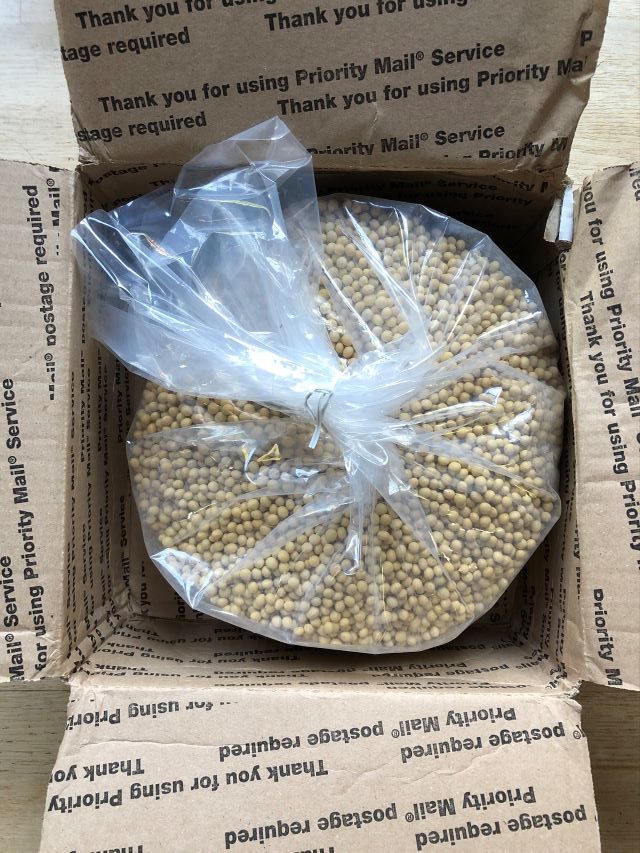
What to do with a big box of soybeans? Along with using them up yourself, how about sharing those beans? I’ve often put together a silent auction or gift package comprised of a copy of Asian Tofu (naturally, right?!), a tofu mold, coagulant, and soybeans.
Or, maybe make friends with a local tofu maker. See if he or she will sell you a few pounds!
How to Store Soybeans
Store dried soybeans in an airtight container at a moderate room temperature. My storage bin came from a Korean market, where super tight containers are available for kimchi and the like. I figure that soybeans would benefit from such Fort Knox security. If kept well, soybeans will keep indefinitely.
If you have tips or questions, add them below. Thanks!
Related posts:



Tami
Wow, so many beautiful colors and varieties. Totally inspiring post. 🙂
Linda | The Urban Mrs
I've never seen/ knew soybean in such wonderful colors. They look so beautiful! I've been reading your book, about how you got into US - what a life experience. Breathtaking and I really salute your parents for that!
Twan
I didn't know that soybean comes in different colors. Oh well, now I know. Thanks for the advices on how to choose soybeans with pictures. That makes it easier to follow.
Andrea Nguyen
Glad you found the info interesting! Soybeans are fascinating. 😉
Andrea Nguyen
Thank you, Linda! Greatly appreciate your support and interest.
Andrea Nguyen
My pleasure. Sometimes we think we know something but then on closer inspection, we learn something totally cool and surprising.
Cyndy
Your comment about the Taiwanese tofu maker utilizing the spring water in his town to make tofu reminds me of my first visit to Hong Kong, over 30 years ago.
my older cousin took us to the area where the airport currently is, to eat super fresh, delicate "dao fu faa". It was softer than silken tofu and was scooped in thin petal shapes from a vat. What appealed to me was the texture and the very delicate taste. That area was known for the dao fu faa, because it was hilly and there were numerous streams supplying water for the tofu makers.
Needless to say, they are all gone know. 🙁 Progress marches on...
Brittany
Hi! Thank you for this informative article! Do you know what kind of soybeans are best for making tempeh? I'm specifically trying to understand the difference between dark and clear hilum. Thank you!
Andrea Nguyen
I don't make tempeh so I unfortunately don't know. However, I would try a good bean like Laura from Iowa. It's a bean that has not failed me. The only way you could understand the hilum business if if you did a bunch of side-by-side comparisons between beans. Trust me and tofu makers on this. Hope to be of some help to you.
Maggie Atherton
I just checked the Laura website for the deal you mentioned had shipping included but I did a checkout estimate of shipping and it would have charged $4.95 so I guess maybe it was a special deal when you wrote this post?
Andrea Nguyen
This is an old post. Since then, they started selling on Amazon.
https://amzn.to/2MCdTnG
Hope that helps!