






Maggi Seasoning Sauce has been a staple in many Asian kitchens for a long time. I grew up sprinkling the inky liquid on rice and dipping steamed bao into a pool of it. It's the 'secret' ingredient in my garlic noodles. But the beloved condiment can be hard to locate outside of Chinese, Southeast Asian, and Latin markets. A few mainstream supermarkets stock it in the international or Asian food aisle.
Frustrated with not being able to find Maggi, Edie M. emailed this question: What are good substitutes for Maggi Seasoning Sauce?
I thought about it and realized that aside from availability issues, some people may have problems with Maggi's ingredients: wheat, and in the case of the European version (in the fanciful smaller bottle), MSG. So Edie's question morphed into one about accessibility and allergies: What to do if you can't find or physically tolerate Maggi Seasoning Sauce?
Maggi alternatives to consider
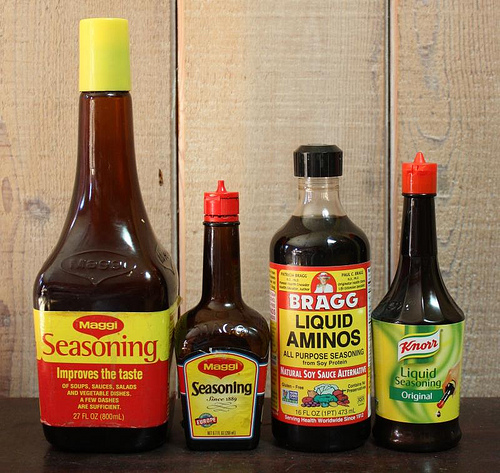
If you shop at an Asian market, scan the condiment aisle carefully. Look for knock-offs, which may be sold in long-neck bottles similar to Maggi's with names that include the word 'seasoning'. I recently bought Knorr Liquid Seasoning (pictured above), which was made in the Philippines. Lighter in flavor than the Chinese version of Maggi Seasoning Sauce in the big bottle, it is a little sweeter than the European version of Maggi. Knorr features soy but it does contains MSG. For a non-MSG version made with soy, try Gold Mountain Seasoning Sauce, a Thai product.
If you don't shop at an Asian market, head to a health food or specialty grocer. Locate Bragg's Liquid Aminos, usually kept near the soy sauces. It is soy based and devoid of MSG. A favorite of natural foods lovers, Bragg's has been around since 1912 (100 years!). The liquid aminos contains only "vegetable protein from soybeans and purified water." Its earthy, savory flavor is practically the same as that of the Chinese version of Maggi Seasoning Sauce.
However, Bragg's liquid aminos is a little less salty than Maggi so I end up using more Bragg's. Price-wise, the 16-ounce bottle above was about $4.50 at Whole Foods. Bragg's brags about being a soy sauce substitute but it doesn't taste like your average soy sauce. It tastes like Maggi Seasoning Sauce. Warning: I once bought Bragg's from a bulk foods dispenser and it was not as intensely flavored as the liquid aminos in the bottle. My market may have diluted it but to play it safe, stick to the bottled stuff.
Use tip: Whichever substitute you choose, do a little math when using it. Look at the sodium content on the label:
- Chinese Maggi Seasoning Sauce has 400 mg per teaspoon.
- European Maggi Seasoning Sauce has 480 mg per teaspoon.
- Bragg's Liquid Aminos has 160 mg per ½ teaspoon.
- Knorr Liquid Seasoning has 1230 mg per tablespoon.
Given that there are 3 teaspoons in a tablespoon, you can quickly guess how the sub will be fare against Maggi, the benchmark. For example, based on sodium content, Bragg's Liquid Aminos is 20% less salty than the Chinese Maggi Seasoning Sauce. That explains why I end up using a bit more of the Bragg's than I do of Maggi in my recipes. (Note: These products, including Maggi, are all sold on Amazon but shipping rates can make them expensive.)
Edie also asked this question: Can you make an ad-hoc version of Maggi? Sorry, I don't know the answer to that one, but these subs are solid workarounds.
Familiar with these condiments? Have a Maggi substitute to recommend? Please share!
Related posts:

Lenny says
I love Maggie Seasoning, I love it with an over medium egg with lots of white pepper. I from Vancouver, BC and when I was living in Amsterdam my German friend saw it in my kitchen and made fun of me 'cause Maggie has Swiss/German origins from the 1800's! He told me nobody in Germany uses Maggie anymore but he saw it all over Asia when he was there. He thinks it's weird lol... I eventually made it to the Maggie store in Germany and loved it!
Tessa Domestic Diva says
Thanks for the tip...I have been using Coconut Aminos too as a substituent!
anh says
I love Maggi seasoning. I always go with the one made in Germany. A good substitute is a seasoning sauce called Youndoo (liquid seasoning - light ) made by a Korean company. It is distributed by Sempio Foods company. Korean markets carry this brand.
The seasoning comes in a small greenish bottle with a picture of green leaf in the front.
I've used the sauce to mix in the fried rice and the depth of flavor is very close to Maggi.
Andrea Nguyen says
Lenny: There's a Maggi store in Germany? I'm putting it on my list! Thanks.
Andrea Nguyen says
Tess: Who would imagine aminos coming from coconut? I'll look for that product. Where do you buy it?
Andrea Nguyen says
Anh: Siempo is a good Korean sauce company. I use their gochujang. Didn't know they made Maggi-like sauce. Now I've got something to hunt down next time I'm at a Korean market. :0
anh says
Andrea, I use their gochujang a lot. In fact, I am currently on a "Korean cooking phase". We have Korean foods 2, 3 times a week. My dear husband would ask me when we are going back to regular Viet's foods. 😉 One day soon.
Amy Ng - Cake Pops says
Thanks, I'm Celiac and I was looking for some Gluten free sauces. Looking into buying the Maggi Seasoning today.
Andrea Nguyen says
Anh: Koreans love pho, why shouldn't we love their food too?!
Amy: The Bragg's is a good option for you.
Brochure Printing says
I love the taste of Knorr liquid seasoning! Just perfect!
Yun Ho Rhee says
Wow, I didn't know there were so many choices besides the small Maggi sauce. I've seen big bottles of Maggi sauce in Chinese groceries here in Korea and I always wondered why they tasted different from the ones I brought from the States...I've had steamed fish in maggi sauce (instead of the traditional soy sauce) and it was actually quite tasty.
Diane says
I bought the small Maggi bottle because it would fit in my small pantry. I had no idea it was different from the big bottle!
Andrea Nguyen says
Yun Ho and Diane: You have to look to see if the Maggi is made in Europe. The shape of the Euro version has a little extra Old World elegance and color on the label. It comes in small and large bottles. I mostly use a small Euro one for eating at the table. The larger, bolder tasting Chinese version is good at the table too, though I use it in cooking more since it is less expensive.
[email protected] says
So has anyone found a gluten-free substitute for Maggi? Growing up in Europe, but now being celiac I miss that stuff 🙂
[email protected] says
Oh never mind, I guess Bragg's is gluten-free
maggie says
Why not just omit Maggi (and other MSG-laden products) altogether? Many foods have a natural umami flavour - dried mushrooms, dried shrimp and scallop, fermented tofu, fermented black beans, not to mention the aromatic flavours of fresh ginger, garlic, scallion, cilantro, chili, etc...! What's more, the wide variety of Asian cooking techniques are well-suited to bringing out the most in these ingredients - quick stir-frying, slow red-braising, the use of contrasting textures and flavours such as sour and sweet. If you're using the freshest ingredients, good quality meat and seafood, and cooking with integrity (not taking shortcuts), then MSG is totally unnecessary. Try it. Food without MSG has a clean, clear quality that allows the natural ingredients to shine. Insist on non-MSG dishes when you dine out - otherwise, you're paying for poor ingredients 'dressed up' with MSG.
maggie says
Oh, I just realise that 'not taking shortcuts' sounds more prescriptive than intended. I'm actually all for simplicity in the kitchen - I would much rather blitz my pesto ingredients in the blender than pound them with the pestle and mortar, and microwaving is a perfectly good way to steam fish in my book! What I mean by 'integrity' is not to take shortcuts with ingredients, ie, buy a free-range, organic chicken even if it costs a little more, and it means eating chicken less often; use butter, not margarine, in your cakes and pastries; try making home-made stock with that chicken carcass, rather than relying on stock cubes. That's all, and I'm sure anyone who's interested enough in food to be perusing this site would agree with me!
marlon says
I had no idea it was different from the big bottle!
Nickle says
This is good for my viand tonight 🙂
Audrey says
Has anyone ever made the maggi sauce from the plant by that name, maggi it smells and tastes just like the sauce in the bottle, I've dried but would like to figure out how to make a liquid one?
emileljanson says
Hi, i have been using Maggi seasoning sauce for a very long time. Its my favorite!! Thanks for sharing the substitutes too. But still nothing else can replace the taste of Maggi.
Andrea Nguyen says
So true.
Clare says
I made some delicious slow roasted vegetable beef soup with beef bones and aded Maggi. Couldn't figure out why I had a nagging little headache and felt "off" for past 2 days of eating it. Now I realize it is the msg in Maggi and I will not be using it. I bought coconut aminos a while back and will try this in my remaining 2 bowls of soup. I love the taste of Maggi but not the side effect. 🙁
Andrea Nguyen says
Sometimes, there's just too much glutamate -- natural or not, in food. Back off the Maggi. There's a funny tart taste in coconut aminos. Maybe try a blending the two! Or, try Bragg Liquid Aminos instead of Maggi. BLA is my go-to Maggi sub.
Friedrich W.O. Vonostrowo says
There is a Polish Maggi knock-off called "Winiary Liquid Seasoning" and also one from the former DDR (Communist East Germany) called "Bino" which may or may not exist anymore. I like my "Maggi" so I haven't tried either. I have seen the Polish "Winiary" at a local Polish Delicatessen.
Andrea Nguyen says
I wonder what "Winiary" refers to? Boy, even in the former DDR, there was a knockoff. Maggi knows no borders.
Frierich says
This is the Polish version of Maggi but much thinner and really not as good but often cheaper. I can be found in any Polish delicatessen usually next to the Maggi. Winiary Liquid Seasoning Maggi for Soups Sauces etc.
Andrea Nguyen says
Thank you for the Maggi insights! They're super useful, Frierich.
Kim says
I'm very confused about the whole seasoning sauce topic. Whenever I look up Maggi and "seasoning sauce" I never see any reference to soy sauce. Isn't it basically a knock-off of soy sauce? Wouldn't a good substitute for seasoning sauce be soy sauce? Why do we talk about it as if soy sauce doesn't exist?
Andrea Nguyen says
Give it a taste and Maggi doesn't taste like soy sauce. It was not created in the 1880s as a soy sauce knock off.