

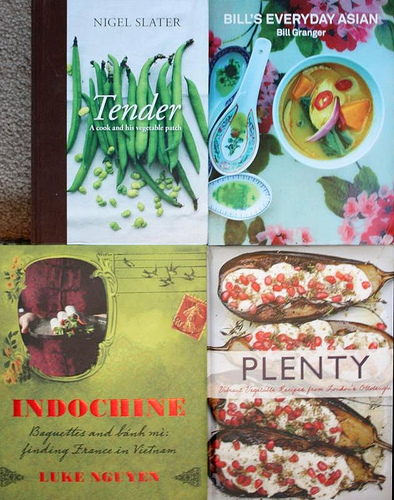
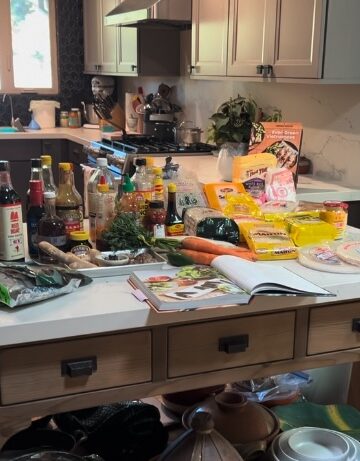
This year, I amassed a 3-foot-tall stack of food-related books. I bought most of them, publishers sent me a number of them, and friends gifted me books picked up in Asia. There are cookbooks, reference works, and memoirs. I've cooked from a handful of them and read others like novels to absorb the authors' ideas, nuances, and messages. The gorgeous four books above caught me by surprise with their approach to presenting Asian foodways. They were written by Australians or Brits.
Indochine is written by Vietnamese-Australian Luke Nguyen, a Sydney-based chef/restaurateur and television show host. His first book, The Songs of Sapa (reissued in the States as My Vietnam), surveyed the country's food as part of his food show on SBS in Australia and the Cooking Channel. This time, Luke traces the French elements in Vietnamese cooking. His travels lead him to interviewing people in Vietnam as well as to meet up with family members in France. I can hear Luke's Aussie voice in the personal narrative of his journey. It reminds me of his very generous soul and how he toured me through his Little Saigon in Cambramatta, outside of Sydney.
The book design, such as the spread below, is stunning and provocative. Are those rooftops in Vietnam or France?
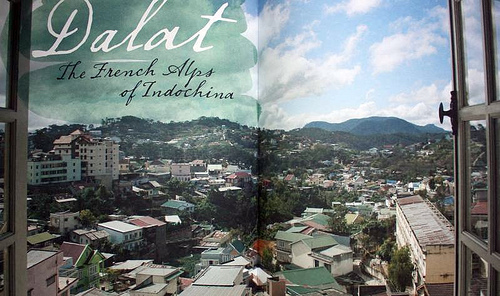
I am not one who wants to romanticize the French colonial period in Vietnam because a lot of terrible things happened and people suffered. Nor, do I ever want to give the impression that Vietnamese food is an offshoot of France. Call me a proud culinary nationalist.
Nevertheless, Indochine canvases traditional and modern Vietnamese food to paint a picture of timeless fusion cooking. Luke highlights the French-ness in each recipe but at the end of the day, they're Vietnamese. Ingredients and cooking techniques travel the world as people immigrate and resettle. Indochine features Luke's interactions with Vietnamese, French-Vietnamese, French, and Vietnamese-French people along with their recipes, which range from street food to fancy plated fare. From that mix of content, you get an interesting global perspective of Vietnamese cuisine.
(Note: If you yearn for a historic and rigorous look at the French colonial era in Vietnam, check Appetites and Aspirations in Vietnam by Erica Peters.)
Bill Granger's Bill's Everyday Asian feels as bright, fresh, and exciting as his restaurants in Sydney. Last week when Karen Shinto came to work and taste instant pho, I showed her the book and she lit up. "Australians know how to style books," she remarked.
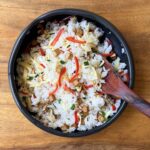
What's more, they have a knack for juxtaposing cultures in a natural manner that's not kitschy or ethnic-specific. Images like this one from the book are just delicious and beautiful:
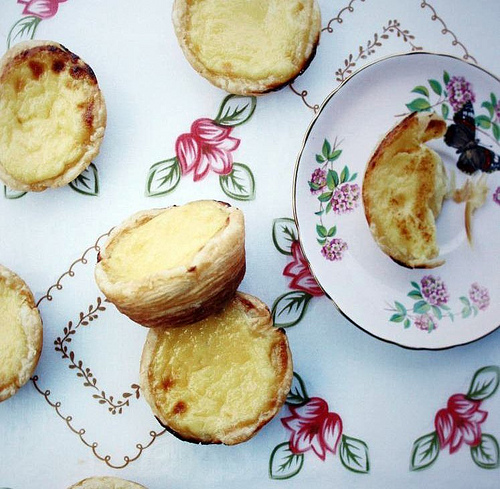
I took one look and thought of the practically sinful Chinese-Portuguese custard tarts I made a while back. Granger's food looks tasty and the situation can be anywhere. There is a balanced amount of respect and mash-ups in his recipes. For example, he understand that "tofu needs very little to make it delicious" and serves it simply with some seasoned soy sauce. On the other hand, he explains that the meatballs with tamarind are his Asian take on an American classic.
Granger conveys a progressive sensibility about Asian foodways, which means that he does not see them as mysterious or precious. He wants to enjoy them.
Nigel Slater's Tender is a wonderful homage to gardening and home cooking. It is an infectious work filled with beautiful photography and inviting prose. I was delighted and surprised to find a chapter on Chinese greens.
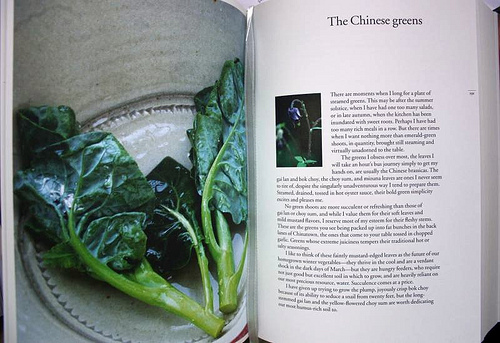
Slater writes in his introduction:
There are moments when I long for a plate of steamed greens. … The greens I obsess over the most, the leaves I will take an hour's bus journey simply to get my hands on, are usually the Chinese brassicas. The gai lan and bok choy, the choy sum, and mizuna leaves are ones I never seem to tire of… The real moment of glory for the Chinese brassicas is when they team up with high-octane dressings such as salty oyster sauce, searing chiles, and chopped and sizzling garlic.
I love his lively characterization of oyster sauce as 'high-octane' and chiles as 'searing.' One of the UK's most respected food writers, Slater's work is charmingly no-nonsense, enthusiastic, and encouraging. He discusses Asian vegetables as vegetables, without exoticizing or fetishizing them. They are part of his repertoire as much as beets and Jerusalem artichokes are. Slater cooks and writes like many of us do - in a cross-cultural manner. There's a lot to savor and learn from Tender.
Yotam Ottolenghi is not a vegetarian but he runs a well-regarded vegetarian restaurant in London. His much-lauded and latest book, Plenty, embraces flavors and traditions from all over the globe. It's an uncommon collection of spirited vegetarian recipes.
For example, a recipe for savoy cabbage and parmesan rind soup sits next to a recipe for sautéed Brussels sprout and tofu. Black pepper tofu is triumphantly described as looking "as if it's been prepared at a top Chinese restaurant" and employs a ton of butter, shallots, chiles, garlic, 3 kinds of soy sauces, and 5 tablespoons of crushed black peppercorns. Some may see Ottolenghi's bold approach as jumbling up cuisines but he engages traditional Asian ingredients with as much gusto as he would give to any other ingredient. He treats them equally.
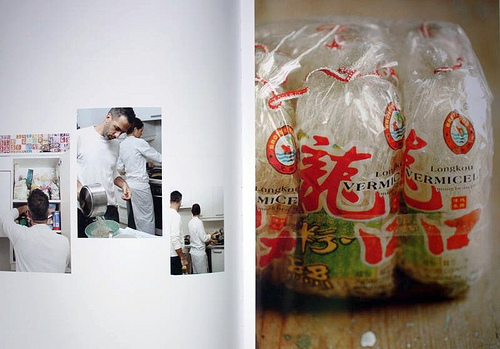
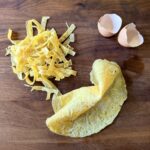
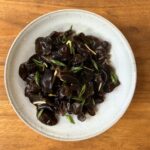
That perspective is seen in the two-page photo spread above. There are home kitchen scenes on the left and a close-up of cellophane noodles on the right. That's how Ottolenghi cooks and lives. That's plenty fine by me.
Good books reinforce universal lessons as they illuminate something new. In breaking down barriers between cuisines and techniques, these four works underscore a trend toward better appreciation and understanding of Asian ingredients and foodways. That makes me extremely glad.
Obviously, there are books that I've overlooked. In fact, my 3-foot stack of books is just a few feet away from my desk where I'm typing. Share your thoughts on these or your favorite cookbooks from 2011.
2011 recipes informed and inspired by cookbooks:
- Crunchy Shrimp Balls/Chef's Special Balls (Easy Chinese Recipes by Bee Yinn Low)
- Kaffir Lime Fried Chicken (Twenty by Michael Ruhlman)
- Tamarind Glazed Lamb Ribs (Odd Bits by Jennifer McLagan)
- Red Wine and Beef Stew in Claypot (A Franco-Viet Experiment) (Odd Bits by Jennifer McLagan)
- Honey and Rose Water Tapioca Pudding (Super Natural Cooking Everyday by Heidi Swanson)
- North Indian Egg Curry (Savouring India by Julie Sahni)


Diane says
I LOVE Nigel Slater and have all his books. I've had a big old cook's crush on him since I first picked up his book "Real Fast Food" in London almost 15 years ago. I just bought TEnder, and while I don't think I'll cook from it as much as his others, it's lovely.
The others - well, what can I say, Andrea. You are some kind of evil pusher! I simply cannot contain myself when buying cookbooks. I have no will power at all when it comes to them. And here are some more than look positively mouthwateringly good. Oh, my transitory bank account....Sigh!
Seriously, they look both serious and entertaining, and I will be picking up at least some of these. Thanks.
Diana says
Great round-up! I'm happy to see innovative Asian cooking get its due share of praise. I've also flipped through the Mission Chinese Food cookbook at the bookstore and at first glance it seems to be pushing the envelope too (will have to buy it and cook from it to comment more). Hope more such cookbooks will get published in the coming years!
Andrea Nguyen says
Diane: Cookbooks are a minor addiction, no? The Aussie books are hard to find at stores. I got mine at Omnivore Books in SF. The Amazon link has some sources too. Tender is a very entertaining and inspiring read.
Andrea Nguyen says
Diana: Glad you enjoyed the list. I'd love to get your impressions of the Mission Street Food book. They rep the uber hip take on Chinese food.
Looking forward to your Chinese take-out cookbook next year. I've been wanting someone to write that book! You are definitely I.T.
Erica Peters says
Thanks for the shout-out, Andrea! What I love about Luke's book (besides the gorgeous photography) is that he shows the interplay between French and Vietnamese techniques and ingredients -- but also the interplay between family stories and culinary history. It's hard to trace the real inspiration behind these culinary mash-ups, a hundred years later -- but fun to try!
Jonathan says
I have been experiencing a book binge as of late. Specifically, books celebrating food, whether through recipes, history, or culture. And with books like the ones you've featured here, anyone could understand my difficulty with restraint. Thank you for sharing!
Tuyet N. says
Thank you for sharing, Andrea! I am addicted to cookbooks and it looks like I will have to add these books to my Xmas wish list!
Justin Bieber Shoes says
“It’s one of those things that wouldn’t have happened had there not been this period of time,’’ said Carlisle, referring to the 149-day lockout. “It was good because I’m a big fan of music and I’m a big believer in the arts.“It also, by agreeing to do a series of these things, we’re going to do one or two more. It puts a good kind of pressure on you to practice and be good enough to not make a fool of yourself.’’
blacklight says
Yes, there is a tragic history between France and Vietnam. But as a Vietnamese American born in France, I say with absolute certainty that something good came out of it: a level of mutual respect and regard between formerly colonized and former colonizer that have few if any equivalents anywhere on this planet. Just as there tens of thousands of French expats in Vietnam, France is a stronghold of the Vietnamese communities overseas. We have contributed tons of Vietnamese doctors, engineers, scientists and engineers to France. And needless to say, there is hardly a Vietnamese family in France who doesn't have cherished French daughters-in-law or sons-in-law. The past was bitter, bloody and dark. But that past is gone and when I myself will be gone, any bitterness, blood and darkness that still remains will most probably be gone with me - This is my hope and my prayer. We honor those who picked up the weapons and fought for us. But they did not fight for hatred. They fought for a future for their people. They fought for life. Not for death. We honor their memory and sacrifice by remembering and acknowledging the past AND by living in the present and by firmly looking toward the future. Just as they would have wanted us to do 🙂 If there is any war between French and Vietnamese these days, it is the wars between husbands and wives, the wars between boyfriends and girlfriends and the wars between close friends. Let it be this way until the end of time 🙂 When you compare the best of the French and the best of Vietnamese - kindness, compassion, generosity of spirit, integrity, respect for learning, love of family - you will most probably agree that we were never meant to be enemies 🙂
And yes, I like French cooking, too. But it's the cooking of the ordinary people not the cooking for kings 🙂 I believe that every great cooking traditionis more or less an open system. There are French influences on Vietnamese cooking, but the reverse is also true. Because good ideas and good conceppts are meant to be used and shared 🙂 A great cooking tradition that has no capacity for change has no capacity for renewal. And if so, it will shrivel up and die. As we speak, the French and Vietnamese cooking traditions are the picture of health 🙂
So long 🙂
Bill Bird says
Shoot! I was hoping the book called Indochine might be somehow, some way, related to the old Indochine Restaurant we had here on J Street in Sacramento. A true HOLE IN THE WALL Andrea, the green pepper beef dish there was to DIE FOR good. One day they closed up and went away. Bang. Just like that. Gone. POOF! There one day, gone the next. They had a HUGE following, and nobody ever knew where they went or what happened to them. I'd love to have a dish of that Green Pepper Beef though. Oh well -- time to go strain my chicken pho broth. Guess whose recipe I used? Look in the mirror!
Xuanie says
Hello Ms. Andrea,
Not quite a cookbook but I think you will find this fascinating.
https://rowman.com/ISBN/0759120757
wireless router reviews says
Of all the colors in the spectrum, blue is an appetite suppressant.
Andy says
In interesting addition for the cookbook enthusiast/collector on your Christmas list. What a great way to open minds to new possibilities in the kitchen.
download Mac keylogger says
This is my first time i visit here. I found interesting things to many in your blog, mostly to the debate.
Retro Jordan Shoes says
it: a level of mutual respect and regard between formerly colonized and former colonizer that have few if any equivalents anywhere on this planet. Just as there tens of thousands of French expats in Vietnam, France is a stronghold of the Vietnamese communities overseas. We have contributed tons of Vietnamese doctors, engineers, scientists and engineers to France. And needless to say, there is hardly a Vietnamese family in France who doesn't have cherished French daughters-in-law or sons-in-law. The past was bitter, bloody and dark. But that past is gone and when I myself will be gone, any bitterness, blood and darkness that still remains will most probably be gone with me - This is my hope and my prayer. We honor those who picked up the weapons and fought for us. But they did not fight for hatred. They fought for a future for their people. They fought for life. Not for
what erectile dysfunction says
I think you deserve the best comments for this post. It is really nice. what is erectile dysfunction
Curry Point Restaurant says
Wow all this images looks so delicious..
maybe I should tear out the recipes. Or take photos of them. I just think it’s such a waste to trash them because I do really enjoy reading them..
keep posting..i'm waiting for your update.
Gretta says
I like to consider myself a foodie and I am humiliated to discover that there is even a thing such as French/Vietnamese fusion food. I will be running out to try to find "Indochine" as soon as possible. I am curious as to whether or not the Vietnamese food I eat in the US is that French/Vietnamese mix or if it is more traditional Vietnamese. Any insight as to whether or not the American version of these foods is diluted or altered for the American palate?
marlon says
This is my first time i visit here. I found interesting things to many in your blog, mostly to the debate.
Nickle says
Im interested to this Cookbook, i want to get one of this 🙂