










Okay, I can be an overly obsessive cook. That’s probably why you’re here! After making enough gluten-free pot stickers to satisfy my curiosity, I had a fine amount of dough and filling leftover. The great thing about dumplings is their versatility. With the basic dumpling dough in your back pocket, you can use different fillings, create different shapes, and cook your dumplings in a variety of ways.
Pot stickers are pan-fried so I got that one out of the way. Pan-frying dumplings technically combines frying and steaming. I pondered what else I could do with gluten-free basic dumpling dough. How would the doughs — dough #2 (millet, sorghum, tapioca, and potato) and dough #3 (sweet rice, millet, and tapioca) — perform when poached, steamed, deep-fried, and frozen? Below are my findings:
Shapes
After you’ve rolled the wrapper into a thin circle, you’re ready to go in a variety of directions with regard to the shape. At first, I tried the half moon and pea pod before progressing to the pleated crescent.
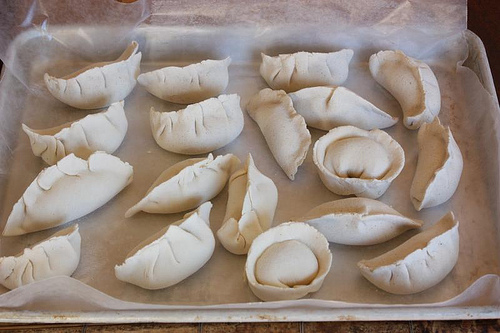
No problems with those. Feeling confident, I tried the big hug, which starts out as a half moon. Because there is a certain amount of pulling on the dough, forming the big hug with gluten-free dough was not easy. One of the dumplings busted a bit so I patched it up with leftover dough. You can’t see the busted one in the above tray but it’s there. Cooked up just fine.
Gluten-free dumpling wrappers have to be moistened at the edge to seal. Trying to do the closed satchel shape was challenging. You cannot pull up on the dough and gather it easily in an accordionlike fashion. I instead made the wrapper extra thin and big, then gathered at the rim. That was no easy task; scroll down to the steamed dumplings to see what they looked like. I quickly came to the conclusion that closed satchels require gluten-filled dough.
That said, forming a rope edge was relatively simple. You pull a little less on the rim before you fold over the edge to twist and fold. Voila!
Freezing
When freezing Asian dumplings, my approach is to put them on a tray and freeze them solid. Then I transfer the dumplings, which are individually frozen at that point, into a plastic zip-top bag.
The gluten-free dumplings froze like a charm. I expect that they’ll have the same frozen life span as dumplings made with regular all-purpose flour. Before cooking, I partially thawed the dumplings and they performed just great.
Poaching, steaming, and deep-frying gluten-free dumplings
After I got through pan-frying the dumplings, I tried different cooking methods. Both types of dough produced good pan-fried dumplings as you’ve seen in the gluten-free pot stickers posts (trial 2 and trial 3) from last week.
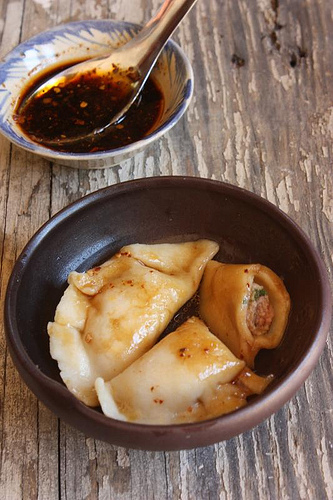
However, don’t overlook poaching the dumplings just because it sounds boring! The wrappers develop their chewiness and tenderness well in the pot of water. The photo at the top is of the poached dumplings tumbled in dipping sauce. We actually enjoyed them as much if not more than the pan-fried pot stickers! Seriously.
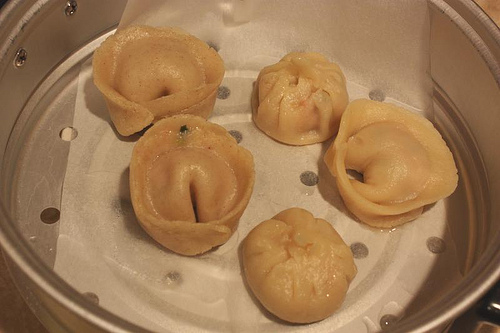
When steamed, dough #2 turned out a little gummy and doughy. It lacked the tender chew of dough #3. If I had to steam a dumpling, I’d use the gluten-free dough with sweet (sticky) rice flour. Of all the cooking methods, this was the least liked.
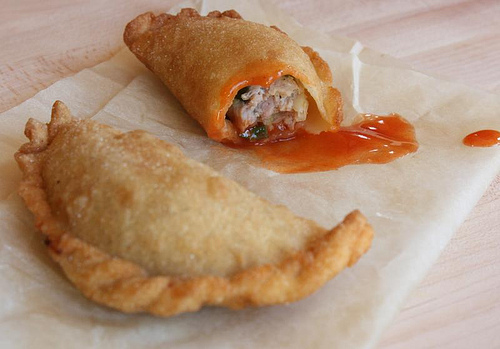
The surprise appeared in the guise of deep-fried gluten-free dumplings. Wrappers made from both kinds of dough were excellent, frying up to a nice crispness. Next time, I would slightly under fry the millet-sorghum dough to avoid getting the edge too hard. Dough #3 fried up a tad softer than the second dough because of the sweet rice flour, which lends a chewy-crispness to fried dumpling. I’d eat practically anything deep-fried, wouldn’t you?
Conclusion
There you have it: two options for making a basic gluten-free dumpling dough. I’ve developed and tested the dough for recipes in Chapter 1 of Asian Dumplings. Whichever gluten-free dumpling dough you select, use it as a substitute for the basic dumpling dough in the book.
However, keep the following in mind:
- The gluten-free dumpling dough will not work well for Shanghai soup dumplings (xiao long bao), which relies on a special dough.
- For Tibetan momos, try a shape other than the closed satchel. See the recipes for suggestions.
Beyond those two points, feel free to fill the wrappers with the various fillings in the chapter. Or make one up on the fly! Then poach, steam, pan-fry, and deep-fry the gluten-free dumplings to your heart’s delight.
Related posts:
- Gluten-Free Pot Stickers: Recipe Trial & Dough 3 (millet, sweet rice, and tapioca starch dough)
- Gluten-Free Pot Stickers: Recipe Trial & Dough 2 (millet, sorghum, tapioca, and potato dough; includes tips on working with GF dumpling dough)
- Gluten-free Pot Stickers: Recipe Trial 1 (on Asiandumplingtips.com)
- Guide to Building an Asian Dumpling Pantry
- Tolerance Test: Are Gluten-Free Asian Ingredients for You?
If you have the enhanced e-version of Asian Dumplings, these technique videos are included. Otherwise, see the printed book for details and/or watch my videos below, which are on Asiandumplingtips.com:




Victoria
Awesome! I've got a copy of the book, but haven't tried the pot stickers yet since I couldn't find millet flour yet. May have to make the trip to find some this weekend....
Lynne
I want to thank you for your obsessive-ness!! What terrific posts - while I eat flour (now moderately - been losing weight & I need to continue), my youngest adult daughter has discovered she's allergic, so she's eliminated it from her diet. I hope to try some of your creations to prepare for our holiday treats. Thanks so much!! (oh - and yes - I would eat just about anything deep fried too... hence, my current dedication with my weight loss, lol).
Andrea Nguyen
Victoria: Head to a health food store or Whole Foods for the millet flour! Thanks for getting Asian Dumplings.
Andrea Nguyen
Lynne: My pleasure. If it's any consolation, if you deep-fry at home, you burn a few extra calories with the clean up. I made some killer fried chicken last night. :0
Vietnamese cuisine addict
This one looks good and tasty! And the chili sauce makes me really crave for it. I'm looking forward to try these one this coming weekends. Thanks for sharing.
Nate @ House of Annie
Kudos to you for giving us these new gf creations!
Lynne Corbitt
So very happy to find this recipe that gives a step by step approach to it also, since I'm not that great a cook anyways .
Annette
I can not wait to try these. My son has been asking for dumplings since kindergarten, he's in 2nd now thank you for posting.
Andrea Nguyen
I'm so happy that my experimentation and OCD-ness for dumplings help you and your family! Thank you.
Lori
This is fantastic! Thanks for the recipes and the testing of the different methods. I will pick up some millet flour this weekend. :O)
Wall Tiles & Floor Tiles
The recipe is very yummy.You have make great shapes of it.Its with the half moon shape.Nice to see the recipe.
Wall Tiles & Floor Tiles
The recipe is very yummy.You have make great shapes of it.Its with the half moon shape.Nice to see the recipe.
Wall Tiles & Floor Tiles
The recipe is very yummy.You have make great shapes of it.Its with the half moon shape.Nice to see the recipe.
Wall Tiles & Floor Tiles
The recipe is very yummy.You have make great shapes of it.Its with the half moon shape.Nice to see the recipe.
Jonathan
I am so happy to have discovered this recipe! And your blog, as well, of course. 🙂
I used to make empanadas with my grandmother as a child, and I remember her patiently teaching me to crimp the filled dough to make a rope edge. And having transitioned to a gfdf diet 4 years ago, it's always been a challenge for me to both make and find a satisfying dough to approximate that taste and texture. Thank goodness for your obsessiveness. 🙂
Much appreciation and I look forward to making this recipe soon.
True Religion outlet
“This preparedness, examined and inspected by the HSE Nuclear Directorate in ten-yearly safety reviews includes ensuring that protection systems, with appropriate back-up systems, remain robust.”
men wrist watches
Rajat Gupta was freed after he pleaded not guilty to charges of securities fraud and that he passed insider information to his friend Raj Rajaratnam, who is a billionaire businessman.
edit 3d picture
So.. testy recipe and the chili sauce makes me really crave for it. It looking also great. I am so hungry.
pharmacy technician salary
Awesome site you’ve got here. Looks like you really know your stuff. I’m glad I found this in my searches. I really liked your angle that you have on the topic.
Nemyearnemo
top odnoklassniki
в одноклассниках
vksaver вконтакте
вконтакте завалил премию рунета
однокласники регистрация
яндекс почта mail ru
вконтакте картинки
mail odnoklassniki
добавить mail ru
поисковик майл ру
одноклассники ru регистрация сайте
день рождения mail ru
вконтакте просмотр закрытой страницы
sayt odnoklassnikov
mamba ru anketa phtml
вконтакте вконтакте
однаклассники регистрация
wwww mamba ru seks mamba ru перевод майл ру майл ру поч война миров торрент купить вконтакте артур и война миров сделать почту майл ру vk saver com вконтакте сообщения друзей
moncler outlet
We cannot always build the future for our youth , but we can build our youth for the future
cheap canada goose
Towering genius disdains a beaten path. It seeks regions hitherto unexplored.
ime and tide wait for no man.
come on!!!!
canada goose
What's in a name? That which we call a rose by any other name would smell as sweet.
Beats by Dr Dre
We do not choose to be born. We do not choose our parents. We do not choose our historical epoch, the country of our birth, or the immediate circumstances of our upbringing. We do not, most of us, choose to die; nor do we choose the time or conditions of our death. But within all this realm of choicelessness, we do choose how we shall live: courageously or in cowardice, honorably or dishonorably, with purpose or in drift. We decide what is important and what is trivial in life.
cheap red bottom shoes
Happy, is looks for a warm person for a lifetime.
canada goose parka
If a man wants you, nothing can keep him away. If he doesn't, nothing can make him stay.
Patty
You are amazing - I have not had a dumpling for two years since I developed gluten intolerance. A few weekends ago I couldn't resist and found myself rolling away making homemade wrappers (version 3) for the first time ever. I couldn't get them too thin without breaking while filling, but the rustic look and chewy taste was so satisfying! I will be making more. Thank you so much!
PS - should I dust the board and rolling pin with rice flour, sweet rice flour or glutinous rice flour?
link wheel
Please let me know if you're looking for a author for your blog. You have some really good articles and I feel I would be a good asset. If you ever want to take some of the load off, I'd love to write some content for your blog in exchange for a link back to mine. Please send me an e-mail if interested. Thank you!
vi da
I suppose that you could say that I've displayed signs of OCDD (obsessive compulsive dissorder for dumplings). With a fine amount of dough and filling leftover from making the gluten-free pot stickers, I wanted to see how versatile the dough is. The great thing about dumplings is their versatility, right? With the basic dumpling dough in your back pocket, you can use different fillings, create different shapes, and cook your dumplings in a variety of ways.
Ana
has anyone frozen the dough prior to making dumplings...I am wondering how the dough would do frozen and thawed prior to making dumplings
Carey Jane Clark
Any chance you'd know the Chinese characters for sorghum? We live in China, and some of these ingredients aren't available (at least that I know of). I'm always up for adventure at the market, but it helps to have a starting point.
kulyia
may i ask what kind of sauce you used? thanks 🙂