
A number of people have written to me over the years about gluten-free strategies for enjoying Asian food. Several of those individuals suffered from Celiac disease. I hesitated until now because aside from occasionally feeling slightly bloated or gassy from eating water crackers in the afternoon, I have little personal experience with wheat intolerances. And none of my family or close friends has problems with gluten. (Ask me about lactose intolerance and I have lots to talk about!)
However, Laura Russell's new book, The Gluten-Free Asian Kitchen, got me thinking about the subject more seriously. (I reviewed the book for a cover endorsement and revisited it after its release.) According to an August 2011 BusinessWeek article on popular trends, less than 1 percent (about 3 million out of 312 million) of Americans have celiac disease but 15 percent of consumers buy gluten-free foods. The result is a $2.6 billion market for gluten-free foods.
The data indicate that a fair number of people experience a range of reactions to food that contain gluten from wheat, barley, and rye. That is, gluten intolerance may range from being mildly uncomfortable to seriously debilitating.
Since the Asian diet is based on rice, making gluten-free Asian food seems like a no-brainer. Russell points out at the outset of The Gluten-Free Asian Kitchen that devilish gluten may be found in a number of Asian staples, such as:
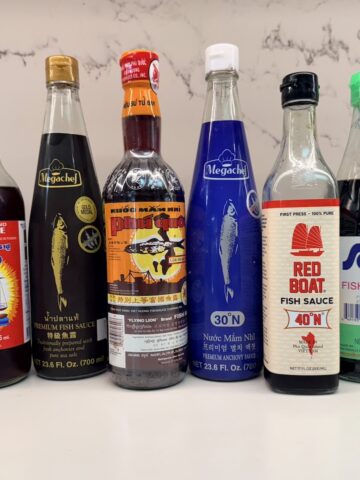
- Fish sauce
- Soy sauce (including tamari and kecap manis Indonesian sweet soy sauce)
- Maggi Seasoning sauce
- Shaoxing rice wine
- Miso
- Hoisin sauce
- Oyster sauce
- Plum sauce
- Wasabi
- Korean red pepper paste (gochuchang)
What to do if you want to eat gluten-free Asian food? How do you navigate Asian ingredients to turn out tasty fare that won't cause you grief?
Read labels and learn about ingredients
This is what Russell advises and I totally agree. Be a smart Asian ingredient shopper. Learn a little bit about how Asian foodstuffs are made so you can make informed decisions. For example:
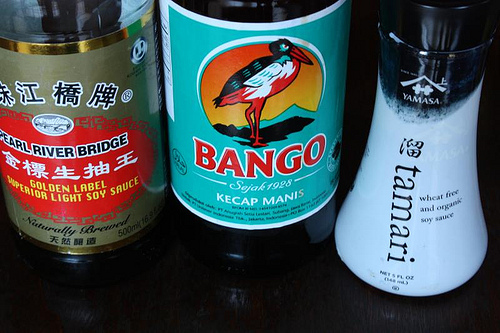
- The production of soy sauce and many Asian bean sauces (e.g., hoisin and miso) combines a legume (most likely soybean) with a grain (wheat, barley, or rice). My bottle of Indonesian kecap manis says that it contains "black soybean extract" (read: soy sauce). Given that kecap manis is made with palm sugar and soy sauce, the "black soybean extract" probably contains wheat.
- Tamari may or may not contain wheat. Traditionally made tamari is dense and intense because it is by definition the concentrate at the bottom of a vat of soy sauce. Wheat-free tamari is a modern approach and delicate in comparison to old-school tamari.
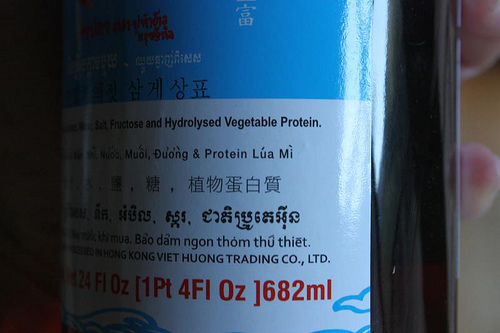
- Fish sauce manufacturers sometimes add a bit of hydrolyzed wheat protein to their brew. On the label below, it's presented as hydrolyzed vegetable protein. In Vietnamese, "protein lua mi" literally means wheat protein.
- Asian companies may mislabel because of a lack of English language fluency. I once found a brand of rice paper that supposedly contained wheat flour, water, and salt. The manufacturer may have lifted that copy from a Chinese wheat-based spring roll label. Rice paper contains rice (gao), water (nuoc), salt (muoi) and sometimes tapioca starch (bot nang).
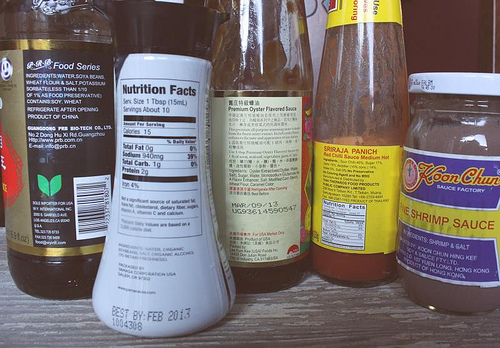
- The more expensive brands of Asian ingredients are more likely to have better labeling of ingredients and manufacturing or best-by dates. They tend to be more marketing and communication conscious.
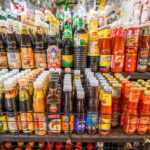
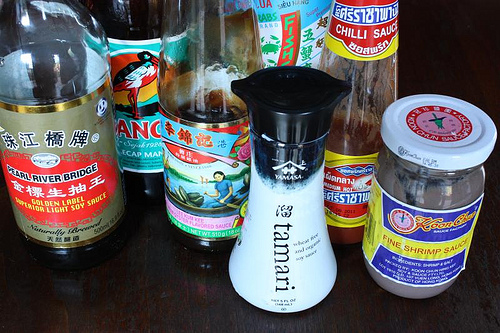
- Asian markets are savvy to their growing base of multicultural customers, whose needs and languages vary. Over the years, I've seen more organic ingredients at Asian markets and better labeling. The Yamasa brand of gluten-free tamari in the top photo was purchased at an Asian market.
Read labels carefully wherever you shop, be it an Asian market or regular supermarket.
How gluten intolerant are you?
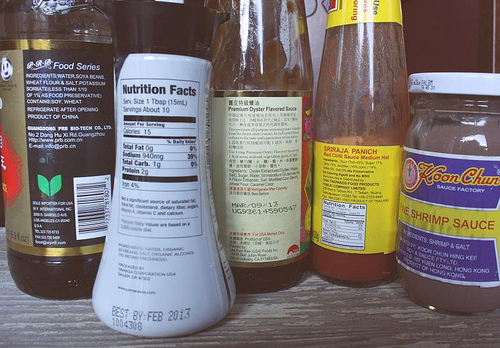
Russell suggests purchasing certain ingredients at mainstream grocery stores because the ingredient labels will be in clear and accurate English. If you suffer from an acute case of gluten intolerance or diagnosed with celiac disease, you definitely need to seek out ingredients that won't harm you. The first part of The Gluten-Free Asian Kitchen contains a helpful grid of ingredients and their gluten status. That section is followed by a guide to ingredients that includes DYI workarounds for ingredients such as kecap manis.
If you're used to standard Asian ingredients having wheat or barley, you may find that their gluten-free kin taste off. You may feel like you've been thrown off your game because the flavors won't seem right. Asian seasonings were produced with gluten for particular flavor and texture outcomes. When you omit the gluten, there's something missing. I've found that when using gluten-free Asian seasonings, I have to add a bit extra salt, sugar, or spice to tweak the flavors to my liking.
However, if you can tolerate a bit of gluten, consider allowing a little gluten into your Asian food via the seasonings. Because you don't use much of those ingredients to flavor food, your body may be fine with regular soy sauce, rice wine, or hoisin sauce. (I've not found much rye in Asian ingredients.) Try a bit out and see how you react. Gauge your personal tolerance for gluten.
Maybe you'll feel better if you reduce your intake on the big-gluten ingredients in Asian foods. Sample strategies for a low-gluten diet include:
- Drizzle Maggi Seasoning sauce and slather on the full-fat mayonnaise in your banh mi sandwich but employ gluten-free bread; it's the Maggi, mayo and other goodies that make the sandwich sing.
- Panfry rice noodles instead of egg noodles but use fish sauce and oyster sauce to lend briny depth to the stir-fry topping.
- Eat non-wheat Asian dumplings that employ rice flour or starches. Go for steamed rice rolls, fried sesame balls and tofu rolls! Refrain from eating pot stickers, shui mai, and wontons. Har gow uses wheat starch, which may have a tiny bit of gluten in it. (Russell's book inspired me to revisit making a basic gluten-free Asian dumpling dough, which I'm still tinkering with and will write about soon.)
- Stay away from wheat gluten and seitan, common Asian meat substitutes; they are your enemy!
So if you can allow a little gluten in your diet, keep the seasonings but find substitutes for the bigger gluten-laden offenders. If you suffer acute, persistent symptoms, see a doctor and go totally gluten-free.
Have experience with gluten-free cooking or gluten-free Asian ingredients? Share your thoughts and insights.

best watches replica says
The study of more than 50,000 adults ages 18 and older provides new molecular evidence that 11 DNA regions in the human genome have strong association with these diseases, including six regions not previously observed.
Amy says
What a great guide for those needing to avoid gluten.
Amy
http://www.theglutenfreemaven.com
@glutenfreemaven
Lori says
Thank you for this information! I looked at my bottle of rice wine and there it was, "wheat". I react to gluten in my diet but it is not celiac or severe. So finding all the hidden wheat in food helps me make a more informed decision about what I eat at restaurants.
Please do share your gluten free dumpling dough! I am so excited about that. My niece cannot eat any gluten and always misses out when I make dumplings. I've been using spelt flour which has less gluten but even that is starting to affect me. so gluten free would be fantastic!
Thanks again!
radio controlled helicopter says
You have shared here the standard Asian ingredients.Your Article is also contains the strategies for a low-gluten diet.Its very helpful note.
jo says
I've also noticed HAACP labels appearing on Asian ingredients in the markets around me in the Boston area. I guess a few of the scares of recent years have them changing their procedures or becoming conscious of the fact that Americans like to know that certain procedures were followed during manufacture.
gluten free shopping tips says
There many Asian products that are really good for the health. However, it can't be denied that there are products that are sold in the market without being throughly evaluated. Being meticulous in picking the right ingredient or food product is truly critical.
men wrist watches says
Crude Palm oil yesterday traded with the negative node and settled -0.96% down at 465 influenced by subdued demand in the spot market and a weak global trend. Also pressuring prices were expectations of seasonal weakness in CPO demand in the October-December quarter as weather turns colder
Beats by Dr Dre says
This doesn’t mean that most unconventionally built people want and should be conventional.
Tim Noble says
I use Dynasty brand Hoisin sauce, distributed by JFC International, the ingredients are as follows:
Water, Sugar, White Distilled Vinegar, Soybeans, Rice, Garlic, Salt, Sesame Oil, Caramel Color, Onions, Red Chili Peppers, Xanthan Gum, Spices, Natural Flavor, Citric Acid, Star Anise, Sodium Benzoate (Preservative), Autolyzed Yeast, Ginger, Licorice Root.
The possible offending (gluten-containing) ingredients are "Caramel Color" and "Natural Flavor", but I tend to ignore these two because they don't seem to bother me. Also, this product is made in the USA and the ingredient label doesn't indicate that there are any Wheat containing ingredients.
Miranda says
Now that needs to be in the new app!!! Cant wait till it gos droid. 🙂 Thank you so much. I was one of your writers. 🙂 Because GF leaves me more choices in an asian market but reading lables is imposable if you dont know the language. I found rice pancake batter the other week! Love my local store!
red bottom shoes says
Towering genius disdains a beaten path. It seeks regions hitherto unexplored.
ime and tide wait for no man.
come on!!!!
canada goose says
What's in a name? That which we call a rose by any other name would smell as sweet.
morammocumuse says
ewxum pittsburgh steelers jerseys ihtpc http://www.quechup.com/blog/entry/view/id/631823
Beats by Dr Dre says
The man who has made up his mind to win will never say "impossible ".
Beats by Dr Dre says
We do not choose to be born. We do not choose our parents. We do not choose our historical epoch, the country of our birth, or the immediate circumstances of our upbringing. We do not, most of us, choose to die; nor do we choose the time or conditions of our death. But within all this realm of choicelessness, we do choose how we shall live: courageously or in cowardice, honorably or dishonorably, with purpose or in drift. We decide what is important and what is trivial in life.
seo service says
A friend of ours who embarked on a gluten-free diet was heard complaining about wheat-free pastas that are gummy, mushy, and just plain unappetizing. We suggested exploring Asian noodles, instead. Although noodles made from ingredients like acorns, mung beans, and sweet potatoes might not work with your favorite marinara sauce, they do offer wonderful textures and flavors of their own. Their appeal isn't just limited to those on gluten-free diets, either.
cooking grill says
wow nice ingredients, i want to try it..:)
Gluten-free says
if you can't tolerate a bit of gluten?!?!?!!? There aren't such a thing.... A celiac can't eat gluten, that's all. Even the smallest part cause you the disease, in your body. Sorry for my bad english
Meghan says
Sorry, "Gluten-free", but some people CAN tolerate a bit of gluten. My sister is deemed gluten intolerant (negative for Celiac), however, she does not get any ill effects from cross contamination, or small amounts of gluten. I, on the other hand, had off-the-chart positive results for Celiac Disease and can not tolerate any gluten whatsoever. I think that Andrea is just trying to give a broad spectrum for people who fall at one end or the other, or in the middle.
Thank you Andrea for your post - I had no idea some of those sauces and condiments could possibly contain gluten, and several of them are in my kitchen right now- I'll be checking the labels in the morning!
Lutefiskgoddess says
Yup, recently I've been thinking of trying the gluten-free diet too- because I seem to have somekind of gluten intolerance, however mild(stomach bloating, skin rashes, roller-coaster mood) it may be.
I think if it's true that I have mild intolerance, I don't have to avoid small amount of gluten hiding in foods like sauces, but I may have to say goodbye to old favorites like pasta, cake(gasp!), breads, breadcrumbed-fried-meats, barley noodle, fried lumpia... Oh Gosh leave me alone in my corner:(. I would try the diet for some mobths to see if it indeed makes me feel better- but I have question for you Andrea: how about dimsum- because they don't come with labels and I don't want to spend the whole evening askig the waiter- how about safe dimsum items for GF dieters? Thanks.
Elsa Dambolena de Mills says
Hi, I am celiac, so I'm very interested in your tinkering about a basic gluten-free Asian dumpling dough, could you please
tell me when you develop a new reciple?
Thank you very much,
Elsa
Andrea Nguyen says
This is the post you're looking for, Elsa!
https://www.vietworldkitchen.com/blog/2011/10/gluten-free-asian-dumpling-dough-best-uses.html
Ewan Campbell says
What people need is a 100% "This is gluten-free" or "No it's not."
The question is: Is there gluten in a product or not?
Advice like this really isnt helpful "Read the label" - yeah, great if you speak Vietnamese or Chinese.
And manufacturers terms like "additive", "color", "extract" - erm, well, WTF is in it?
Like we all have 3 hours to spend reading labels in the supermarket every time we shop.
Most labels print is so small - impossible to read.
No pressure on manufacturers to be clkear about their ingredients. Sad.
Andrea Nguyen says
You don't have to speak Vietnamese or Chinese to read most ingredient labels. They're in English. I use my phone's camera zoom function when necessary. It's very handy.