


A few weeks ago, I went to Texas for a business conference and road trip. Before going, my well-meaning progressive California friends warned me that I’d see gun racks all over the Lone Star State, but I never saw one during my entire time there. In fact, most of the talk about guns occurred on my flight from San Jose to Austin. Two Silicon Valley execs chatted non-stop about guns, ammunition, and hunting. They were on their way to Texas for a weekend loaded with fun. I was glad when we landed and deplaned.
I’d heard that Texas had great food, and while I had to do my due diligence and attend the IACP conference, I could not wait to escape from the hotel to roam and eat. When the conference ended, my husband Rory joined me for a weeklong vacation. We stayed in Austin, then ventured to San Antonio and Houston, and returned to Austin to fly home. Along the way, we connected with old friends and made new ones. We learned lots about Texas hospitality and pride. More importantly, we ate remarkably well. This is the first of 2 posts dedicated to what we tasted in Texas.
Central Texas BBQ Trail
Unbeknownst to us when we made our travel plans, our triangular route between the three Texan cities allowed us to hit three of the four major barbecue hotspots. There is such a thing as the Texas BBQ trail and we got to sample brisket, ribs, and sausage in Lockhart (outside of Austin), Luling (on the way between San Antonio and Houston), and Elgin (enroute from Houston back to Austin).
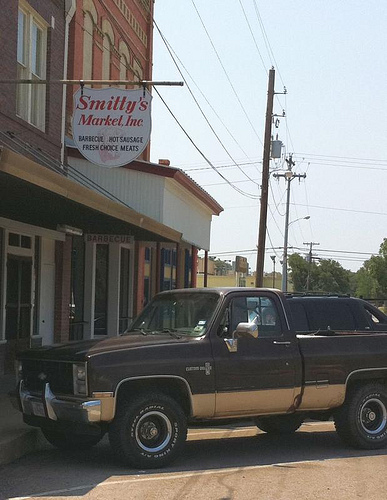
We had to save Taylor, located northeast of Austin, for the next trip; I hear that Mueller's has some mean beef ribs! For a history of Texas BBQ, read this on the Southern Foodways Alliance site. (Note that you can build a Southern BBQ intinerary on the SFA website.)
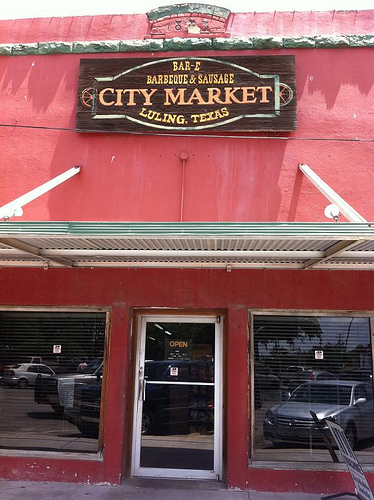
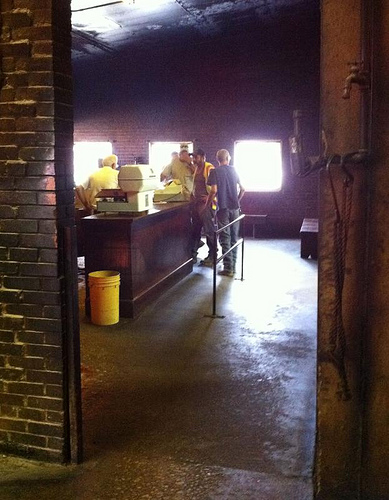
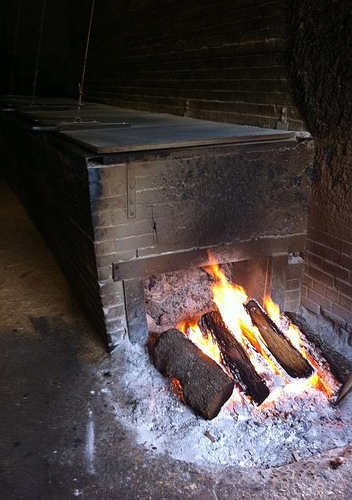
My friends, it is amazingly good, old-fashioned American food. The meats are simply prepared and not sauced, unless you want it. You taste the meat and eat with your hands at communal tables. When you order in the barbecue pit room – a warm, well-ventilated space where the meat cooks and men carve up the orders on thick butcher blocks -- you can get as much or as little as you want. The meat is served by weight. At Smitty’s in Lockhart, the pit room is improbably dark from decades of smoke. You feel like you’re inside of a coffee bean.
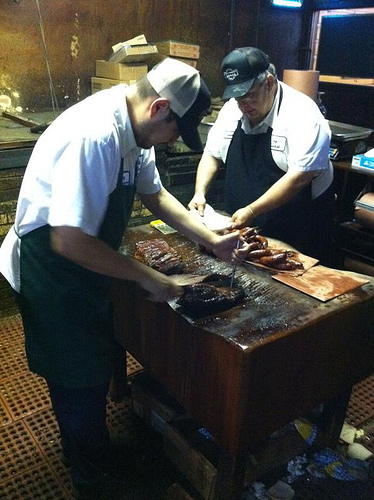
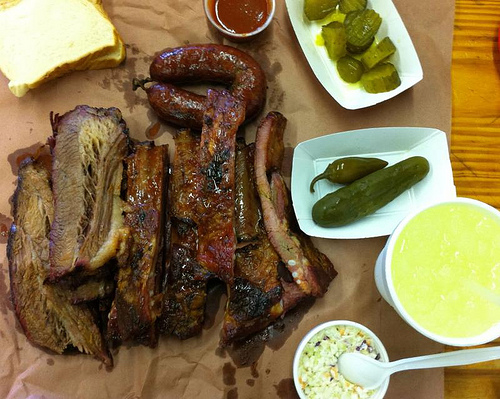
Texans are super friendly, and a gentleman at Smitty’s in Lockhart gave us detailed instructions and nodded approvingly at our choice of the fatty brisket, tender pork ribs, and a juicy ring of sausage.
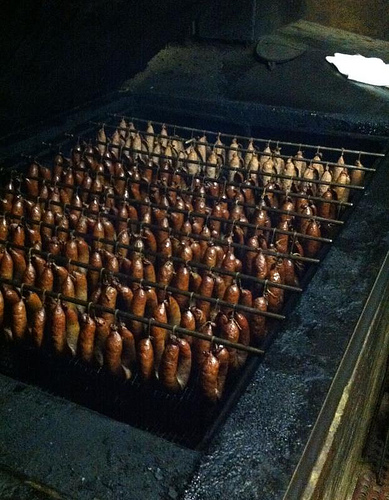
Everything is put atop layers of butcher paper – which function as your “plate†– and you get sliced white bread or saltines as freebie accompaniments. The “plate†is crimped at the ends and customers carry each order out with two hands. The hands-on, personal engagement between customer, cook, and food from the get-go makes this BBQ ritual as unique as Texas.
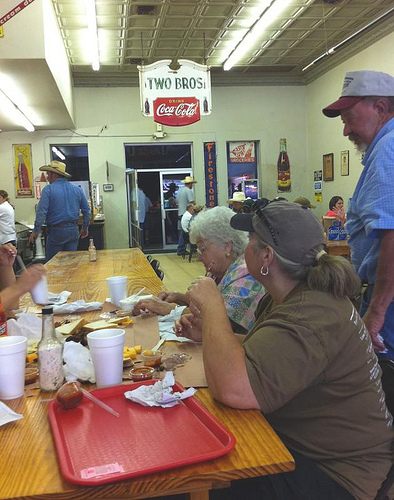
In the next room (the dining room), you can order sweet or dill pickles, potato salad, coleslaw, whole tomatoes, thick slices of raw onion, and avocados. Those are add-ons. All the utensils are disposable. The eating affair is totally practical and unfussy. You don’t even get a fork.
People made BBQ sandwiches with the tomato, onion, and/or avocado. We simply ate the meats with mildly hot sauce, potato salad and sweet pickles. Freshly made lemonade and Shiner bock beer washed down the food perfectly.
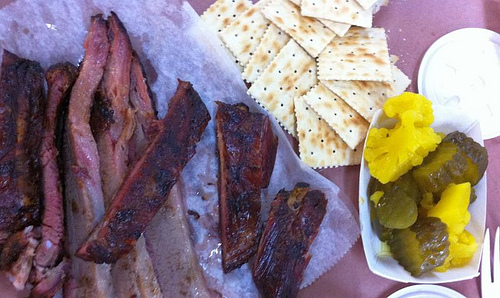
And what about the Wonder-like white bread and saltines? They were the perfect foil for the meat, functioning as a cushion of sorts for the rich, tasty flesh. And in case you needed a sweet chaser after the BBQ meal, these joints always have an ice cream concession too!
Though it was about 95F out, we didn’t feel weighted down by the any of the barbecue meals that we ate. Really. If you have one Texan BBQ spot to hit, I suggest Lockhart and Smitty’s. (Kreutz’s is equally good, people say.)
Tex-Mex and Regular Mex
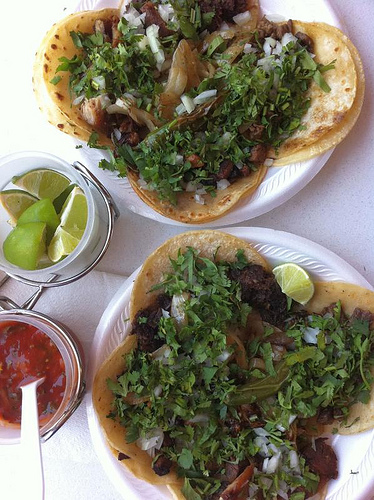
Texas history is firmly rooted in Mexican culture and you cannot leave the state without eating some form of Mexican food. In Austin, we sampled nouveau Tex-Mex at overly styled food trucks (think tacos filled with fried avocado wedges and chips with fancied up Velveeta).
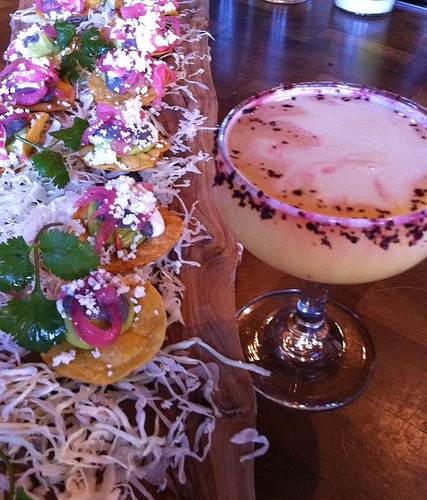
Then there were gems such as the Oaxacan fare at El Naranjo (85 Rainey Street) and Mexico City delights at La Condesa. The muddled corn cocktail (pictured above) at Malverde is excelente! One of things that we enjoyed most in Austin were the affordable drinks -- $5 for a top-shelf Margarita!
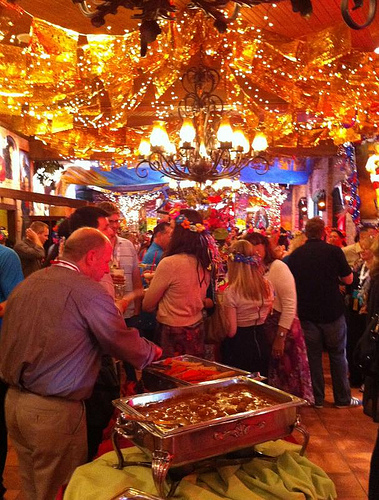
Things got colorful and crazy for us in San Antonio, where Saveur magazine Executive Food Editor Todd Coleman took us to a reception at Mi Tierra, an over-the-top Tex-Mex restaurant.The place is full of bling and kitsch. They are rarely closed, serve a huge volume of customers daily, and have an underground commissary.
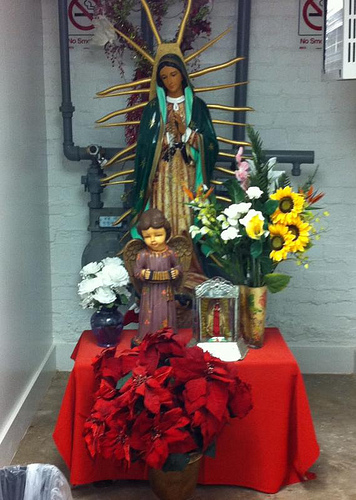
The commissary stretches a block long with walk-in refrigerators, prep stations, and even a religious shrine; San Antonio is surrounded by 3 missions and the Alamo, a former mission. We ate dinner at Mi Tierra with strolling mariachis and throngs of tourists and locals. While Mi Tierra's fajitas and taco salad were pretty standard, the ethereal flour tortillas were perfect for sopping up the queso cheese sauce. It was a worthwhile food bomb.
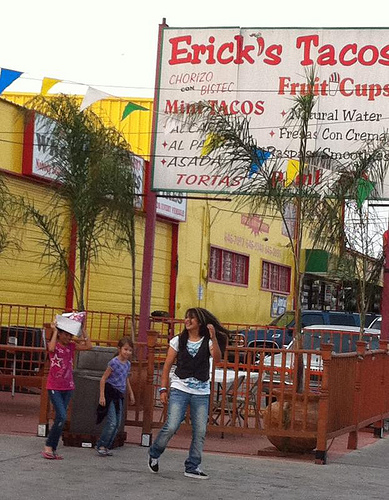
Food trucks abound in Texas because it’s a car-oriented state. People are used to driving long distance and there’s good food to be had at gas stations and semi-rural “farm to market roads.†Miles away from the touristy Riverwalk in San Antonio on Nacogdoches Road, we found wonderful food at Erick’s Taco Stand, Fruteria, and Restaurant.
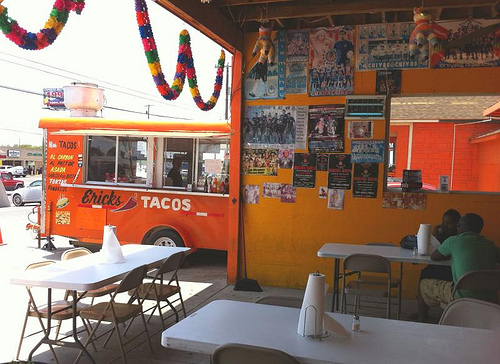
The three businesses are conveniently lined up right next to each other and share a common parking lot. The gaily decorated, open air dining reminded us of places we’d eaten at in Southeast Asia. We dined on cactus salad, greasy puffy crisp tacos (a San Antonio specialty), and pork cooked with squash and salsa verde at the restaurant and kept thinking about the food at Erick’s (12715 Nacogdoches Road). The next day, we drove back to lunch on mini tacos (4 for $5 and you can order different kinds of meats).
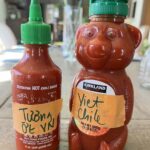
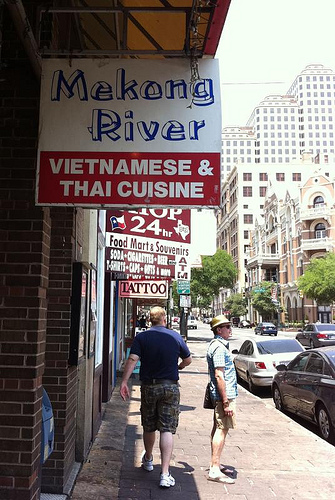
What about the Asian food? In Austin, the Texas-Japanese fare at Uchi and Uchiko were great but the homey offerings seemed slim. There was banh mi and pho in Austin, particularly around the university area, but kitschy signage for Asian restaurants such as this Viet-Thai one didn’t inspire confidence. They seemed awkwardly “ching chongâ€.
An upscale San Antonio tourist magazine listed P.F. Chang as the only noteworthy Chinese restaurant. In Luling, a Chinese restaurant menu highlighted its crab Rangoon fried wontons and pu pu platters. I like those old-fashioned dishes but was looking for something more special. For that reason, I held out until I got to Houston – a major hub for the Vietnamese-American community.
Have experiences or recommendation for Texas BBQ and/or Mexican food? Share them below!
Related recipes
- Classic Crab Rangoon (from Trader Vic's cookbook, plus links to other historic info on the Tiki-lounge favorite)
- Sriracha and Crab Rangoon Wontons (from Sriracha cookbook)



Kim
This sounds like a great trip! Texas has great food, especially if you are willing to drive. Impressed that eating at *3* barbecue spots didnt lead to a meat-induced coma...
We lived in Houston for almost 10 years during/after undergrad (until a recent move to the Peninsula), so I am Looking forward to hearing about your experience in Houston and especially to see if you hit any of my favorite Viet (and Mexican/Tex-Mex) spots. 🙂
jan
Luling is where I had my first Texas BBQ too!
Karin
Most of the good Asian food in Austin (and we could definitely use more) is way north of downtown and the university. One of my current favorite places for banh mi is a little shop called Tam Deli off North Lamar. Totally unassuming outside and full of deliciousness within. Asia Cafe has good Szechuan, and is next door to Chen's Noodle House, which does hand-cut noodles. And then there's Din Ho, which is the place to go for Chinese BBQ pork. All of these places are pretty well off the beaten path, but worth the trek when in need of a proper Asian food fix.
Kim
A great Vietnamese restaurant in austin is called Sunflower. You must try it next time!
Andrea Nguyen
Gals: Thanks for the tips on the Asian restaurants in Austin. I just didn't go far enough on Lamar. The area that you're talking about is around the MT market?
Jan: Oye, I didn't have enough time for any Tex-Mex/Mexican spots in Houston, though a friend said that his favorite spot is Mi Tiempo.
burkie
andrea, i'm happy to hear that your first visit to my home state was pleasant & delicious, as it should be!
Xuanie
You need to try Kansas City BBQ!
Nate @ House of Annie
This reminds me of our Central Texas, Austin-SA-Houston trip back in 2007. We went to Kreuz and Black's. I was not that impressed with their barbecue, actually. (To each his own.) Best thing about it was they don't smother the ribs in sauce before serving it to you.
We really enjoyed San Antonio. Mi Tierra was kitchy and crowded but cool.
Our best barbecue came from Houston (Williams Smokehouse - Robb Walsh might know more about it). http://www.houseofannie.com/williams-smokehouse-houston/
Didn't make it to Elgin to try some of their sausages, unfortunately. But we did find a great winery in College Station called Messina Hof - wonderful tawny port!
The Texas Barbecue Trail also runs through the Texas Hill Country, west of Austin. For instance, Cooper's in Llano. For that reason, Austin definitely warrants a trip back!
Kie
That barbecue looks amazing!
Check out my dim sum post at http://hongkongintern.wordpress.com/2011/06/17/having-lunch-in-good-company/
burkie
i can second Cooper's in Llano for excellent brisket!
Annie
you need to come to Houston if you want to try good Asian food.
Waverly
I am a native Houstonian and enjoyed your perspective on Texas food very much. In Houston, EL TIEMPO and HUGOS are my absolute favorites for Mexican food. As you pointed out, we have a tremendous Asian community here and an abundance of fantastic restaurants as a result. China Garden, downtown across from the Toyota Center is delicious. We like NIt Noi for Thai food. That said, I am looking forward to reading about where you go.
Laura
Traveling thru Texas there are so many varieties to choose from for food choices. It's great thank you for sharing.
Andrea Nguyen
Thanks for sharing all of your eating experiences. I have to admit that since returning home, even though it's a lot cooler here (65-75F), we keep thinking about all that good food in Texas.
Elgin -- Oye, the sausages in Lockhart and Luling were better. We should have gotten up earlier and headed to Taylor. Alas, we had a plane to catch in Austin.
Waverly -- Thanks for the recommendations. El Tiempo and Hugo's are on my list for the next Houston trip.
Karin
There's a lot of good stuff around MT Market -- at least two pretty solid banh mi places, if I remember correctly. Tam Deli isn't quite that far up North Lamar, though -- it's just north of 183, and you are almost guaranteed to drive past it twice on your first visit. (I did.) Asia Cafe and Chen's are at 183 and Spicewood Springs, in what is admittedly a very unpromising-looking strip mall, but that strip mall has become something of a food mecca. In addition to the Chinese food, I'm told that there is now a really good Indian place, and there is also Sambet's, which does good Cajun. And Din Ho is at 183 and Anderson Lane.
kim
Andrea, Sunflower is off of 183 kinda near research blvd. It's where Din Ho is. Actually, my brother said it burned down awhile ago and just reopened. I came a few times with my brother and it has been the best Viet restaurant I've been to in Austin.
If you're looking for good Thai food next time you're in Houston, my all time favorite place is called Thai Gourmet, off of Richmond near Harwin.
online clothing store
I can see here so many great things with food and fun.And i really enjoyed a lot by seeing these all things.Such a great Trip it is.Nice sharing it is.
Jaylynn
This piece was cogent, well-wtirten, and pithy.
Aurora
Yep, the most authentic Mexican food you will find in Texas (at least Austin and SAT) are the small taco carts. Most of the established restaurants offered Tex-Mex food which is not the same :).
Jaye
Ah, the elusive Austin Asian food...As others have said, north of 183 on Lamar is where you'll find the good stuff. Le Soliel is much like Sunflower, and another great choice. Our best pho, in my opinion, is Pho Saigon in the Chinatown center with Pho Dan close on it's heels. Best Bahn Mi is at Tahn Ni on Lamar as well, plus the lady who owns it is one of the nicest people on the planet.
For Chinese, A + A Sichuan is now head and shoulders above Asia Market Cafe, (located a little north of Asia Market on 183, same side of the highway), and First Chinese BBQ in Chinatown Center shines for great duck, pork and veggies.
But the really good Vietnamese, as you've talked about here, is definitely in Houston. Ours is limited to the Pho, Com and Bahn Mi variety in the ATX.
Next time for BBQ, I would suggest making the trip out to Lexington on a Saturday morning for Snow's, or heading to Llano to eat at Coopers.
Kie
Your lunch looks delicious! Check out the famous Hong Kong egg tart, which is a delicious dessert: http://hongkongintern.wordpress.com/2011/07/12/egg-cellence/
Red Bottom shoes
Empty vessels make the most noise.
Christian Louboutin
Two is company, but three is none.
marlon
Texas history is firmly rooted in Mexican culture and you cannot leave the state without eating some form of Mexican food.
Mr. Cooking Grill
I totally loved it! This is my favorite recipe. You have done mind blowing.
marlon
A great Vietnamese restaurant in austin is called Sunflower. You must try it next time!