












A while back, I got a message asking about sodium benzoate in fish sauce. What is it and where do I stand on it?
I mention its use in Into the Vietnamese Kitchen, and you may notice it on some fish sauce labels. Sodium benzoate is a preservative that's found in certain acidic foods (e.g., salad dressings, and pickles), medicines, and cosmetics. As a rule of thumb, I generally buy ingredients with the least amount of chemicals involved.
Looking back at Viet World Kitchen blog postings, I came across Singaporean-based food expert Chris Tan's fish sauce tasting conducted a few years back. He has a terrific palate and sent me his tasting notes. When rereading Chris's comments, I noticed one fish sauce that he said tasted flat, a quality that he attributed to the presence of sodium benzoate. Indeed, there is a flabby, almost zingy, aftertaste that certain fish sauces have, especially when sodium benzoate is present. So that's a negative for it being used in fish sauce - bad flavor!
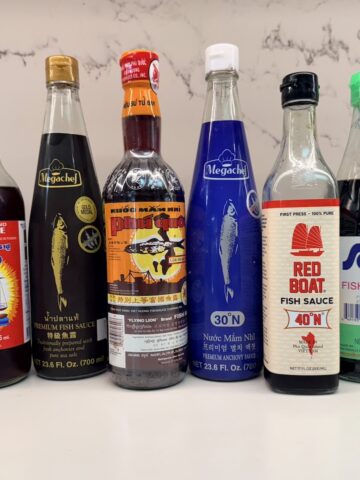
I examined all the fish sauces in my pantry the other day and none of them had sodium benzoate. My collection included Viet Huong's 3 Crabs and Phu Quoc brands, MegaChef, and Red Boat's 35 and 40 dam (a notation of concentrated flavor, the higher the number, the better). Viet Huong combines Vietnamese and Thai fish sauces into their blending process. MegaChef is aged Thai nam pla. Red Boat (full disclosure: they advertise on this site) is pure Vietnamese nuoc mam from Phu Quoc.
These are premium fish sauces that cost a little more than the competition and they're worth it. Use them for dipping sauces and they'll make your food shine. Or, sprinkle some on a bowl of hot rice. I just use them for all my cooking and sauce needs as they make my food taste really good.
You can find Viet Huong at many Asian markets. MegaChef has yet to be distributed in the States so you have to be in Thailand to get it! With regard to obtaining Red Boat fish sauce, order it from Amazon.
Safety of sodium benzoate?
Try to avoid it. Here is information on sodium benzoate from Center for Science in the Public Interest:
Manufacturers have used sodium benzoate (and its close relative benzoic acid) for a century to prevent the growth of microorganisms in acidic foods. The substances occur naturally in many plants and animals. They appear to be safe for most people, though they cause hives, asthma, or other allergic reactions in sensitive individuals.
Another problem occurs when sodium benzoate is used in beverages that also contain ascorbic acid (vitamin C). The two substances, in an acidic solution, can react together to form small amounts of benzene, a chemical that causes leukemia and other cancers. Though the amounts of benzene that form are small, leading to only a very small risk of cancer, there is no need for consumers to experience any risk. In the early 1990s the FDA had urged companies not to use benzoate in products that also contain ascorbic acid, but in the 2000s companies were still using that combination. A lawsuit filed in 2006 by private attorneys ultimately forced Coca-Cola, PepsiCo, and other soft-drink makers in the U.S. to reformulate affected beverages, typically fruit-flavored products.
So aside from an off taste in fish sauce, there are potential ill effects from sodium benzoate, especially when it is combined with absorbic acid (vitamin C). The risk level seems to be low but why risk your health at all if you don't have to? I'd read the fish sauce labels carefully and try ones that don't contain sodium benzoate. Or, don't drink fish sauce like you would a can of soda pop!
Any urban legends to report on sodium benzoate in fish sauce? Slap them into the comments below!
Related posts and links
- Fish sauce post archives (vegetarian fish sauce, Phu Quoc fish sauce, Viet Huong (3 Crabs) taste off, fish sauce buying tips)
- Sodium Benzoate + Vitamin C in sodas affect mitochondrial DNA (fish sauce is not the same as soda but this worth a read)
- Center for Science in the Public Interest's quick low-down on additives in foods


Quan V says
Bought my first bottle of Red Boat the other day, $15 after shipping. Expensive for a bottle of fish sauce but supposedlly it's made from "anchovies and salt" only. I stayed away from Viet Huong sauce. They are processed in Hong Kong, god knows what they "processed" into the sauce beside sugar . Wish the price for Red Boat was cheaper.
Belinda @zomppa says
This is so helpful - thank you so much!
Zach3 says
Andrea - Be very careful on anything coming from Science in the Public Interest. I have two PhDs - 1 in engineering geology and another in molecular biochemistry. I'm a technical reviewer for several professional journals. SPI material 99.9% of the time fails the most basic tests of scientific objectivety. It's built on emotion not science. For the last 30 years I've seen this sort of "science" presented and to lay people it makes sense. Unfortunately it's mostly pure bunk. A lot of the hoopla over any sort of chemical exposure is no mention of the dose-response. Our lab instruments now are so sensitive, we can reliably measure things in the part per trillion range. Parts per billion became common 20 years ago. Just because a substance is there does not mean it causes a damaging health effect. The example of arsenic in drinking water is one you may remember as it was all over the newspapers several years ago. Drinking water was and is allowed to contain some arsenic at a very low level. SPI came out along with some other "science" groups (read this as community activists looking for a headline and money) and made a big stink. Instruments to measure metals like arsenic had gotten cheaper, better and more wide-spread. So they and their less-than-knowledgable political allies started wanting to lower the arsenic limit below anything near reasonable or necessary (arsenic is everywhere in the environment along with lead, asbestos and a host of other things that aren't good for you). In the end a lot of small water systems all across the US either shut down or became much more expensive to pay for purification equipment they didn't need and most don't know how to operate. The levels of arsenic allowed have been shown NOT to cause health effects for almost 100 years! SPI, Public Interest Research Group (PIRG), Union of Concerned Scientists - and the list goes on - are propogandists, not scientists. I agree with the Benzoate in the presence of ascorbic acid isn't smart. The dirty little secret is that a free benzene molecule/ring can form from the benzoate and almost any acid (like citric from fruit). CocaCola paid one of my colleagues almost a $1M to shut up about mold growth in Mellow Yellow back in 1982; the mold was growing due no benzoate in the formulation to stabilize it. And don't ask how they degrease bottles on a lot of bottling production lines in Asia and Africa; that's right benzene and chlorinated solvents cut the grease very well. Go forth, avoid the chemicals by all means if possible (I do). But don't get trapped by "popular" science or, as I've always called it, dead babies on pitchfork science. Sure does stir things up though. All the best.
pendant watches says
Sodium Benzoate is one of the chemical i can say and its used as a preservative in so many tings like with the acidic foods,medicines and all.And i can get so many best and informative things from your great stuff.
wholesale nfl jerseys says
These are premium fish sauces that cost a little more than the competition and they’re worth it. Use them for dipping sauces and they'll make your food shine. Or, sprinkle some on a bowl of hot rice. I just use them for all my cooking and sauce needs as they make my food taste really good.
EAR ear plugs says
Its one of the great information about the sodium benzoate.And you have also shared here the content of safety of sodium benzoate is too good.so while going to buy any of the food be sure with its amount in that food.
Andrea Nguyen says
Quan: Viet Huong is a reputable organization and they process at modern facilities in HK because the technology is good there. How do like using Red Boat in your food? Thanks for sharing your thoughts!
Andrea Nguyen says
Zach3: Greatly appreciate the back story on the organization's agenda. I was a bit suspect but I also cross referenced their info on sodium benzoate with other sources. Filtering materials online can be such a chore. But that is why we have discussions like this one! 🙂
Madeline says
Very helpful information. I'm glad there are affordable choices without the additives.
Jerry says
Because I don't use fish sauce a lot, I had picked up a small bottle of "Thai Kitchen Premium Fish Sauce" from my local grocery store. This article made me dig it out of the refrigerator and check ingredients.
Anchovy extract, Salt, Pure cane sugar(?). Ok, not top quality, seems to not contain any Sodium Benzoate.
So if I picked a bottle of something better quality, how long can I expect it to survive my occasional use stored in the refrigerator?
Linh-Dang says
Zach3: I applaud your plea for skepticism but I object to the outright dismissal of public interest groups efforts for better regulation as money grabbing schemes. We absolutely do need better regulations in many areas to better protect us and our common environment, but regulations tend to cut into corporate profit margins and are opposed. We need public interest groups and concerned scientists to combat both corporate lobbying in the public sphere and bad science published in the academic sphere (look up, for example, how pharmaceutical companies cooperated with certain publishers to put out friendly data in fake peer review journals.) Also the idea that the well-meaning people including concerned scientists who participate in non-profits would act as cynically as self-interested corporate lobbyists is frankly insulting.
We can assume that a range of competing voices will lead us to a middle ground, which is the way things work usually, but the only real way to get good science awareness is for more scientists to participate in public discussions. We need solid numbers and help with interpreting data rather than packaged conclusions from one perspective or another. I think we can handle such a discussion and it is fundamentally important for people to realize that any conclusion in science must be backed not just by homegrown results but also by an accumulation of independently derived data.
If you are familiar with the subject of benzene, it would be great if you could provide some relevant numbers - doses that cause harm, background environmental doses, doses expected in fish sauce, rise in cancer risk attributable to benzene in fish sauce, etc.
Andrea Nguyen says
Jerry: If stored in the fridge, fish sauce lasts for months. Remember to close the cap tightly. If crystals form, it is time for a new bottle.
Andrea Nguyen says
Linh Dang: Good points. There is a lot of information for consumers to wade through. You and Zach3 are clued into the details on this matter, which is fabulous.
Indeed, when reading research materials/scientific claims, we have to ask: Who is the messenger? How was the argument/position formulated? Then check with other reliable sources and finally make an informed decision.
Rumors love to run rampant in Asian communities about food additives. One of my recent favorites was the use of human hair in Chinese-made Maggi Seasoning sauce. My all time fav was how engine oil was used to fry food; that was from when I was a kid in Vietnam.
Karla Pengsagun says
Andrea, its best to store fish sauce at room temperature so that salt crystals do not form. It can keep up to 2 years this way, but when it becomes dark and cloudy it is time to throw it away. Traditionally, in hot and humid Thailand, fish sauce is stored on the kitchen counter. Regarding brands, more affordable for everyday cooking are Golden Boy and Tra Chang (Scale) both from Thailand compared to Red Boat (which I heard it is very good and hope to try soon).
Laura says
It's hard to find good sauces that contain so much sugar and who knows what else. thanks for sharing the information.
Carmie says
Andrea, thank you so much for all the wonderful info on fish sauce. For like 20 years I cooked with what was available - dark, really strong smelling that made my husband leave the kitchen when I tossed it into the wok! He was fine with the taste after cooking - but now I've got a source for 3 Crabs and Phu Quoc, yummy. He loves it, like I do. Thanks!
Bear says
Question for Linh Dang:
After about two years of experimenting with Japanese and Chinese Soy Sauces, I bought my first bottle of Fish Sauce at my favorite Asian Grocery and this conversation got me looking at the label. I bought Golden Boy brand which is just Anchovy fish, salt and sugar, but specifically says not to refrigerate because of crystal formation. Which is best, to refrigerate or not to refrigerate?
Tenjo says
Thank God for fish sauce not containing sodium benzoate. I'm severely allergic to it. Last time at a restaurant they marinated meat with a sauce that has MSG and sodium benzoate in it, and my entire forehead (including my eyes) swelled up to like 3 inches thick! I quickly ended up at the emergency room, and the doctor couldn't believe how serious it was.
I don't believe chemicals should be in ANY food. I read labels VERY CAREFULLY and there are very few soy sauces, sauces of any kind that are pure. I now buy sauces that are pure, naturally fermented, without any preservatives, no food colorings.
Kikkoman is NOT a real soy sauce, as they use leftover soybean meal as the base to ferment soy sauce.
REAL soy sauce starts with WHOLE soybeans and is fermented for a minimum of 1 year.
I don't refrigerate my fish sauce; I do keep it in the cabinet (out of light), as UV light tends to break things down faster. If you can finish a wine bottle size of fish sauce in 3 months, it doesn't matter.
Canada Goose says
we have more knowledge,but less judgment;
Red Bottom shoes says
Love me, love my dog.
Beats by Dre says
Pain is forgotten where gain follows.
Canada Goose says
Speak of angels and you will hear their wings.
marlon says
Thank God for fish sauce not containing sodium benzoate. I'm severely allergic to it.
Mr. Cooking Grill says
You have to believe in yourself. That’s the secret of success.
shopbasketballshoes says
Awesome!! Thanks so much for sharing!!!
Tele says
Every time after just accidentally sipping a soda with sodium benzoate in it, I get a migraine. So I know that sodium benzoate is harmful to my body.