






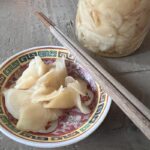

Today I sent out the last recipe chapter to get tested for Asian Tofu. Whew! Relaxation time. I wanted to make a little Asian dumpling for fun, not for tweaking multiple times for print. I wanted the pleasure of fooling around with dough to create a satisfying afternoon snack. No pressure.
I picked these little guys. For months, I'd been thinking about trying these chewy-soft rice dumplings in Elizabeth Andoh's Japanese vegan cookbook, Kansha. The dough is fast and easy to prepare.
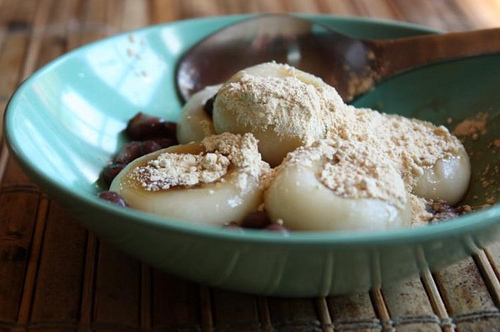
Elizabeth formed her sweet rice flour dough into little balls for a classic Japanese sweet dumpling called shiratama dango. I decided to make the dumplings larger and dimpled so that they'd have tiny wells for holding thick brown sugar syrup – called kuro mitsu in Japanese. Plus, I could also pile on some adzuki beans in those indented dumplings. Sweet adzuki bean paste is commonly eaten with shiratama dango but canned beans and the brown sugar syrup do the trick.

The above combination of poached dumplings, buttery beans and sweet syrup was good. However, it was splendid with the addition of nutty toasted soy flour (kinako), which I had to make on the fly. Here is my afternoon dumpling snack for you to try.
RECIPE
Sweet Rice Dumplings with Brown Sugar Syrup, Adzuki Beans and Kinako
Shiratama Dango
Based on recipes from Kansha by Elizabeth Andoh. If you are unfamiliar with the rice flours below, see the ingredient discussion in Asian Dumplings or this page at Asian Dumpling Tips.
Serves 4 to 6
Kuro mitsu:
⅔ cup packed dark brown sugar
¼ cup water
Pinch of salt
2 ¼ ounces (½ cup) glutinous rice flour, any Thai brand
2 ounces (⅓ cup) Mochiko sweet rice flour
About 6 tablespoons water or unsweetened soy milk
¾ to 1 cup cooked adzuki beans (canned is fine)
About 2 tablespoons purchased or homemade toasted soy flour (kinako), optional
1. In a small saucepan, combine the sugar and water. Heat over medium high heat, stirring until the sugar has dissolved. Bring to a boil, then lower the heat to vigorously simmer for about 3 minutes, until the syrup has thickened a fair amount. Dip a spatula or spoon into the syrup and it should cling before dripping off. A dark shiny film should remain on the spatula or spoon.
When the syrup is done, take it off the heat and wait for the bubbling action to subside before stirring in the salt. Pour the syrup into heatproof glass jar or bowl and set aside to cool. You should have about ½ cup.
2. For the dumplings, combine the two rice flours in a bowl. Drizzle in half of the water (or soymilk) and use your fingers to stir and moisten the ingredients. Then gradually work in the remaining liquid, kneading the dough into a PlayDoh type of consistency that’s firm yet soft and smooth. Toward the end, add the liquid slowly as a little of it can affect the dough dramatically. This dough can dry quickly and crack. Take care to cover it if you’re going to walk away for too long.
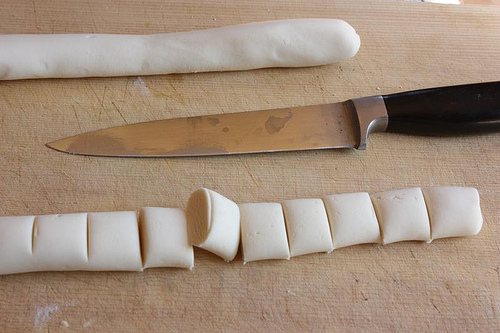
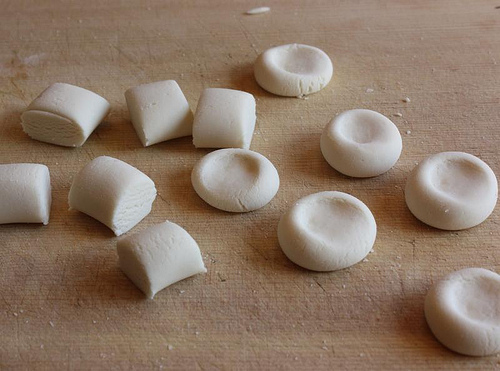
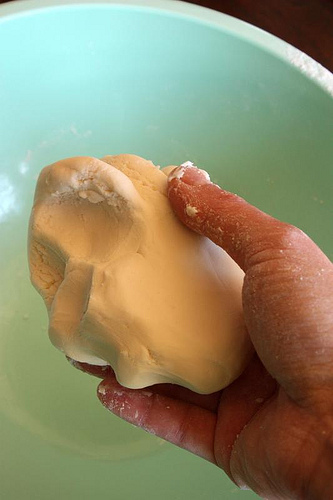
3. To shape the dumplings, work with half of the dough at a time, covering the other half with a dishtowel to prevent drying. Roll the dough into a 12-inch-long log. Cut it crosswise into 12 pieces. Roll each one into a ¾-inch ball and then flatten it into a thick disc, about a scant ½ inch thick.
Use your index finger or thumb to make an indentation in the center. Set aside and repeat with the remaining dough. You’ll form two dozen 1-inch-wide dumplings total. When done, cover them with the dishtowel.
4. Fill a large saucepan or pot with about 3 inches of water and bring to a boil. Depending on the size of the pan, drop in half or all of the dumplings. (In a 3-quart pan, I do 2 batches.) After all the dumplings float to the top, let them cook for another minute, then use a skimmer to scoop them from the water. Drop them into a bowl of cold or room temperature water to let them cool.
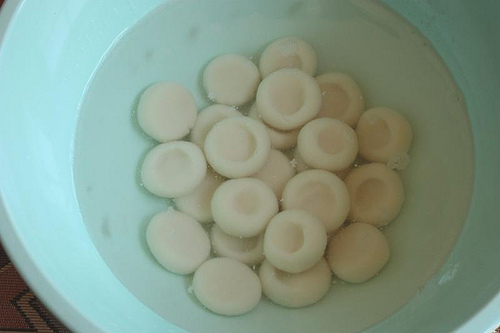
The dumplings are tastiest within 30 minutes after they are made. They will still be at their peak soft-and-chewy selves. If you leave them in the water longer they’re gradually firm up. To revive them, drain them and dunk them in boiling water to soften (essentially a quick recooking) or warm and soften them in the microwave oven.
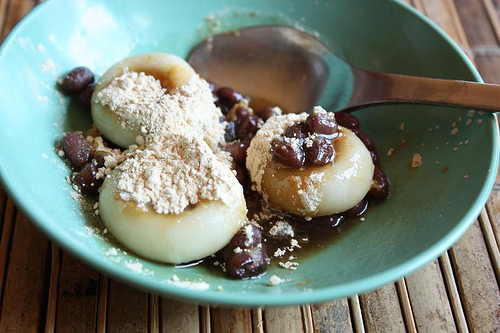
5. For each portion, put 2 to 3 tablespoons of adzuki beans in a small shallow bowl. Top with some dumplings, and a drizzle of the sugar syrup. Then finish with about 1 teaspoon of the toasted soy flour. Eat with a spoon to ensure that you get some of each of the ingredients in every bite.




Rosa
Those look so delicious! I love that dessert.
Cheers,
Rosa
Andrea Nguyen
It's a comforting sweet preparation. Some people describe it as a dessert dumpling but why wait for dessert?! 🙂
Nike Duck Shoes
your website is so great that i love it very much. thank you for sharing it with us.
Merry
I think I gained calories simply by reading that recipe -- but it was worth it 🙂
3M respirators
Hey it looks so cool and Delicious my mouth is watering by seeing it.And i am crazy about the sugar syrup.I will defiantly go for it.I like your Recipe as well as your decoration also.
Andrea Nguyen
Merry, I think this dumpling is kinda low-calorie! Sticky rice sticks to your ribs. The adzuki beans and soy flour contribute protein to make you feel satisfied.
Mary N
This looks just as tasty as Chè trôi nước. I love making Chè trôi nước with my mom and seems we can do this minus the mung bean paste. I have so many dried beans in the cupboard I am going to have a trying it with a variety of beans for dessert, multi-color for visual fun. Seems fun and a good quick sweet to do when we have family gatherings. Thanks for the recipe Andrea.
VMA
Andrea, we have a similar sticky rice snack food in the Philippines we call "floaters"-
because they float when cooked in a wok filled with boiling water. What we put on top are a combination of freshly-grated coconut, muscovado sugar and ground black sesame seeds. Very filling and oh so good with a cup of hot tea.
Pregnancy Clothes
Its Very yummy rice recipe with the sugar syrup.It looks so testy and Delicious one.And my Mouth is watering by seeing it.Nice Recipe it is.
J$
the presentation is looking admirable...tempting too will try it..thanks for sharing..
online poker
It looks so Delicious and Yummy.This Japanese dish i like the most with my Favourite Brown Sugar Syrup.My mouth is watering.I like your Sharing.Well Done.
Teresa F.
Oh it looks so delicious, like a Chinese tang uan. The adzuki bean paste looks like a delicious combo. Oh, how I would like some now!!
Nike Shox TL3
HI!YOUR WRITE-UP IS VERY INSTRUCTIVE AND I ACTUALLY LIKE THE CONTENT EXACTLY WHERE IN EACH DETAIL IS VERY USEFUL!!!
sylvia cleary
i saw another recipe of dumplings here and this one caught my eye too..i will go for them soon..
cheap supra shoes
Helena, its lack of strategic focus for much of its early existence, I think its too early to wonder about its future.
cheap mbt shoes
From an early age, on the fear of regret. Because the teacher said that the world did not sell drugs to regret. So, has been working, so no regrets.
Coach Outlet Online
Little drops of water, little grains of sand, make the mighty ocean and the pleasant land.
mbt online
That was my thought,too.
Cheap Nike Dunks
It happens to be a lot of our obligations for the reason that analysts, being familiar with the improve of which proceeds from an effective vision from lack of education, the improve that may be typically the plant from escape from concept, towards proclaim the beauty of that escape; to show the simplest way doubting is absolutely not to always be dreaded and yet welcomed not to mention spoken about; and then call for this unique escape for the reason that a lot of our challange to any or all getting versions.
Justin Bieber Shoes
YES.i love it very much. thank you for sharing it with us.
...
zeglekslile
JEWRQCFWSN vancouver canucks jersey JTFLBQKPMQ http://www.womenforasianmen.com/blogs/entry/detroit-red-wings-jersey-73cp
Oretssota
XWTVLJRJZR uggs on sale HUAMWOLIXV http://canadagoosecoats.beep.com/uggsforsale.htm
Red Bottom shoes
Love and a cough cannot be hid.
Christian Louboutin
Once a man and twice a child.
marlon
Hey it looks so cool and Delicious my mouth is watering by seeing it. It happens to be a lot of our obligations for the reason that analysts, being familiar with the improve of which proceeds from an effective vision from lack of education.