
If you've worked your way through a few recipes in the Asian Dumplings cookbook, you may want to break out on your own. You have a lot of dumpling leeway in the filling, which are mostly interchangeable in the cookbook recipe chapters. Read the recipe introductions and think of a mix-and-match ensemble wardrobe. (How many ways can you wear a business suit?) Once you understand the foundational filling flavor profile and texture, try winging one. Below are few pointers on how I did that today.
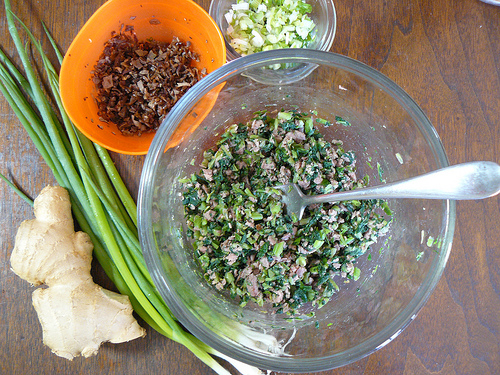
My fridge was overloaded with odds and ends of ingredients that I had prepped, cooked, or over purchased. There was leftover grilled steak, a partial bunch of bok choi, finely chopped wood ear mushroom from recipe development, and too much scallion, which I bought on impulse at our farmer's market yesterday.
Key size, moisture, and ingredients
After making a steak sandwich for my husband's lunch, a few slices remained. I wondered if I could chop them up fine and put them into a dumpling filling. I went at the beef with my knife until it was reduced to bits. You want things small for dumpling fillings. When improvising an Asian dumpling filling, do it with cooked meat as you can safely adjust the flavors by taste.
A pot of water was boiling on the stove for blanching tomatoes destined to be peeled. As the tomatoes sat in the hot water, I quickly washed and chopped the bok choi. After plucking the tomatoes from the pot, I threw the bok choi in to cook. I then drained and squeezed excess moisture from the greens. To avoid diluting Asian dumpling filling flavors, get rid of as much liquid from high-water content vegetables such as bok choi, spinach, or cabbage. Cook it or salt it raw (see the Pork and Cabbage Water Dumpling (shuijiao) recipe in Asian Dumplings, page 31, for an example).
Then I mixed in the woodear mushroom for crunch and chopped up rau ram (Vietnamese coriander) leaves that I'd picked from the garden for pizazz. But I couldn't forget am ample half cup of finely chopped scallion and a tablespoon of minced ginger. Scallion and ginger are present in many Asian dumpling fillings. You need them for the 'right' taste.
Finessing the seasoning
Then I added salt, pepper, sugar, soy sauce, sesame oil, and Shaoxing rice wine in small quantities. I aimed for a savory flavor that was stronger than what I'm comfortable with. That's because the dumpling wrapper is flavorless. The filling carries the dumpling in many regards. When seasoning fillings on the fly like this, do it incrementally by the pinch or partial spoon measurement, depending on the ingredient. It is easier to add flavor than to reduce flavor in food.
Tweaking the texture
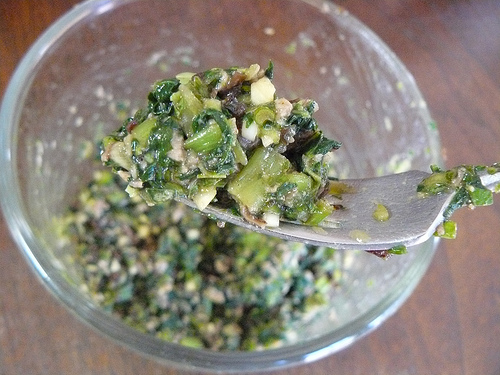
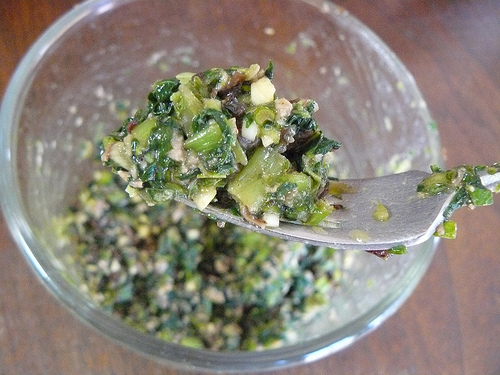
The dumpling mixture got denser with the seasonings. Then I added water by the teaspoon as I wanted it to have a certain rich texture, not crumbly. The filling is good when you can mound it on a fork. If the filling got too wet, I figured that my workaround would be cornstarch. I let the filling sit for 30 minutes, then tasted it again before I used it.
Have you created dumpling fillings on your own? Share your insights! Or pose a question.


patricia says
My favorite dumpling filling is Dill with pork! it is the best dumpling filling ever 🙂
Belinda @zomppa says
This looks sooooooooo good - perfect filling!
Andrea Nguyen says
Thanks for the tip, Patricia!
Belinda: I did it from just stuff in the fridge. Glad the filling appeals to you.
Güzel Resimler says
It looks delicious !
Amie says
I made deer and coriander dumplings once. My blog about it is here if you're interested:
http://multiculturiosity.blogspot.com/search/label/Deer%20kofta
They were really more like wontons but you could use a thicker wrapper, wrap them differently, and steam them instead of boiling. I have the same problem buying frozen dumplings - I won't buy them if they have MSG. Fortunately my city, Montreal, has a very good Chinese dumpling house with soup dumplings, and they offer bags of them frozen for takeout at very reasonable prices. I love seeing the two women wrapping each dumpling by hand in the kitchen. That's a long process. I've been there.
Red Bottom shoes says
No country , however rich , can afford the waste of its human resources.
red bottom shoes says
you are the best! I’m the greatest! you are invincible
Beats by Dr Dre says
That achievement is at bottom empty? That the efforts of men and women are of no significance alongside the force of movements and events now not all success, obviously, is worth esteeming, nor all ambition worth cultivating. Which are and which are not is something one soon enough learns on one’s own.
Red Bottom shoes says
Envy has no holidays.