









I love eggs, particularly soft boiled, poached, and fried. I love the firmish white commingling with the rich yellow-orange yolk. Whether with toast, in banh mi, or atop a bowl of rice, eggs comfort and satisfy me. All I need is one and I’m complete. Little did I know that Chef David Chang and Peter Meehan’s new Momofuku restaurant cookbook would shine some extra bright eggy light into my life. Reviewers have praised the book but also commented that the recipes are not tailored for home cooks. I beg to differ as there are a number of simply brilliant ideas, such as Momofuku’s slow-poached eggs.
In fact, there are lots of wonderful takeaways from the book that go beyond the recipes, such as Chang’s frank humor and observations on race. “OS” sauce is Momofuku’s generic pan-Asian seafood sauce and the acronym stands for Oriental Sauce. Telling it like it is in a thoughtful-yet-brusque manner, Chang explains – as channeled through Meehan’s prose, in the recipe introduction for pan-roasted bouchout mussels with OS (page 100):
I enjoy appropriating the out-of-date and borderline-racist term Oriental whenever I get the chance. But I was one of the few Orientals working in the kitchen at Noodle Bar, and the rest of the round-eye crew wasn’t happy with the name. So we kept it under wraps. Since we’re here alone together, let’s call it what it is: Oriental sauce.
That’s not such an outdated term. It’s just one that’s used behind closed doors.
Few Glitches, Lots of Brilliance
It’s that straight-ahead tone that makes me overlook several Vietnamese misspellings in the book. If you’re going to use all the diacritics (accent marks), you should go all the way and across the board, regardless of culture and cuisine.
Furthermore, restaurant cooking is not like home cooking. Momofuku has many recipes that are complex and time consuming. Chang has a recipe for the Chinese steamed buns that he stuffs with braised pork belly, but he admits that Momofuku buys their buns/rolls from a supplier. The recipe in the cookbook doesn’t produce the pillowy, snowy white bun that’s pictured in the book and served at the restaurant. There are three rises involved, and at the end of the day, the Momofuku bun steamed up a pale tan color, most likely due to the use of baking soda in the dough. For a doughy geek like me, that recipe was a fussy disappointment. I’m sticking to my reliable basic yeast dough for fix of Chinese buns and braised pork belly.
Slow-poached Eggs Recipe
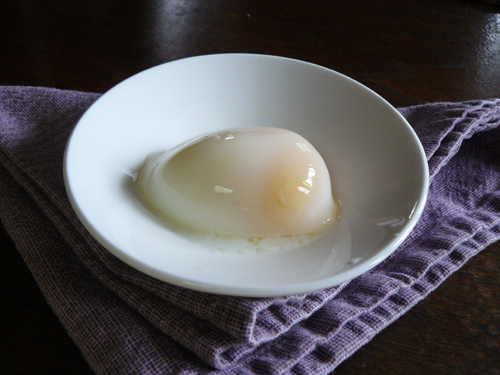
But none of those things kept me from trying out more recipes, and I struck pay dirt with the slow-poached egg recipe. Meehan did a splendid job conveying Chang’s fervor over the utter simplicity of the cooking process, which originated in Japan with old ladies who took to multitasking at the natural hot springs. They soaked themselves while slow-cooking eggs in 141F hot baths. The finished eggs hold a wonderful elliptical shape (in the photo above) that charms and excites all at once. The yolk is barely cooked and remains runny so that you can enjoy their unctuous essence. At Momofuku Noodle Bar, the slow-cooked eggs are added to ramen and fried too.
I slow poached all the eggs I had – 8 total – and ate them over the course of several days. I don’t usually eat that many eggs in a week but it was fun to play around with them. Then I had to eat them. Thank G.O.D. Rory was around to help.
To give you a sense of my thinking process when using a restaurant chef’s recipe, I’m providing Momofuku’s slow-poached egg recipe verbatim but with [my annotated text in brackets]:
Large eggs, as many as you like [as fresh as you can get, organic, free range, all the quality you can afford]
1. Fill your biggest, deepest pot with water and put it on the stove over the lowest possible heat. [If you have a 5,000 BTU burner for simmering, that works perfectly.]
2. Use something to keep the eggs from sitting on the bottom of the pot, where the temperature will be highest. If you’ve got a cake rack or a steamer rack, use it. If not, improvise: a doughnut or aluminum foil or a few chopsticks scattered helter skelter across the bottom of the pan will usually do the trick, but you know what you’ve got lying around. Be resourceful. [Chang and Meehan know that this is a potential obstacle for home cooks and their encouragement is great. You don’t need much to MacGyver the cooking set-up. I used a heavy-bottomed 8-quart stockpot and a collapsible steamer rack to elevate and cradle the eggs. A deep 4-quart pot would have done the trick too. Any pot that will hold eggs in 1 layer and will fit a rack of some sort; or do the foil coil. You have to keep the eggs submerged for 45 minutes. Think of the Japanese ladies in their hot springs!]
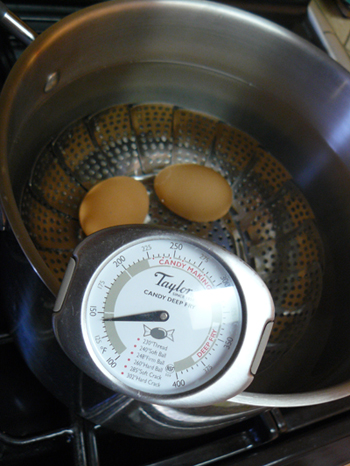
3. Use an instant-read thermometer to monitor the temperature in the pot – if it’s too hot, add cold water or an ice cube. Once the water is between 140 and 145F, add the eggs to the pot. Let them bathe for 40 to 45 minutes, checking the temperature regularly with the thermometer or by sticking your finger in the water (it should be the temperature of a very hot bath) and moderating it as needed. [On a home stove’s simmer burner, achieving the low water temperature and maintaining it is easy. I just clipped my deep-fry thermometer on to gauge the temperature and then stuck my finger into the water to double check. Set a timer. My temperature fell below 140 for about 10 minutes so I adjusted the temperature and then bathed them for longer. It’s not rocket science though vigilance is required.]
4. You can use the eggs immediately or store them in the refrigerator for up to 24 hours. (If you’re planning on storing them, chill them until cold in an ice-water bath.) If you refrigerate the eggs, warm them under piping hot tap water for 1 minute before using. [I kept the eggs around for 4 days. Before using them, I returned them to room temperature by letting them sit out for about 1 hour. If I served them as warm poached eggs, I boiled a saucepan of water, then let it cool for about 15 minutes, then let the egg sit in the hot water for 1 minute.]
5. To serve the eggs, crack them one at a time into a small saucer. The thin white will not and should be firm or solid; tip the dish to pour off and discard the loosest part of the white, then slide the egg onto the dish it’s destined for. [Chang and Meehan are totally right on about this. The egg holds a mounded shape but it’s jiggly. And, there’s some white for you to pour off.]
How to use the slow-poached eggs:
- Eggs Benedict without much last-minute fuss.
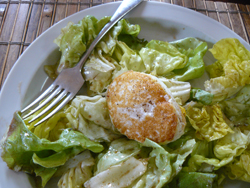
- Fried eggs – use a nonstick skillet with a film of oil. Heat over medium high to smoking, slide the egg in (do the sauce thing to make it easy), then fry for 45 seconds on each side. Sprinkle with Maldon or kosher salt and black pepper. Eat as is. Or, top a salad orbowl of hot rice. Add Maggi Seasoning sauce and black pepper or homemade Sriracha sauce. Heavenly.
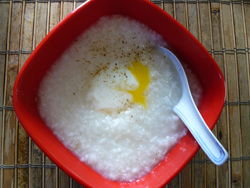
- Add the poached egg to an impromptu bowl of rice soup (chao/congee/jook). Use leftover cooked rice 1 part cooked rice: 4 part broth, water, or combination of. Simmer for about 30 minutes, until creamy. Add salt, scallion, and ginger. Ladle it into a bowl, slide the egg into the middle and top with black pepper.
Momofuku’s slow-poached eggs recipe is a keeper. The technique is easy to master and one that I’ll keep in my back pocket. That’s the kind of restaurant cookbook that worth adding to your bookshelf.
Have other ideas for slow poached eggs? Jot them down here for us!





Nate
A fried, poached egg! What a revelation.
I think I'd eat it with some OS.
Jessica Lee Binder
I really love runny yolk but hubby doesn't so I rarely make eggs at home. I'll have to invite some friends over to enjoy this because I can't imagine spending that much time watching eggs just for one.
David
lol OS?I've never heard that term before, operating system?No buddy Oriental sauce, thank you for the tips on the poached eggs. I too enjoy poached eggs, I just don't think I could pull off having one everyday.
Andrea Nguyen
That was a lot of eggs to eat. My strategy was to cut back on a few other things. Eggs are good, complete protein . . . but I know -- 8 of them.
Oriental Sauce = Operating System: Quite funny. Guess who's good with computers and math? Okay, I'll stop the stereotyping.
Valerie
Wow, this is amazing! I love poached eggs, but it took me a long time to get the hang of preparing them, and they're rarely perfectly formed. This method is so convenient! Thank you so much for sharing!
Jai
How about pasta carbonara with pancetta garlic, black pepper and the slow poached egg laid on top (individual servings). BACON AND EGGS!!! Maybe use rice noodles and stir fry it.
Karin
Just tried this and the eggs came out beautifully. As a variation on the fried version, I fried one in a little butter (heated until it stopped foaming) for 45 seconds on a side. It turned out this was just enough time to brown the butter nicely, creating a sauce for the egg! Delicious.
Rena Takahashi
Hi Andrea, thank you for another wonderful article! I will definitely try the eggs. If I were sitting in hot water and were cooking my food beside me, I would think twice about staying in that hot water!
Could you please re-examine your link to the LA Times bao article? I had some trouble getting it to come up - there's a bad 'link' prefix there. And then once I read the article, somehow the LA Times has lost the sidebar link to your yeast dough recipe! After some googling I found it without your name attached (http://www.latimes.com/features/food/la-fo-baorec7a-2009oct07,0,793383.story)
Thanks for the inspiration and wonderful writing!
Carolyn Jung
Would you believe the hubby surprised me by making this for me atop grilled asparagus and prosciutto the night I drove home from the "Worlds of Flavor'' conference. It was the first time he'd ever poached an egg, too. Like yours, his came out perfect. It's a great technique.
Andrea Nguyen
What a nice husband Mr. A. is! After Worlds of Flavors, we all needed simple, food.
r4 dsi
Even i love eggs with toast, I was actually looking for this type of post where i have eggs in a different ways, u wont believe i have got a book where i recipes full of eggs.
Electric Omelet Maker Guy
I love eggs. I live in a dorm, so I make fluffy omelets with electric omelet maker. I thought I am a big egg-eater but 8. I don't know. It is a little too much.
guard
I don’t know whether to cry or laugh knowing that people making millions more than I do cannot even notice the difference between “people” and “pepper”.
supra skytop 1
Genius is one percent inspiration
Juicy Couture Handbags
How long does 2012 it will coming , i don't know what will happen in world ending.
shop taobao china
oh I hope you all have a blessed days!
Florida Medical Centers
All those recepies sound delicious.. I'll have to make them myself and see if those are as the look... amazingly good..
Florida Certified Public Accountants
Eggs are so versatil and just need a little more creativity to get anything..
From a perect breakfast to a masterpiece...
I already tried Slow-poached Eggs, It wasn't as easy as I thought, but had great results.. Thanks for the recipe..I really like it
Generic Cialis
Hola,
Ha hecho un trabajo muy bueno. Hay muchas personas en busca de eso ahora van a encontrar suficientes fuentes por tus consejos.
espera para obtener más consejos acerca de que
ファロム
Hey, Great post **
careprost
Really great post, Thank you for sharing This knowledge.Excellently written article, if only all bloggers offered the same level of content as you, the internet would be a much better place. Please keep it up!...
Buy Geodon Online
ehi amico, questo è uno dei migliori post che io abbia mai visto, si possono comprendere le idee ancora un po 'nel tema stesso. Sto ancora aspettando alcune interessanti riflessioni da parte vostra nel prossimo post.
Generic Tadalafil
Sei nett zu besuchen Ihrem Blog wieder hat es seit Monaten für mich. Nun dieses Artikels, dass ich seit langer Zeit mit bereits wartete. Ich brauche dieses Artikels wir komplette diese Zuordnung im College, und es hat Sam Thema mit Ihrem Artikel. Danke, großen Anteil.
nike dunks
And of course, before we get wagging our fingers at these Scribes, we should also remember to examine our own behaviours first. Are they any among us who have not felt entitled to be greeted with respect, to have our favourite seat in church or the honoured place at the potluck. Do any of live in ways that impoverish others - while reciting long prayers? Let those without sin cast the first stone I say. Well, actually it was Jesus who said that.
Canada Goose Jakker
One of the most serious problems many people talk about centers on the lack of adequate housing space .
Red Bottom shoes
The best often the enemy of good.
marlon
I'd tried this and the eggs came out beautifully. As a variation on the fried version
annkeo@gmail.com
I had the slow poached egg at Sakagura in NYC and had searched for the way to cook it ever since. Of course, I should have checked your blog first. Let me try to poach it. :)Thanks.