







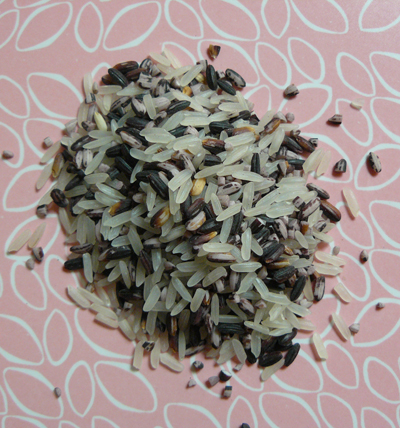
Pim and I get together on occasion for coffee and dinner out, but we have more fun when we cook together. Recently when Pim was over, I had a pot of purple rice prepared from a new rice blend I found at the Whole Foods down the street. I’d never seen the Alter-Eco fair trade rice before but it was an interesting combination of Thai rices: long-grain jasmine combined with short grain black. I made a pot of Alter Eco’s “purple jasmine” (photo below) earlier in the day to test it out, and the brilliant purple-stained result was more like a soft Thai black sticky rice, rather than regular long-grain rice. The flavor was delicately sweet and very much like com nep (Vietnamese sticky rice cooked in a pot like regular rice). A good canvas for Thai sticky rice and coconut milk?
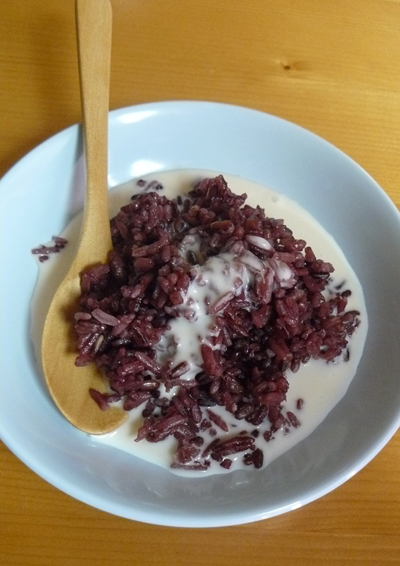
I showed Pim the cooked rice, she tasted it, and her eyes widened like that of a child. In her imitable style, she blurted out, “Thai sticky rice with coconut milk! All we need is coconut milk, palm sugar, and salt.”
Carefull Cooking Off the Cuff
With simple foods like Thai sticky rice with coconut milk, you just need a handful of good ingredients. I keep several brands of coconut milk and cream on hand, and I figured that one packaged in an aseptic box would have the brightest flavor, akin to freshly made coconut milk. Rummaging through my pantry (aka the hall closet), I found a box of Indonesian Kara brand of coconut cream. Pim was unfamiliar with the brand and packaging and asked for a taste, after which she deemed it suitable but not as good as fresh. Since, we couldn’t run out to a wet market for freshly grated coconut and make our own, the boxed stuff was as good as it could get. Similarly, I had a few types of palm sugar around, and suggested that we use the caramely artisanal Thai coconut palm sugar that Naam Pruitt had mailed to me. Pim tasted and cooed.
I let Pim do her Pim thing at my stove. In her new book,The Foodie Handbook, Pim encourages food enthusiasts to climb on board her wagon (well, maybe into a nice sedan) and get into her boat (just a small fast one, yatch not required) to enjoy the culinary splendors and conviviality of a delectable life. Pim proclaims that she eschews super precise recipes, but if you read her recipes in The Foodie Handbook, you’ll find them to be fairly detailed and full of insight, including how home cooks can reproduce food prepared by Michelin-starred chefs such as Joel Robuchon. And if you’ve witnessed her cooking like I have, you realize that what Pim champions -- cooking off the cuff, requires a discerning palate and deft touch. Like I’ve said many times, cooking is a craft that one needs to practice.
Pim has cooked plenty and eaten around at numerous high and low-end places to know what’s required to prepare good food. I’ve seen her duel with her partner, Chef David Kinch, in my home kitchen. That evening, she quietly bent over the small saucepan, poured in about 1 cup of coconut cream, then added a good tablespoon of the soft palm sugar. She hesitated with the sugar a tad, backing off from the initial amount that she’d gauged. (Cooking tip 1: It’s easier to add an ingredient than to take it away from a dish!) She asked for salt, I offered several kinds, and she selected plain sea salt, adding a generous pinch to the pot. (Cooking Tip 2: When cooking in someone else’s kitchen, try to season food with salt similar to what you normally cook with so that you stay on your game.)
Stirring slowly over moderate heat, Pim observed the texture of the coconut cream, tasted it when all the sugar had been dissolved, then said, “Ahhh, it’s perfect.” She pulled it off the heat and that was it. Ta-da. Nothing more was said or done until dessert time, when I reheated the rice and let Pim serve up the sweet treat.
Rory, Pim, and I had had a fairly full meal of pasta Bolognese and salad, but we made room for dessert, which I can only say we gobbled up. It was frankly, as good as crack. The plush rice was enriched by the creamy sweet coconut and made edgy by the slight bite of sea salt. A terrific example of the savory-sweet marriage that embodies Southeast Asian cuisines.
Making Thai sticky rice with coconut milk was a casual, impromptu thing that evening. I had the rice and Pim plugged into the program using ingredients that I had on hand. Granted, I keep an unusual pantry, but that’s what being a foodie is about, right? Having the good stuff and knowing how to use it.
RECIPE
Thai Sticky Rice with Coconut Cream
You could use regular sticky (glutinous) rice, coconut milk, light brown sugar and table salt for this dish and the result will be fine. However, push yourself a bit to get great coconut cream (which yields a wonderful rich flavor) or even make your own coconut milk. Frozen coconut milk from Thailand would work well too; it’s available at Asian markets. You’ll get spectacular results. This sticky rice with coconut cream recipe below reflects what we enjoyed that evening:
Serves 4
1 cup raw Alter-Eco Purple Jasmine rice
1 ¼ cups water
1 cup coconut cream, preferably the aseptic kind, such as Kara or Aroy-D brands
1 generous tablespoon Thai palm sugar
1 generous pinch sea salt
1. Use the instructions in “How to Cook Perfect Rice” to cook the rice up with the water. Set aside.
2. In a small saucepan, combine the coconut cream with the palm sugar and sea salt. Over medium heat, stir to dissolve the sugar. Bring to a simmer, then taste, making any flavor adjustments with extra sugar or salt. Set aside.
3. To serve, reheat the rice, if necessary, and then spoon it into individual small bowls or saucers. Top with the coconut milk and enjoy with spoons.
Note: Aseptic boxed packages of coconut milk is available at some Asian markets but the cream is seems to be more widely available. You can always scoop out the cream from an unshaken can of coconut milk, if you want.



Rasa Malaysia
Now it would have been perfect if there was ripe mangoes or better still, durians. In Penang, we eat this type of sticky rice with durians, which are plentiful in the many durian orchards in Penang.
Sounds fun to be cooking with fellow bloggers! 🙂
Ivy Manning
Hia
Great post! I have a question for you. When cooking Thai sticky rice for this, I was taught to soak the rice overnight, rinse it and steam it. Do you feel there is much difference between this method and just using the HTCPR (How To Cook Perfect Rice) method? Just curious. I'd rather make it your way (much easier).
FRESH LOCAL AND BEST
My mom used to make a similar purple sticky rice dish cooked in freshly squeezed coconut milk. I still can;t get over how she made coconut milk from scratch. She quite enjoyed having this rice with mangoes, jack fruit and durian. Bravo for making such a wonderfully comforting dish!
betty
mm i love this 🙂
chris
In Manila I once had a langka suman - purple sticky rice (a medium-grain Filipino variety, I think) that had been soaked or parcooked, mixed with thick coconut milk, wrapped up in leaves with strips of ripe jackfruit, then steamed. The colours and flavours were amazing. Yep Asian desserts be crack alright!
Sue Holt
My dive buddies and I loved this dish in Bali in August -- not just for dessert but also for breakfast! Even more fitting as preparation for Monterey Bay's cold waters. Thanks for giving us a way to recreate this dish at home.
Andrea Nguyen
Ivy -- the ULTRA cool thing about the Alter-Eco rice is that you can cook it like regular rice. The reason being is that the blend includes regular jasmine. You're right that normally you have to soak sticky rice before steaming it. However, Vietnamese cooks can cook up sticky rice in a pot like regular rice too. It's not as delicate but does work. Here, the purple jasmine is blended with a shorter grain (glutinous) rice so you get something interestingly in between.
Rasa Malaysia and Chris -- you tease us with the durian, jackfruit -- banana leaf packet. Now that sounds like a dumpling, my friends!
Sue -- now you have to shop at Whole Foods! This rice unfortunately isn't at Shopper's Corner (our local indie market) but maybe you can complain to Shopper's and they'll carry it!
Lan
I'm surprised this is actually available in stores.
The next crop of Jasmine rice hasn't come in yet so the Jasmine rice that is available now has been on the dry side. To give the Jasmine rice more moisture, my mom has been blending it with black sticky rice over the past few weeks as a substitute regular Jasmine rice for meals. It's not the same but I've gotten used to it.
sophia
when koreans make what they call mixed rice, they usually mix in this sweet rice but in a much smaller ratio to white and brown rice and barley. makes it quite yummy and a pretty purple hue
i've done it with jasmine rice, and my mother can't get enough of it (she says it doesn't fill her up and so eats way more rice than if she were to just eat white rice)
sophia
i think i may have seen a recipe like this in the red lantern book? not sure, but looks delicious!
ginkgo biloba
I love to have coconut vream. I liked the recipe of the Thai Sticky Rice with Coconut Cream a la Chez Pim. Thanks for such a nice recipe with me.
3hungrytummies
just like how grandpa used to made. aroi maak!!
Andrea Nguyen
Sophia -- I have had the Korean version of what you mention. It's lovely and less glutinous than the Alter Eco product.
Yes, folks, I'm surprised at the availability of it at Whole Foods. I'm sure it's available at other specialty grocers. It's not a cheap rice to purchase.
3hungrytummmies -- Grandpa was good to you!
watch gossip girl
I am to submit a report on this niche your post has been very very helpfull
Andy
Great post - I love rice, but always find it much more interesting when you use colours like you have here.
Thanks
Andy - http://onceuponathyme.wordpress.com/
Diane
You've inspired me. I haven't made black sticky rice with coconut milk in ages and it is about time! I'll use regular old Thai black sticky rice. With sesame on top.
Impromptu Diva
I love sweet rice for dessert. Mango should be good with this too. We have a lot of sweet rice desserts in the Philippines when I was growing up and I still do them up to now here in the US.
I feel so much at home at your blogsite... so much inspiration!
Andrea Nguyen
Impromptu Diva -- my pleasure! Enjoy.
Nike Sb Blazer Low
I think I would throw some coconut in there as well. Have you ever tried melting all the white chocolate first and then whisking in the matcha, pour and cool
Our store offers you all kinds of favourite products like Nike Sb Blazer Low
Coach Outlet
Pitching cake with each other at birthday party is the most common scene sweet, frolic hurt, happiness or endurance?
Taobao English
Un...like the style of your writing
air yeezys
Faced with you, I am shallow smile, there is no so-called;
Air Jordans
shishang zicai bing, shenghuo jiankang you meili. ni keyi qu pinwei yixia.
coach bags
Um...like the style of your writing.
Taobao
That's not his. Steve's is black*_*
agent taobao
Um...like the style of your writing.*_*
Shop taobao
Education is a progressive discovery of our own ignorance.
taobao mall
I can accept failure, but I can't accept give up.
oakley sunglasses
*=*Open innovation has not spurred improved innovation implementation, just justified spending less with no real plans to achieve growth. With open innovation, of course, failures no longer belong to the company because the "open environment" didn't produce anything - hence innovation simply wasn't possible .=*=
vibram toe shoes
I am going to try to mix some up tomorrow
haha
love you men
True Religion Jeans Outlet
In an earlier post, I noted that I thought that the real cost of the cash for clunkers program went well beyond the $4500 rebate per car. Edmunds.com just came out with an analysis that shows that the cost of the program, once purchases that would have occurred during that period without the rebate are taken into account, at $24,000 per car!
True Religion Jeans
Happy are the families where the government of parents is the reign of affection, and obedience of the children the submission to love.Do you understand?
PoommaBat
Uah uggs Cdg uggs sale Fly http://uggs-on-sale.page4.me/_blog/2011/12/01/uggs/ Azg http://cheapuggssaleonline.blog.cd/2011/12/01/ugg-uk/
Barcelona Apartamentos
You raise a lot of questions in my head; you wrote an excellent post, but this post is also mind provoking, and I will have to think about it a bit more; I will return soon.
Barcelona Apartamentos
You raise a lot of questions in my head; you wrote an excellent post, but this post is also mind provoking, and I will have to think about it a bit more; I will return soon.
Oretssota
CVWSMIUCAR uggs for sale ZFMPVJVWSK http://www.cheapuggsforwoman1.sitew.com/#uggs_on_sale_particularly.B
marlon
We have a lot of sweet rice desserts in the Philippines when I was growing up and I still do them up to now here in the US.