




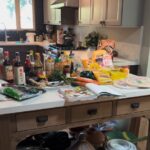

I get to realize a small dream of mine this week -- a skylight in the kitchen. We purchased our 1970s ranch house six years ago and remodeled the tired, inefficient kitchen but our contractor at the time told us that it was impossible to install a regular skylight due to something about our attic. Every morning, I walk into the kitchen and turn the lights on and keep them on so I can work. It’s not right to have to keep your kitchen lights on from morning until night!
Enter a different contractor, one who we called on to install skylight in another part of the house. He said that the kitchen was not a problem area whatsoever! So today, the crew arrived and for the next three days, our kitchen is off-limits during their work hours. We can barely make a sandwich without disturbing the work as the contractor has put up plastic drop cloths around the kitchen.
How to feed ourselves? I didn’t feel like going out today as we’ve just spent the weekend at the San Francisco food and wine festival in Union Square. (Hey, many thanks to folks who crashed the sold- out Asian dumpling
panel/tasting, and those who withstood the sweltering conditions for my talk and signing!) The festival's rich foods and wine and cocktails do take their toll on your body. Also, I need to get work done at home. We headed to Trader Joe’s since we had to replenish our cheap wine supply. (They have a fantastic $8.99 Santa Lucia Highlands pinot noir right now under the VINTJs label.)
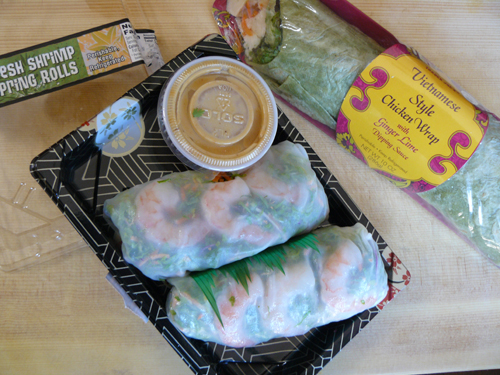
Rory wanted a ham sandwich and I hungered for something Asian as there was little Asian flare at the weekend’s food festival. For my Asian fix, I selected the items in the photo above – a Vietnamese-style Chicken wrap ($3.99) and fresh spring rolls ($4.29). Since I’ve reviewed and written about Trader Joe’s Asian dumplings and even came up with a way to doctor up their Chinese BBQ pork for char siu pork, these Vietnamese-ish items intrigued me. What made them Vietnamese? Was that even important? What did they taste like? Here are my thoughts:
Vietnamese-style Chicken Wrap
The “wrap” is basically a spinach flour tortilla. Unlike most wraps that I’ve encountered and put down, this one did not have mayonnaise to make it gloppy as it sat in the cold case. The label describes the wrap as an interpretation of east meets west – the whole thing is “spiced” up by the “green spinach tortilla, premium grilled chicken breast, the best mixed greens you can find, and sweet carrots.” HOW IS THAT SPICING THINGS UP? As you can imagine, the flavor and textures are crunchy, firm, chewy, and bland. There was shredded jicama too, which is actually a cool tropical note but it’s not mentioned on the label; ‘sweet carrot’ is more attractive than ‘sweet jicama’. Who writes this copy for Trader Joe’s? Geeze.
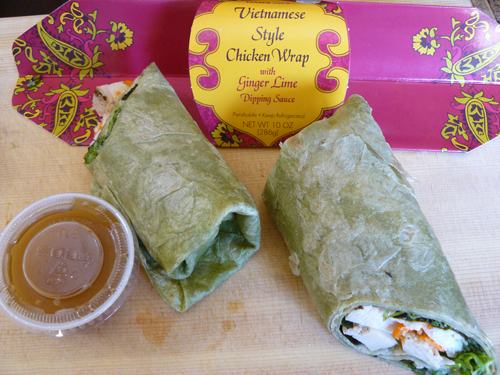
I suppose that the dipping sauce – hidden in the center of the unusually clever tubular packaging – was supposed to also do the spicing up. It is described as being “like the traditional sauce found in the best restaurants” and I didn’t know what that meant either. Which of the best restaurants? It’s like asking which continent do continental restaurants cater to. The Trader Joe’s sauce is kinda gingery, kinda tart from rice vinegar and vaguely sweet. Said sauce contains exotic seasonings but I didn’t see nor taste any. Did it deliver ‘its special punch’ as promised on the label? Not quite. If you were hungry and didn’t know much about Vietnamese food, you’d find Trader Joe’s Vietnamese-style chicken wrap to be edible. I wouldn’t say that it was a ‘delicious interpretation’ but rather one that is tolerable.
Fresh Shrimp Spring Rolls
These two chubby fatties were more expensive than the wrap so did they taste better? I’m always suspicious of rice paper rolls (goi cuon) that have been refrigerated as the rice paper firms up and becomes rubbery. Then there’s the double insult to Vietnamese cooking when cellophane noodles (mien) are used to fill the rolls. As I’ve said before, that is the wrong noodle for Vietnamese rice paper rolls. The proper and tastier noodles are round rice noodles called bun. Cellophane noodles (also called glass noodles) are not destined to be served at room temperature. Sometime in the 1990s, someone said that cellophane noodles were “it” for Vietnamese rice paper rolls. I’d like to undo that practice as cold cellophane noodles resemble fiber optic lines, not food.
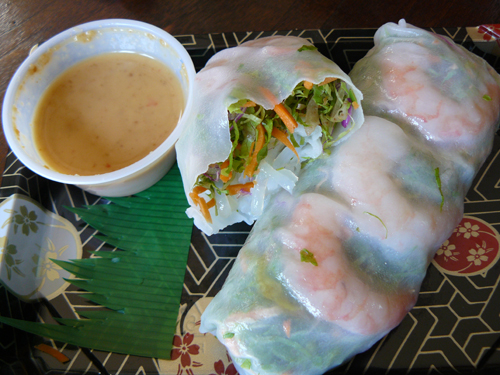
My griping aside, the cellophane noodles used were really big – a good ⅛ inch thick and wormlike. Employing the bigger noodles was a smart move as they weren’t as hard as the skinnier versions of cellophane noodles. All the lettuce, herbs and carrot were finely shredded to make the rice paper easier to roll up. The shrimp were pretty but tasteless. The rice paper was rubbery (expected) but not totally unpleasant (unexpected). So what you had was a slightly rubbery, crunchy, and somewhat soft roll. The tangy, sweet peanut butter sauce was actually not bad. Drizzle a bunch of that on the roll and stuff it in your mouth. As I was extremely hungry and desperate for a bite of something Asian, Trader Joe’s fresh shrimp spring rolls were alright. (Note that there was a fresh tofu spring roll and I wasn’t about to go near that one!)
At Vietnamese delis and bakeries, rice paper rolls are delivered fresh several times a day to ensure that the rice paper remains soft and the filling ingredients retain their fresh textures. But Trader Joe’s doesn’t masquerade as a Vietnamese storefront. The fact that the spring rolls came packaged in a Japanese sushi container, with the fake piece of green foliage, indicates that Trader Joe’s is not about to label the roll as being Vietnamese. Not everyone has access to freshly made Vietnamese rice paper rolls to go, and I realized that today when I wanted to satisfy my Asian cravings.
While I was not impressed by these two vaguely Vietnamese items from Trader Joe’s, I do have to say that it’s pretty cool to see Vietnamese-inspired items there. Has Vietnamese food ‘arrived’ to the broader mainstream? I’m not quite sure, but hopefully, these items bode tastier fare in the future. We just have to tell retailers like Trader Joe’s that the public hungers for flavor. It doesn't have to be Vietnamese but just taste great.
If you’ve tasted one of these Vietnamese products at Trader Joe’s, put in your 2 cents!
Btw, Rory thoroughly enjoyed his ham sandwich.
Related information on Vietnamese rice paper (banh trang):



Thrifty DC Cook
I love Trader Joes for the wine and cheese selection but I stay far away from any Asian inspired food. Their Korean marinated short ribs were terrible. You were brave.
Garrett
Those rice paper rolls when prepackaged are always so funky. It's hard to tell if it's old or just wrapped in cellophane.
MIKO
Because I can see Trader Joes from my driveway, I shop their almost daily. I dont think we have the spring rolls in Seattle! I would have seen them by now I think. I've had that "wrap" many times, and there is not ONE thing about it that seems Vietnamese. I kinda like it- I used to like the sweet sauce, but it's such a one-trick pony- with NO kick to it- that one soon fully bores with this wrap. Also the sauce is so watery that it drips far too easily all over everything.
wayne wong
Andrea -- dunno if this is proper article to post to but it does deal with Trader Joe's so here goes: awhile back you posted a quick-and-dirty-but-tasty recipe for Chinese Cha Siu ala TJ. I shopped and found all the ingredients but one for which I substituted Cha Siu BBQ Sauce. (1)Please repeat the name of that product you referred to as your "secret" flavor-picker-upper for Cha Siu (kee-lok or something ???)and (2)please tell me WHERE the bleep I can buy it? I'm tired of leaving indented trails around the aisles for soy sauce, bbq sauce, marinade, etc. at 99-Ranch and Marina Mkts and still not finding that special ingredient.
Lan
The chicken wrap looks way too big to actually dip in the watery dipping sauce. Overall, it seems like a regular wrap taking misguided a stab at fusion cuisine.
I never understood why the fake plastic foliage is added to these and other packages of food. It doesn't really make it seem authentic when it is on a sushi tray and served with a Thai-style peanut sauce.
Diane Putnam
Funny, I've been looking for hoisin sauce at TJs and was surprised not to see it. I don't think they have fish sauce, either. Not much of an import store when it comes to Asian staples, or am I overlooking it somehow? I just see soy sauce stuck in with the olive oil and vinegar.
Gastronomer
I think you might be shopping at a "special" TJs because I have yet to see the spring rolls in Pasadena. I'm not surprised to hear that the food was less than great. I do agree with you that it's good to see Vietnamese food go mainstream, even if it's an effed up version 😉
Andrea Nguyen
Looks like we're in agreement that Trader Joe's doesn't so such a great job with Asian food.
Thrifty DC cook -- you were brave on the Korean stuff. I was highly suspicious. Pre-marinated meat give me the heebee-jeebies.
Garrett -- The wrapper was funky dunky. You can see from the photo above how whoever that rolled the rice paper up had problems. The lack of grace reminded me of how Mario Batali rolled an unattractive fatty on Iron Chef America. Anyone watch that episode?
Wayne -- I added the link to the short cut TJ char siu pork. Thanks for keeping me up on my own content.
Lan -- The chicken wasn't rubbery hard, just there. I don't know what the 'premium' part was about. I suppose that TJ is trying but in a misguided way.
Diane -- You need to go to that odd Live Oak market owned by Koreans for hoisin sauce. Or actually, Nob Hill, Whole Foods, Staff of Life, Shopper's. They carry those Asian staples, which are more junior/senior level.
Gastronomer -- You'd think that they'd have the rolls in Pasadena. That's the TJ headquarters. Huh. They should get some Viet women in a warehouse to make them and deliver them twice a day! No refrigeration, please.
Diane
Heh - I hear you! I put in a wood floor in my kitchen last year (replacing 30-year-old vinyl) and was without a stove for 2 weeks. And I don't have a microwave. Boy did I get sick of eating out.
PS - I have a skylight in my kitchen and LOVE it. between that & the French doors it's almost like cooking outside.
me.yahoo.com/a/EreEcTZvyeRylrcpg2OxFaV08g--
While we are on the subject of TJ's, here's my gripe: Several years ago TJ's carried a wonderful, truly authentic sesame crepe, just like the ones you can buy in Vietnamese stores in San Jose and Little Saigon in Westminster. They were wildly popular...and then suddenly disappeared. When we inquired, we were told that the manager for Northern California stopped ordering them, because it was not an item in demand! I don't know if the SoCal TJs carry these sesame crepes, but I wish TJ's would get them back on the shelves! Andrea, here's a thought: Do you know how to make these sesame crepes? Now, that would be a recipe I'd love to have!
jo
You know what frightens me? There are kids growing up whose parents are under the cult of Trader Joe's "Cheap and tasty" who grow up thinking that THAT is what Vietnamese food tastes like. I took my favourite 12 year old foodie to Kam Man on a shopping expedition at the little Vietnamese stall we bought a Banh Mi (with head cheese and pate thank you very much) and 3 of those lovely rolls for $1.00. THREE! They were fresh and delicious with little sticks of Chinese chive sticking out and he, who hates peanuts, loved them.
Andrea Nguyen
Diane -- the skylight is so bright that we're seeing neglected areas of the kitchen that need cleaning!
RE: sesame crepes from Trader Joe's -- you mean the little rounds of rice wafers coated with sesame seeds and sugar? Oh yeah, I totally remember those and they were the same price as what was at the Viet markets. That's the only authentic Viet thing TJ has ever carried! I unfortunately don't know how to make them, though I imagine that you dip the rice wafer into some melted sugar with sesame seeds. It's the kind of thing that may be easier and less trouble to buy, huh?
Jo -- OMG the Trader Joe's stuff isn't so cheap and tasty when 2 of the rolls set me back $4.29. You got 3 for $1 -- that's is a deal. I'd pay 3 for $2 or even a dollar each. Oye, commercially made food isn't for everyone, that's for sure!
Thanks for sharing your grievances and thoughts.
Rusty
TJs is again carrying the sesame crepes. how do you use them?
coach handbags
Sweet post David, you make a tremendous point about loving the job you do. It's amazing how much better you work and how much more creative your thinking gets when you're really engaged. Hope to read more great blogs like this!
coach handbags
It has been such a glorious summer with the nice weather. Made yesterday's heat and humidity even that more unbearable. I cross my fingers that we have an early autumn
True Religion Outlet
Times and Roku is what thye ARE NOT doing by keeping old business models while inventing new ones. Sort of one hand not knowing what the other is doing. Roku rolls out new platforms but hasn't tackled the key question of selling more boxes. You need one for each TV. Why not discount multiple orders for people with more than one TV? Financial Times wants to make online access free or pay depending upon the frequency of use, but it continues to charge customers TWO fees if the customer subscribes to print AND wants an subscription online as well. Do the people in office A ever talk to the people in office B
marlon
The chicken wrap looks way too big to actually dip in the watery dipping sauce.