
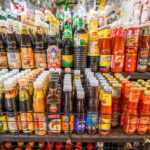

Let me just start off by being honest: Buying rice paper confounds me. Whenever I have to purchase rice paper (bánh tráng) I find myself standing in the Chinese or Vietnamese market staring at the various brands. There are things that I look for in the labeling and there are brands that I prefer. However, there are usually so many different brands and several kinds that it's hard to choose. Plus, hyper-competitive entrepreneurial manufacturers constantly tweak their products to attract customers so there seems to be something new to consider and try every time I shop for rice paper. Because I'm curious by nature, I tend to buy several kinds and test drive them.
Last week Laura C. asked me about how to buy rice paper for rice paper rolls that she fills with seared ahi tuna. (Sounds delish, no?) When I inventoried my cupboard and refrigerator, I discovered that I had 12 (!!) kinds of rice paper in various shapes, sizes, and composition. I purchased most of them in the U.S. but also have some that I brought back from Vietnam. There are many partially opened packages and each one brings back a cooking memory - mostly good and some disasters. So I'm taking time out to write about one of the most important ingredients in the Vietnamese kitchen.
Since my mom and I eat lots of goi cuon (unfried rice paper rolls that are often translated as salad or summer rolls) cha gio (fried rice paper rolls often referred to as Vietnamese spring rolls), and meals during which we make hand rolls with rice paper, we are always sharing tips on what brand of rice paper is good. Some of you may need guidance as well or have advice to share.
What is rice paper?
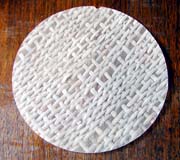 It is not the stuff used for arts and crafts. That kind of rice paper used for painting, etc. is made from plant fibers such as mulberry and hemp. Rice paper used for Vietnamese food is traditionally made from just rice, water, and salt. They are one of the unique aspects of Vietnamese cooking and dining, and food wrapped up in sheaths of translucent rice paper is utterly charming. Aside from looking pretty and holding a bunch of goodies together, they contribute chewy texture and a slight tang to whatever they encase.
 Basically, rice paper is a thin steamed rice crepe (or sheet, as some people call them) that has been dried. Traditionally, rice paper gets dried on bamboo mats or stretchers of sorts, which explains why they have a woven, rattanlike pattern. Rice paper is a great way to store rice for a long time and it is convenient too. Right before using, it is rehydrated and softened in warm or hot water. Vietnamese rice paper is a cooked ingredient and once rehydrated, it can be eaten as is or fried. It is not for baking so don't think it can be used like phyllo pastry!
Can you make rice paper at home?
No. Vietnamese people buy rice paper just as French people buy baguettes. It's a specialty ingredient made by artisanal producers by hand or manufactured in modern factories by machines. Most people now use factory-made rice paper.
How do you say rice paper in Vietnamese?
Download the Vietnamese pronunciation for bánh tráng
Where do you buy Vietnamese rice paper?
The best selection will be at a Vietnamese market or Chinese market. Many health food store and specialty markets now carry rice paper so do check there in the Asian food aisle. If you have no access to Vietnamese rice paper, consider buying them online.
What to look for when buying Vietnamese rice paper?
Select a type of rice paper -- all rice, tapioca and rice, or all tapioca rice paper? Rice paper nowadays is much easier to work with than the ones of the past, which were thick, made of just rice, water, and salt, and required super hot water to soften. That's changed in the recent past as producers have blended in some tapioca starch to make the papers more pliable and thinner. I like these modern renditions as they soften easier. When shopping for rice paper, look for ones made with rice or a combination of rice and tapioca starch. The more rice that's in the papers, the more opaque and thicker they are. Papers made with rice and tapioca starch are on the translucent side and seem loftier in their packaging; these thinner ones conveniently soften in warm or lukewarm water, whereas the thicker ones need hotter water.
Avoid the super thin, see-through, all-tapioca starch papers. They lack the tang of rice, go limp in a flash, and tear easily; they're often labeled bánh tráng dẻo (soft and pliable rice paper) or bánh tráng mỏng (thin rice paper). In English, they're oten labeled tapioca sheets. These rice paper are for skilled cooks who know how to manipulate them well. Some people like all-tapiocal starch papers because rolls made from them stay soft for hours. I don't like their flavor and they're notoriously difficult to tame.
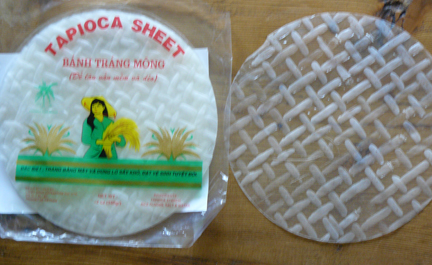
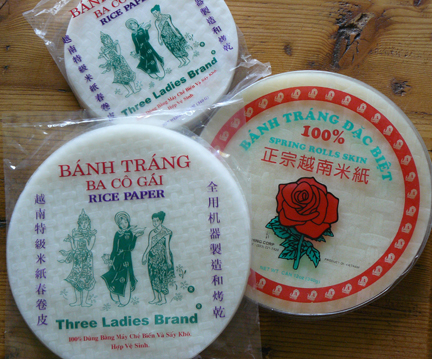
Trust the Red Rose brand of rice paper. The reliable Red Rose brand is borrowed by many producers as a symbol of quality. The impostors are often quite good so don't shy away from them.
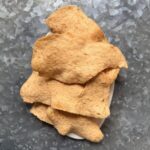
Three Ladies brand is my preferred brand. I've been using the Three Ladies Brand for years, and it's been good to me. When I teach cooking classes, that is the brand I use because it's easy for beginners to use and experienced cooks like it too. Plus, there are no impostors -- at this time, anyway. The small size (think corn tortilla) rice papers from Three Ladies are hard to find but really great for small rolls. See the photo at the top for the logo and regular and small sizes.
Buy what the store carries when shopping at a regular market. I like to assume that rice paper sold at mainstream and specialty markets, such as Whole Foods Market, have been screened for shoppers. You're likely to get a quality product at such places.
Pay more when in doubt. Select the higher priced rice paper and buy several kinds to try them out. They're not expensive. Asian ingredient manufacturers are very competitive and a 25 cents difference matters in quality.
How to store rice paper?
Keep it in the cupboard and once the package is opened, store it in a zip-top plastic bag in the cupboard where they will last for several years.
Foods that can be wrapped in rice paper:
- Grilled Shrimp on Sugarcane (chao tom)
- Vietnamese Restaurant-style Grilled Lemongrass Pork (thit heo nuong xa)
- Korean-Vietnamese Grilled Pork Belly (add a few carbs for an extra layer of flavor!)
- Check the Recipe Index listing of all recipes on this site for more ideas
Next up: Step-by-step how to wrap rice paper rolls, some unusual types of rice paper, and artisanal rice paper making.
Feel free to add tips (do you have a brand you like? why?, insights and/or questions below!

thuy says
As wierd as it sounds... I try to avoid rice paper made in Vietnam. Not only is it a political statement, it is an environmental statement for me. I can't get myself to drink the water there, how can I eat banh trang made from Vietnamese water? When I can see it is made with bottled water, I would consider buying banh trang made in VN.
Over the years, I have managed to stay with one brand and it is the OK one. I like the elephant one too but the shelves never stay stocked with them. What is important to me is that it doesn't rip when I am rolling items in it. I love the rose brand, but it isn't consistent with the rip factor.
We don't get the 3 ladies banh trang here in Florida (well I haven't seen them.) But their banh pho is pretty good.
Amy says
Thank you so much for this information! I bought rice paper not too long ago. : )
Diana says
Great post! I just bought myself some rice paper a week ago and was surprised to see so many of them were made from tapioca. Fortunately they had the kind I knew from Hawaii, so I just grabbed those. It's so fun to work with!
Pat says
i've always been confused by the variety of brands of rice paper, not to mention, noodles and their different sizes and shapes! i'm no rice paper expert but i've tried the rose brand and it worked ok. thanks for the primer, andrea!
Andrea Nguyen says
Choosing rice paper can be confusing. Three Ladies brand is the same as the Thai Jasmine rice producer. However, the rice paper is made in Vietnam. On the packaging, it says:
100% dung bang may che bien va say kho
Hop ve sinh
Translation:
100% machine made and dried
Clean and Sanitary
It's a good product and I trust them. As for Vietnamese drinking water, well... who drinks water from the tap in Asia? People either boil the water first or filter it. I've been in modest homes where there's a charcoal filter Sparkletts type thing to dispense water.
von says
I really appreciate it when you test different brands of Asian cooking staples and recommend the ones that work best because it really saves me time and money to know which ones are superior especially when cooking your recipes.
What I find disturbing these days are that some brands make rice papers and noodles that are so blindingly white that they look like they've been drowned in bleach or been through some sort of artificial process to coerce them into that unnatural shade of white. I definitely stay away from those.
Alice says
Thanks for this helpful post on rice paper! Since moving from Los Angeles to Melbourne, Australia I've felt a little lost on things like this without my mom just putting things in the cart.
Andrea Nguyen says
Von, ugh, white colored foods and ingredients are perceived to be more 'civilized' in Asia. With rice, it may be that the rice is being milled to strip it of most of the bran layers -- thereby polishing it more. I'm not an expert but hope that bleaching rice isn't part of making rice paper.
Alice, glad to help you cook in Melbourne!
Corey says
Thank you so much for pointing out the translation problem on some rice paper packages. I've been avoiding the brand that is most commonly sold in my area because I assumed it actually had wheat flour in it, so I'm glad you cleared this up!
Andrea Nguyen says
You're welcome, Corey. I'm an obsessive label reader and with Vietnamese food ingredients, there's extra detective work involved. I often cross reference the English with the Vietnamese -- understandably it's not easy for everyone to do! So I pass on what I learn!
OysterCulture says
Thank you for this post, I confess to being befuddled when I check out this section. There are so many options, I feel like I am getting in over my head.
LN says
what brand or kind would be good for making cha gio? I have several brands in my pantry because Ive been searching for that ONE brand that will fry up crispy and brown. Some of them fry up really white and chewy. There is a local rest here that server the cha gio wrapped in rice paper and its always golden brown and delicious. Help.
Andrea Nguyen says
LN, I use the 3 Ladies Brand for cha gio, and I dip them in sugar water (mix 1:4 ratio of sugar to water) to help browning. Double fry them to recrisp the cha gio. The all tapioca banh trang will fry up white -- very strange looking.
The local resto may be mixing in some caramel sauce into the dipping water but I've not had luck with that. There's a caramel sauce recipe on this site at:
http://www.vietworldkitchen.com/blog/2007/10/caramel-sauce.html
Hope I'm of help.
Linh Nguyen says
Thank you for the tips! I just tried frying some spring rolls in rice paper for the first time and was disappointed to see the end result was clear in colour. I was hoping to make it bright yellow as my local Vietnamese restaurant does. I will try the sugar water and see how it goes. Thanks!
Andrea Nguyen says
You're so very welcome! Have fun!
Tammy says
I'm so glad to finally realize that I'm not the only person who stands in a sea of rice paper at the store and feel lost. It usually takes an impatient boyfriend and his heavy sighs for me to make a decision on one, and even then, I second guess myself.
I have tried to remember the brand my mother always got and used when I was younger and living at home and can't remember. I have been trying out different kinds.
I have found that the rice and tapioca mix works very well for me and the clumsy hands of my boyfriend.
Andrea Nguyen says
Tammy, you are NOT alone! Your boyfriend just needs some practice. Hey, it's just food and you eat your boo boos.
pvpserverlar says
I have tried to remember the brand my mother always got and used when I was younger and living at home and can't remember. I have been trying out different kinds.
mandie932 says
Thank you so much! I don't have much experience with asian cooking and am often overwhelmed by the choices! Your detailed info helped me feel much more confident about my choice of Three Ladies Brand!
kulyia says
hello once again 🙂 i always buy mine (three lady) too because its thick and they dont have missing spots on them.
xat sohbet says
thank post . nice informations man.
KATHY MUI says
Hi every body, my company produce rice paper and spring rolls. pls see website and email to me if you want to buy: http://lyanpro.com
My email: [email protected]
ukhotdeals says
Thank you so much for pointing out the translation problem on some rice paper packages. I've been avoiding the brand that is most commonly sold in my area because I assumed it actually had wheat flour in it, so I'm glad you cleared this up!
Pamela Olding says
My sister recently returned from Vietnam and brought home rice paper that was like lace, not a whole flat surface. She took a cooking class where they used these to deep fry, we foolishly forgot to keep the packaging when we made some here in Australia, and now we can't find any in the asian supermarkets. Can anyone tell me the name of this type of rice paper, or where I can buy it online?
Gwen Hindhaugh says
To Pamela Olding - Yes< I also did the cooking class with the "lace" rice sheets, in Vietnam, just home yesterday, - also want to know where to buy lace looking rice paper? Gwen Hindhaugh
stewie says
I prefer the tapioca paper myself bc it is stickier & rolls stay together.
Healthy Flat says
I don't have much idea about rice paper but I think Tapioca is the best. My mom usually used it to wrap sushi.
Juicy Couture says
This is totally freaking me out! He's definitely a challenging kid, but has never behaved like this before. We are reacting more calmly than we did at first, and things seem to be getting better, but I am still very concerned. Have you ever heard of behavior like this that comes on so suddenly? I am wondering if it's a coasdf mbination of sadness that his birthday is over and the transition of the end of school (and he knows that he will be at a new school next year, which may be causing him stress). At what point is this a problem that we need some help with?"
Cheap Jordans Canada says
I thought I would write about something I did a few weeks ago on the line of graduations.
Me and another church group leader decorated the doors of the girls graduating from High School in our youth group. We waited until they left for graduation so that when they came home they would come home to their house being all decked out.
Em says
I bought a package of rice paper where I live in China, I just noticed that there are no instructions. How do I prepare them?
UGG Amelie Suede says
This is a guest we want back again! Indeed, he has developed into a sweet, charming, and affectionate boy, some one really very special!
Truong Van Nhat says
hi ,
we are the manufacturer and exporter of Vietnamese rice paper in Cu Chi dist, Hochiminh city. our product made of Tapioca, rice, water, salt.
If our product interest you, kindly free to contact me on my email id: [email protected]
Regards/Nhat
Oretssota says
SZZNQPYCIM uggs for sale DMWQLTFUIG http://hunterbauer615.lache-tes.com/p56339/2011-12-23-can-someone-really-locate-uggs-for-sale.html
Cam says
My local Vietnamese restaurant serves a number of these together sort of like a vietnamese version of fajitas. They have special seperators to make multiple sheets of rice paper at once. Any idea were I could find them?
mnims22 says
andrea,
I have nut/seed allergies...and reacted to one rice paper...is there a brand that is not made in a facility where nuts/seeds are used?
mnims22
marlon says
Thank you so much for pointing out the translation problem on some rice paper packages.
marlon says
Thank you so much for pointing out the translation problem on some rice paper packages.
Drew says
When it is that "copy paper" whit color, all it means is that the raw ingredients (rice) have been bleached (not with household type bleach) so that there aren't brown speckles through out the papers. Remember, people eat with their eyes first and when they see a few brown specks on the paper of their summer rolls, they start to question what it is. It is bleached for aesthetics. It is just like going to a main stream super-market and getting rice that says "Bleached White Rice", or "White Enriched Bleached Flour". You can get natural flour that has a brown tinge to it, and the same goes for rice, you can get unbleached rice that is slightly brown. This is not to be confused with "brown rice", they are two different things. Although brown rice is also not bleached, of course.
Drew says
The brown rice is just rice with the husk, or bran layer still on it. It hasn't been milled or shucked off of the rice. It is also healthier with the bran layer on it, it has more fiber.
Drew says
Andrea,
I see this a lot with Asian food labels, actually labels from food produced from all over the world, not just Asia. I also see major grammatical errors on labels too. wouldn't you think that the large companies that are large enough to produce and export on such a large scale would have someone proof read it that is bilingual in whatever language is necessary for that labeling to be written correctly? I mean it cant cost that much to have someone do that, it only needs to be done once per product that the company produces. It's not like they need to have someone working full time checking each one, once they get it right, the rest will be printed the same as the proof read original "proof". Right? I mean wheat flour is nowhere even close to tapioca or rice. I have always wondered this, and i hope you can shed some light on this seeing how knowledgeable you are.
Thanks For Your Insight,
Drew
Andrea Nguyen says
Drew, I feel the same way as you do. I don't understand but over time, hopefully, manufacturers will use the internet for better translations. For now, we gotta plod along together! Thanks.
Andrea Nguyen says
Thanks for weighing in, Drew. For many people in the world, white food is luxe food. A sign of progress and better hygiene. Go figure.
Ruthy says
where can I find it in Hollywood, Florida??
Dung says
It amazes me how every time I go to the market, the brands change. Sometimes I find one that I really like (most recent one had bamboo trees on it) but when I go back it is gone.
Growing up my mother usually bought the rose brand which I recall tearing easily & even breaking when trying to handle dry. Maybe it has changed over the years as that was a while ago.
I prefer to get the ones w/ tapioca as it is stickier & much easier to roll. Some may not care for the chewier texture but it makes it so much easier to hold ingredients together especially if you are going to deep fry it.
Michael Beljn says
Does anyone know where I can buy rice paper wrappers in Finland?
RJ says
When I was in Vietnam last summer, we were often given dry sheets of rice paper to wrap food in. For example, in the north, we wrapped banh xeo in dry rice paper rather than in lettuce (as we did in the south). When I buy rice paper at the market at home, it never works to eat it dry. It is always . . . unpleasant. Any advice on what I am doing wrong?
Brenda says
Recently visited Vietnam where I went to a cooking class and among other delicious things, made fresh spring rolls. They had a unique rice paper holder there that you keep the rice paper on the outside in a slot, but fill the inside with water. When you want to wet the rice paper, you simply stand it up in the water and turn it around. Wish I would have taken the chance of trying to find out and get it home safely, but didn't. If someone is interested in helping me find out, I can send you my email along with a picture of it.
Thanks.
[email protected] says
Andrea
When we were recently in Vietnam we enjoyed a spread of Nem Nuong, Banh Xeo, Ram Cuon and Thit Nuong, all wrapped by us at the table into rice paper rolls. The rice paper didn't require soaking and seemed softer than brands I've used before. The moisture in the food seemed to soften the paper and then we enjoyed the slightly crunchy texture with the delicious food inside. Where would I source this type of paper?
Alain Ngo-Manh says
Dear Andrea,
My mother used to buy Red Rose for rice paper...but as you say in your post, there are so many impostors...I would like to have your advice on how to identify the authentic Red Rose rice paper...I am trying to buy the rice paper for Cha Gio...
Thank you very much.
Alain
Alain Ngo-Manh says
Dear Andrea,
I live in NYC and have been to Hong Kong supermarket as well as Tin Tan Hung and I don't seem to be able to find the authentic Red roses or the three ladies rice paper. It may be that I cannot tell if they are authentic, but the packages are quite different from the pictures for the three ladies and as for Red rose, there were so many different brands attached to the package.
I would very much appreciate if you could give me any advices on determining the authentic rice paper..My wife and I love cha gio and we would like to use the correct vietnamese rice paper and not the Chinese ones..
Thank you...
Alain
Thank you..
achmad sandi says
saya mau order barang ini, saya harus menghubungi k siapa??
Dee says
What is the best rice papers for frying?
I’ve tried many of them but they come out chewy and hard after frying rather then crispy.
Andrea Nguyen says
I use 3 Ladies. Rice paper fries up chewy crisp when the papers list rice first, then tapioca. What brand do you use? This may help you:
https://www.vietworldkitchen.com/blog/2015/09/cha-gio-imperial-roll-frying-tips.html
Jodie A Mathies says
Hello; I am on a food protocol that allows tapioca but not rice. I cannot find 100% tapioca wrappers for sale online. Anyone else know a brand or store that sells 100% tapioca wrappers?
Thank you!
Andrea Nguyen says
I hope to have helped you with my previous response. If anyone knows an online source for Jodie, do weigh in!
Jodie A Mathies says
Hello; I cannot find 100% tapioca wrappers for sale online. Anyone else know a brand or store that sells 100% tapioca wrappers?
Thank you!
Andrea Nguyen says
You want the all tapioca ones? It's a Vietnamese market item. Most of the rice paper sold online have rice and tapioca. Sorry. My favorite is Three Ladies brand. I imagine that there's a fair amount of tapioca in them -- if that helps in any way.
http://amzn.to/2DsSZiU
Jodie A Mathies says
thanks! I'll look at Vietnamese markets. Can't eat rice right now so hoping I can find all -tapioca ones.
Judith van Boxel says
Hi Andrea. Recently in Vietnam we enjoyed Bahn Xeo which was served with very thin and papery, (brownish and opaque) rice paper to wrap the pancake in. It didn’t require soaking. I have looked everywhere to buy it but no luck. Then last week we had the same in a Vietnamese restaurant in Melbourne. Can you tell me what it is called in Vietnamese so that I can ask for it by name in Asian Grocery Stores
Andrea Nguyen says
Hi Judith, that kind of banh trang is unavailable in America. It's a very regional/local product. Sorry.
Elle says
I think it's called bánh đa nem. Looks like it only uses rice flour. Helen talks about it a bit here: https://youtu.be/taa0BZs1Xvo?t=236
kari says
i recommend the three ladies brand
also on amazon .com if u can locate i recommend blue dragon
happy pho people
Gabrielle says
Do you know why the rice paper sometimes smells “dusty” after soaking. My last batch, the smell turned me off so much i haven’t made any since. Are they’re brands to avoid? Or could it be one of the ingredients that give it that dusty smell.
Andrea Nguyen says
Oooh, that sounds awful. I mostly use Three Ladies and have not had that experience. I'm sorry!