






Now that you have a sense of how to buy rice paper and how to wrap rice paper rolls to create lovely summer rolls and cha gio imperial rolls, you may wonder if you should tackle making rice paper from scratch. It seems like an easy task as just a few simple ingredients -- rice, water, and salt are involved. So why not? Well, you may want to think again. I surely did when I first observed an artisanal banh trang producer in a small hamlet (it wasn't even an omelet!) outside of Phan Thiet (a city north of Saigon) in Vietnam.
She had been practicing her craft for decades and sitting in the same position for hours, day in and day out hurt, she told me. But, her livelihood and family depended on these skills, which she had honed to a seemingly effortless precision. Such level of culinary craftsmanship comes only from having done something tens of thousands of times. (You have to cook 1,000 steaks to know how to do them just right!)
"Our rice paper is made by hand and are bigger than normal so we can sell them at a higher price than the factory-made ones," she told me. We ate some of the fresh, hot rice sheets and they were delectable. I could not bring any back to the U.S. with me and now regret it. Here is how this woman makes Vietnamese rice paper:
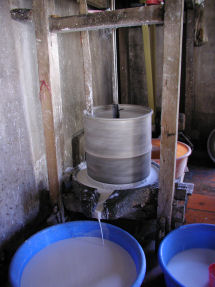
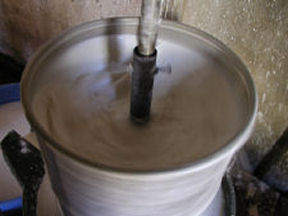
Rice grinding: Soaked raw rice is ground with water into slurry by this very simple machine. The trough at the bottom of the bucket is made of stone. The grinding mechanism, which the family had obtained just a few years before, spins very quickly, so much so that the walls are splattered by the rice and water mixture.
Tangy addition: Nearby, there's a bit of thick old batter that is added to the slurry for a wonderful tang.
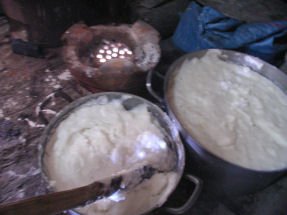
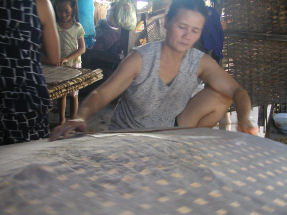
Making thin rice sheets: The banh trang maker sits on a low stool (a position that she said gets extremely tiring over time) to spread the batter onto a cloth that's stretched over a wide pot of boiling water. After the batter has been thinly spread (note the wide tool that she uses), a bamboo lid covers the rice sheet. The resulting rice sheet (sometimes also referred to as a rice crepe in English) is steamed for probably about 30 to 45 seconds.
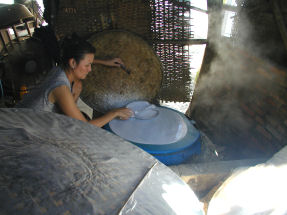
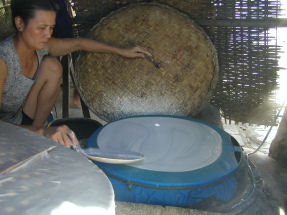
Removing cooked rice sheet: A long narrow stick is used to lift and transfer the cooked rice sheet to a cooling "rack" (at far left corner). The cooling rack is a very wide convex (slightly domed) round bamboo rack with a cloth covering it. The rack spins around. Like as with a lazy Susan or roulette wheel, the banh trang maker gives the rack a spin and by the time the rack completes a full spin, the crepe is cool enough to handle.
(Thin, steamed rice sheets like these are called banh uot in Vietnamese. They may be served with a simple fish sauce dipping sauce or filled with a savory mixture of pork, shrimp and mushroom and rolled up into banh cuon -- a favorite Vietnamese breakfast item.)
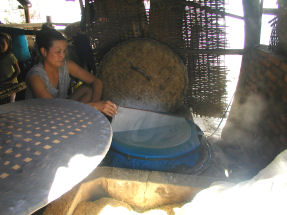
Transferring to a drying rack: Another person then picks up the cooled rice crepe and places it on bamboo drying rack that resembles a narrow 6-foot-long stretcher. The two women work in this assembly line fashion to produce many rice papers each day.
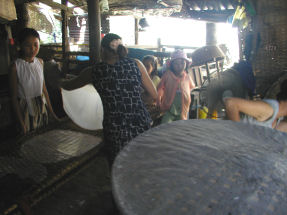
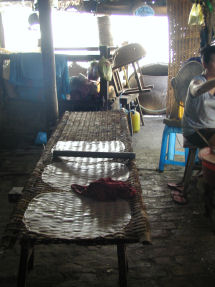
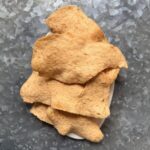
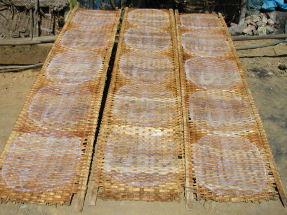
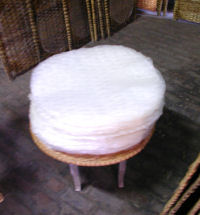
Drying the rice paper: To dry the cooked rice sheets into rice paper, the racks are brought outside and placed under to hot sun for a day. The woven pattern of the racks gives the rice papers their distinctive appearance, which factory-made ones mimic. The dried, finished rice papers are stacked up, then tied into smaller stacks and taken to market. These rice papers, which were about 14-inches wide, are sold for a premium because they're made by hand.
Additional information:
- Guide to buying rice paper (brand recommendations, where to buy, how to pronounce banh trang)
- Step-by-step instructions on how to wrap rice paper rolls

Krista Jo says
When I was in Vietnam, I took a cooking class in which we made fresh sheets of rice paper exactly as indicated above. However, instead of drying them, we ate them immediately.
It would definitely take a lot of practice to get them as thin as do the experts, but it isn't impossible. People who like like fiddly things like making their own pasta would probably enjoy it.
Diana says
Wow, that's so cool! Those rice papers are huge. I had wondered about the patter, thanks for the info.
Andrea Nguyen says
Krista Jo, yes, lots of practice. I steam my own rice sheets at home using a special pot and it took me a good week's worth of practice to get things the way I wanted. Lots of fun, though.
Diana, I was very impressed at the size of this woman's rice sheets. Each one was about 16 inches wide and she managed to remove it in one piece every time.
wayne wong says
Women are indeed from a different planet than men: I doubt the famous patience for which Job was known existed in sufficient quantity for him to make artisanal banh trang for a living --- he certainly wouldn't have managed to remove each sheet flawlessly every time.
Christina says
Thanks for the wonderful lesson. I've always wondered about the pattern on the sheets too! How interesting.
Brian says
When I went to a rice paper factory in the Mekong Delta, they were raising pigs at the factory. They said they fed the pigs the rice bran.
You were in Phan Thiet, did you go to a fish sauce factory. Had the most amazing "pure" fish sauce from a factory in Phu Quoc. I don't even know if you can buy it in the US, there really was a significant difference in the taste. I was told that most fish sauce is "blended"?
mavigul says
al of you satute Hello! How ar you chat waiting thanks prio
kathryn says
I found your blog via a friend on Twitter, as I wanted to find out how rice paper rolls were made. Thanks for this, it's really interesting and a great visual guide. I never realised the indentations on the sheets came from the bamboo racks on which they're dried.
Chuck says
I spent a lot of time in Vietnam from 1964 until April 1975, first year in the military then with a small private airline attached to U.S. Forces....I married a lady from Nha Trang, a lady who was "upper class" and couldn't cook....however....I spent a considerable amount of time in the kitchen with a couple of ladies that cooked for the family and to my mother in laws deep regret, I learned to do this. Mother in law no longer with us, divorced after bringing family to the U.S. I still cook and make cha Gio and soups, especially stuffed grape leaves and spicy beef pho.
There is a great community around Wash. D.C. and in Northern Virginia, there are still ladies who make the rice paper at home, and make cha gio to order. I usually call ahead and bring home enough for a month.
Judith says
I have just returned from Vietnam recently and after making the rice papers from the blended mixture at a cooking class there we tried to make our own at home. It all looked fine but after steaming them, when we tried to remove with a bamboo stick it just turned to goey - any ideas what went wrong?
Sunshinemom(Harini) says
It is similar to how we South Indians make 'vadaam' (rice crackers), but ours are much smaller in size and the paste is cooked before being spread. Very interesting! Thanks for sharing.
Cheap Coach Bags says
Great article. Welcom to the Cheap Coach Bags when you have free time! There are many kinds shoes on the website!
Sylvia says
Thanks for this post t was great to learn how these things are made. It looks way beyond my skillsets, so it may be better for me to go to my local asian supermarket.
property inventory London says
Wow, this is amazing process. I have never seen something similar.
Beats by Dr Dre sale says
That way you get all of your pedestal sheltered and you will not dirty the pearls.
Theoffsetpress says
Wow. Great explanation and good pictures. Helpful for what I'm looking for.
http://offsetpressman.blogspot.com/2011/05/how-is-offset-printing-paper-made.html
Warm Canada Goose says
Books introduce us into the best society; they bring us into the presence of the greatest minds that have ever lived.
FeedeBrearo says
dJs uggs on sale cheap iEq http://www.incompany.com/blog.php?user=garrettcurti37&blogentry_id=25103
BypeGeolley says
nmA gucci bags on sale vpP http://ladytime.su/user/trdwlqkjkqxowb/ neO hermes birkin xcC http://www.wattsupmeters.com/forum/index.php?action=profile;u=302961 beT chanel outlet qjZ http://nextcom.altervista.org/forum/member.php?u=23664
marlon says
Books introduce us into the best society; they bring us into the presence of the greatest minds that have ever lived.
garima agrawal says
Can anyone here give me an idea how much rice and water they use to make the batter? And do they keep the rice batter overnight or make it immediately after grinding?
michaelnatkin@gmail.com says
Hey Andrea - I just had fresh banh cuon for the first time a few weeks ago (at Ba Bar in Seattle; only on Sunday mornings I believe). Process just as you described. I was watching Bourdain eat them just now it occurred to me to see whether I'd be insane to try it at home, and of course the first thing I found on google was your site!
Andrea Nguyen says
Ha! You know I'm good friends with Eric Banh? I'm looking forward to trying his banh cuon when I'm in Seattle!
Bipin says
You have to use the same variety of Rice ( Sticky Rice ), then only it will stay in one piece. You can try removing with a rolling pin i.e. Roll-lift-place and DeRoll. Good Day
Bipin says
Hi Harini,
Please, try making these Rice papers with the suitable South Indian Rice and let us know, if these can be made with which type of Indian Rice. Regards
Bipin says
Dear Garima,
Pl read the original artical. You will find that he is suggesting you to start with 1 cup of dry rice to begin with. You can however mix some overnight kept Batter as well. It will give that typical Khameera taste to the paper. Good Luck Cooking.
Fujisawa Hiroshi says
Hi Krista:
Would you please tell me where the class was (city) and how to register this class?
Thank you.
Hiroshi
Fujisawa Hiroshi says
Hi Krista:
I forgot to say "Thank You" (Domo Arigato) for the wonderful article. It is very interesting. Learning new things never ends.
The Best of Regards.
Hiroshi
Rits Singh says
Wow,thats great idea.Can anyone know how to prepare paper powder from rice straw.
Tamara says
Thank you very much for posting this. The pictures and the description are great. I am in Africa now, and CAN NOT purchase these here, so I want to at least TRY to make them. We will see what the local rice can produce, and if it fails - I am sure we will makes something interesting out of the mess-ups! THANK YOU.