







Since last Monday night when I attended a master class in butchering and cooking goat, I’ve had goat 6 different ways. Up until then, the only goat that I’d ever eaten was Mexican birria, which I thought was good but not phenomenal. (¡Pero mi amigos, me gusto mucho la comida Mexicana!) The class was organized by Women Chefs and Restaurateurs (WCR), a professional women’s group that I belong to. About 20 of us gathered in Emeryville, CA (near Berkeley) at Paulding and Company, an industrial kitchen space.
At “Got Your Goat,” we learned about sustainable ranching from Jeannie McCormack and Al Medvick, the farmers who raise the goats on a ranch near Sacramento. Then Café Rouge Executive Chef and Owner Marsha McBride and the restaurant’s butcher, Scott Brennan, gave us a great lesson on how to break down the bones on a goat and cook it. If you’re not familiar with butchery terms, ‘breaking down the bones’ refers to the act of cutting an animal carcass into parts to be used in cooking.
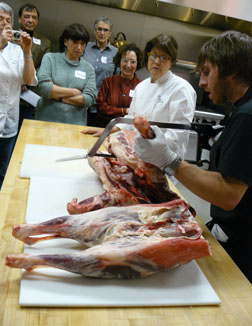
An electric band saw is typically used but Scott and Marsha left theirs at their Berkeley restaurant. They brought a hack saw and we all went to town. Cleavers, boning, paring and chef knives were used too! Then we got to taste the goat. (Funny how goat meat is presented as ‘goat’ whereas beef, pork, lamb stand for the flesh of cows, pigs, and sheep. Somewhat strange) The four goat dishes we tasted that night included a rich goat patties wrapped in caul fat, spicy goat merguez sausage, slow-baked goat with goat milk, fennel and potatoes, and grilled goat chops. The flavor? Definitely not goaty like goat cheese. Not gamy nor rich like lamb either. In fact, it was like lamb light. When butchering the flesh, my hands didn’t pick up any gamy odors.
I didn’t grow up eating goat, and the goat sold at Asian markets often looks somewhat creepy to me. It's frozen and sawed into unattractive pieces. Up until last Monday, I’d never cooked goat myself. Before going to the class I looked up goat recipes in my Vietnamese cookbooks. In the Vietnamese culinary repertoire, goat is a special occasion meat. However, if you were Hindu in Vietnam, you’d eat goat a lot of times as pork and beef weren’t your meat for religious purposes. The typical Viet goat preparations include carpaccio, hot pots, multilayered simmered dishes, stir-fries, grilled morsels and curry.
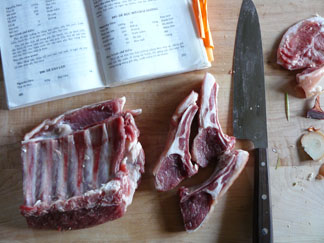 The grilled goat and curry recipes in a number of the Vietnamese cookbooks caught my eye. At the end of the night, I bought some of the meat that we’d butchered, a rack and some boneless leg meat to make goaty Viet dishes at home.
Last Tuesday night, I cut up the rack into chops (just like we did in class) and marinated them in a Vietnamese seasoning paste of galangal juice, lemongrass, garlic, shallot, sesame seeds, and chile flakes. Goat is often paired with galangal (rieng) in Vietnamese cooking as the meat tends to be strongly flavored. The sesame seeds lend richness, the lemongrass flavors, and the shallot helps to break down the fibers and make the flesh tender.
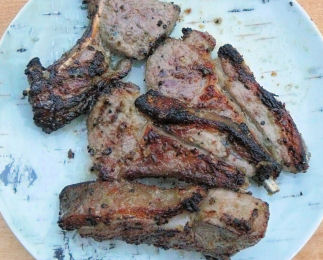
Rory and I went out for our daily walk and when we got back, we lit up the grill and cooked up the chops. There was a nice layer of fat and very thin skin left on the goat. The fat was fragrant and the skin cooked up rather crispy chewy. It was finger-licking good, either alone or dipped in a tart-savory dipping sauce of salt, pepper, and lime juice. So this was goat dish #5. The goat curry was the sixth dish of the week.
If you’re unsure about using lemongrass, be sure to check the Lemongrass 101 article for tips.
Grilled Goat Chops with Galangal and Lemongrass
Dê Nướng
The main seasonings below are pretty typical for many Vietnamese goat preparations -- galangal (or ginger), lemongrass, and garlic. Galangal is available at many Southeast Asian markets and health food stores too. Buy it fresh, cut it into chunks and freeze what you don't need.
To render galangal juice, grate about 1 ½ inches unpeeled galangal on the finest holes of a box grater. Transfer to a fine mesh strainer and press to extract the juice. If you don’t have galangal, substitute ginger. Feel free to use a rack of lamb or lamb chops instead of goat.
Serves 2 generously or 3 moderately as a main course
1 rack of goat, about 1 ¾ pounds
Seasoning paste:
1 tablespoon toasted white (hulled) sesame seeds
1 teaspoon light brown sugar
⅛ teaspoon salt
2 tablespoons chopped lemongrass
2 large cloves garlic, chopped
1 small shallot, chopped (about 2 ½ tablespoons total)
1 tablespoon galangal juice
Generous ¼ teaspoon dried red chile flakes
1 tablespoon fish sauce
2 tablespoon oil
Salt, Pepper, Lime Dipping Sauce
1. Cut the rack into individual chops. Aim for the space between the rib bones. Set aside.
2. Put the sesame seeds, brown sugar, and salt into an electric mini chopper. Process into a fine, sandy texture. Add the lemongrass and process until finely textured; it will look like a blizzard as the machine works. Add the garlic, shallot, galangal juice, dried red chile flakes, fish sauce and oil. Run the machine, pausing to scrape down the sides as necessary, to create a creamy, aromatic paste.
3. Transfer to a bowl. Taste and adjust the seasoning to create a flavor that’s slightly saltier than you’re comfortable with. The end result will be less intense as you lose some of the flavor during grilling.
Add the chops and combine to coat each one well. Cover with plastic wrap and set aside for 1 to 2 hours.
4. Preheat the grill to high and then grill the chops for about 6 to 8 minutes, moving them around the grill often to prevent over charring. I usually aim for medium rare. Knick the flesh to test, if you’re not sure. Serve immediately with the dipping sauce.


Rosa
Interesting! that flavor combination is great!
Cheers,
Rosa
Andrea M-S
I first had goat while visiting friends in Long Xuyen, VN. It was a curried version and I fell in love with it. (Nothing to do w/ the potent goat penis liquor I am sure :/ ) Luckily, we can find goat here in Boston fairly easily and I try to make the curry at least once a year. Maybe this year's foray into goat will be bbq'd? Thanks for another tasty recipe.
Tuty
Oh I bet the seasoning paste is good for making goat satay too! Goat is more common in Indonesia than lamb.
I also love Jamaican Curry Goat.
Anny
yesterday I made attempt do it, it turned out not badly. but I did not have galangal juice. I dontt know what is this! ))
watch gossip girl online
I am to submit a report on this niche your post has been very very helpfull
Ujwala Samant
Goat: the chicken of Indians! It's a Sunday lunch treat. And the myriad ways that goat is used from kheema (minced, in many different ways from silky as for Galouti Kabab to double-minced for a Shami kabab), to grilled baby goat chops in a creamy yoghurt marinade or pepper hot chops slow baked to perfection, or chunks in a biriyani and the fight for the unctuous marrow bones in a rich, coconut gravied curry. I hope you get to go back to the Asian stores and understand why goat is cut differentl
Nike Shox Turbo
Everything can be taken from a man but one thing; the freedom to choose his attitude in any given set of circumstances.
nike shox saya
Did you ever expect a corporation to have a conscience, when it has no soul to damned, and no body to be kicked? (Edward Thurlow, British Lawyer)
Supra Vaider
[ this is good]
Shop taobao
* be happy together is good enough. I am not asking for things that I could never get.
cheap jordans
Plenty of good CEOs are bullies - the answer is to keep out of his way and if he lets rip at you, not to take it too personally.
Alex
This was absolutely delicious. I made it with a rack of lamb instead of goat and had it with some rice noodles.
it's going on my list of favorite recipes.
order cigarettes
This is really good article. But from Europe your blog are to slow:( I dont know why!
oakley sunglasses
86&&this fabulous photo is that you don't look like you're being ironic.
788*)
Beats by Dr Dre
You never come to the end of the surprises he has in store for you.
Canada Goose Parka
The tongue is boneless but it breaks bones.
Beats by Dre
Some books are to be tasted, others to be swallowed, and some few to be chewed and digested.
Mr.B
Tried this tonight and I was impressed though my wife didn't like it, strange as we both like curried goat and Thai food. She did agree to try the seasoning again but with fried king prawns.