








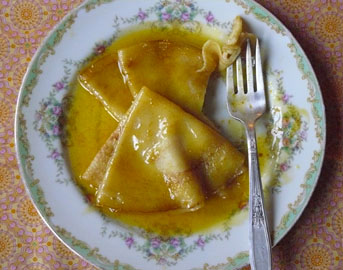
Shrove is the term used in the United Kingdom, Australia, and Canada. Celebrants of Shrove Tuesday also know it as Pancake Day and Pancake Tuesday, as pancakes were a great way to use up rich foods in your pantry, such as eggs, milk and sugar. Since Lent is the antithesis of decadence, luscious foods such as crepes, filled or doused with butter and booze are a great way to prepare oneself for the 40 days of abstinence ahead. Note that the gras in Mardi Gras and the fat in Fat Tuesday are nods to bidding a temporary farewell to living large. (No wonder Easter is celebrated with so many sweet goodies -- cakes, candies, etc.)
Vietnamese cookbooks with sections devoted to colonial French recipes or ones dedicated to French cuisine often include recipes for crepes, which are called typically called bánh kẹp. Viet cooks are adept at making more complicated crepes such as bánh xèo sizzling crepes and filled rolls such as bánh cuốn steamed rice rolls so French crepes were not an issue.
Getting Western ingredients in tropical Southeast Asia may have been the issue. But Vietnamese cooks surmounted many obstacles to master French classics. Instead of butter, oil or lard could be used. No milk? Substitute water, as Escoffier suggested in the 1930s. In Nguyen Lan Chi’s Sách Dạy Món Ăn Tây (Book on French Dishes), she called for rum as the booze to be added to the batter. There’s so little that I’m sure you could use some of the local rice wine too. The crepes could be filled with a cooked fruit puree and rolled up into bánh kẹp nhân trái cây.
As a teenager, I made stacks and stacks of crepes, and the idea of flambéing them into crepes Suzette thrilled me to bits. Convention said that orange zest and juice be used to imbue the crepes with their signature citrus flavor. However, my research this week revealed that mandarin oranges (tangerines, folks) were what were used in the early part of the 20th century, when crepes Suzette came to be as a chic Parisian treat. Vietnamese cooks likely used sweet mandarins for their crepes Suzette, making them actually closer to the original than ones that used oranges.
With all that in mind, I set out to make crepes Suzette. One of the nifty tricks I found is that you can pretty much set them up days in advance. Here’s the recipe. Enjoy them between now, on Mardi Gras, and even beyond that if Lent is not your thing!
Crepes Suzette
Bánh Kẹp Suzette
Heating the liquor before flambéing is the best way to ensure that it lights up! If this is your first time flambéing, have a friend do the lighting up. The batter produces thin crepes, for something heartier, use all milk, or ½ cup milk and ¼ cup water. The resting time allows the gluten to relax enough to create tender crepes.
Makes about 12 crepes, enough for 6 people
Sweet crepe batter:
3 ¾ ounces (¾ cup) bleached all-purpose flour
11/2 tablespoons sugar
⅛ teaspoon salt
2 eggs
6 tablespoons whole milk
6 tablespoons water
1 ½ tablespoons orange liquor such as curacao or triple sec
2 ½ tablespoons melted butter
Compound butter:
Grated zest of 4 tangerines or 2 navel orange
5 tablespoons sugar
10 tablespoons unsalted butter, at room temperature
6 tablespoons strained, freshly squeezed tangerine or orange juice
2 tablespoons orange liquor such as curacao or triple sec
1 tablespoon unsalted butter, melted
¼ cup brandy, bourbon whiskey, or rum
¼ cup orange liquor such as curacao or triple sec
1. Make the crepe batter. Put the flour, sugar, and salt in a bowl. Whisk it a few times to blend the ingredients. Make a well in the center.
In another bowl, whisk together the eggs, milk, water, and liquor. Whisk into the dry ingredients, pouring the liquid ingredients into the well in a steady stream. When all has been added, whisk a little more to ensure a smooth consistency. Then whisk in the butter. If you fear any lumps, strain the batter through a mesh strainer. You should have about 1 ⅔ cups. Cover with plastic wrap and set aside for 1 hour. Or refrigerate for as long as overnight, return to room temperature before using.
2. Meanwhile, make the compound butter. Put the zest and sugar in a mini food chopper. Process to create a fragrant, orange-colored mixture. The zest should be barely visible. Cut the butter into ½ inch cubes and then add to the sugar mixture. Process to combine well.
Combine the juice and liquor, then add to the compound butter, ¼ at a time, processing well after each addition. After all the liquid has been added, keep running the machine (it can take a few minutes) until there is no liquid visible. The finished butter will resemble soft frosting. Transfer to a plastic container and set aside.
3. To make the crepes, heat a small (8 inch) or medium (10-inch) nonstick skillet over high heat. When hot enough to sizzle water, lower the heat slightly to steady it. Brush a small amount of butter on the skillet. Then give the batter a good stir and then ladle in about 2 tablespoons of batter, pouring it in the center of the skillet; it’s helpful to pre-measure 2 tablespoons of batter into your ladle so you can gauge the amount needed.
Immediately pick up the skillet by the handle and swirl it gently to distribute the batter to create a circle about 5 ½ to 6 inches wide. It doesn’t need to be perfect. Set the skillet back on the burner and let the crepe cook for about 30 seconds, until the rim has started to brown. Give the skillet a shake and the crepe should slide free. To flip the crepe over, use a spatula and your fingers or jerk the skillet. Cook the other side for about 10 seconds to finish cooking; this second side is the nonpublic side so there’s no need to make it pretty.
Slide the crepe onto a rack to cool. Repeat with the remaining batter to make more crepes, stacking them atop one another.
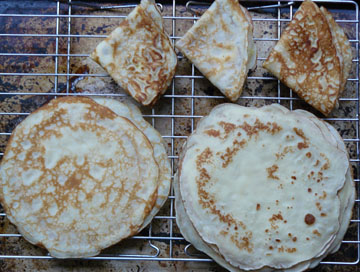
(Top) Crepes filled with compound butter and folded into quarters
(Left) crepes topside up, (right) nonpublic side of crepes
4. When all the crepes are made, fill each with compound butter and fold into a quarter. Holding a crepe with the nonpublic side facing upward, spread on a generous teaspoon of the butter. Fold the crepe in half, spread about 1 teaspoon on the side now facing you, and then fold in half again. The crepe is now folded into a quarter of its original size. Set aside on a plate and repeat with the remaining the crepes.
When done, cover the crepes and leftover compound butter. Cover with plastic wrap and refrigerate for up to 3 days before using. Return to room temperature before proceeding.
5. In a large skillet over medium heat, melt the remaining compound butter. Meanwhile, heat the brandy and curacao in a saucepan over medium-low heat, turning off the as soon as bubbles form at the edge of the pan.
Add the crepes to skillet, bathing each one in the butter and then arrange them in the skillet, overlapping them as necessary. After all the crepes are in the skillet, wait for the liquid to come to a bubbly boil and thicken slightly before adding the warmed liquor. Light the liquor, preferably with a long match or lighter. When the flame dies down, remove from the heat. Transfer the crepes to heated dessert plates, top with the sauce, and serve immediately.




Joel
That's a nice crepe which I believed once disappeared from many Western restaurants for being too stodgy and old-fashioned, although there are signs it is coming back to fashion since the turn of the new millennium.
Also interesting to note that for the Commonwealth English-speaking nations and Britain itself, crepe has that French concoction and people will ask you if want the regular pancakes (hotcakes) instead. It is almost impossible to find crepes at most places outside restaurants.
will
those crepes look great! but i think fat tuesday falls on Feb. 24th this year. i think Feb. 28th is a saturday...
Paula Maack
I see you have developed the Mardi Gras jones, as well.
While not crepes, it's pretty close: I just blogged about Cottage Cheese Pancakes with Orange Butter Honey, should you be interested.
I hope you have an enjoyable Fat Tuesday and Mardi Gras celebration. I will be posting about Mardi Gras on my blog soon, as well. 🙂
Cheers,
~ Paula
Andrea Nguyen
Will -- duh! What was wrong with my brain's calendar? Thanks for pointing out the error. It's fixed.
Sharon
Oh my goodness, amazing crepes! I just made some and am polishing them off right now. Just made the crepes and had them with lemon curd. Will definitely try the compound butter next time. Thank you so much!
Andrea Nguyen
Sharon -- My pleasure. Crepes are easy. Why not make them at home?
Crepes Suzette
That looks yummy.. Gonna try them..
https://www.yousendit.com/transfer.php?action=batch_download&send_id=817789614&email=7cff47bb7cdcb76fbfa15e66c81a1961
dining tables
This is something so delicious! I like it so much. I just made some again and I really can't get enough of it.
Beats by Dr Dre
Sorrow comes unset for.