



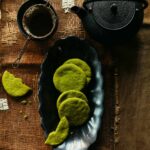
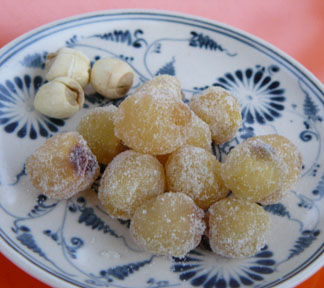
I thought about various oxen qualities as I experimented with candied lotus seeds earlier this week. Sweetmeats are a must-have at Tet, Vietnamese Lunar New Year. I can’t stand the stuff sold at the markets as they tend to be laden with food coloring and tasteless. As busy as I was this week with an arduous four-day photo shoot for a new cookbook (more on that soon), I carved out time to fiddle with candying lotus seeds, one of my favorite sweetmeats. They’re a little buttery and lightly sweet. A touch of vanilla lends a nice floral note to them.
Recipes from Viet cookbooks suggested soaking the seeds for hours before cooking them and then repeatedly coating in sugar syrup, much as you would for French candied chestnuts (maron glacee). But I have a neat trick for cutting down the cooking time for the seeds.
It’s baking soda. My mother got the tip from a friend and we use it to cook up lotus seeds in about 15 minutes. After they’re boiled to a firm tenderness, I cooked the lotus seeds in sugar syrup. The trick in candying is getting enough moisture out of the fruit/peel/etc. so that it doesn’t become watery again after cooking. The first time I tried, I boiled the seeds too long and they became chewy-firm. On my second attempt, I left too much moisture in the seeds and while they were great after being coated in sugar, they did not stay dry once stored in an airtight container. So the upshot is that I have to pull them from the sugar at just the right moment. This kind of culinary finesse is achieved only with close observation and repeated tries. How very ox-like and apropos for year 4707 (that’s according to the Lunar calendar)!
If you’re game, join me in finetuning the recipe below. Feel free to add your insights. Don’t get down if you mess up like I did. It’s just food and frankly, my husband, friend Karen and I sampled both batches of candied lotus seeds with abandon. They were really tasty, much better than storebought.
For more on Vietnamese Tet traditions and foods, see the Tet postings.
Candied Lotus Seeds
Mut Hot Sen Tran
At Chinese and Vietnamese markets, the dried lotus seeds are typically shelved near the dried mushrooms, dried beans, and other dessicated goodies used for sweet and savory preparations.
1 teaspoon baking soda
1 package (5 or 6 ounces) dried white lotus seeds, rinsed and drained
1 cup plus ⅓ cup sugar
¼ cup water
1 teaspoon vanilla extract
1. Put the baking soda in a medium saucepan and add water to fill the pan halfway. Bring to a boil over high heat and add the lotus seeds. When the water returns to a rolling boil and threatens to rise over the sides of the pan, remove the pan from the heat but don’t turn off the burner. When the boiling subsides, after about 20 seconds, return the pan to the heat. Bring it back to a vigorous, threatening boil and remove from the heat again until the boiling subsides. Repeating the boiling one more time, and then pour the lotus seeds into a colander to drain. They will have expanded and be tender yet still firm. (In total, you’ll have heated up the lotus seeds to a frothy boil 3 times.)
2. Transfer the seeds to a bowl. Rinse them in several changes of water, swirling the seeds gently to coax any leftover pearly skins to float upward and then pouring out the water. After removing most of the skin bits, drain the seeds. If you’d like to avoid the bitter green tonguelike centers, inspect each lotus seed to ensure it is tongue free. As needed, gently pry open the seed and remove the green center.
3. Put the 1 cup sugar and ¼ cup water in the saucepan; the seeds should fit about 2 layers deep. Bring to boil, stirring constantly to dissolve the sugar. Add the lotus seeds and vanilla. Adjust the heat to simmer for about 20 minutes, or until the lotus seeds are brown and translucent – a sign that they have absorbed the sugar well. During simmering, swirl the pan evenly expose the seeds to the sugar. There should be little liquid left in the pan. If you cook the seeds until they’re completely dry, they turn chewy hard but still taste good.
4. Remove the pan from the heat. Use a fork or teaspoon to remove nice whole seeds, depositing them onto a parchment paper-lined baking sheet. When there are too many bits left, gently pour them onto the paper in an empty area, spreading out the lotus seeds as best you can. Now pick out large chunks with the fork or spoon. Expect a leftover mass that will be rather gluey; you can discard this quantity or let it dry and roll it into balls and dredge in sugar as directed in the next step.
5. Let the seeds dry until tacky. Then in batches, roll the seeds in sugar to coat. Deposit the coated seeds on a new sheet of parchment and allow to dry before eating or storing.




Huon
I tried to make this last nite, but the only 1/4 of the seeds came out whole or half, the rest of all clumpy but still taste very good though.
Supra Footwear
wow, your blog is so interesting, it gives me a lot of fun. And maybe we can share our idea, welcome to our website http://www.supras.cc/ .
vepkasxvp
oLuWFk pgaogrwkhrtj, [url=http://abfawmvowcot.com/%5Dabfawmvowcot%5B/url%5D, [link=http://ydlfeancoxqc.com/%5Dydlfeancoxqc%5B/link%5D, http://afsahdjntkds.com/
air max 90
Tomorrow is an other day!@
air max 90
Tomorrow is an other day!@
Best Bread Maker
Nice post! I have been looking for recipe using lotus seed, but this one catch my attention! thank you for sharing.
jean spokes
i have a dam full of lotus. the pods are just drying now with lots of seeds. do i treat them the same way as dried seeds? i am cooking them right now! sounds like fun.
Bruce Madsen
The Nuwave Oven is a counter top oven that uses infrared technology to cook the food. I saw the ad on TV so many times that I stopped paying attention to it. It wasn't until recently that I noticed the line where it said that the oven cooked food in half the time it takes a normal oven. Not the fastest time possible but I wanted to try out some more healthy meals instead of home nuked meals from the microwave, it seemed to be a reasonable compromise.
zojirushi bread maker
I haven't cooked with lotus seeds before but this looks too good to pass up on. My fiance and I are always looking for unique and interesting new recipes. This one certainly fits the bill.
Beats by Dr Dre
It always receives us with the same kindness; amusing and instructing us in youth, and comforting and consoling us in age.
Canada Goose sale
It is never too late to mend.
Bread Making Recipes
This is a very interesting recipe, and it is gluten-free!?
asian
Do not add to too many lotus seeds in step 8. If you do the lotus seeds will stick together! You can also put the lotus seeds in a dehydrator and dry until the sugar crystallizes (this method takes a while). Can adjust the amont of sugar to your taste, just remember that the amount (weight) of water has to be 1/5 of the weight of sugar or else sugar will not crystalize.
marlon
do i treat them the same way as dried seeds? i am cooking them right now! sounds like fun.
Thu Dang
I tried this today and but after a few hours, the seeds started hardening again. Does this happen with yours?
Andrea Nguyen
That's what happens. It's totally natural and to be expected with this recipe. The seeds are very dense so getting the sugar to penetrate and hold is hard. But I enjoy the taste better than commercially made stuff.