




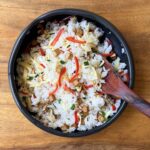
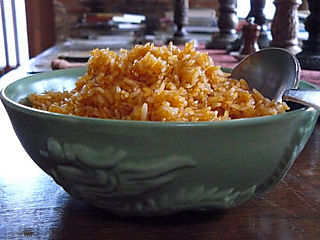
 There are certain dishes that people ask me about and Vietnamese red rice is one of them. It's a dish that's become popular in a number of Vietnamese restaurants abroad -- a diaspora dish, if you will. It's not part of the Vietnamese repertoire in the sense of being a classic dish that says, "I'm Vietnamese!" On the other hand, what makes something a classic? Perhaps, a particular food becomes a classic if over time, enough cooks make it and enough people like it.
There's a red sticky rice called xoi gac in traditional Vietnamese cooking where sweet rice is coated in the red-orange pulp of the gac fruit (Mormordica cochinensis), a spiky volleyball-sized fruit that's related to bitter melon. That slightly sweet, rich xoi gac sticky rice is associated with celebratory occasions, like weddings, because its reddish color symbolizes prosperity and good luck. Usually, the rice is paired with roasted meats like crispy pork or duck.
I imagine that Vietnamese red rice is a take on xoi gac, only it's made with long-grain rice and is essentially a glorified fried rice. The difference is that the rice is cooked in butter and lots of garlic. Vietnamese restaurants, like their Chinese brethen, have lots of rice around so why not make fried rice?
I recently purchased a copy of the Red Lantern Vietnamese restaurant cookbook from Australia and there was the red rice recipe. I gave it a whirl , found it to be a tad greasy and bland, and adapted the recipe here for you to try.
For those of you who love this rice, let me know if it comes close to what you've enjoyed in Vietnamese restaurants. And if you try the recipe, do tell us all about your personal tweaks!
Red Rice
Com Do
Like all good fried rice, cook your rice on the firm side (use less water than usual) so that the grains retain their individuality. Then let the rice dry out in the refrigerator. If you have leftover rice, here's a great way to use it up! The rice will literally fry without soaking up tons of fat. The less moisture the better for fried rice, lest it becomes soggy. That's why the tomato paste is a champ and giving the rice great color and a touch of sweet flavor. As for the Maggi Seasoning Sauce . . . I like it for some savory depth.
Pair the rice with wok seared (shaking) beef (thit bo luc lac) or grilled or roasted meats. Something rich here is nice -- something you'd eat with knife and fork. I served mine with a pan-seared pork chop seasoned with shallot, garlic, garam masala, fish sauce, and kecap manis.
Serves 3 to 4
4 cups cooked long-grain rice
3 tablespoons butter or canola oil
2 large cloves garlic, minced
2 tablespoons tomato paste
Scant ½ teaspoons salt
1 ½ teaspoons Maggi Seasoning Sauce or light (regular) soy sauce
1. Put the rice on a baking sheet and refrigerate it, uncovered, for 8 to 24 hours, until it is dry enough for you to gently crumble in your hands. Midway through, turn the rice to ensure even drying. Before cooking, return the rice to room temperature.
2. To make the rice, heat a large nonstick skillet over medium-high heat and add 2 tablespoons of butter. Once the frothing subsides, add the garlic, and cook, stirring frequently for about 2 minutes, until the garlic no longer smells raw and turning blond. Add the rice and stir to combine. Add the tomato paste and stir to coat the rice and turn it red. Increase the heat slightly and cook, stirring constantly for about 3 minutes, until the rice is heated through.
Sprinkle in the salt and Maggi Seasoning Sauce and stir to combine well. For extra richness, add the remaining 1 tablespoon of butter. Continue to gently fry the rice for another 1 to 2 minutes, to sear in the flavors. Remove from the heat, taste and add extra salt, if necessary. Transfer to a bowl and serve immediately.
Chuck says
Thanks for the background on red rice. We never made this in our family, so I've never had it. I've had a few people mention it to me recently. I'll have to give it a try.
My version of red rice is plain rice with a spoonful of chili garlic sauce mixed in!
Rosa says
Thanks for the tips! I love fried rice and that Red Rice looks delicious!
Cheers,
Rosa
Andrea Nguyen says
Chili garlic sauce fried rice sounds mighty good, Chuck.
KL says
Thank you for such an extensive work. I have been in and out of Vietnam the last 12 years and it has the best food in Asia. I love the noodles, dessert, coffee and the seafood! I hope to try some of the recipes.
Joel says
Andrea, is the Red Lantern book worth the dollars to buy? I may want to change my stance and buy it after all, if something like 50% discount comes up in bookstores like Whitcoulls or Borders. It looks like it has more "dinner dishes" rather than one-bowl/dish quick dishes (noodle soup/rice set) than many other Vietnamese cookbooks.
I have also seen the recipe for "red rice" (com rang) in Michelle Lo's book that you bought a while back, which she uses to accompany diced beef fillet. On pg 115
Tiffany Ta says
I am not a chef but this is the way that I have learned to make it from a restauranteur. Stir-fry the washed, drained, uncooked long-grain rice in the half mixture of butter and olive oil with minced shallots and garlic until the rice is opaque, then add boiling mixture water and tomato paste and Maggi seasoning sauce to taste. Be careful when you add the boiling saucy mixture to the rice, it will splatter and boil over if not cautiously and slowly added. Cover with lid and turn heat down to
beryl says
Just love the sound of this rice and wondered when I tried to make fried rice, why it was not so successful. Will be getting my rice ready tomorrow and now know about drying it out, that should help. Thanks
Beryl
top chef says
i tried this out a few months back, and since then its become a staple in my home. i just wanted to say thanks for the recipe. i also add a handful of chopped cilantro which is folded in at the end. this gives it a cleaner bite which i love with steaks.
Linda says
My friend's children love the com ga roti (Vietnamese roasted chicken) at this restaurant (Pho 999 in Reseda, CA) that serves it on red rice. Their rice is quite good, but the chicken was very dry with very little meat - so I sought to recreate their dish by finding the recipes for both red rice and chicken. I have pasted the link to the ga roti recipe.
I just finished making com do with your recipe and I am guessing theirs is much sweeter because they add sugar. It took awhile to coat all of th
An from Fremont says
Thanks Andrea, it turns out quite well. Another technique I've learned from someone is to stir-fried some shallots, garlic, tomato paste and some tablespoons of water (or broth) on the side first to get it to a ketchup-y consistency. After stir-frying the rice I would spoon in this texture, which is easier to bland into the rice than tomato paste itself which requires some dispersing that can make the rice mushy.
ugg outlet store says
Literature is a kind of intellectual light which, like the light of the sun , may sometimes enable us to see what we do not like.
taobao auction says
*Oh I hope you all have a blessed day
Supra Shoes says
If u receive other people good article, dun be selfish to share, u can continue to share wit your friend, dun forget mine.
Nike Air Jordans says
Un bon départ est la moitié de la bataille.
Video Surveillance says
this is a very good sweet rice!! I love it... with some pineapple, orange and mint.. it's perfect!!
Florida Certified Public Accountants says
This is a perfect dessert for summer, even if I serve it a little warm, the sensation in great.
I love it with a little bit cinammon and fruit in a side... wow delicious!!
Minecraft says
It's interesting to see this point of view. I can't say fore sure if I agree or not, but it is something I will think about now.
HoneyBadger says
Thanks for this recipe, it's just like the red rice at a Vietnamese restaurant I went to recently and wanted to make it. It's so easy. I don't think I'll ever want to buy this rice again. Didn't have the Maggi seasoning, so I just used soy sauce and salt and it tasted fine.
london inventory company says
I have never taste it, but it looks too fat for me. Thanks for the recipe.
seeking says
I am new to cooking. I miss something in the step 2. You wrote "2. To make the rice, heat a large nonstick skillet over medium-high heat and add 2 tablespoons of butter. Once the frothing subsides, add the garlic, and cook, stirring frequently for about 2 minutes, until the garlic no longer smells raw and turning blond. Add the rice and stir to combine. Add the tomato paste and stir to coat the rice and turn it red. Increase the heat slightly and cook, stirring constantly for about 3 minutes, un
Canada Goose Jakker says
Canada Goose parka er ligesom en flamme, der kan gøre os varme hele vinteren.
pagelines coupon says
magnificent points altogether, you just gained a new reader. What would you suggest in regards to your post that you made a few days ago? Any positive?
marlon says
I don't think I'll ever want to buy this rice again. Didn't have the Maggi seasoning, so I just used soy sauce and salt and it tasted fine.
Mr. Cooking Grill says
Great Recipe! it really is and must be appreciated by all! 🙂
Mr. Cooking Grill says
a very good post by a great author only some people have the ability to write like this way.
Judy says
Hi, is this the tomato rice that is often served with the crispy chicken? if so, do you have the recipe for the crispy chicken? crispy chicken with tomato rice is hands down my hubby's favorite Vietnamese dish!