

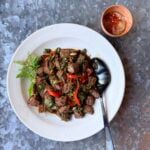








When you go to a Vietnamese restaurant in Vietnam or abroad, there is often super thin shreds of cabbage and or banana blossom that are presented as garnishes for dishes such as bun bo Hue spicy beef and pork noodle soup. Cabbage salad with chicken and Vietnamese coriander is a classic dish in which shredded cabbage is featured. So how do those clever Vietnamese cooks get those thin shreds?
Several people have asked. For example, Diana in New Zealand inquired a while back, saying that her mother in-law claims that only a special knife from Hanoi yields those unmistakable thin slices. John, who read the post on finely shredding ingredients, asked if a mandoline works well, and how it compares to a knife.
What Diana's m.i.l. was referring to is a tool called a dao bào
("zow bow").
It's a Southeast Asian vegetable knife/peeler/slicer that resembles a
knife but has a peeler type of blade cut into the main blade, which is
also very sharp. I've often seen it used to shave off very thin slices
of banana blossom and cabbage. In the States, you'd buy it from a Vietnamese
grocery store. The photo below shows the two main versions, the modern (and safer) one with a plastic handle is on top and the more rustic version with the steel blade is below.
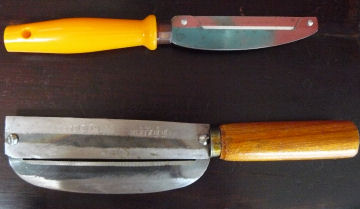 The knifes are often labeled a vegetable peeler but can be
used for peeling and slicing. The rustic version can be used to chop too, like a regular knife, though it's not as precise. It can be unscrewed and sharpened easily, though after washing, I found that the blade rusted easily.
I've not seen either kind sold on the Web, and
it's likely not to be since the dao bào became somewhat
controversial with the shooting of a Vietnamese American woman who was mistakenly killed for wielding a rustic version at a police officer. (Read story)
When trying out both of these dao bào I found that they just weren't as great as using a regular knife. Surely, if you're squatting without a cutting board, holding a wedge of cabbage or banana blossom and using the knifes directly over a bowl into which the shaved pieces would go, is quite handy. But for me, I'm standing at a kitchen counter and there's always a piece of the vegetable leftover that I end up cutting with a knife since I can't use the dao bào on it.
However, I don't see why you need a special knife to thinly slice up
cabbage or banana blossom. If you use a sharp Japanese style vegetable knife, which has a
thin blade, you'll get nice thin shreds; those knives (called usuba; see sample knife)
typically have thin rectangular blades. Your salad or soup garnish won't be ruined if
you don't have the knife.
Actually, traditional Viet cooks didn't have
that special slicers/shredders/dao bào to use. They employed their multipurpose kitchen knife and
kept it sharp. Get your knifes professionally sharpened occasionally
and steel it before you use it. Your sharpening professional should
teach you how to maintain your knives.
Also, if you have a firm, tight head of fresh cabbage or banana blossom, cutting a thin shred works too. I suppose you could use a mandolin, as well, as John suggested. But unless you have a huge quantity of cabbage or banana blossom to slice, I don't see the need to bring out the mandolin.
Related information: Finely Shredding Ingredients


Nobody says
That thing doesn't work very well and you have to spend too much time pushing stuff out from between the blades. A sharp Chinese cleaver is all you ever need in the kitchen. It does everything and can even grate coconuts.
Rob says
You don't need a Chinese cleaver either, any decent sharp knife will do. Chinese cleavers are very hard to master, and a waste of money unless you have a lot of time to spare learning how to use it. As a young chef I bought one thinking it would magically improve my cutting, but after a lot of time wasted I went back to my good old Victorinox chopper and that was that.
Andrea Nguyen says
Thanks for your professional input! Yes, a good reliable knife (or two) that is easy to sharpen matter most.
Andrea Nguyen says
Amen. That's totally true. Nothing beats a good, sharp knife!
Binh says
The vegetable/potato peeler works better as the blade rotate to the right cutting angle. The opening/blade part is wider and allow the sliced part to fall of easier.
http://www.amazon.com/Cuisinart-Vegetable-Peeler-Handle-Black/dp/B0006G0GSE
Andrea Nguyen says
That peeler is amazing looking, and that's the first time I've seen it. Very raking looking. I'll have to check it out! Thanks, Binh.
Simon Bao says
Andrea, when they are "freshly purchased," the modern Dao Bao with the plastic handle always seems superior to the typical vegetable peeler found in most American kitchens. I prefer a Dao Bao any time I have to peel potatoes, carrots, or sweet potatoes, or have to peel a very hard skin off some vegetable (e.g., taro, butternut squash). The problem is, they have a "Dollar Store" quality to their manufacture, and very quickly the blade begins to loosen from that plastic handle. From what I can
Anonymous says
It's good to read a quality article for once
Lotus says
Try the Rongfa Stainless Steel Peeler. The large and medium ones have wooden handles and appear to be firmly attached. They do look a little different, but they do come in Large medium and small and there is no curved portion at the bottom which is actually sharpened into a knife. Where can you get the one in the picture with the curved lower ssection. I saw the plastic ones in the store, but did not buy it because it looked cheap.
coach handbags says
Do you like take a travel or go shopping, if you like why didn’t you bought a new bag or wallet? That will attract people attention and make you fashion!
woodworking books on cutting boards says
Thanks!That peeler is amazing looking, and that's the first time I've seen it. Very raking looking.
Anonymous says
...
Anonymous says
...
Anonymous says
...
christian louboutin shoes says
*Every great achievement was a dream before it become a reality.
cheap air jordans says
I want to bring out the secrets of nature and apply them for the happiness of man . I don't know of any better service to offer for the short time we are in the world .
nike air max says
I was once asked.*_*
coach outlet says
A look at things from other people's ideas, the activity of mind to know other people who never have to worry for their future.
Coach Poppy says
All sentences are about a little something or another person. The a little something or anyone that the sentence is about is called the topic on the sentence. From your blog, I see that, and study a thing I'd like. Thanks for sharing.
Chain Sprocket Hobs says
We at Capital Tool Industries welcome all international and domestic inquiries pertaining to our products and services. We reaffirm our commitment to all our valued customers and potential clients that all inquiries will be replied to within 48 hours as we value your business.
mercurial vapor says
The final clearance most drastic hundred and Qin Chu. Pains were no live,the more a thousand hardships can sw allow Wu.
NIKE DUN SB says
The meaning of the article reflected the depth of the cultural level is the subject of a historical topic
cheap uggs says
Ambition is nothing but the memory of the slaves, to the birth of a vibrant, but it is difficult to grow.
JC says
your post is impressive, just bookmarked and share with my friends on facebook. Hope to seeing more updates from you
Gina B says
Hello! I found your post using google search. This is a greatly written article. I’ll be sure to add to my favortie site folder and regularly visit to read more of your informative posts. Thanks so much for the posts. I will certainly come back
Florence G says
Your post is pretty illuminating and practical,I completely agree with the above comment. Thanks for the sharing.Will you share more about it? I just want to know more.
Dyson says
do you got any fb fanpage or twitte? really wanna listen more from you
Vy says
My family have always used rustic Dao Bao. The trick is to slice away from the body. If you try to peel or shred pulling the blade towards you (as most Americans do) its difficult.
Slicers says
Not only Vietnamese, I saw people using this kind of Shredder Tool in China
CobraCo says
i think using these kinds of tool are safer than knives
Beats by dr dre says
The greatest lesson in life is to know that even fools are right sometimes.
marlon says
Thanks!That peeler is amazing looking, and that's the first time I've seen it. Very raking looking.