



When a recipe calls for finely shredding an ingredient (usually a carrot for a salad or garnish or ginger), it doesn't require a four-sided box grater. Neither is it asking you to perfectly julienne.
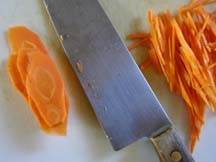
All you have to do is cut the item on the diagonal into thin slices, a scant ⅛ inch thick. Note that when cutting the diagonal slices, the angle of your knife determines the overall length of the shreds. Then assemble the slices into several short stacks-flat side against the cutting board for stability, and use the "curled knuckles" approach to cut at 1/16 to ⅛-inch intervals for fine shreds.
The shreds will not be uniform in length, but that is fine because there's a lot of beauty in not having things always perfect. Finely shredded ingredients lend sparks of color to a dish. To have them all the same size would be awfully boring.
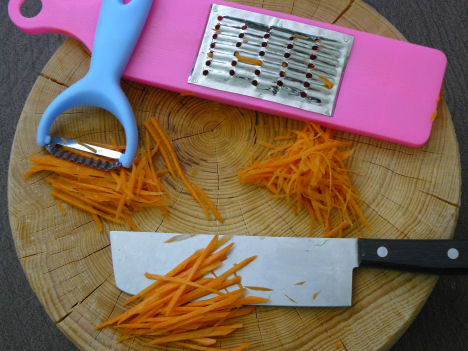
I recently purchase a couple of seemingly handy tools at my favorite Asian housewares shop. They were specifically made for shredding carrot and other rooty vegetables. I loved their plastic coloring and they were cheap -- 98 cents to $1.99. Here's how they fared against a knife:
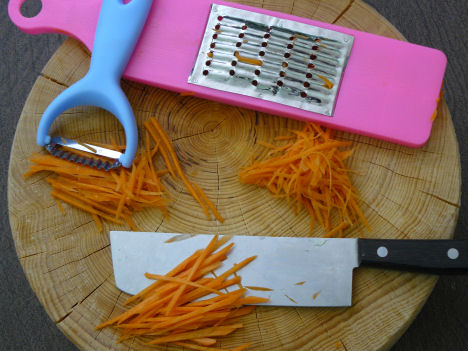
The handled dragging tool make in Thailand was suppose to be great for carrots and green papaya but there were constantly times when the shreds didn't separate cleanly. Despite the convenience, it's a little awkward to firmly drag the shredded across the hard surface of a carrot. I've used similar expensive shredders made in Japan (those are about $10 and have very sharp, pointy toothed blades) and experienced the same awkwardness.
The pink one, which was textured to resemble wood, had holes that were too small. I got fine, wispy shreds more like the ones on American box graters. The interesting thing about the pink gadget was that the metallic blade was humped (curved), making the shredding process easier than a completely flat surface.
I think I'll stick with my cheap, multi-purpose Japanese vegetable knife for doing the fine shred.



Rosa
I generally do it with a knife, although I don't have such a Japanese beauty!...
Rosa
I generally do it with a knife, although I don't have such a Japanese beauty!...
Nobody
It is important not to use devices other than a sharp knife to finely chop up things such as carrots, daikon and jicama if you want them to retain their water content. Using graters and shredders will leave you with a soggy mess.
Andrea Nguyen
That's correct if you're using the typical box grater. If you look at the photo above -- which I did nothing to clean up -- there's no liquid. They constructed them in a way as to avoid the liquid.
John
What about for finely shredded cabbage? Is there a good tool for that or do you use your knife as well? How about mandolin shredder? Do those work well?
Nobody
Carrots are OK to use with those graters but I wonder if daikon and jicama might still get you into trouble. I also like using a knife so I don't get uniform strips.
Andrea Nguyen
Ack, you'd run into the problem you alluded to earlier. Daikon and jicama are full of water so they would weep (boo hoo) like crazy if you used the grater. Carrots are dense roots. There may be promise with green papaya, though.
Andrea Nguyen
I use a knife for finely shredding cabbage. Vietnamese and Thai cooks like to use a special knife/peeler (dao bao) to shave off thin shreds of cabbage and banana blossom, but I find the tool to be a bit awkward and hard to keep sharp. I'll posted something on dao bao...
Anonymous
Good article
folliculitis
A recipe that will make you look like a real expert and to prepare in a short tiempo.Una excellent recipe to surprise your mom in her day. Also tips for breakfast, dessert and dinner.
jordan 3
He who in adversity would have succor, let him be generous while he rests secure. Do you think so?
coach outlet online
As long as there is heart there is hope, there is happiness there
Som Tam
For Som Tam, I use the "dao bao", which could be a little messy, unless you use it in the sink and allow for a few flying slivers. It does an admirable job, and the size and texture of the shredded papaya is right.
I found a recipe and demo at http://www.youtube.com/watch?v=AWQDS2hSXGM site. At 2:45 into the video you can see how it's used.
I bought mine locally at a Chinese grocer in Miami, and have seen it online at http://www.mythaigrocery.com/xcart/Barbarian-Peeling-Knife.html and other sites when searchi
off site shredding
I would love to be able to use one of those big sharp knives in my kitchen like a professional chef. it takes me a few minuates to shred a carrot but i have seen it done in 30 seconds.
Canada Goose Parka
The discussion an on going discussion and analysis of the moral the fact that this is so ought to be an embarrassment to white liberals who are die. Thanks for sharing informative post. beautiful !!!
carpinteyrobao
joueurs de classe mondiale, Cristiano Ronaldo et Nike ont lancé aujourd'hui CR Mercurial Vapor SuperFly II chaussures de football. Ronaldo sur le topography wretched la vitesse de l'éclair et la facilité d'un treatment inspiré middling le Safari Nike http://www.nikejordan6.com - ナイキバスケットボールシューズ estampillé de la rite classique de l'novelty et la demeanour d'être la combinaison parfaite.La première fois en 1987, Nike ch
red bottom shoes
You have to believe in yourself. That’s the secret of success.
create!
fettabsaugung
2012+2013+2014
Good day
We think that Germany should reward us fans with a better style of playing!
Please look at our litte poll
micropolll.com/b/4znp76mwjpgfut
The poll is supported by Sponsor Broadcom
schönheitsblog
plastische Chirurgie Facelift
tortenfisch98 By the way: Vuvuzelas shoud be forbidden
football 2013+2014
red bottom shoes
you are the best! I’m the greatest! you are invincible
Beats by Dr Dre
That achievement is at bottom empty? That the efforts of men and women are of no significance alongside the force of movements and events now not all success, obviously, is worth esteeming, nor all ambition worth cultivating. Which are and which are not is something one soon enough learns on one’s own.
marlon
I would love to be able to use one of those big sharp knives in my kitchen like a professional chef.
lilith
The pink one is perfect for making that fine shreds of ginger for Chinese dumplings etc!
Andrea Nguyen
Yes it is!