


Below is
text from a booklet written by Didier Corlou, former executive chef of the Sofitel
Metropole hotel and current chef/owner of Verticale restaurant in Hanoi. Published in 2003, the booklet came from a series
of seminars organized by Chef Corlou and the European Commission to Vietnam
to discuss the origins of pho noodle soup. Here's how the booklet is organized:
- Introduction
- by Frederic Baron, Delegation of the European Commission to Vietnam - Pho's
Art - Didier Corlou - Pho
soup recalls my childhood's flavor - Cultural meanings and
emotional attachments to pho - Portable
Earthenware Stoves of Street Hawkers - French connection to
pho - Pho Recipe
- by Didier Corlou - Afterword
- by Didier Corlou
This document is presented online with the permission of Didier Corlou.
The
Mysteries Surrounding 'Pho' (noodle soup)
This booklet
was devised as means of expressing his profound feelings of friendship
by Didier Corlou, executive chef of Sofitel Metropole Hanoi; a lover of
Vietnam, its culture and its cuisine.
Pho soup,
like many other myths, has a mysterious beginning. Historians and fervent
defenders of Vietnamese gastronomy have tried to penetrate the mystery
of the arrival of this soup, considered for a long time to be the national
dish of the North. The cuisine, like many other cultural aspects of a
nation, is subject to evolution and it has grown richer and stronger after
having contact with neighbors and visitors.
The question
raised during the press conference organized by Sofitel Metropole Hanoi
and the Delegation of European Commission at the end of 2002, turns around
the origin of 'Pho'. Is this soup an original Vietnamese creation or an
adoption of some foreign culinary blend, which has been adapted and integrated
into the Vietnamese culture? The answer? No one, for certain knows.
Although,
the first conference couldn't give out any definitive answer to the question;
please feel free to express your own ideas and thoughts on the origins.
Many thanks
to Didier Corlou and to Nguyen Dinh Rao, President of Unesco Club of Gastronomy.
Frederic
Baron, Ambassador
Chief of the Delegation of the European Commission to Vietnam
To have steaming
bowl of Pho, crouching on a stool a tightly-packed shop, crowded with
customers is an art in itself. You order arrival, a bowl of rare or well-done
beef Pho, with or without onion, and of course, no seasoning. A few minutes
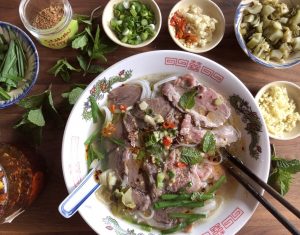
later, the Pho will be served at your table. The ritual begins, squeeze
on some lemon, add chilies and pepper, then mix the soup with chopsticks;
bring the bowl level with your mouth and start to swallow it while drinking
the bouillon with a porcelain spoon.(metal spoons are not recommended
as they give a cold taste at the mouth)
It is not
advised to leave fresh noodles standing, they should be eaten within 5
minutes as they tend to swell up and lose their texture. After finishing
your Pho, pay for it on your departure, then take the traditional toothpick
and move to the tea shop next door for a cup of green tea or coffee. Now,
you are ready to start the new day.
In the past,
Pho was mostly served in the morning and when Vietnam experiencing difficult
periods, Hanoians only had the soup on Sundays or when they were sick.
It cost 3 cents (xu) a bowl in those days. Nowadays, people have Pho any
day, at any time of the day, especially in the evening. Although lifestyles
and habits have changed Pho remains the hallmark of Vietnamese cuisine,
despite the competition of other delicacies, such as banh cuon (steamed
rice pancake stuffed with chopped pork).
Pho, the
best soup of the world, the representative of Vietnamese gastronomy, is
equivalent to paella in Spain or the double pancake of Brittany. It is
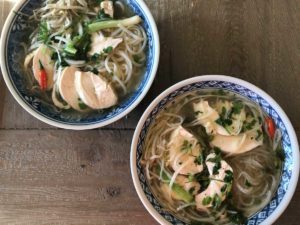
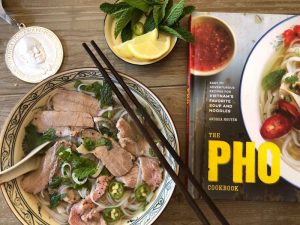
a unique dish, served with white noodles, consommé, sliced meat,
fragrant herbs, grilled onion, added with nuoc mam (fish sauce) and perfumed
with lemon, chilli, herbs and spices.
To us, it
is worthy of its title of the best soup of the world because of its history.
Its identity was created and developed throughout different periods, from
the colonization to the war years and the US embargo. Today, it has become
the pride of a nation. Popular and economic, Pho can be an enjoyed by
almost anyone, of any social range or status. This dish is known to be
rich in vitamins and plays an important role in the staple diet, health
and the morale of the Vietnamese people.
Pho is regarded
as an everyday soup, which is not served during parties, weddings or other
festive occasions. And when someone is not seen to be taking an interest
in festive fare, you can almost guarantee they will be found some time
later at the local Pho stall devouring their daily dose of their favorite
dish.
Hanoi's streets
are the soul of the city and people do say Pho is synonymous with Vietnam's
quaint capital. While it is served in a great number of restaurants in
Saigon, Paris and New York, somehow it does not hold meaning as eating
it in Hanoi. As we know, it may be great to enjoy cheese fondue in the
Alps, but for sure, it will be not taste the same in Hanoi and vice-versa.
And for a bowl of Pho, there is only on place to go - Hanoi!
Pho can be
cooked with fish, duck, and vegetables. In the country-side, people also
make Pho with pork, even the pig's hearts or kidneys. What you make it
with is not important, after all, Pho will still remain what it was before;
the pride of Hanoi's people.
Didier
Corlou, Executive chef
Sofitel Metropole Hanoi
"Pho
soup recalls my childhood's flavor"
The speeches
published below are extracted from the press conference "Pho - Vietnam's
Heritage", organized in Hanoi on November 29th 2002 at the offices
of the Delegation of the European Commission:
Its birth
certificate is packed full of question marks; where does Pho come from?
When was this soup, together with nem (spring rolls), symbol of Vietnamese
gastronomy, brought into the world? Nguyen Dinh Rao, a decidedly determined
seventy-year-old man and president of Unesco's Gastronomy Club in Hanoi
expresses his opinion on this subject; more than an opinion, he insists
he knows Pho's true origins. He says that the birth place of Pho is in
Nam Dinh city, which is situated in the southern Red River delta. Its
birth's date? Beginning of 20th century he claims confidently "when
a big industrial zone for textile was established there".
Rao continues:
"Nam Dinh's population included, in those days, new city dwellers,
workers, salaried employees, officials, as well as French and Vietnamese
soldiers. All of them required a dish which was less "rustic"
than the traditional soups of the delta's farmers, like chao (rice soup)
or bun (fresh noodles made of rice)".
This mixed
population turned to its culinary roots to "invent" Pho. A novelty
which was simmered in the pot of traditions. "It perpetuates the
traditional flavor" - Rao explains "Thus, the bouillon, made
of bone and prawn, rich in amino-acid and sweetly perfumed, is inherited
directly from old coastal roots of our civilization. Regarding popular
fresh and soft rice noodles, called banh pho, cooked in vapor, they are
definitely from Vietnam. Finally, to satisfy a modernized demand and to
meet the taste of European people, they add beef among other ingredients,
only once per year, in occasion of village's festival. It replaces aquatic
products, like crab or shellfish." Rao concludes: "Pho combines
a cultural interference and local ingredients, the traditional flavor
blending with European taste. The whole blend creates a universal soup".
Poet Vu Quan
Phuong shows himself more pliant in his views: "They may be right
when saying pho comes from Nam Dinh; I often see the signboard "Nam
Dinh recipe" in front of pho shops. However, the famous writer Tu
Xuong, who was very devoted to Nam Dinh, fails to mention anything about
Pho in his writings. Pho sustains certainly the influence of different
countries, but its Vietnamese soul still remains. That's why, I believe,
the most important thing is that Pho makes up half of Vietnamese national
pride; the second half is the popular war."
More important
than different questions related to the origin and the culinary crossings
of Pho, which prevailed throughout its birth, is the acknowledgement of
Pho as an element of Vietnam's heritage that nourishes the national pride.
"We understand the Vietnamese culture is highly discerning to other
foreign cultures" said Dang Huu Hung, deputy editor in chief of Sciences
and Fatherland magazine, "Thus, there are interferences with French
and Chinese cultures. But we also know how to "Vietnamese" a
Pho soup. Today, Pho becomes a Vietnamese soup, which makes us proud,
that is more important than the origin of Pho".
Furthermore,
Pho's taste and the ingredients to make it have varied and developed with
time. At the beginning, Pho is cooked with hard-boiled beef cut into nice
slices, then also with rare beef poached in the bouillon (pho bo tai),
with chicken (pho ga) and even with pork (pho lon) during hard times in
the war. Some people don't hesitate to evoke the "secrets" of
making Pho soup. An old Pho shop regular cites 3 secrets: the first one
is the cleanliness, the bowl in which pho soup will be served should not
have any smell, the second, is the way to prepare the meat, and the third,
lies in the bouillon, its ingredients and the right moment to integrate
them in the water.
Regarding
the bouillon, Mr. Huu Bang, Director of Military Theatre also shares his
opinion. He recalls that, when he was a child, a bowl of pho, without
bouillon, cost one cent (xu), while the one with bouillon was 3 cents.
"The bouillon should be simmered from the day before, in order to
extract all of vitamins from the bone and the meat should be boiled together
with the bone, both of them being plunged in cold water at the start of
cooking. ".
Thus, is
it right that a "standard" for Pho to be defined, giving exact
details on quantity of herbs and condiments, the way to prepare the bouillon
and perhaps, eventually leading a label guaranteeing the quality of Pho
? Poet Vu Quan Phuong adds the following: "We have to protect Pho
on the one hand and give it a free development on the other. Pho is the
soul of Vietnam and when I enjoy a bowl of pho, I recall firstly, the
flavors of my childhood".
Synthesis
of journalist Franck Renaud
Portable
Earthenware Stoves of Street Hawkers
Today, pho
is served in some restaurants as a specialty or in some small provision
shops set up at night on the pavement. However, Pho was originally sold
by roving street hawkers who walked around the city carrying on their
shoulders a wooden stick holding a bucket on either end. The bucket in
the back contained a bouillon's pot and an earthenware stove. According
to Nguyen Dinh Rao, the name of "Pho" comes from the appellation
of earthen stove, called "coffre-feu" in French.
This stove
related directly to the origin of Pho word. When the customers saw the
hawker, they would shout "Eh! Feu!" and receive a response "Oui!
Feu!". These appellations, by continuous repetition, may have lead
to the name of the pho, which is familiar with us today. Some people believe
that the word pho comes from from a Chinese character or even inspired
from a real French dish, for example "le pot au feu." …
Concerning
this subject, Didier Corlou, pointed out the resemblance between the French
dish mentioned above (le pot au feu) and Pho soup. He makes the connection
between grilled onion in the French dish and grilled shallot and old ginger
on plate in Vietnamese "Pho" to give it color nice taste - as
these spices keep the whole of contents concentrated when being grilled.
Pho
Recipe (for
approximately 10 persons)
Ingredients:
-
"Pho" noodles (Banh pho): 1kg
- Beef bone: 1kg (approximately)
- Beef rump or shoulder: 400g
- Beef fillet (optional): 150g
- Shallot (Hanh kho): 20g
- Old ginger (Gung gia): 30g
- Star anise (Hoa hoe): 1 unit
- Cinnamon stick (que): 3cm
- Black cardamom (Thao qua): 1 unit
- Lime (Chanh): 3 units
- Spring onion (Hanh la): 100g
- Fresh herbs: sweet mint (rau thom), coriander (rau mui) and saw coriander
(rau mui tau)
- Nuoc mam, fresh chili, salt, pepper grounded.
Preparation:
1/ Wash the bone and the meat. Drain the piece of beef fillet with kitchen
absorbent paper.
2/ Grill the ginger and shallots. Dry the star anise and the black cardamom,
slightly crush them and put them in a piece of clean cloth together with
a piece of cinnamon stick, tie well.
3/ Stir the stock with 3 liters of cold water, put the beef bone and cook
on high heat. When it comes to the boil, skim. Add the spices in the cloth
and the piece of beef rump. Season with nuoc mam and salt. Simmer on low
heat for about two and a half hours. Take the spices out when the stock
has become fragrant.
4/ Take out the beef bone and meat. Hang the meat and drain it well. Keep
the stock simmering and check the seasoning.
5/ Slice the herbs, spring onion and the beef.
6/ Blanche the noodles in boiling water for 2 seconds, divide it in individual
bowls. Arrange the meat in each bowl, onion and herbs on top. Pour the
boiling stock.
7/ Serve immediately accompanied with a little lemon juice, sliced chili
or chili sauce.
Note:
For the Pho with rare beef: slice the raw beef fillet before the serving,
marinate it with a little ginger, put it in a ladle and poach it in the
stock. Pour the meat and stock in each bowl on the noodles and herbs.
In certain
Pho restaurants, some spuncules (sea worm) are added while making the
stock to make it more tasty.
The voracious
appetites and pleasure in gastronomy of my colleagues and friends, Frederic
Baron, Franck Lafourcade, Nguyen Dinh Rao, Franck Renaud, Nguyen Thanh
Van, Nguyen Thi Kim Hai, Dang Duc Tue and Jean-François Mallet,
all helped me to realize my dream of producing this booklet. This soup,
popular and royal at the same time, remains the chief representative of
Vietnamese cuisine. It continues to develop and some grand French chefs
have already used the basis of cooking Pho to create frogs' legs soup
with fresh peppermint. It means that this cuisine is made for traveling
and for a simple pleasure, which is what I would define as gastronomy.
Bon appétit!
Didier Corlou



costa rica hotels
A friend recommended this website, always listen to it and I finally found this great. thanks!
cheap baltimore ravens jerseys
Welcome to our website, maybe here are the item you want and expect to cooperate with you.
Beats by Dr Dre
Perhaps it is time to reexamine the idea that college degrees are a guarantee of intelligence .
Heather Graham
An old Pho shop regular cites 3 secrets: the first one is the cleanliness, the bowl in which pho soup will be served should not have any smell, the second, is the way to prepare the meat, and the third, lies in the bouillon, its ingredients and the right moment to integrate them in the water.