


Along with folding dumplings, my mother used to assign me to clean a dozen stope crabs at a time for Vietnamese deviled crab (cua farci). I got a lot of practice, starting around the time I was 12. Whether you cooked a crab yourself or bought it pre-cooked, you still have to get the meat out yourself.
Some tips to pre-cooked crab buyers: Don't let the fish monger crack the crab for you. Chances are, the person will bang on the crab with a mallet, and dump out all the tomalley and fat. Also, don't forget to ask when the crab was cooked. If you get home with the crab and it smells off and ammonia like, or if the flesh is mushy, take it back to the store for an exchange or refund. One time I got a crab that was totally black inside. Eewwww.
Whether you pick Dungeness, blue, stone crab or another variety, it's a fun thing to do. Kind of meditative. Keep a glass of wine nearby and turn on the tunes. Invite someone to join you. I've trained my husband and we do it together.
How I Clean and Pick Crab
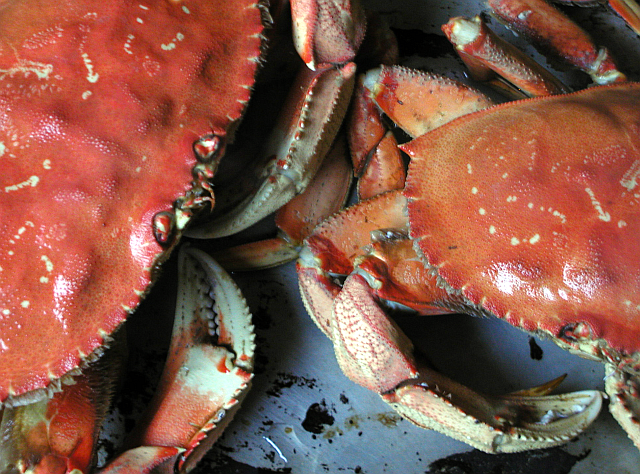
If the crab was just cooked (see this post for info on buying and cooking live crab), transfer it to a plate or baking sheet for about 20 minutes, or until it is cool enough to handle. People with skin reactions to crab shell may want to put on a pair of thin gloves.
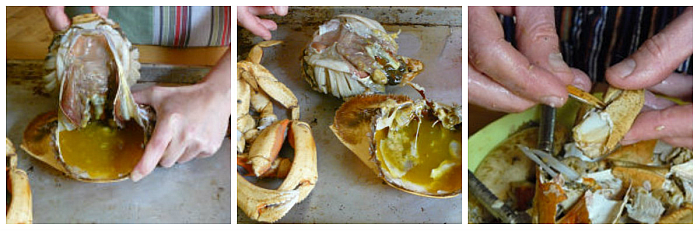
Work near the sink and have a plastic bag nearby to hold unwanted shell bits. Put the crab, top side down, on the work surface. Pull off the claws and legs and pile them nearby. Lift up and break off the triangular flap (the apron). Holding the crab down with one hand, pry off the body section with the other hand, lifting from the back hinge. Be firm and strong. Set the body section aside.
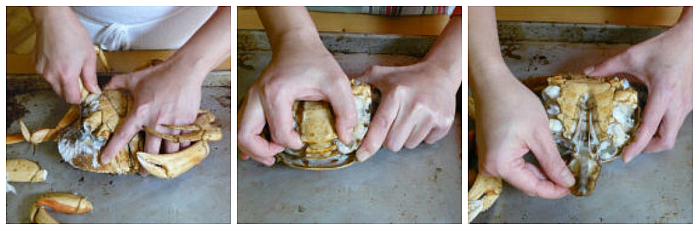
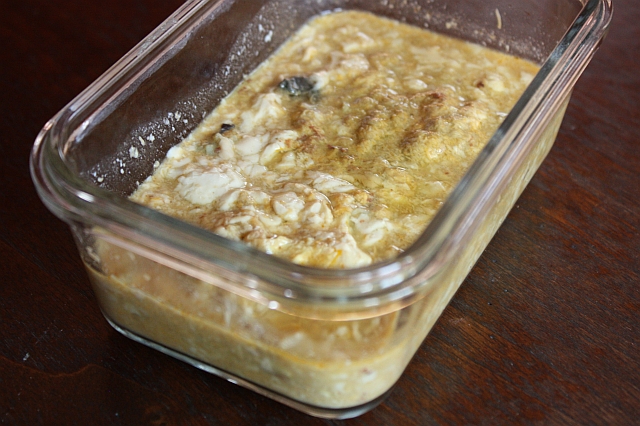
Discard the shell if you don't want the tomalley (liver) and fat, which some call the viscera. Otherwise, pour out the liquid inside the shell, stopping short of the more solid, thickish contents, which is the greenish gold tomalley and white fat. It may look like the contents of a poopy diaper, but it's crab gold to those who love it. If you're fond of the stuff like I am, use a teaspoon to scrape the tomalley and fat (below) into a small container and discard the empty shell.
Discard the fang-shaped spongy gills on the body section. Snap off and discard the thin jaws. If present, discard the reddish membrane that covers the center and the squiggly white pieces underneath. Scrape out any additional tomalley from the body section with the spoon.
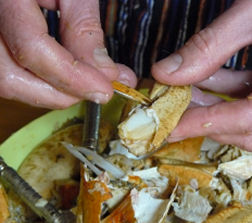
Use your hands to snap the body in half. Use your fingers to remove the meat from all the little channels, depositing it in another bowl. Then crack and remove the meat from the claws and legs, adding it to the bowl. A metal nutcracker is handy for cracking, and the pointy tip of a crab leg is perfect for digging out the meat.
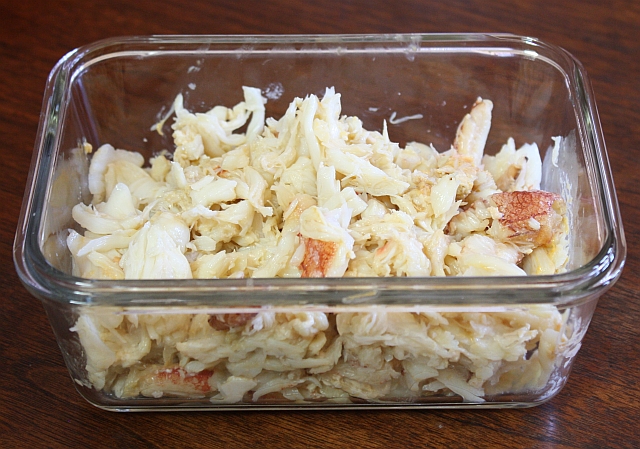
Crab Meat and Tomalley Yield
A 2-pound Dungeness crab yields about 8 ounces (225 grams) of meat and ¼ cup of tomalley and fat. To save time, cook, clean, and pick crab a day or two in advance, then cover the bowls of meat and tomalley and fat and refrigerate. My personal rule is that I get a chunk of fresh crab to eat when I'm done.
Crab Recipe Ideas
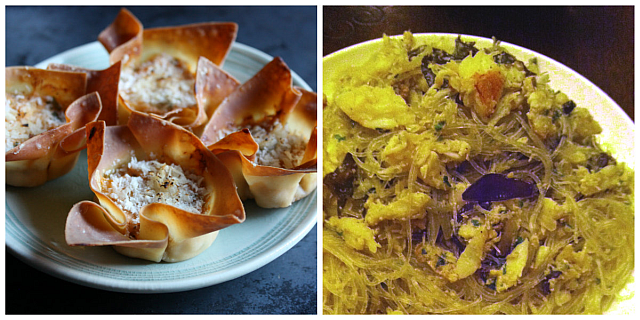
- My favorite way to show off crab is in a Viet mien xao cua, a stir-fry of cellophane noodles and crab. The tomalley and fat, along with an egg, imbues the noodles with golden color and briny flavor. It's a fabulous and effective way to make the most of your efforts. The recipe is in Into the Vietnamese Kitchen (IVK), page 236. If you get Edible SF, the recipe was featured in the Winter 2013 issue; look for Celia Sack's essay.
- You can also make a Franco-Vietnamese deviled crab (cua farci). There's the ramekin version on page 44 of IVK. Or, try this one made with a Sriracha and crab mixture baked in wonton skin cups.
- A classic northern Viet crab noodle soup preparation is bun rieu cua, which I make with crab and shrimp. See page 215 of IVK for a recipe. There's a vegetarian version posted here that includes a nifty trick of coagulating soy milk.
- If you like to pick crab at the table, consider a Viet nosh treat called cua hap bia (crab steamed in beer). Or, keep things ultra simple and eat the crab with a dip in a salt, white pepper and lime dipping sauce. Homemade mayonnaise ain't bad either!
- Crab finds its way into many Viet dishes. Check the index of Into the Vietnamese Kitchen and Vietnamese Food Any Day for more ideas, as well as search this site for crab.
What's your favorite way to eat crab?
More Cooking Tips & Tools




Suzette
My in-laws are from Cambodia and also do the lime, S&P dipping sauce which I like with the meaty bits. The fat and guts in the shell are the best! I jam spoonfuls of rice in the shell, mix it up, and gobble it down! MMM!!
Andrea Nguyen
Suzette, we are kindred spirits in the crabbyland!
Joel
I've cleaned and picked many Dungeness crab in my life, but in the last year one thing, recommended by America's Test Kitchen, has made me twice as fast in the picking process: http://amzn.com/B00AOMYUY6. Buy one for everyone at the table, because you won't want to share them.
Simon Bao
Andrea, we just had Sup Mang Tay Cua on Sunday, for Tet, and that is both one of my own favorites but also of everyone around me. We used up the very last of the 2012 Crab Stock, made from destructive, unwelcome, and invasive European Green Crabs. There are few things in life as pleasing as unlimited supplies of free crab stock, the making of which helps to restore the natural environment.
And that Crab Stock also elevates most pots of Bun Rieu. Extra crab isn't at all necessary for most Bun Rieu, but it's a great bonus if one can get it.
But *favorite* way to eat crab? I've been here long enough now that my one single *favorite* way is probably the Classic American Crabcake. And second favorite way might be the Classic American Softshell Crab. There's something transcendent about the simplicity and great pleasure of those two.
And while crabs steamed in beer are great, blue crabs steamed with extravagant quantities of Old Bay are even better. Old Bay is one of the very few American seasonings to be found in almost all Vietnamese households around here. Cold beer and Old Bay steamed blue crabs are a perfect summer Sunday afternoon for lots of folks around here.
Andrea Nguyen
Joel, the link didn't work. What's the name of your crab picking tool?
Andrea Nguyen
I always enjoy your cross-cultural comments! Thanks, Simon. Happy Tet to you both.
Abbe@This is How I Cook
I love the Vietnamese crab dish that is stir fried with sugar, butter and pepper. This is a lot of work but it looks worth it!
Andrea Nguyen
Totally, Abbe. I'm right there with you.
soldes asics
Love is a lamp, while friendship is the shadow. When the lamp is off,you will find the shadow everywhere. Friend is who can give you strength at last.
maluE
andrea, your method is also what i've used since i was a wee one in the philippines .. but i like to pick, dunk and suck as i go ;-).
recently got this demo of an alternative method .. first time you'll be watching the man's finger movements intently .. watch it again and enjoy his wife (i assume) in the background 😉 .. http://www.youtube.com/watch?v=7Eal-GfJ1_U