

Earlier this week, the Los Angeles Times ran a story on the astounding food safety problems in the People’s Republic of China. From pork that glows in the dark and glazes that render pork to look like beef to fake eggs that cost less to produce than letting a chicken hatch one naturally, the piece by Barbara Demick revealed the growing pains of a fast-paced socialist-capitalist economy. Rampant corruption, fear, and outlaw behavior combine for a situation that not only compromises public safety but also poses a major threat to political instability.
I traveled to China last September to conduct research for the Asian Tofu book and met many honest people who were as concerned about food safety as any of us are abroad. They unfortunately live in a situation where they constantly have to worry about fake products. It is one thing to by a cheap knockoff Louis Vuitton handbag, but it’s another thing to digest food made with synthetic materials that are not designed for human consumption. My heart goes out to the Chinese people who face that level of uncertainty on a daily basis.
Reader responses
As of today, there were about 60 comments in response to Demick’s story. Some self-identified Asian Americans expressed shame but in the main, most people communicated anger and frustration. There were vitriolic comments that reflected misconceptions about Asian foods and cultures. The doozies included:
Can’t expect too much from a country that regularly serves boiled dog and cat in its restaurants. Far as I’m concerned they can all croak.
Well then, let them eat all that crap... It’s fine with me, as long as they don’t ship any of that stuff to this country.
Wake-up America! If you have EVER eaten an eggroll, you were ingesting yesterdays (and someone else’s) chicken & broccoli or pork-fried rice scraps that come back to the kitchen. This is the Asian way and it happens in the Philippines, Vietnam, and Cambodia and of course China...and to a lesser extent in Thailand. This cultural effort to recycle groceries -- did not stop at the border. I don’t care if you eat at a Panda Express in a stripmall of PF Changs…You’re eating the scraps of yesterdays buffet or uneaten plate scraps.
[IN RESPONSE TO ABOVE COMMENT] Having seen the food service trucks delivering the so-called "fresh" eggrolls and such from corporate HQ, I know that this is bullcrap. Panda Express, Chang’s, all chains get their food in pre-measured, pre-wrapped packaging and buckets from corporate. Now, your little strip mall ma and pa buffet might be doing some creative recycling, but I know I could smell the difference (let alone taste it) and I don’t eat in those places anyway. Didn’t you ever wonder why the eggrolls in one joint are exactly like the ones in another? Answer: food service, not plate scraps.
Make no mistake, there’re many Chinese restaurants here in the US using dangerous or forbidden ingredients. The thing is that they never allow anybody, other than their own people to learn about the procedures and the kind on ingredients they use to make their delicious Kung Pao dog... I mean Kung pao Chiken. [SIC] At Panda Inn, only Chinese cooks are allowed in to their kitchen.
[IN RESPONSE TO ABOVE COMMENT] It’s obvious you have never worked in a restaurant before in the US. Dog meat is more expensive than chicken meat, even in China. If you look in the kitchen of many Panda Express or PF Chang’s, the cooks are mainly Latino. Try doing some research next time before pulling crazy lies out of the air.
Let’s all go to WALMART and get some food, toys, clothes, et al. We won’t have to worry about the deficite, [SIC] we will all be dead. I try to not buy anything from CHINA, but it is nearly impossible. That is what is wrong with the UNITED STATES, we keep doing it to ourselves. Even some things that are "MADE IN AMERICA" get the materials from CHINA. What a country.
These comments gave me pause about what people think of Asian cuisines. (Remember the discussion we had about the U.S. marine's fight to curb Vietnam's dog eating?) While the comments above are from self-selecting individuals, there are still a lot of ill-notions about what Asian food is and is not. On the other hand, I’ve heard many Asian people express distrust of their own people. The negativity comes from many directions. The last comment listed above brings up the larger issue of our love for cheap Chinese goods.
What can you do?
Indeed, food safety upsets and brings up prejudices. But what can you do for your family and friends? How can you navigate the food safety issues regarding Asian ingredients?
Be vigilant and shop smart. Whether I’m at a mainstream market or Asian grocery store, I basically follow some general rules when selecting ingredients:
- Shop at a store you trust. Look at the management and staff in the eye. Are they honest people? Do they know and pick the best ingredients for their customers?
- Is the store busy most times? A busy store is one with quick turnover of inventory, which means things are fresher.
- Find brands that work for you and stick with them.
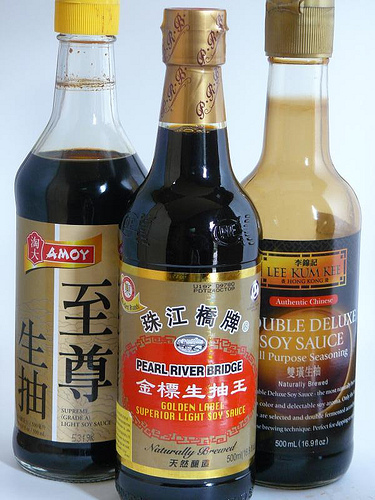
- When possible, avoid ingredients from China. Look for comparable brands from Taiwan, Hong Kong, or elsewhere. Maybe there is a domestic brand that’s good? However, know that certain Asian ingredients, such as good Chinkiang vinegar and Pixian chile bean sauce come from China. Additionally, there are reliable Chinese brands have been stellar for years and remain so.
- Some ingredients are labeled as “export quality,” meaning that they’re of high quality and suitable for shipping overseas. I always wonder what’s left for people in the country of origin to use. Nevertheless, that terminology is used to indicate a superior product.
- If you have to take a stab in the dark, buy at the middle to high-price range. Asian ingredient manufacturers are super competitive so a 50-cent or dollar difference matters.
- Check to make sure the packaging is well sealed.
- Select packages that haven’t sat around long enough to gather dust.
Stories such as this one from the Los Angeles Times are not meant to stoke public fear here in the States. The journalist was reporting on problems in mainland China. Yes, there are Chinese products that reach our shores and we rely on them to cook well. Just take a measure of caution but remain level headed when you’re shopping for food ingredients – whether they’re Asian or not.
If you’ve got a reaction, experience, or shopping tip to share, contribute them below!

burkie
andrea, thank you for countering the knee-jerk reactions with sober reasoning and thoughtful suggestions.
Andrea Nguyen
Burkie: when good food is at stake, I try to do all that I can. Thanks!
Diane
My rules of thumb are "no China if possible," and "no dusty packages." Of course, for some food stuffs there's no choice but mainland China sources, but I've tried to avoid it ever since the melamine incident.
Of course, I happily consume products from India, Thailand, Vietnam, etc and for all I know they could have similar QA issues. But a gal's got to eat, so I just hope for the best.
Simon Bao
Sorry to say, but I join Diane in just not *knowingly* purchasing any kind of food product from mainland China. As we learned with the milk scandal, however, plenty of products made in other nations include corrupted, tainted Chinese ingredients.
I am not persuaded that what we seen in China are "the growing pains of a fast-paced socialist-capitalist economy." The US went through many decades of tainted, adulterated, contaminated food products, and was very slow in passing food safety laws.
And to be fair to China, they are not alone in hosting food scandals. Vietnam too has had problems with adulterated and contaminated food, and with some agricultural practices that are inexcusable and a danger to people well beyond its own borders.
Frankly, I don't see this as any kind of an Asian issue at all. I suspect that similar things occur in other lands, where there is also no real rule of law, no independent media, no regulatory enforcement, and no possibility of anyone blowing the whistle... in safety.
Andrea Nguyen
There is a certain frontier and Wild West mentality in China. The inequities are so huge that people are desperate to get ahead. The notion of a social contract is slim. China is wonderful with beaurocracy and death is the penalty for anyone caught of directly harming others through tainted food. The other policy issue is that there could be mass public protest and outrage, leading to destabilizing the country.
Truth be told, in other countries, Vietnam included, there are counterfeit stories on a regular basis. I recall Viet farmers over feeding their pigs with antibiotics so that the pork smelled and tasted bad. People were warned to not buy pork at wet local markets and advised to purchase from brick-and-mortar markets. That was a story I read about when traveling there. It wasn't headline news in the US.
These bizarre food safety incidents are pretty much about people hurting their own in their own countries. I hope they diminish over time.
Laura@silkroadgourmet.com
Andrea:
Did you delete my comment posted this morning? It was there and now its gone... A bit odd.
Laura
Anh G
Hi Andrea, Thanks for your general tips. I am pregnant at the moment and most food I crave for are Asian food, however I have to be extra careful in what I buy, especially with stuff from China. So far, I have tried to substitute Chinese brands with Thai, Taiwanese or Hong Kong brands when possible but certain things are not really the same. Do you know Lee Kum Kee brand (oyster sauce and hoisin sauce)? In your opinion and experience is that a good brand to buy? Many thanks
Linh-Dang
Thanks for the post and for pointing out the LA Times story.
I generally avoid Made in China products as well. Same with Vietnam, actually. Has nothing to do with nativist politics or old history.
Humans being the way we are, I just feel more comfortable buying products from countries ranked high on press freedom. Every country has well-meaning regulations and honest producers as well as crooked ones. It's just easier to be an honest producers when you can count on the press to expose your crooked competitors.
Andrea Nguyen
Laura@silkroadgourmet.com: I didn't see your original post. Sorry.
Andrea Nguyen
Anh G: Lee Kum Kee is a highly reputable producer of Asian condiments. I've visited their facilities in the U.S. and it is totally -- scrupulously -- clean. I like their products, especially the oyster sauce. Koon Chun is good for hoisin sauce as theirs is a little more robust in flavor.
Tuyet
Andrea, thank you for sharing your thoughts on the LA Times story. It made me very angry to read those comments posted by readers who clearly have no proof of what they claimed to be true.
It's a very unfortunate matter to hear about 'fake food' being served in China. I definitely will have to think twice about what I eat when I travel.
Jerry
I've long ago quit reading comments on controversial stories on *any* online story, whether it's CNN or LA Times. The knee-jerks could give one a black eye...
julie
thanks for this post, andrea. i was pregnant and in beijing for a month this may and had the hardest time figuring out how to eat. when i talked with some of the american families living there, they said at some point you just have to accept the risks (US companies actually pay their employees there "hardship" compensation because of the health risks). i ended up avoiding all seafood and otherwise just making sure i wasn't eating a lot of any one thing, just in case there ended up being something wrong with it. as you and others have said, it's probably not an issue in china alone, though for some reason i feel less worried in other countries. i'm normally a pretty adventurous eater, too, but after one dubious experience in china many years ago, this is just one country where i am wary to try new and exciting things. it's such a shame!
Seline
Its a worrying thing. Thanks for sharing the LA times post.
you
Thank you for sharing, I really enjoyed your posts and pictures they were great! I think that all of us who follow this blog have that same feeling that you got from visiting. It is very special and the people are wonderful.
Canada Goose Parka sale
Peace on earth and good will towards men.
marlon
thanks for this post, andrea. i was pregnant and in beijing for a month this may and had the hardest time figuring out how to eat.
Mr. Cooking Grill
it's already gorgeous looking!! Love your work (and research), you're a true food writer whom I absolutely look up to. 🙂