


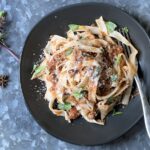
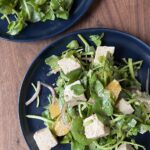




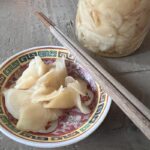

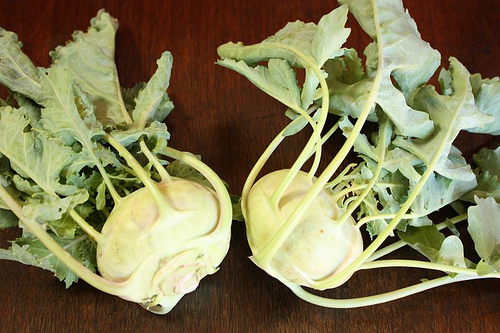
Resembling a buoy with tentacles and sporting an odd sounding name, kohlrabi is not a sexy vegetable. However, it comes around this season to many farmers’ markets. I paid more attention to it recently after receiving this message:
Dear Andrea,
I'm a huge fan of your books and website, and have loved trying to create Vietnamese food at home. I've recently run across a quandary and am hoping you could help. We've joined a local CSA here at Cal Poly Univ, where we just moved from Honolulu, and we keep getting Kohlrabi bulbs in our weekly produce.
I am pretty sure we have eaten this in Hanoi/Vietnam, but I cannot remember what/how exactly, I also can't remember the term in Vietnamese. I'm having trouble eating it raw, so today I am making it into a pickle, following your easy carrot and daikon pickle recipe (that is FABULOUS thank you!), and hopefully that will work. But I was wondering if you could tell me in which recipes this vegetable appears in Vietnamese cooking. At first, I thought maybe it is the funny crisp green thing sliced into kidney shapes and put in dipping sauce for bun cha and other dishes, but then I think maybe that's green papaya. Could it be used in a green papaya type salad?
Anyway I've searched your website, your books, and the internet at large and the mystery remains. Please help me figure out if there is a good way to use kohlrabi,,, maybe in some Vietnamese style food. And what the heck is this called in Vietnamese? (I think su hao is the squash that looks like a sock puppet, but somewhere online that came up as a translation for kohlrabi...err)
Kohlrabi is indeed called “su hao” in Vietnamese. It is a prized vegetable because of its crunch and sweetness. Some liken it to the broccoli stems and a sweet turnip, though it is technically related to cabbage.
It is a root vegetable and you can eat the tender leaves too, which tastes like collard greens. I add the leaves from the ones photographed above to a simple everyday Vietnamese canh soup with some pork and onion.
In Vietnam, people eat it raw, pickle it, drop it into soup (particularly with fish maw), and stir-fry it too. My mom’s eyes practically glazed over with delight when I mentioned su hao.
The key to buying kohlrabi is to pick one that’s not woody. Tom Coke, a local farmer in Santa Cruz County, told me to look for smooth skinned, firm ones that are consistently round. “Once they get elongated, they tend to be woody.”
Kohlrabi is rather pricey because only one grows per plant. But one medium one is enough for 2 people. It’s dense flesh!
What do you do with kohlrabi? I know it’s enjoyed in other parts of Asia. What is it called elsewhere?
Related Post: Kohlrabi Stir-fried with Garlic and Egg Recipe (Su Hao Xao Toi)



Diane
I think it's called ganth gobi (knotty cauliflower?) in Hindi and it's eaten a lot in India. It's quite popular especially Kashmir where it grows well. I make a very simple kohlrabi/mung bean dry curry that's good with rice. As a non-Asian thing I also like it grated as a salad with some chilis and sometimes some apple and a light dressing.
Evi
I love Kohlrabi! Here in Germany, it's one of the most common vegetables. We just cook it slowly with some butter or in a roux with milk, with some bacon bits added. You can even slice it, coat it with breadcrumbs (and parmigiano) and fry it like a schnitzel. I also like it thai-style, with a bit of green curry paste and coconut milk. I'd use it just like any other vegetable, really. 🙂 Sorry, no specifically Vietnamese ideas here, hope it helps anyway.
sunflower
I love kohlrabi. Chinese called it 'da thoa chai 大頭菜' meaning big vegetable head. Love it shredded add to spring rolls filling, also shredded make light zingy salad with shredded carrot and mung bean noodles, stir fries, kimchi, pickled with soy, vinegar and chilli. All yummy.
Anh
I love my su hào! 🙂 Mom stir-fry it with eggs. So good!
Another favourite: cut "giò lụa" very thinly, add in stock and cook soup with the veg!
milton
super idea!!!!I make a very simple kohlrabi/mung bean dry curry that's good with rice. As a non-Asian thing I also like it grated as a salad with some chilis and sometimes some apple and a light dressing.
Matrimonial
webdesigner
Top sites
Lynne (PlumLeaf)
I never knew what this vegetable tasted like 'til I met my husband. He told me his mum would slice and stir-fry it woth pork. He described it as being 'turnip-y'. I agree with your description of it tasting like brocolli stems - crisp and sweet.
Unfortunately, it's not often seen in western supermarkets here in UK but can be found in Turkish/ethnic grocers.
I think it may be one of my hubbs favourite vegetables. I had a great suggestion from my mum as how to cook it. She suggested peeling and dicing it to stir-fry with other mixed vegetables to make a "Cashew nut and cubed Chicken Stir-fry". Oh, what a sugggestion! It was delicious!
Madeline
My family cooks all veggies similarly. Either stir-fry with ginger garlic - seasoned with a little salt, and sometimes a little oyster sauce and pinch of sugar. Or braised with ginger and season with salt, drizzle with garlic oil. Are the leaves of the kohlrabi edible?
Claire
I have been following your blog for about six months. In my opinion your blog is the best one around. I love your recipes, writing, pictures, everything!!! Thanks so much for sharing your expetise with us.
Christine
No Viet suggestions here, but in my house we like it pickled! I'd bet that the pickled radish brine will work out well. 🙂
lynh
I hope your reader sees this: this recipe:
http://www.foodandwine.com/recipes/stir-fried-rice-noodles-with-kohlrabi-and-basil
is great! I ate it with rice instead of rice noodles, and I'm sure you could put some fish sauce in for a little of the soy sauce.
Happy kohlrab-ing!
Chef Jay
I have had su hao served with twice cooked pork belly but if you use it this way try to make sure you have pork skin with layer of fat and some meat .. its a great contrast of texture and a wonder added layer of flavor , I especially enjoyed it with a little noc chaun kind of on the very spicy side ..
Eve
Interesting to see all the different ideas for kohlrabi.
We eat quite a lot of it here because it shows up at a time when fresh vegetables are hard to come by and mostly imported (and thus expensive). It's nice when cut into extremely thin slices (using a vegetable peeler) and eaten as a salad.
Oh, and we call them 'Sputniks' because of the shape.
tpwalsh
Julienned su hao is wonderful addition to cha gio filling!
twitter.com/aqnguyen
Geeze, I didn't know so many people enjoyed kohlrabi! This is just great. Who would have thunk that the sputnik of vegetable could grace all our tables?
Your enthusiasm inspired a simple recipe for a kohlrabi stir-fry. Here's the new post:
http://bit.ly/cPbdY5
Drew Grantt
Bankruptcy
Kohlrabi I think in general, but do not see a lot of grocery stores here, is the kind of thing, you need to grow or get the time to markets for agricultural products. I bet you could use it for pizza topping, instead of spinach, only to die in garlic, basil and olive oil, maybe a bit ;of crushed red pepper crust and top with the sauce.
Maggie
thanks so much for posting Andrea, and all these great comments! Sputnik! Vegetable head! This gives me a lot of options. I liked it sauteed with garlic, that worked rather well for me.
nike shox saya
We know the good, we apprehend it clearly, but we can't bring it to achievement. To persevere, trusting in what hopes he has that is courage in a man. (Euripides, ancient Creek dramatist.)
Jean
I wrote up my kohl rabi childhood memories here:
http://cyclewriteblog.wordpress.com/2010/11/27/kohl-rabi-memories-and-redux/
My mother braised/stir fried it. It has returned into my life, because my German-born Canadian partner enjoys cooking it. Fine by me!! There's a pic of a huge kohl rabi, which amazed both of us.
supra shoes
Don't be mislead by what I'm about to write. There are plenty of public courses I would rather play than some country clubs. If you're from the Pennsylvania area, Glen Mills comes to mind. However, private clubs offer a few things I personally enjoy.
Cheap True Religion
The button is simply marked 'A Bit More'. Because that's what it does, and also because it has a touch of the conversational, domestic, familial, colloquial. Entirely appropriate for its context. And it's funny, in a gently everyday way.
Poker Online
Olá:), chamo-me Isabel estudo Psicologia e gostei imenso da tua página! Muito linda sim senhora!
Aplixa-se muito bem tudo aquilo que aqui li.Existe por vezes imenso para escrever nos blogues!Nada nada mais gostoso do que por a nossa escrita na net!
Até à próxima 🙂
Canada Goose
While there is life, there is hope.
Sedekeync
bH uggs outlet pX http://2mblog.com/uggboots231/2011/12/31/uggs-outlet-might-be-the-down-cellular-lining/ jM uggs mF http://uggbootscheapsale1.blogerka.cz/shopping/uggs-the-actual-skin
marlon
I love your recipes, writing, pictures, everything!!! Thanks so much for sharing your expetise with us.
Eric Scott
Cabbage, broccoli, and kolrabi are all the same species. It is accurate to say it is as closely related to cabbage as it is to broccoli. Also, it is not a root vegetable at all. The part you are eating is a stem and it grows above ground (you can tell because it is green and has leaves growing from it).