

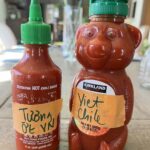


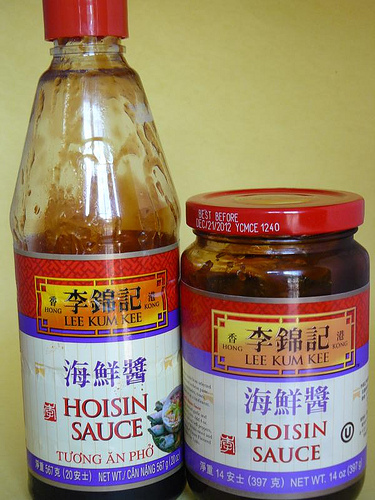
Asian food products never fail to keep me guessing. Not long ago, I was in desperate need of hoisin sauce for Vietnamese tuong, the dipping sauce that I use for salad rolls (goi cuon). My preferred brands of hoisin are Lee Kum Kee and Koon Chun, the former being easier to find in regular supermarkets than the latter. I don’t have an Asian market in my town, so I went to my well-stocked local health food market, Staff of Life. I discovered that they had squirt bottles of hoisin sauce that were labeled in Vietnamese as “tuong an pho” – meaning bean sauce for eating with pho.
For years, if I wanted a little hoisin sauce for dipping my pho meat balls (bo vien), I’d simply dilute some of my regular jarred hoisin sauce. I always use the jarred stuff and figured that pho restaurants did the same. I’m not one to squirt hoisin sauce into my pho bowl because in my mind, that’s sacrilege. Given that, my personal knowledge of the hoisin sauce used for pho is limited.
I took the squirt bottle of Lee Kum Kee hoisin sauce home and used it for my spicy garlic tuong dipping sauce. It didn’t quite taste right, was somewhat flat and strangely tart. On that day, I thought I was off my game.
But I recently bought a new jar of Lee Kum Kee hoisin sauce and realized that the contents of the jar and those of the squirt bottle are NOT the same. Who can tell from the labeling at the top of this post? In either English or Vietnamese?
Check it out in the ingredient labels below:
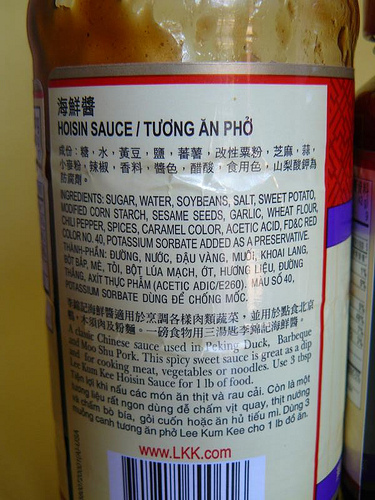
the jarred version's label below.
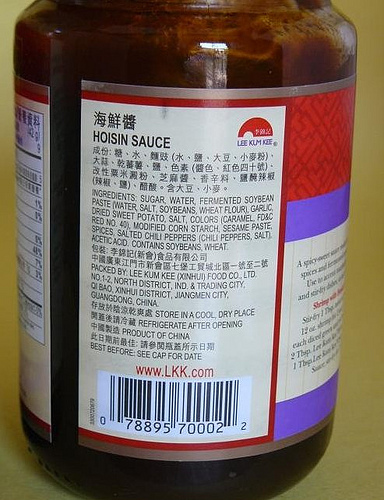
The important thing was the flavor. I did a side-by-side taste test. The Lee Kum Kee hoisin in the squirt bottle didn’t have as strong of a flavor as that in the jar. The jarred condiment offered a more complex flavor as it is based on sweet soybean paste, an earthy, savory fermented bean sauce that’s a favorite in northern Chinese cooking. The southern Chinese use of the bean paste for Cantonese hoisin sauce marries the hearty flavors of the north with the delicate qualities of the south. Ah-so.
The squirt bottle hoisin was actually bland tasting in comparison and not interesting whatsoever. Per the text on the bottled version of hoisin sauce, it is for dipping foods such as pho and Peking Duck. Perhaps that's why it is for pho but not for cooking? Lee Kum Kee should re-label the squirt bottle of hoisin so that consumers are not misled.
But it doesn't matter because I don't even care for the bottled hoisin. In fact, I threw out the bottle of hoisin.
From here on in, I’m sticking to the jarred hoisin sauce for cooking and eating. The jarred sauce is more versatile and more complex. And, my friends, they cost about the same.
Have you experienced or noticed this difference between the hoisin sauces?


Amy
Interesting! Thanks for sharing. I like the Koon brand as well.
Bryon Karren
My biggest problem with hoisin is that it seems to always contain wheat. I've only recently found a decent gluten free one: Sun Luck. Othe GF brands I tried were nothing like the real thing. I don't understand as the goodness of hoisin has nothing to do with wheat. Recipes I have seen for it would only get wheat with the soy sauce, but perfectly good GF soy sauce is readily available.
Andrea Nguyen
Bryon -- The wheat is used for fermentation. If you'd like to make your own, I have a recipe for a pho hoisin sauce in "The Pho Cookbook." The base is miso. Thanks for suggesting Sun Luck!
Scotty Harris
Yes, at a Vietnamese grocery downtown, also for Pho.
I too tossed it. Did you notice it decribed as "A classic Chinese sauce used Peking Duck, Barbecue and Moo Shu Pork" (you can see it in your photo).
sunflower
For hoisin I use LKK most of the time. I am very sure LKK has changed their hoisin sauce recipe few times over the years. Years ago it was very thick, very dark brown with a hint of red and the flavour was nice and rich. Now it's thinner and lighter brown shade (like watered down). Also recently when I was in LA I found there are LKK products (not just hoisin sauce) from China and some made in Vietnam. LKK soy sauce made in Vietnam was cheaper that the one made in China. Hoisin sauce in the jar has always been quite salty, needs watering down before use. There is a similar sauce less salty called Peking duck sauce. http://www.spicesofindia.co.uk/acatalog/Lee-Kum-Kee-Peking-Duck-Sauce-Big.jpg
I do use hoisin sauce as dipping sauce too (on a separate sauce dish) to go with Vietnamese style chicken pho noodles.
From the two picture you have shown, the jar version did not mention it is for pho or noodles far as I can read the Chinese. Ingredients look similar. The bottle version listed soybeans with other ingredients, while the jar version listed fermented soybeans and other ingredients. Also potassium sorbate (preservative) listed on the bottle not on the jar.
I will look around over here to see if we also have LKK import from Vietnam.
Tuty @Scentofspice
Andrea,
Thank you for posting this. I am always in a rush when I shop. I thought that the squirt bottle was just for convenience... Yikes! Not so, huh?
I am almost certain that all manufactured products have somehow "tweaked" (read: dilute) their recipes.
JulieD
Hi Andrea,
It's sacrilege for you to put hoisin sauce in pho? I'm curious to why. I grew up putting hoisin sauce in my pho.
I have a little story to share, I convinced my co-workers to go a to a little pho place that opened up not too far from our office a few years ago. When the pho arrived, one of my co-workers proceeded to dump soy sauce into his bowl. I was horrified and told him that soy sauce didn't even belong on the table next to sriracha, etc.
That's interesting about the different hoisin sauces. I'll have to check which one I have at home in my fridge. My preferred brand for hoisin and oyster sauce is Lee Kum Kee as well.
Eve
It's interesting, the North-South divide in whether or not to put hoisin in pho. All the pho shops in Prague are run by North Vietnamese, and you never see hoisin on the tables. It's always Sriracha, chillies and garlic in vinegar, fish sauce, fresh chilli slices, lemon slices, sometimes beansprouts and sometimes a homemade chilli sauce.
tiger
Hours are spent in the kitchen to make the perfect pho broth. The quality of pho is characterized by the fragrance of the broth, is it not? To add hoisin sauce just does not make sense. Whenever I eat pho, I eat it simply with the herbs that accompany it, adding, a bit of lime (a drop) AFTER I've judged whether the experience has been good or not.
More does not = better.
Simple food, simple life, joy.
slammie
Now I'm going to have to get the jarred the next time I'm at 99 Ranch and see. LOL! Thanks!
Andrea Nguyen
Tiger -- you've got it as to why for me, hoisin sauce in pho is sacrilege. All those hours brewing pho broth would go to waste if someone were to squirt bean sauce into the bowl. It's akin to putting ketchup into chicken noodle soup.
I believe that the jarred hoisin contains fermented soybean sauce, which has a much greater depth. It's like having been double fermented. Sunflower, LKK has changed their recipe over the years.
April Agne
I'm an obsessive label reader but never looked at the LKK hoisin bottles - thanks for the note as I've both types in my pantry due to an indecisive shopping trip. 🙂
chris
I concur with sunflower. The LKK hoisin I remember from my youth was dark and thick with a slightly caramelised sweetness and good beany, rooty notes. These days it is thinner, more translucent, much less rich-tasting, and has slightly heightened acidity...
can't imagine it being tasty in pho at all.
celina
I have been wondering for a while about this sauce though for a different reason: "Hoisin" ( cantonese pronuciation) as the Chinese name on the label means "seafood."
When I first encounted this sauce in the States, I was surprised to find its most popular use: dipping pho meat.( I like it!) From its name, I would have thought this sauce is for dipping shortly-poached seafood ( like squid) or stir-frying seafood.
Alicia Van-Weed
my mom used to tell me that the "accessories" that would enhance the "yumminies" of food is the seasoning
Kitty
I've actually just realized this recently also! I had gone to the supermarket looking for hoisin sauce, but I could only find the jarred version. Bought it and used it as part of a marinade, and the meat turned out more savory than it would have with the bottled hoisin. I'll definitely try the pho next time with the jarred one!
Andrea Nguyen
Celina -- Yes, "hoisin deung" means seafood sauce. Sometimes it is improperly translated as sweet bean sauce but that is actually another kind of Chinese sauce. Funny that hoisin is more associated with char siu and roast duck instead of seafood. Oyster sauce is typically thought of as going with seafood.
Joel
Hi Andrea, I can say it straight there are slight but only minor differences between the two hoisin sauce preparations, like whether the chilli is preserved or the sesame seeds are pasted in preparations. I'm more used to the Chinese version so I think the thinner one seems to be a little strange for Chinese dishes.
drive a man wild
I would like use the squirt bottles to make a circle of hoisin sauce and a circle of sriracha.i will do it with oyster sauce and sambal instead.i also take one of the spoons and mix the two sauces in it to dip my meatballs and meat in.
Jomac99
Hi.
I have read the article and its been good and effective.
get your girlfriend back
Shingo
Actually, I just bought the jarred hoisin sauce a few hours ago to use for the pho I was making, and I compared the ingredients, and I did notice the difference!! I didn't have enough of the bottled stuff left to make broth (I love to make pho broth with hoisin sauce, oignons, chilli powder, beef bouillon cubes, welsh oignon, cilantro and some water), so i bought and re-filled it with the jarred tuong an pho... I hope it was n't a mistake... cus i sort of mixed it... D:
😀
What a a coincidence i'd find an article like this when I just bought that today... 😀
nike shox saya
Experience is what you get when you don't get what you want. (Dan Stanfort, American businessman)
Red Bottom shoes
Early to bed, early to rise, make a man healthy, wealthy, and wise.
Itz_Dan0s
It depends on what flavoring your used to. Being southeast Asian, me and my brethren seldom eat pho as is. We enjoy our pho with tons of condiments to tailor it to our own level of sweet spicy sour salty combo!; hoisin bottle is one of the many ingredients we use! I have cooked my own pho for years now I have always made my broth for hours. I seldom go to a Vietnamese pho restaurant anymore. For those that think most pho restaurants slave over hours to produce the broth would be shockingly surprised. After producing my own pho for years, one develops a nose and palate for what's bone broth and what's bouillon or other type of flavoring.
Andrea Nguyen
Thanks for the insights!