

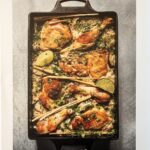
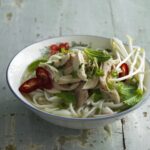

Want some good info on Asian food? Check out The New Yorker's annual food issue released today. There's a fabulous profile of Naomi Duguid and Jeffrey Alford, the folks behind Hot, Sour, Salty, Sweet (food traditions along the Mekong River) and the latest Beyond the Great Wall (foodways of western China). Naomi and Jeffrey are terrific people and it's a pleasure to get to know them even better.
Journalist and author Fuschia Dunlop strikes another blow for Asian cooking. Her story about a Hangzhou, China, chef who strictly adheres to high standards demonstrates how Asia is not all about quick-money-making schemes and tainted food. Dunlop wrote a great memoir called Shark's Fin and Sichuan Pepper and cookbooks Land of Plenty (Sichuan) and Revolutionary Chinese Cooking (Hunan).
What does any of this have to do with Vietnamese food and cooking? These are the kinds of writers who demystify and de-exoticize Asian cuisines, connecting and knitting them into the global culinary landscape instead of letting them sit on the margins. That's what the aim of this blog is. If you read and cook from these people's works, you'll be able to connect the dots between Vietnamese cooking and the cooking of the region!
Finally, I often am asked: Do you have to be Asian to authoritatively write about Asian food? Do you have to be Asian to cook Asian food well? What do you think?


Graham says
In answer to your question, "Do you have to be Asian to authoritatively write about Asian food?"
No, but it bloody well helps 🙂
Funnily enough one of the best Indian restaurants I have ever been to had a kitchen full of Indian curry obsessed white folk - they were brilliant.
You don't have to be Asian to cook good Asian food, just like you don't have to be French to cook good French food. Location and access to good ingredients is the key point and whether or not you are interested in food and
Ed says
David Thompson (Sailor's Thai Sydney and now the Michelin starred Nahm,London) is probably one of the finest Thai chefs out there. His book on Thai Cooking is also one of the best. In Australia, it's mainly white anglos who have taken Asian cuisine and developed it for fine dining. It's exposure to the region and ingredients more than anything else. Remember when you had to be French to get a Michelin star?
Andrea Nguyen says
Some of the most obsessed Asian food experts I know are white and driven by a need to do right by a cuisine. Those are not the kind of folks who sport ethnic costumes while cooking, such was the case at a San Diego, CA, food and wine event that I attended this weekend. I don't know of any Asian people who don special collarless outfits to get the seasoning just right. I can squat but not for very long before I'm in pain.
Graham, you question, assess and respect Vietnamese cooking in a way that's
Chris says
I reckon that anyone can write smartly about a cuisine that they have intimate experience of, regardless of ethnicity (or collar shape)...however I do think one has to grow up, or at least spend formative years, within a particular culture to viscerally understand the specific roles and importance of food in that culture. Which of course is not synonymous with being able to write about it!
Al says
"one has to grow up ... within a particular culture"
- (Chris)
That is true. One can learn to produce individual dishes "perfectly," but not know how to plan a meal, or a weeks worth of meals, or exactly what to do with leftovers. Those things are learned in a "real" home in the cuisine's original environment.
It would be fascinating, as a "Westerner," to adopt one viewpoint for a period of time. I know some Northern Viet dishes, some Hue dishes, etc., but what would it be like to "simulate" a f
Robyn says
I think outsiders (foreigners, if you like) have the advantage of seeing what insiders miss (if Jeff and Naomi and Fuschia Dunlop aren't perfect examples of this I don't know who is). There are many things I'll never 'viscerally' know about Asian food - but there are also things that I am more likely to hone in on just because it's all 'foreign' to me. Often I've been told by Asians that I write about aspects of food culture they've always taken for granted, to the point that they don't 'see' th
Harmony says
"Do you have to be Asian to cook Asian food well?"
I hope not! I'm a non-Asian married to an Asian, and I do the cooking, so I sure hope that ethnicity doesn't exclude me from cooking good Asian food.
It is helpful for any kind of cooking to grow up eating and cooking the food, so Asian natives or first generation emigrants are at a definite advantage. But there are tons of Asians living outside of Asia who know nothing more about Asian cuisine and cooking than your average white American.
Andrea Nguyen says
It's funny because I write for both audiences -- insiders and outsiders. There's lots that you miss when you're too far deep into it to step out of your circle of comfort and look objectively at something. Writing about food in the way that Naomi, Jeffrey and Fuschia do is journalistic and anthropological.
With regard to reviews of Asian restaurants by non-Asian people, I always read them very carefully. How well does the person know the cuisine? Are they just being nice to the little people? Bu
Anonymous says
Restaurant reviews are a whole other thing. Any reviewer must be at least somewhat knowledgeable about food in general - and all the better if they know the cuisine they're reviewing - to write what I'd consider a good review. But now I think we might be getting close to the topic of authenticity (how can you say what good Sichuan food is if you've never had REAL Sichuan food) and I don't want to go there.
As for cooking ... I don't believe you must be Asian to cook great Italian food any more t
Robyn says
make that 'Asian to make great Asian food'
Chris says
Hey Robyn, hear hear! 🙂 How you doing?
Andrea Nguyen says
Aiya on restaurant reviews by un- or ill-informed writers. Without going to the real depth of things, the power of a review is appalling. It can actually destroy a good restaurant because it may max out the staff. On the other hand, a so-so place can ride a review for years, even decline. There's a Hue restaurant in Little Saigon that non-Viet reviewers and diners continue to flock to. Inside the community, people have been going elsewhere for better food for several years.
Whenever someone asks
Annie says
You have to have a passion for it. Actually being from the culture you write about has a certain advantage, as well as a certain disadvantage as Robyn points out.
Irrarllem says
zNr http://www.pelindo4bpp.co.id/index.php?option=com_phocaguestbook&view=phocaguestbook&id=1&Itemid=81| bIt http://www.officialcn.com/viewthread.php?tid=454616&extra=| gTl http://virtuelivr.com/forum/viewtopic.php?f=2&t=12841 gPc
BypeGeolley says
fjV gucci bags outlet oqR http://l2firedragon.chicago265.server4you.de/index.php?action=profile;u=69616 dnD hermes birkin replica ypF http://asiapurple.com/clients/vinaliving/forum/index.php?action=profile;u=128805 nqQ chanel outlet online msX

+ about me

Hello, it's Andrea!
I'm the award-winning cookbook author, teacher, and consultant. My work centers Asian food and cooking. Welcome!
2024 IACP award winner and
Beard award finalist
Get details and register!